Mixed Reality Development Companies
Mixed reality changed hardware underneath its suppliers. The headset the category was built on is out of production, its two enterprise apps reach end of support at the end of 2026, and the passthrough headsets that replaced it cost a tenth as much. Ask any studio what it has shipped since that happened, not what it shipped on HoloLens.
In short:
- The platform question is now the first question. A portfolio full of HoloLens 2 work is evidence of capability and not evidence of a current pipeline.
- One company here is not a headset developer. Next/Now builds physical installations, which is real work and a different commission.
- Two of the five publish a project count and a founding year. In a category where almost nobody publishes anything, that is the whole comparison.
- No supplier in this category publishes a price, checked across all five on September 29, 2026.
How this list was built
Mixed reality is software that places digital content in the room with you and keeps it anchored there while you move. BestInXR's mixed reality guide sets out what separates it from augmented reality, and the XR development company list covers the same suppliers across all three realities.
This list ranks five companies on four criteria: what the company publishes about its own delivery record, which devices it names, whether it builds headset software or physical space, and what the buyer owns at the end.
Not a ranking factor: showreel quality, and awards that cannot be verified from the awarding body. An earlier version of this list ranked a company called Sensorama and named no website for it. Two companies trading under that name were found, a Polish advertising agency and a Brazilian design consultancy, and neither develops mixed reality. It has been removed and replaced, because an entry a reader cannot identify is not an entry.
| Company | Publishes | Builds | Where |
|---|---|---|---|
| Treeview | Named enterprise clients, full IP transfer | Headset software | MR services |
| Magnopus | A decade of applied R&D, its own platform | Headset software and connected spaces | Capabilities |
| WE/AR Studio | 2016 founding, 200+ projects, 21+ countries | Headset, web and mobile | Homepage |
| 4Experience | A named state defense research program | Headset software and products | MR services |
| Next/Now | Named brand work, a service taxonomy | Physical installations first | About |
The question that reorders every shortlist
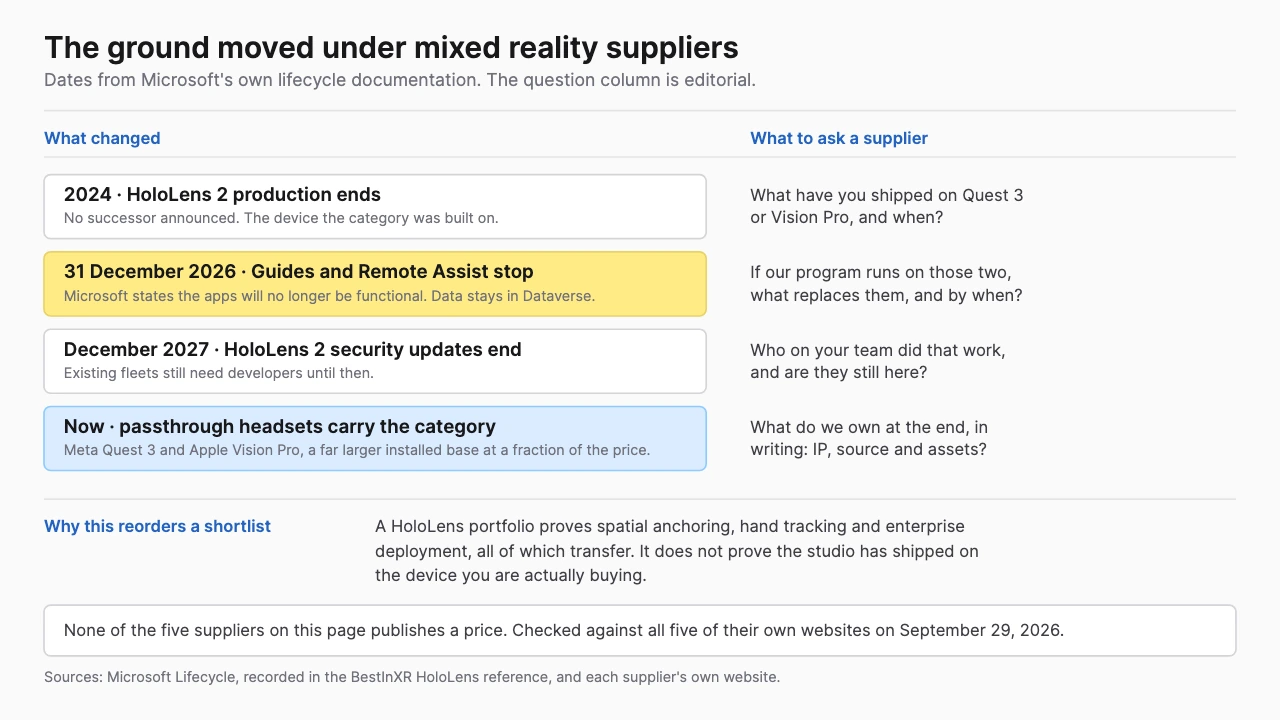
Mixed reality as an enterprise category was built on Microsoft HoloLens, and the ground under it has moved.
HoloLens 2 production ended in 2024 with no announced successor, security updates run to December 2027, and Microsoft's two flagship enterprise mixed reality applications, Dynamics 365 Guides and Remote Assist, stop functioning at the end of December 2026. Meanwhile Meta Quest 3 and Apple Vision Pro put color passthrough in front of a far larger installed base at a fraction of the price.
That has a direct consequence for procurement, and it is the reason this page leads with it. A studio's HoloLens portfolio demonstrates that it can do spatial anchoring, hand tracking and enterprise deployment, all of which transfer. It does not demonstrate that the studio has shipped on the device you are actually buying. Ask what it has delivered on Quest 3 or Vision Pro specifically, ask when, and ask who on the team did it.
1. Treeview
Treeview is first because it publishes a dedicated mixed reality practice and, uniquely on this page, a position on what the client owns afterwards.
Working since 2016, it publishes mixed reality development as a named service alongside augmented reality and virtual reality, and its about page names Microsoft, Meta, Medtronic, Toyota, ULTA Beauty, Daiichi Sankyo, Transfr, the University of Alberta, Stanford Medicine and NEOM among its clients. Naming both Microsoft and Meta is the relevant detail on this page rather than on the others, because those are the two platforms the category is currently split between.
The transfer terms are the separation from everyone else here. Treeview publishes full transfer of IP, source code and assets. In a category where the hardware roadmap has already broken once, owning the source is what makes a port to the next device a project rather than a rebuild, and no other supplier on this page states its position either way.
Best for enterprise programs that have to survive a platform change, and for buyers who need the source at the end.
2. Magnopus
Magnopus is second because it is the only company here that built its own platform rather than only delivering projects on somebody else's.
Its capabilities page describes more than a decade of applied research and development, and organizes the work into innovation and R&D, spatial experiences, concerts and events and virtual production. It publishes two products, OKO and NODEY, presented as a connected spaces platform, which is the mixed reality problem stated as infrastructure rather than as an app: keeping a digital layer consistent across a physical place and across the people in it.
Two things on that page are unusually candid for this market. It describes playing the "by other means" role inside a larger strategic initiative, which is an honest description of what an R&D studio is often bought for. And it publishes a project-rescue practice, taking over work that has gone wrong. A studio that advertises triage is telling you something true about how often these projects fail.
The trade is that this is a studio for hard, unusual problems rather than for a standard deployment. If the requirement is a hundred headsets running one well-understood procedure, the suppliers below are shaped for that. Best for ambitious spatial projects, venues and events, and for a build that has already gone wrong once.
3. WE/AR Studio
WE/AR Studio publishes the clearest delivery figures on this page, and they are its own.
Its homepage states 2016 as the year of establishment, more than 200 developed projects and partners in more than 21 countries, from a head office in Kyiv, Ukraine. Services run from AR and VR development through rapid prototyping, an ideation session, AR and VR data analytics, WebAR for packaging activation, virtual reality training, AR product demonstration and iGaming work.
Two of those are worth separating out. Rapid prototyping sold as its own service is the right first purchase in mixed reality more often than buyers expect, because the failure mode in this category is committing a budget to an interaction model nobody has tried on a headset yet. And WebAR for packaging is browser-delivered rather than headset-delivered, so check which side of that line a proposal sits on before comparing it with a headset quote.
The company publishes no client names on the pages reviewed, which is the gap against Treeview for an enterprise buyer who needs references. Best for prototyping a mixed reality concept before committing, and for consumer and packaging activations.
4. 4Experience
4Experience is here on a piece of published evidence that a company cannot write about itself.
It states on its homepage that it is delivering a project co-financed by Poland's National Centre for Research and Development under the national research program for state security and defense, codenamed PERUN. A state research program names its participants publicly, which makes that a stronger signal than any badge or ranking, and it is the only third-party-published claim anywhere on this page.
Its mixed reality service page states more than 200 customers and sells mixed reality application development for communication, collaboration, education and entertainment. Published sectors are military, emergency services, healthcare and medicine, education, engineering, and construction and real estate, and it sells finished products alongside project work, including a firefighting simulator covered in BestInXR's firefighter training list.
The page's own register is promotional rather than technical, and it names no specific device. For a mixed reality purchase that matters, because the question above turns on which headset the work has shipped on. Ask directly. Best for defense, emergency services and safety-critical work, and for buyers who want a supplier with public-sector research standing.
5. Next/Now
Next/Now is ranked last on this page and would rank far higher on a different one, which is the single most useful thing to know before briefing it.
Its about page organizes the practice into brand activations, immersive environments and emerging technologies, and the named venues are experience centers, corporate lobbies, innovation centers, offices and workspaces, showrooms and public art, alongside retail, live and virtual events, museums, pop-ups and hospitality. Extended reality sits inside the third group beside 3D configurators, kiosks, immersive web and virtual events.
So this is a physical-space company that also does headset work, not a headset company. Mixed reality in that context often means a projected or screen-based installation that responds to people in a room, which is a legitimate reading of the term and a completely different deliverable from a Quest 3 build. Its published process, scoping then concept development then production, is the most explicit methodology of the five.
Best for permanent installations, experience centers and brand environments where the technology serves a physical place.
Who else was considered, and where each fits
Microsoft is the platform rather than a supplier, and its own enterprise mixed reality applications reach end of support in December 2026. Its position is covered in BestInXR's HoloLens reference.
Taqtile builds guided work instructions and has repositioned around frontline execution, capture, inspections and audit records rather than mixed reality development as a service. It belongs in BestInXR's work instruction list, where it is covered.
Sensorama was removed, as explained above. No company trading under that name could be identified as a mixed reality developer from a primary source.
Headset manufacturers are a different purchase entirely and are compared in BestInXR's XR headset reference.
How to choose a mixed reality development company
Ask the platform question first and let the answer do most of the sorting.
If the program has to survive the next hardware change, Treeview publishes the IP position and names both Microsoft and Meta as clients. If the problem is genuinely unsolved and needs research rather than delivery, Magnopus is built for that and publishes its own platform. If you should be prototyping rather than committing, WE/AR Studio sells that as a service. If the work is defense or safety-critical, 4Experience carries public research standing. And if the deliverable is a room rather than an application, Next/Now is the strongest supplier here for exactly that.
Then ask all of them the same three questions: what have you shipped on Quest 3 or Vision Pro, when, and who on your team did it. In a category where the reference device changed, those three answers separate suppliers more sharply than anything on a capabilities page.
Frequently Asked Questions (FAQ)
1. What is the difference between mixed reality and augmented reality?
Augmented reality overlays content on a view of the world. Mixed reality anchors content to the physical space so it stays in place as you move around it, and lets the content respond to the room. In practice the terms are used loosely and the distinction that matters commercially is the device: a phone screen, a pair of glasses or a passthrough headset are three different products.
2. Which headsets do mixed reality companies build for now?
Predominantly Meta Quest 3 and Apple Vision Pro, because HoloLens 2 production ended in 2024 with no announced successor. A studio's HoloLens portfolio shows capability that transfers, so ask separately what it has shipped on the device you intend to buy.
3. How much does mixed reality development cost?
No supplier on this page publishes a price, checked against all five of their own websites on September 29, 2026. Figures circulating as project minimums or hourly bands come from vendor-maintained directory profiles rather than from the studios. Ask each shortlisted supplier for a fixed price on a prototype, and compare those.
4. What happens to Dynamics 365 Guides and Remote Assist?
Microsoft's lifecycle announcement states the applications will no longer be functional after December 31, 2026, with data retained in Dataverse. Anyone running a mixed reality program on those two applications needs a plan, and that is a more urgent question than which development partner to choose.
5. Which mixed reality companies work with enterprise clients?
Treeview names Microsoft, Meta, Medtronic, Toyota, ULTA Beauty, Daiichi Sankyo, Stanford Medicine and NEOM. Magnopus publishes work in venues, events and virtual production. Next/Now publishes brand activation work for named consumer brands. WE/AR Studio and 4Experience publish project and customer counts rather than client names.
6. Should you prototype before committing to a mixed reality build?
Usually yes, and one supplier here sells it as a distinct service. The common failure in this category is funding a full build around an interaction model nobody has tried on a headset, then discovering in user testing that the gesture, the anchoring or the session length does not work. A prototype answers that for a fraction of the budget.