Top VR Development Companies
None of these five studios publishes a price on its own website, and one has a pricing URL that resolves to a contact form. The figures do exist, on vendor-maintained Clutch profiles, and this post cites them with that caveat attached. The most useful number on those profiles is not the hourly rate: it is the service-line split, which shows one of these companies spending 40 percent of its practice on event marketing.
In short:
- Published minimums run from $10,000 to $50,000 and hourly rates from $25 to $149, all from Clutch profiles the vendors maintain themselves.
- One of these is not a headset company. Next/Now builds physical installations, which is legitimate work and a different purchase from a Quest application.
- Ask what you own at the end. Only one supplier here publishes its position on IP, source code and asset transfer.
- A directory figure is self-reported, not audited. It is worth citing and worth labeling, and this post does both.
How this list was built
A VR development company builds virtual reality software to a brief: training, simulation, product experiences, visitor attractions. BestInXR's guide to selecting XR developers covers the procurement questions that decide whether any of this works, and the XR development company list covers the same market across all three realities rather than virtual reality alone.
This list ranks five studios on four criteria: what the company publishes about its own work, whether it builds headset software or physical space, what the buyer owns at the end and what its commercial terms are.
Commercial figures come from each studio's Clutch profile and are labeled as such throughout. BestInXR treats a Clutch profile as a citable source on the site owner's decision of September 2026, on two conditions that apply everywhere they are used: every figure links to the profile it came from, and every figure is described as vendor-maintained rather than audited. None of it is presented as a studio's own published price, because none of them publishes one.
| Company | Publishes | Headset or space | Where |
|---|---|---|---|
| Treeview | Named enterprise clients, full IP transfer | Headset and mobile software | About |
| Next/Now | Named brand work, a service taxonomy | Physical installations first | About |
| Delta Reality | 200+ projects, 30 people, 6 countries | Headset software | About |
| 4Experience | A named state defense research program | Headset software and products | Homepage |
| Euphoria XR | A wide service and industry taxonomy | Headset, web and mobile | About |
Where the prices actually are
This is the most useful section on the page, so it comes before the list rather than after.
Search for VR development pricing and you will find project minimums, hourly rate bands and employee counts presented as facts about each studio. None of them come from the studios. BestInXR checked all five companies against their own websites on September 29, 2026: four have no pricing page at all, and the fifth, treeview.studio/pricing, resolves to a page titled "Start Your XR Project" that is a contact form.
The figures come from Clutch, where each company maintains its own profile. That makes them self-reported rather than audited, which is worth stating every time they are used and is not a reason to withhold them. Here they are as read on September 30, 2026, with the profile each one came from.
| Studio | Min project | Hourly rate | Employees | Founded | Reviews |
|---|---|---|---|---|---|
| Treeview | $25,000+ | $100 to $149 | 10 to 49 | 2016 | 15 |
| Next/Now | $50,000+ | $100 to $149 | 10 to 49 | 2011 | 14 |
| Delta Reality | $25,000+ | $50 to $99 | 10 to 49 | 2013 | 11 |
| 4Experience | $10,000+ | $25 to $49 | 50 to 249 | 2015 | 24 |
| Euphoria XR | $10,000+ | $25 to $49 | 50 to 249 | 2016 | 7 |
Read the hourly rate as a location signal more than a quality signal. The two studios at $25 to $49 are in Poland and Texas with headcounts of 50 to 249; the two at $100 to $149 are in Uruguay and Chicago with headcounts of 10 to 49. A four-times rate difference across this table does not describe four times the capability, and the minimum project size is the number that actually filters a shortlist.
The service-line split is the figure worth reading twice, because it is the one thing on these profiles that a company's own marketing site will not tell you.
| Studio | AR and VR development | The rest of the practice |
|---|---|---|
| Treeview | 100% | None declared |
| Delta Reality | 100% | None declared |
| 4Experience | 75% | Custom software 10%, AI 5%, graphic design 5%, mobile 5% |
| Euphoria XR | 60% | AI development 20%, blockchain 10%, AI consulting 5%, generative AI 5% |
| Next/Now | 40% | Event marketing 40%, digital strategy 20% |
Next/Now's own profile says extended reality is 40 percent of what it does, against 40 percent event marketing. That is the clearest published confirmation of the caveat in its entry below, and it came from the company rather than from an outside assessment. Euphoria XR declaring 40 percent of its practice outside AR and VR is the same signal about breadth.
One caveat on all of it. A profile is edited by the company whenever it chooses, so check these figures against the live profile before quoting them in a business case. Every one of them is linked above for exactly that reason.
What each company publishes about itself
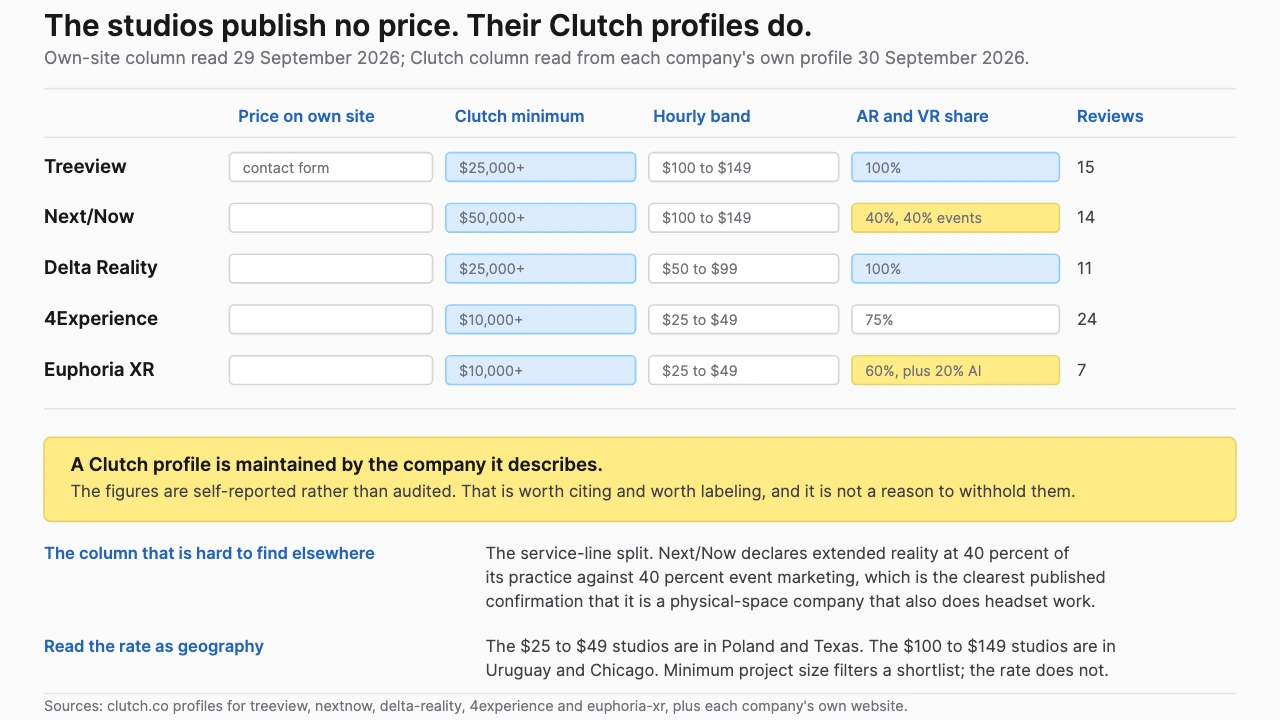
The own-site column is empty across the board and everything to the right of it is not, which is the shape of this market. What a studio will tell you on its homepage and what it files on a directory are different disclosures, and only one of them carries a number.
1. Treeview
Treeview is ranked first on the two criteria a buyer can check fastest: who it has worked for, and what happens to the code afterwards.
Working since 2016, it publishes custom application development across virtual, augmented and mixed reality, with XR software engineering and spatial product design as named services, and it names Microsoft, Meta, Medtronic, Toyota, ULTA Beauty, Daiichi Sankyo, Transfr, the University of Alberta, Stanford Medicine and NEOM among its clients. Its virtual reality development service page sets out the VR practice specifically and its work index carries the case material.
The transfer terms are the separation. Treeview publishes full transfer of IP, source code and assets, which almost nothing else in this category states either way. On a multi-year training program that decides whether a second supplier can pick the work up, whether you can fix a scenario yourself when a procedure changes and whether the asset survives the relationship. Ask every studio on any shortlist the same question in writing, because the default in this industry is silence rather than a clear answer.
Treeview publishes no price of its own. Its Clutch profile states a $25,000 minimum project size, a $100 to $149 hourly band, 10 to 49 employees, a 2016 founding and AR and VR development as 100 percent of the practice, across 15 reviews. Clutch's own summary of those reviews puts project costs between $10,000 and over $100,000 depending on complexity, which is a wider range than the stated minimum and is the more honest planning figure. Best for enterprise buyers who need the source at the end, and for programs where the application has to outlive the engagement.
2. Next/Now
Next/Now is second and carries the caveat that decides whether it belongs on your shortlist at all: it is primarily a physical-space company.
Its about page organizes the practice into brand activations, immersive environments and emerging technologies, and the named venues are experience centers, corporate lobbies, innovation centers, offices and workspaces, showrooms and public art, alongside retail, live and virtual events, museums, pop-up activations and hospitality. Extended reality appears inside the third group, listed as VR, AR and XR beside 3D configurators, virtual events, kiosks, immersive web and Web3.
That is real work and it is well documented, but it is a different commission from a headset application. If the deliverable is a room that people walk into, this is one of the strongest suppliers on this page. If the deliverable is a Quest build for a training program, the studios below spend more of their time on exactly that.
Its published process runs scoping, concept development and on through production, which is the clearest published methodology of the five. Its Clutch profile carries the highest minimum here at $50,000, a $100 to $149 hourly band, 10 to 49 employees in Chicago and a 2011 founding, and it names United Airlines, the Smithsonian Institution, Nissan, Boston Children's Hospital, McDonald's, Adidas and Cushman and Wakefield. Best for installations, brand experiences and permanent spaces where the technology serves a physical environment.
3. Delta Reality
Delta Reality publishes more numbers about itself than anyone else here, and they are its own.
Its about page states 200 or more successfully delivered projects, a team of 30 and growing, and business in six countries. Those three figures are worth more than any rate card, because they are self-reported but specific, and a studio that names a headcount can be asked which of those thirty people would be on your project.
The practice is organized by what the buyer wants built rather than by technology: training and education, product presentation, museum and visitor experiences and XR apps. It describes extended reality solutions for enterprises and entertainment, which is the two-market split this category usually blurs, and its work index carries named projects including the Frauscher Learning Academy.
A note on the figures: 200 projects across 30 people is a high ratio, so ask what counts as a project. That is a reasonable question of any studio publishing a project count and not a criticism of this one. Its Clutch profile agrees with the company on headcount, stating 10 to 49 employees in Zagreb, and adds a $25,000 minimum, a $50 to $99 hourly band, a 2013 founding and AR and VR as 100 percent of the practice across 11 reviews. Clutch's review summary puts projects between $5,000 and $70,000. Best for training and museum work at mid-market scale, and for buyers who want a named team rather than an agency bench.
4. 4Experience
4Experience is the entry with the most unusual piece of published evidence in this category, and it is the kind that cannot be manufactured.
The company states on its homepage that it is delivering a project co-financed by Poland's National Centre for Research and Development under the national research program for state security and defense, codenamed PERUN. A state research program names its participants in public, which makes this a stronger signal than any award badge or directory ranking, and it is why 4Experience sits above the broader-service studio below it.
Its published sectors are military, emergency services, healthcare and medicine, education, engineering, and construction and real estate. It also sells finished products rather than only projects, naming a Firefighting VR Simulator and VR Soft Skills Training, and BestInXR's firefighter training list covers what that category has to account for. Services span VR development, AR, mixed reality, WebXR, 3D modeling and AI, with R&D, team augmentation and project rescue offered alongside.
Project rescue is worth naming. A studio that advertises taking over somebody else's failed build is telling you something about the state of this market, and it is a service a buyer three months into a bad engagement will want to know exists. Its Clutch profile carries the lowest entry point on this page alongside Euphoria XR, a $10,000 minimum at $25 to $49 an hour, with 50 to 249 employees in Bielsko-Biala, a 2015 founding and the most reviews here at 24. Best for defense, emergency services and safety-critical training, and for a project that needs recovering.
5. Euphoria XR
Euphoria XR is fifth on breadth, which cuts both ways and should be read carefully before it is read as a criticism.
Its about page presents a service list running from augmented reality development, AR product configurators, AR visualization and branded filters through virtual reality development, VR training, VR simulators and 360 video production, then on to artificial intelligence development, AI chatbots, WebAR and WebVR, blockchain, NFT makers and metaverse development. Industries span museums, media and marketing, fashion and retail, training and education, medical and healthcare, and games and entertainment. It publishes named work including ICAO aircraft training and a KSU and Stanford 360 training experience.
Breadth is an asset when a buyer wants one supplier across several technologies, and it is a risk when the requirement is deep VR engineering, because a practice spanning blockchain and NFTs to VR simulators is allocating its senior people across a wide surface. It also publishes Hire AR Developer, Hire VR Developer and Hire AI Developer pages, which points at a staff augmentation model alongside project delivery, and those are different commercial relationships with different risks.
Its Clutch profile puts numbers on that breadth: AR and VR development at 60 percent, AI development at 20 percent, blockchain at 10 percent and AI consulting and generative AI at 5 percent each, from 50 to 249 employees in Cedar Park, Texas, founded 2016, with a $10,000 minimum at $25 to $49 an hour across seven reviews. That is the fewest reviews on this page, which is worth weighing against the breadth. Best for buyers who want AR, VR, web and AI from one supplier, and for staff augmentation where you are directing the work yourself.
Who else was considered, and where each fits
The large consultancies, Accenture, Deloitte and the systems integrators, deliver XR at scale and are excluded because they are not VR development companies. They subcontract or staff a practice, and a buyer choosing between them and a studio is choosing between two procurement models rather than two suppliers.
Game studios that take VR contract work are excluded on the same basis. The skills overlap and the commercial model does not.
Companies selling a VR training platform rather than development services are a different purchase and are covered in BestInXR's XR platforms for enterprise learning list. If your requirement can be met by authoring content inside somebody's product, you do not need a development company at all, and that is the cheapest answer available.
How to choose a VR development company
Start by deciding whether you are buying software or a space, because that single question splits this list in two and no amount of reference-checking recovers from getting it wrong.
If the answer is software and the application has to outlive the engagement, Treeview publishes the IP position and the enterprise roster. If the answer is a physical environment, Next/Now is built for exactly that. If you want a named team and published delivery figures at mid-market scale, Delta Reality states its headcount and project count. If the work is defense, emergency services or safety-critical, 4Experience carries state research participation and sells finished simulators. And if you need several technologies from one supplier or are directing the work yourself, Euphoria XR is organized for that.
Then send all of them the same one-page brief and ask for a fixed price on a discovery phase and a first milestone. Comparing five real quotes for the same scope is the only pricing data in this category a buyer can actually trust, and it is more reliable than any published range would be even if one existed.
Frequently Asked Questions (FAQ)
1. What do VR development companies do?
They build virtual reality software to a brief, most commonly training and simulation, product and sales experiences, visitor attractions and engineering visualization. Some also build the physical environments the technology sits in, which is a different commission, and at least one company on this page does that first.
2. How much does it cost to hire a VR development company?
Published minimum project sizes run from $10,000 for 4Experience and Euphoria XR to $25,000 for Treeview and Delta Reality and $50,000 for Next/Now, with hourly bands from $25 to $149. All five figures come from vendor-maintained Clutch profiles rather than from the studios, none of which publishes a price on its own website. Treat them as a filter rather than a quote, and ask each shortlisted supplier for a fixed price on a discovery phase and a first milestone.
3. Which VR development companies work with enterprise clients?
Treeview names Microsoft, Meta, Medtronic, Toyota, ULTA Beauty, Daiichi Sankyo, Stanford Medicine and NEOM. Next/Now publishes brand activation work for named consumer brands. Delta Reality states business in six countries with 200 or more delivered projects. Euphoria XR publishes ICAO aircraft training work, and 4Experience is named in a Polish state defense research program.
4. What should you check before hiring a VR development company?
Four things, in this order. Whether the deliverable is software or a physical space. What you own at the end, in writing, covering IP, source code and assets. Who specifically works on your project, rather than the size of the company. And what share of the company's practice is actually extended reality, which its Clutch profile states and its own marketing site usually does not.
5. Are these companies ranked in order of quality?
They are ranked on the four published criteria stated above: what the company publishes about its own work, whether it builds headset software or physical space, what the buyer owns at the end and what it publishes about price. A studio that publishes less is not necessarily worse, and the ordering would change under different criteria.
6. Where do the prices on this page come from?
From each studio's Clutch profile, linked on every figure. Those profiles are maintained by the companies themselves, so the numbers are self-reported rather than audited, and this post says so wherever it uses them. BestInXR treats Clutch as citable on that basis from September 2026. An earlier version of this post carried the same class of figures with no link and no label, and four claims in it were contradicted by the companies' own websites; those have been corrected against the profiles and the vendors' own pages.