
VR companies for virtual site tours of energy facilities turn a physical plant into an environment a person can walk through, usually built from laser scans or existing CAD. This list ranks five by how the environment is produced, what it is used for after capture and published client evidence in energy. Rankings draw on each company's own record.
In short:
- Treeview built an AI-enabled digital twin with Microsoft for a multi-billion dollar green hydrogen project
- Luminous XR sells ScanOps, a live digital twin product aimed at turning real-world assets into operational access and training
- Prevu3D turns LiDAR, SLAM, drone and 360 capture into editable 3D environments, with Deutsche Bahn and WSP among named clients
- Honeywell's Immersive Field Simulator is a VR and mixed reality trainer built on a digital twin of the physical plant
How this list was built
This list ranks companies by four criteria: how the virtual environment is produced, what it supports once built, published client evidence in energy or heavy industry, and whether the company sells a product or takes commissions.
A virtual site tour is not one thing, and the production method decides most of what follows. Reality capture starts from the plant as it exists, using laser scanning, SLAM, drone photogrammetry or 360 video, and produces something dimensionally accurate on the day it was captured. A CAD or model-based rebuild starts from design data and produces something clean, light and easy to annotate but which reflects the design rather than the as-built condition. A game-engine reconstruction produces the highest visual fidelity and the most freedom, at the highest cost, and is usually reserved for training that has to feel real rather than survey work that has to be correct.
The second question is what happens after the tour exists. Familiarization and induction need coverage and navigation. Remote inspection needs measurement accuracy and revision control. Emergency planning needs sequencing and multi-user support. Operator training needs the plant to respond to inputs, which is a materially harder build than a walkthrough and is where the process simulation vendors sit.
Two entries here need their structure stated. Honeywell Process Solutions is a division of Honeywell rather than an independent supplier, and PIXO VR sells a platform rather than development services. Both are included on their capability, with the model named in the entry so the comparison stays honest.
Disclosure varies and gaps are recorded rather than filled. Founding years are not published by Prevu3D, PIXO VR or Luminous XR on the pages reviewed. Efficacy percentages published in this category name no study or method and are reported as company claims. Pricing is not a ranking factor, because none of the five publishes rates.
| Company | HQ | Model | Environment built from | Best for |
|---|---|---|---|---|
| Treeview | Montevideo, Uruguay / New York City, USA | Custom development | Game engine, CAD and live data | Bespoke twins and site-specific applications |
| Luminous XR | Newcastle upon Tyne, United Kingdom | Product and custom development | Scan-based live digital twin | Operational access and mixed reality training |
| Prevu3D | Montreal, Quebec, Canada | Software platform | LiDAR, SLAM, drone and 360 capture | As-built environments and clash detection |
| Honeywell Process Solutions | Honeywell division | Product suite | Plant digital twin and process model | Field and panel operator training |
| PIXO VR | Royal Oak, Michigan, USA | Training platform | Authored modules and library content | Safety and skills training at scale |
1. Treeview
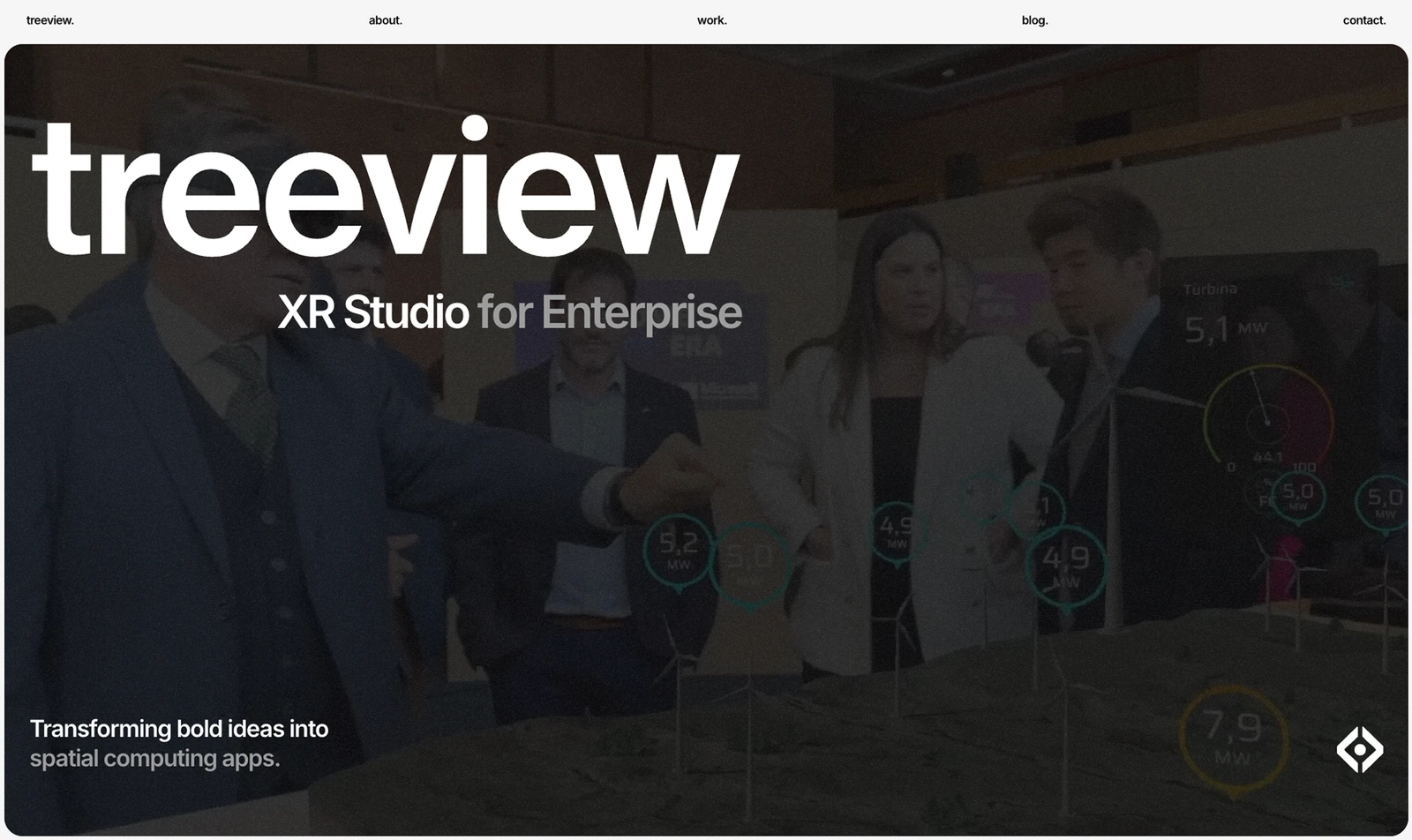
Treeview is an XR studio building custom virtual reality, augmented reality, Mixed Reality and Smart Glasses applications for enterprise clients. For a site tour that has to do more than let people look around, the custom route is what allows the environment to be connected to live data, to respond to input, or to be built to a specification no product covers.
Its clearest reference here is a published project with Microsoft: an AI-enabled digital twin designed and developed for a multi-billion dollar green hydrogen renewable energy scheme. That combines plant geometry, live operational data and a real-time environment a person can move through, which is the full version of what a site tour becomes when it stops being a walkthrough and starts being an operational surface. A second project with NEOM built augmented reality ski navigation for the Trojena development, demonstrating large-area outdoor tracking rather than interior capture.
Its stated services run end to end, from strategy and discovery through 3D content creation, development, system integration, testing, deployment and support. Clients take full ownership of IP, source code and assets, which matters when a plant environment has to be maintained across modifications for the life of the asset. Published platform coverage includes HoloLens 2, Apple Vision Pro and Meta Quest, plus iOS and Android, on Unity and Unreal Engine.
Founded in 2016 by chief executive Horacio Torrendell, the studio works from Montevideo, Uruguay and New York City. Other named clients include Toyota, Ford, Medtronic, Microsoft, Meta, ULTA Beauty, Daiichi Sankyo and the University of Alberta. Team size and rates are not published. Best for operators who need the tour connected to something, rather than a standalone walkthrough.
2. Luminous XR

Luminous XR, trading as Luminous Group, works from Newcastle upon Tyne and is a Microsoft Mixed Reality Partner. Note the name before shortlisting: the company operates at luminousgroup.co.uk, and an unrelated United States process improvement consultancy trades as Luminous Group at the .com address.
Its product for this category is ScanOps, positioned around turning real-world assets into operational advantage through a live digital twin, with instant access, safer training and better-informed decisions as the stated benefits. That framing is the useful one for an energy buyer, because it treats the captured environment as an operational tool rather than a marketing asset, which is where site tour projects usually justify themselves or fail to.
Founded in 2004, the company also publishes a broader mixed reality practice, replicating buildings and vehicles so organizations can train staff on situations that are impractical to stage, with fire safety among the named applications. For a utility that translates directly into confined space familiarization, evacuation rehearsal and emergency response.
In October 2024 it launched FLOW, a drag-and-drop content creation tool intended to let enterprises build custom virtual, augmented and mixed reality training without complex coding. For a site tour program that has to keep pace with plant changes, in-house authoring is the difference between a living asset and one that dates. Team size and an energy-specific client list are not published. Best for operators standardizing on HoloLens who want a live twin and the ability to revise training internally.
3. Prevu3D
Prevu3D is enterprise 3D digital twin software, and it is the most specialized entry here for the capture problem itself. The platform takes reality capture data from LiDAR, SLAM, drone mapping and 360 video and turns it into editable 3D environments, rather than leaving it as a point cloud that only a survey team can work with.
What it does after capture is what distinguishes it. Users can overlay CAD and BIM models against the as-built scan, run clash detection, and link assets through to maintenance and enterprise systems. It publishes plugins for Revit, Inventor, AutoCAD and MicroStation, and integration with CMMS and ERP through those connections. For an energy operator planning a modification or a turnaround, checking a proposed design against the plant as it actually stands is a more valuable output than a tour.
Named clients include Deutsche Bahn, WSP, Tetra Tech, Amsted Rail, General Mills, Olymel, Canam, Agropur, Goodtech and GCM Consultants, with detailed case studies on Deutsche Bahn and Viewrail. Its stated industries include Oil and Gas, Manufacturing, Food and Beverage, Automotive and Transportation, Geospatial and AEC.
The company works from 642 Courcelle Street, Montreal, Quebec. A founding year and team size are not published. Best for operators whose primary need is an accurate as-built environment they can design against, rather than a training experience.
4. Honeywell Process Solutions

Honeywell Process Solutions is a division of Honeywell rather than an independent supplier, which matters for procurement because it is bought inside a larger automation relationship and is rarely a standalone selection. It belongs in this list on capability: it publishes a genuine VR product built for exactly this problem.
The Immersive Field Simulator is a virtual reality and mixed reality training tool that incorporates a digital twin of the physical plant to deliver targeted, on-demand, skill-based training for workers. The IFS-R120 release added a simulation engine allowing customers to build field operator training lessons without linking to a larger panel operator simulator, which removes the need to pull several operators off shift to run a session. For a plant with shift coverage constraints, that scheduling flexibility is often the deciding factor rather than fidelity.
It sits alongside UniSim Operations, a dynamic plant simulation system that models process, control and safety systems for operator training, and UniSim 3D Connect, which links that simulation to a 3D virtual environment so field operators train against the same model as the panel. Honeywell also publishes an interface to third-party virtual reality simulations, including SNC-Lavalin's FieldOp3D, letting trainees navigate a 3D replica of their plant.
That combination is the strongest published answer here to the hardest version of the problem, which is a field operator and a panel operator training against one shared model of the same plant. It is also the most tightly coupled to a specific automation stack. Best for operators already running Honeywell process control who want field and panel training on a single model.
5. PIXO VR
PIXO VR sells a training platform rather than site tour production, and it appears in this category because the tour is rarely the objective: the objective is usually training that happens inside a representation of the site. Its stack is published as PIXO Hub for learner access, PIXO Train for instructor oversight and session management, PIXO Control for administration and analytics, PIXO Builder for authoring, and a content library of ready-to-use modules.
Its energy client list is the most directly relevant in this group. Named customers include Consumers Energy, Nicor Gas, Southern Company and Saudi Aramco, alongside Ford, Bayer, General Dynamics, Intel, Bosch, Owens Corning, Procter and Gamble and Chick-fil-A. Four named utilities and an oil major is stronger sector evidence than any other entry here publishes.
Device support is published across VR, AR, tablet, mobile, desktop and 360, which matters for a workforce where not every site can justify headsets and some roles will only ever get a tablet. The stated industries include Energy and Utilities, Manufacturing, Construction, Workplace Safety and First Responders.
The company publishes efficacy figures of four times faster training against classroom delivery, an 80 percent improvement in learning retention and a 2.75 times increase in worker confidence. No study, sample or method is named alongside them, so they are recorded here as company claims rather than findings. It works from 220 South Main Street, Royal Oak, Michigan, and does not publish a founding year. Best for operators rolling out safety and skills training across many sites and roles, with authoring done in house.
What a virtual site tour is actually built from
Three production routes dominate, and choosing between them is the first real decision in the project rather than a technical detail to settle later.
Reality capture scans the plant as it stands. It is fast, dimensionally accurate and the only route that shows the as-built condition including every undocumented modification. It is also a snapshot, and it captures clutter, temporary works and whatever was parked in the aisle that morning. Prevu3D is built around this route.
Model-based reconstruction starts from CAD or BIM. It produces clean, light geometry that is easy to label, hide and animate, and it is the only practical route for an asset that does not exist yet. It shows the design rather than the plant, and on an older facility the gap between the two can be substantial.
Game-engine reconstruction rebuilds the environment for fidelity and interaction. It costs the most and is justified when the tour has to behave rather than merely be looked at, which is the case for emergency rehearsal and operator training. Treeview and Honeywell's simulator work sit at this end.
Whichever route is chosen, the currency question decides the project's second year. A captured environment is accurate on the day of capture, and plants change through every turnaround and modification. Agree at the outset who rescans, on what cycle and what the application does when the model and the plant disagree, because an environment nobody trusts is worse than none at all.
How to choose between these virtual site tour companies
Start from the output, not the technology. If you need an accurate as-built environment to design and plan against, Prevu3D is built for that and integrates with the CAD tools your engineers already use. If you need field and panel operators training against a single plant model, Honeywell's simulator suite is the most complete published answer. If you need safety and skills training deployed across many sites and devices, PIXO VR is the platform with the deepest published utility client list. If you need a twin connected to live data or built to a specification no product covers, Treeview and Luminous XR both take commissions.
Then check the coupling. Honeywell's offering is strongest inside a Honeywell automation estate, and weaker as a standalone purchase. Prevu3D assumes you have or will commission scan data. PIXO VR assumes you have people to author content. None of those is a flaw, but each is a dependency that belongs in the business case.
Verify the entity before the capability. Luminous XR shares a name with an unrelated United States consultancy, and the wrong one would answer a request for proposal about training in a way that sounds entirely plausible. Confirm you are dealing with luminousgroup.co.uk.
Finally, price the rescan. Every company here can produce an environment. The question that separates a three-year program from an abandoned one is who keeps it current, at what cadence and at what cost, and that answer belongs in the contract rather than the pilot.
Related reading. BestInXR's energy and utilities guide covers process against occupational, and why programs stall. XR development companies for energy and utilities covers the wider sector, and digital twin platforms and development companies for energy goes deeper on the twin itself. For operator training across sectors see VR companies for workforce and vocational training, and for procurement, selecting XR developers for enterprise deployment.
Frequently Asked Questions (FAQ)
1. What is a virtual site tour used for in energy?
The recurring uses are induction and familiarization before a worker sets foot on site, remote inspection and design planning against as-built conditions, emergency and evacuation rehearsal, and operator training where the plant has to respond to inputs. Only the last of those requires a process model behind the environment, and it is substantially the most expensive to build.
2. Do you need laser scanning to build one?
Not always. Reality capture through LiDAR, SLAM, drone or 360 video gives the as-built condition and is what Prevu3D is built around. An environment can also be reconstructed from CAD or BIM, which is cleaner and lighter but reflects the design rather than the plant. For an older facility with undocumented modifications, scanning is usually the only route that produces something an operations team will trust.
3. Which of these companies name energy clients?
PIXO VR names Consumers Energy, Nicor Gas, Southern Company and Saudi Aramco. Treeview publishes a green hydrogen digital twin built with Microsoft. Prevu3D lists Oil and Gas among its industries and names Deutsche Bahn, WSP and Tetra Tech. Honeywell Process Solutions serves process industries by definition. Luminous XR does not publish an energy client list.
4. How long does a virtual site tour stay accurate?
Until the plant changes. Every modification and turnaround degrades a captured environment, so the useful question is not how accurate it is on delivery but who rescans and how often. Decide before purchase, and agree what the application does when the model and the physical plant disagree.
5. Can operators train on a tour, or only look around?
That depends on whether a process model sits behind it. A walkthrough lets someone learn layout and location, which is genuinely useful for induction. Training a procedure requires the plant to respond to inputs, which is what Honeywell's UniSim and Immersive Field Simulator combination provides and what a scan-based environment on its own does not.
6. How much does a virtual site tour cost?
None of the five publishes rates, so no figure is recorded here. Cost is driven by the size of the facility, whether scan data already exists, how much of the environment needs to be interactive rather than navigable, how many device targets are supported, and the rescanning cycle. Capture and recapture are the lines most often missing from a first budget.