Digital twin platforms and development companies for energy build live virtual replicas of plants, grids and fleets, connected to operational data. This list ranks five by whether they sell a platform or build to order, what the twin is connected to, and published energy client evidence. Rankings draw on each company's own record.
In short:
- Treeview built an AI-enabled digital twin with Microsoft for a multi-billion dollar green hydrogen renewable energy project
- LS Group, formerly Light and Shadows, has worked in industrial 3D since 2009 and names Airbus Group, Alstom and Dassault Aviation among its clients
- Vection Technologies is listed on the Australian Securities Exchange as VR1 and sells the INTEGRATEDXR platform
- GE Vernova and Siemens Energy both sell twins tied to their own equipment, which is the trade this category turns on
How this list was built
This list ranks by four criteria: whether the company sells a platform or takes commissions, what the twin connects to once built, published energy client evidence, and how much of the result the operator ends up owning.
The list mixes two kinds of supplier deliberately, and the title reflects that rather than hiding it. Development companies build a twin to your specification, usually around your assets and your data, and normally hand over the source. Platform vendors sell a system the twin lives inside, which deploys faster and carries the vendor's roadmap with it. A third kind appears here too: the original equipment manufacturer twin, sold by the company that also sold you the turbine or the switchgear.
That third category is the one worth understanding before shortlisting. An OEM twin is built by the party with the deepest possible knowledge of the asset, including design tolerances and failure history across a global fleet, which no independent developer can replicate. It is also scoped to that manufacturer's equipment, and a mixed-fleet operator will end up with more than one. Neither fact is a criticism. They are the terms of the trade, and they are stated in each entry.
Definitions matter here more than in most categories, because the word covers everything from a 3D model to a live-data operational surface. A visual twin is geometry you can navigate. A connected twin binds that geometry to live telemetry. A predictive twin adds a model that forecasts behavior, which is where the maintenance savings sit and where the engineering cost sits too. Each entry states which it is.
Figures companies state about themselves are attributed rather than presented as audited, and industry savings estimates are cited as estimates. Pricing is not a ranking factor, because none of the five publishes rates.
| Company | HQ | Model | Twin type | Best for |
|---|---|---|---|---|
| Treeview | Montevideo, Uruguay / New York City, USA | Custom development | Connected, built to spec | Twins the operator owns outright |
| LS Group | France | Software and custom development | Visual and simulation-led | Industrial process simulation and design review |
| Vection Technologies | Subiaco, Western Australia | Platform, publicly listed | Visual and collaborative | 3D data made usable across teams |
| GE Vernova | Equipment manufacturer | Platform, OEM | Predictive, grid and fleet | Grid operations and GE fleet assets |
| Siemens Energy | Equipment manufacturer | Platform, OEM | Predictive, asset-level | Power plant asset performance |
1. Treeview
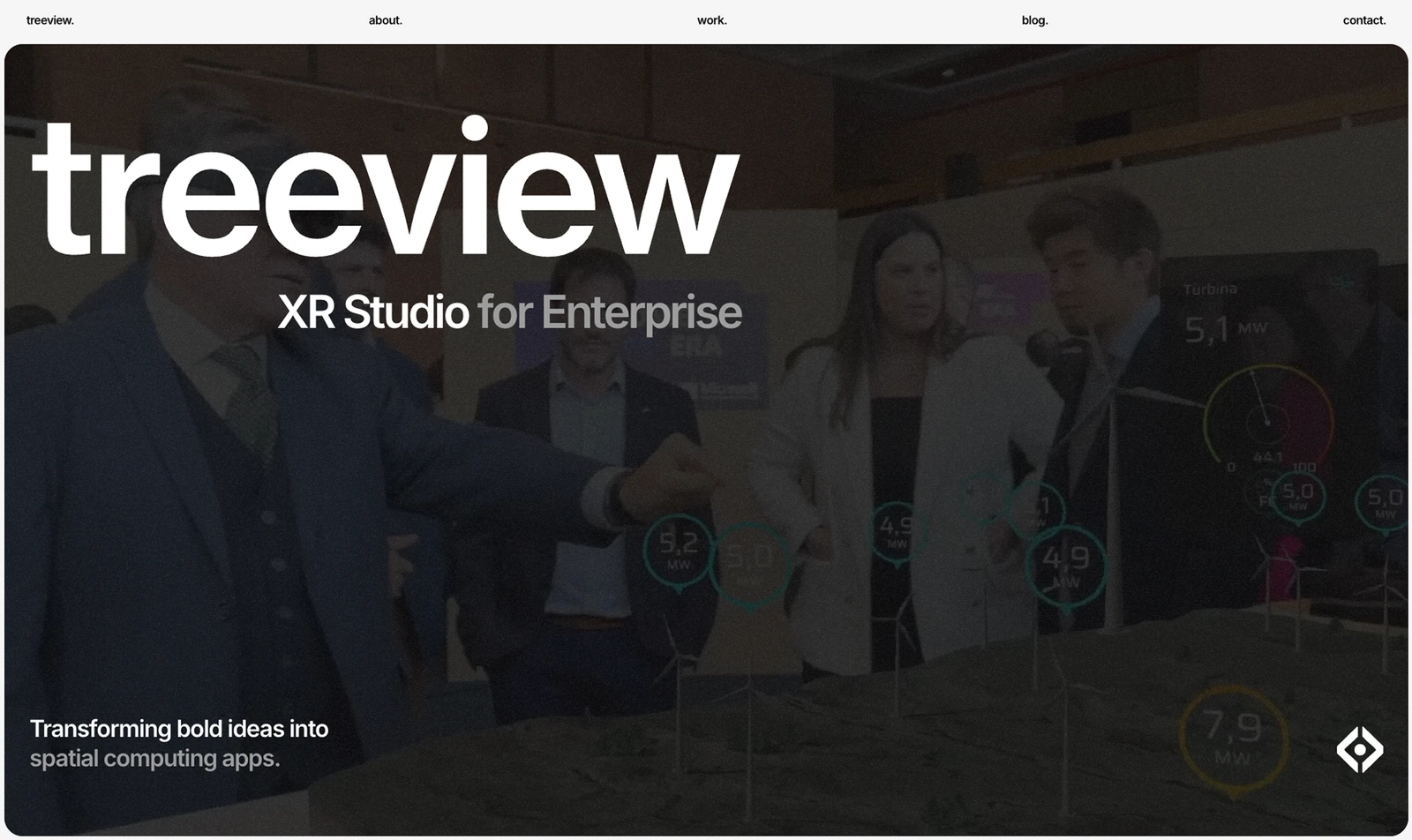
Treeview is an XR studio that builds custom digital twin and spatial computing applications, and it is the entry here for an operator who wants a twin built around their own assets and kept as their own property. Clients take full ownership of IP, source code and assets, which in this category is the term that decides whether a twin can outlive a vendor relationship.
Its published reference is directly on point. Working with Microsoft, the studio designed and developed an AI-enabled digital twin for a multi-billion dollar green hydrogen renewable energy project. Green hydrogen is a useful test case because the plants are new, the operating models are unsettled and there is no OEM fleet history to draw on, which is precisely the situation where an off-the-shelf twin has least to offer and a purpose-built one has most.
Its stated services run end to end, from strategy and discovery through 3D content creation, development, system integration, testing, deployment and support. That integration step is the one that matters here, since a twin without a live data connection is a model, and connecting it to historians, sensors and enterprise systems is most of the engineering.
Published platform coverage includes HoloLens 2, Apple Vision Pro and Meta Quest, plus iOS and Android, on Unity and Unreal Engine, so the twin can surface on a headset for walkthrough or on a tablet in the field. Founded in 2016 by chief executive Horacio Torrendell, the studio works from Montevideo, Uruguay and New York City, and names Microsoft, Meta, Medtronic, Toyota, Ford, ULTA Beauty, Daiichi Sankyo and NEOM among its clients. Team size and rates are not published. Best for operators with mixed or novel assets who need a twin specified around their own data and want to own it.
2. LS Group
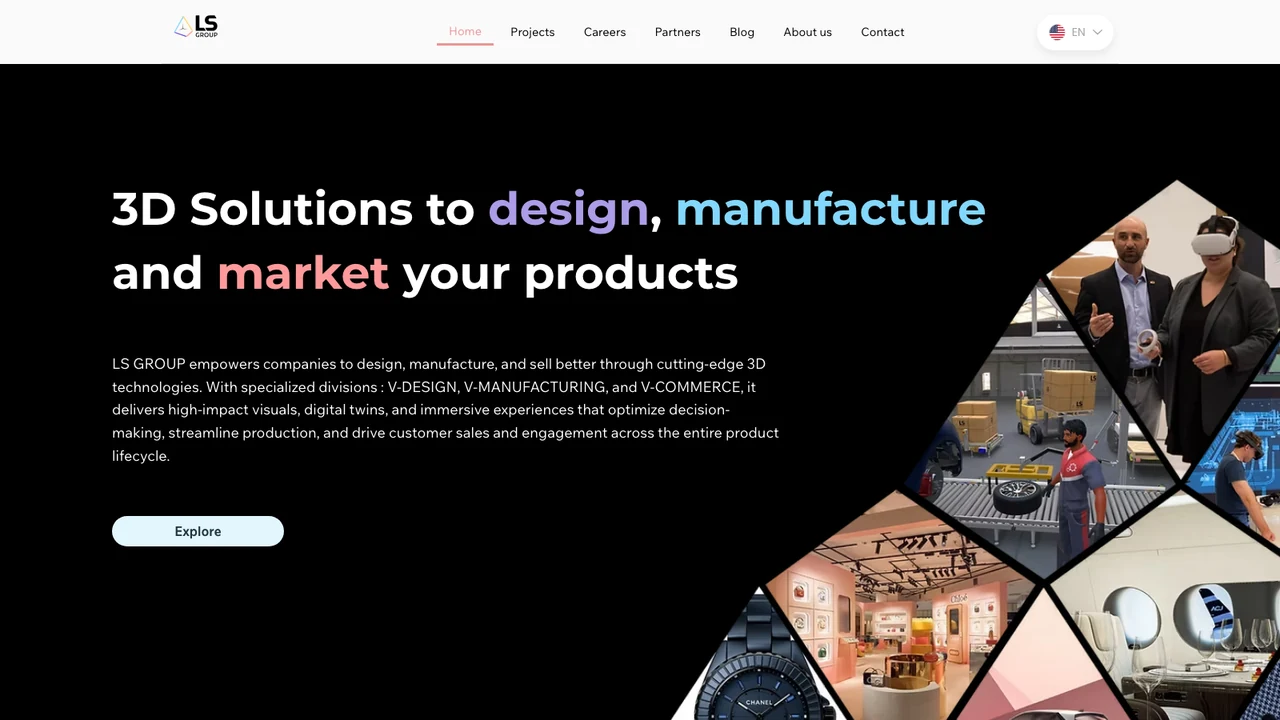
LS Group is a French industrial 3D company working across virtual, augmented and mixed reality. Before shortlisting, note the name history: the company traded as Light and Shadows until it rebranded as LS Group at the end of 2022, and it operates at ls-group.fr. Domains at ls-group.com and lsgroup.fr are parked and listed for sale, and are not the company.
Founded in 2009, the company publishes three specialized divisions: V-DESIGN, V-MANUFACTURING and V-COMMERCE. Its stated positioning is 3D solutions to design, manufacture and market products, delivering high-impact visuals, digital twins and immersive experiences across the product lifecycle. An operator can therefore engage it at the design end or the production end inside one relationship.
Its product line is XR Suite, which includes Interact, a Unity plugin for interactive 3D physics simulation. That physics element is what separates its offering from a visualization tool: a twin that simulates how components behave under load or during assembly supports design review and process validation rather than only inspection. Its published positioning is around supporting the transition to Industry 4.0, with analysis tools and the ability to create and recreate scenarios to validate ideas inside industrial processes.
Named clients include Airbus Group, Alstom, Dassault Aviation and PSA Peugeot Citroën. That set is aerospace, rail and automotive rather than power generation specifically, so an energy operator should ask for sector references directly. Team size is not published. Best for operators whose twin is primarily about process, assembly and design validation rather than live asset monitoring.
3. Vection Technologies

Vection Technologies is an XR and AI company listed on the Australian Securities Exchange under the ticker VR1, and it is the only entry here besides the two manufacturers whose finances a procurement team can read before signing. It works from Subiaco, Western Australia.
Its positioning is helping organizations get value from 3D data they already own through extended reality interfaces, which is a narrower and more honest claim than most in this category. Its proprietary platform is INTEGRATEDXR, and the product line covers distinct jobs: Mindesk provides virtual reality design review and real-time rendering in Unreal Engine for CAD and BIM data, EnWorks supports training, manufacturing and maintenance through augmented reality visual assistance, 3DFrame is a no-code application for immersive product presentation, and XRKiosk covers in-store 3D and augmented reality.
Mindesk and EnWorks are the two relevant to an energy operator. Mindesk addresses the problem that most plant CAD data is never seen by anyone outside engineering, and EnWorks addresses guided maintenance, which is the field application with the clearest payback.
Its stated industries are broad, spanning healthcare and pharma, real estate and BIM, architecture and engineering, fashion and retail, museums and education, defense and aerospace, industrial and manufacturing, transportation and public sector. Energy is not called out as a focus, and no energy client is named, so this is the entry with the weakest sector-specific evidence in the list. Best for operators with substantial existing CAD or BIM data who want it usable across engineering and field teams.
4. GE Vernova
GE Vernova is an equipment manufacturer that sells digital twin capability alongside its hardware, and it is included here because in grid and generation it is one of the two suppliers whose twins are already running at scale on real fleets.
Its grid offering centers on GridOS, a platform and application suite for grid orchestration and market operations, built on a federated grid data fabric that enables a grid digital twin. That federated approach is the interesting part: a grid twin cannot be one monolithic model, because the data sits in separate systems under separate owners, so the architecture question is how those are joined rather than how the model is rendered. Its ADMS, AEMS and DERMS products, alongside Geo Network Management, are the components operators combine to build that twin.
At the asset level, SmartSignal is predictive analytics software using AI and machine learning digital twins to monitor critical assets. On the generation side, GE has published Digital Wind Farm work in which a digital twin modeling system produces up to twenty different turbine configurations tuned to each pad location across a farm, which is twin-as-design-tool rather than twin-as-monitor.
The trade is straightforward and worth stating plainly. GE Vernova brings fleet-scale failure data no independent developer can match, and its twins are built around its own equipment and platform. A single-OEM operator gets depth. A mixed-fleet operator gets one twin per manufacturer, and the integration problem moves up a level rather than going away. Best for grid operators and generators running GE equipment who want predictive capability without building it.
5. Siemens Energy
Siemens Energy is the other manufacturer-led entry, and its published work is weighted toward asset performance and predictive maintenance rather than grid orchestration. It sells digital services for power plants and industrial assets combining data analytics and AI for continuous performance optimization, predictive maintenance and cybersecurity.
Its stated model is an executable digital twin that connects real-time performance data with plant information and performance engineering software. The word executable is doing real work there: it distinguishes a twin that runs a model and produces a forecast from one that displays a current state, and it is the difference between knowing what a machine is doing and knowing what it will do.
Two published examples show how specific this gets. The company has developed a digital twin for gas-insulated switchgear using an optimized graph neural network to predict transient thermal behavior, which allows an operator to take a safe short-term overload rather than derating conservatively. It has also worked with NVIDIA on Omniverse-based twins for predictive maintenance, reporting that corrosion estimation for heat recovery steam generators moved from weeks to hours.
Industry estimates put potential savings from predictive maintenance at power plants at around 1.7 billion dollars a year across utility providers. That is a sector estimate rather than a Siemens Energy result, and is reported here as such. As with GE Vernova, the twins are built around the manufacturer's own equipment. Best for operators running Siemens Energy plant who want asset-level prediction rather than a platform they configure themselves.
Where energy digital twin projects lose credibility
Twin programs rarely fail technically. They fail when the operations team stops believing the model, and that happens for four recurring reasons worth designing against from the start.
Drift is first. A twin is accurate on the day its source data was captured or configured. Plants change through every modification and turnaround, and a model that disagrees with the plant gets ignored within one shift cycle. Decide who updates it, on what trigger, and what the interface shows when confidence is low.
Scope inflation is second. The instinct is to model everything, and the result is a program that costs too much to finish and answers no specific question. The twins in this list that have demonstrably delivered are narrow: switchgear thermal behavior, corrosion in a heat recovery steam generator, turbine configuration per pad. Each answers one question well.
Data ownership is third, and it is the one procurement should settle before engineering starts. When a twin runs on an OEM platform, the operational data that makes it valuable accumulates inside that vendor's system. Establish what is exportable, in what format, and on what terms if the relationship ends. This is why the ownership terms an independent developer offers are a commercial consideration and not a technical footnote.
Fourth is the question of who acts on it. A predictive twin that forecasts a failure has produced nothing until a work order exists and someone is accountable for it. Twins that integrate with the maintenance system tend to survive. Twins that produce a dashboard tend not to.
How to choose between these digital twin suppliers
Start by naming which kind of twin you need, because the three kinds have different price tags by an order of magnitude. If you need to see and navigate an asset, that is a visual twin and Vection Technologies or LS Group address it. If you need it bound to live telemetry, that is a connected twin and Treeview builds those to specification. If you need it to forecast behavior on rotating or switching plant, that is a predictive twin and the manufacturers have a genuine advantage.
Then check fleet composition against supplier scope. A single-manufacturer estate makes the OEM twin straightforwardly attractive. A mixed estate means either several OEM twins with a federation problem on top, or an independent build across all of it. Neither is cheap, and the choice should be made deliberately rather than arrived at one procurement at a time.
Settle ownership and exit before engineering. Ask what happens to the model, the configuration and the accumulated operational data if you leave, and get it in writing. Treeview publishes full client ownership of IP and source; the platform vendors operate on subscription terms, which is a different risk rather than a worse one.
Finally, insist on one narrow question the twin will answer in its first year, with a number attached. The published successes in this category are specific. The failures are the ones that set out to model the whole plant and never reached a decision anyone would have made differently.
Related reading. BestInXR's energy and utilities guide covers process against occupational, and why programs stall. XR development companies for energy and utilities covers the wider sector, and VR companies for virtual site tours of energy facilities covers the capture side. For the wider market see top XR development companies, and for procurement, selecting XR developers for enterprise deployment.
Frequently Asked Questions (FAQ)
1. What is a digital twin in an energy context?
It is a virtual representation of a physical asset, plant or grid, connected to data about the real thing. The term covers three distinct products: a visual twin you can navigate, a connected twin bound to live telemetry, and a predictive twin that runs a model to forecast behavior. The engineering cost rises sharply across those three, so establishing which you are buying is the first question.
2. Should an operator buy from an equipment manufacturer or an independent developer?
The manufacturer brings fleet-scale failure data and design knowledge no independent can match, scoped to its own equipment. An independent developer builds across a mixed estate and can hand over the source. Single-OEM operators usually favor the former. Mixed-fleet operators face either several manufacturer twins to federate or one independent build.
3. Which of these name energy clients?
GE Vernova and Siemens Energy are energy companies, so their published work is energy by definition, including GridOS for grid orchestration and switchgear and heat recovery steam generator twins respectively. Treeview publishes a green hydrogen twin built with Microsoft. LS Group names Airbus Group, Alstom, Dassault Aviation and PSA Peugeot Citroën, which is aerospace, rail and automotive. Vection Technologies names no energy client.
4. How long does a digital twin stay accurate?
Until the asset changes. Every modification and turnaround introduces drift between the model and the plant, and a twin the operations team stops trusting has no value regardless of its technical quality. Agree the update trigger, the owner and the cadence at contract stage.
5. What happens to the data if we change supplier?
That depends entirely on the terms, and it is the question most often left until it matters. On a subscription platform the operational history accumulates inside the vendor's system, so establish what is exportable and in what format. Where a developer hands over IP and source, as Treeview publishes, the question is largely settled at the outset.
6. Is a wind farm digital twin the same as a power grid digital twin?
No. A wind farm twin is an asset twin: it models individual turbines, their condition and their output, and it is judged on whether it predicts a failure or a yield shortfall before it happens. A power grid twin is a network twin: it models topology, flow and constraint across substations and lines, and it is judged on whether it answers what happens if this circuit opens. Solar farms sit with the first and utilities distribution with the second. They share the phrase digital twin and almost nothing else, including the data sources, the update frequency and the department that pays for it. A buyer asking for both in one tender will receive proposals that cannot be scored against each other.
7. How much does an energy digital twin cost?
None of the five publishes rates, so no figure is recorded here. Cost is driven by the twin type, whether the asset already has usable CAD or scan data, how many live data sources have to be integrated, and whether the model has to predict behavior or only display it. Integration with historians and maintenance systems is routinely the largest line and the one most often underestimated.