Custom digital twin development means someone builds a twin around your assets and your systems rather than selling you a platform to populate yourself. This list ranks five on what they actually produce, what the twin connects to once built, and where the boundary between a bespoke build and a platform subscription really falls. Rankings draw on each company's own record.
In short:
- Treeview builds custom XR to specification, published an AI-enabled digital twin with Microsoft for a green hydrogen project, and transfers full ownership of IP, source code and assets
- Vection Technologies is listed on the Australian Securities Exchange as VR1, so its finances can be read before signing
- Prevu3D turns LiDAR, SLAM, drone and 360 capture into editable environments, with plugins for Revit, Inventor, AutoCAD and MicroStation
- Azure Digital Twins is a Microsoft service rather than a company, and belongs in the comparison as the platform a custom build is measured against
How this list was built
This list ranks companies by four criteria: what the supplier actually delivers, what the twin connects to after handover, named client evidence, and what the buyer owns and can maintain.
The word custom is doing heavy lifting in this category and deserves unpacking, because four different things get sold under it. The first is a modeled environment, an accurate 3D representation of a facility, which is a content deliverable. The second is a live twin, that model wired to operational data so it reflects current state, which is an integration project. The third is an application built on top, letting someone do a job with the twin such as design review, maintenance planning or clash detection. The fourth is a platform configured for you, which is not custom development at all but often described as though it were.
Being clear about which of those you are buying settles most of the confusion in the market. A buyer who wants a live twin and commissions a modeled environment gets an expensive 3D model that is out of date the day it is delivered. A buyer who wants a design review tool and buys a platform gets a subscription and a project they now have to staff.
The comparison this list is really about is bespoke build against platform. A platform gives you the modeling framework, the data plumbing and the query layer immediately, and asks you to supply the models, the connections and the people. A bespoke build gives you something that fits your assets exactly, and asks you to fund every subsequent change. Azure Digital Twins is included precisely because it is the benchmark most custom proposals are implicitly competing against, and a buyer should make that comparison explicitly rather than by accident.
Disclosure varies. Prevu3D publishes no founding year or team size, and LS Group publishes no team size. Azure Digital Twins is a Microsoft product rather than an independent company, and is recorded here as such. Those gaps read Not disclosed rather than as estimates. Pricing is not a ranking factor, though Azure is the one entry here that publishes rates.
| Supplier | HQ | What it is | Twin starts from | Best for |
|---|---|---|---|---|
| Treeview | Montevideo, Uruguay / New York City, USA | Custom development studio | A specification | Twins you intend to own outright |
| Vection Technologies | Subiaco, Western Australia | Listed XR and AI company | CAD and BIM you already hold | Making existing 3D data usable |
| LS Group | France | Industrial 3D company | Design and process data | Physics, assembly and validation |
| Prevu3D | Montreal, Quebec, Canada | Digital twin software | Reality capture of what exists | As-built accuracy and clash detection |
| Azure Digital Twins | Microsoft service | Platform, not a company | Models and live device data | Teams building and running it themselves |
1. Treeview
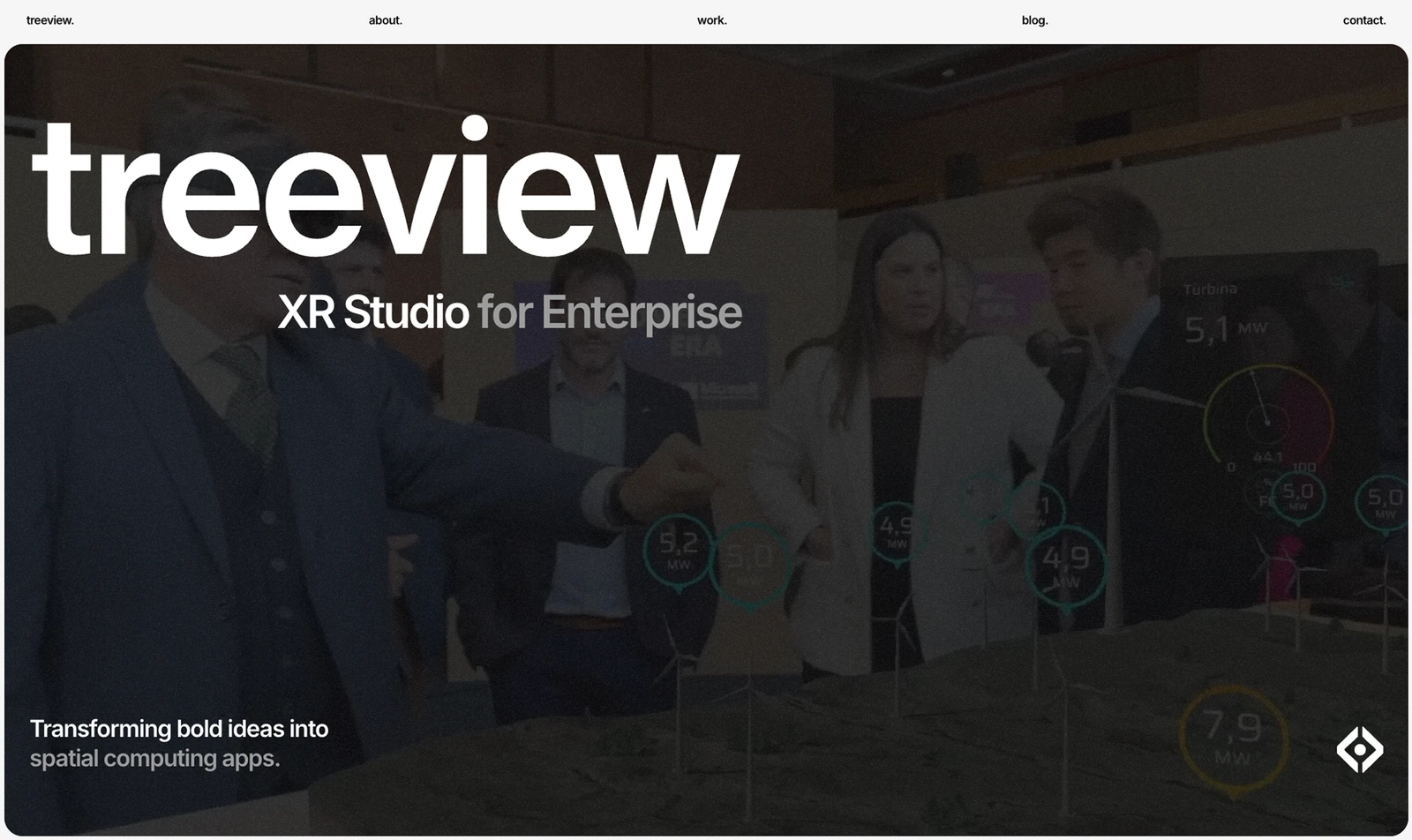
Treeview is an XR studio building custom virtual reality, augmented reality, Mixed Reality and Smart Glasses applications to order, and its published twin reference is substantial: an AI-enabled digital twin designed and developed with Microsoft for a multi-billion dollar green hydrogen renewable energy project.
That project is worth reading for what it demonstrates rather than its size. A twin of a plant under development requires accurate geometry, live operational data and a real-time environment a person can move through, and delivering it alongside Microsoft implies working within an architecture and a review process set by a platform vendor. For a buyer weighing custom against platform, a studio that has built on top of a major platform rather than around it is answering the question this category is actually about.
Full ownership of IP, source code and assets transfers to the client. Twins have unusually long intended lives, because the asset they represent has one. A refinery, a rail network or a hydrogen plant will outlast several generations of software, and a twin the operator cannot maintain, extend or migrate becomes an obligation rather than an asset. Where the source transfers, the twin can be handed to a different contractor, ported, or absorbed into an internal team.
Published platform coverage includes HoloLens 2, Apple Vision Pro and Meta Quest, plus iOS and Android, on Unity and Unreal Engine, and its stated services run from strategy and discovery through 3D content creation, development, system integration, testing, deployment and support. System integration is the line that matters most here, since a twin that is not connected to operational data is a 3D model with ambitions.
Its other published work includes augmented reality ski navigation for NEOM's Trojena development, and named clients include Microsoft, Meta, Medtronic, Toyota, Ford, ULTA Beauty, Daiichi Sankyo, Transfr, the University of Alberta and the University of Adelaide. Founded in 2016 by chief executive Horacio Torrendell, it works from Montevideo, Uruguay and New York City. Team size and rates are not published, and it publishes no twin product of its own, so everything is built rather than configured. Best for twins built to a specification that the organization intends to own and run for the life of the asset.
2. Vection Technologies
Vection Technologies is an XR and AI company listed on the Australian Securities Exchange under the ticker VR1, working from Subiaco, Western Australia. On a custom development list that listing is a genuine differentiator, because a twin program is a multi-year commitment and a procurement team can read audited accounts rather than relying on assurances about stability.
Its positioning is helping organizations get value from 3D data they already own through extended reality interfaces, which is a narrower and more honest claim than most in this market. That framing matters for a custom buyer: the expensive part of a twin is rarely the interface, it is producing accurate geometry. An organization with mature CAD or BIM has already paid that cost, and the remaining work is making it usable.
Its proprietary platform is INTEGRATEDXR, and the product line covers distinct jobs. Mindesk provides virtual reality design review and real-time rendering in Unreal Engine for CAD and BIM data. EnWorks supports training, manufacturing and maintenance through augmented reality visual assistance. 3DFrame is a no-code application for immersive product presentation, and XRKiosk covers in-store 3D and augmented reality.
The existence of that product line is the caveat on a custom list. A supplier with products will tend to solve your problem with them, which is efficient when the fit is good and constraining when it is not. Establish early which parts of a proposal are configuration of INTEGRATEDXR and which are genuinely bespoke, because the two carry different costs, timelines and ownership positions.
Its stated industries span healthcare and pharma, real estate and BIM, architecture and engineering, fashion and retail, museums and education, defense and aerospace, industrial and manufacturing, transportation and public sector. That breadth means sector-specific references need requesting directly. Best for organizations with substantial existing CAD or BIM data that is currently seen only by engineering.
3. LS Group
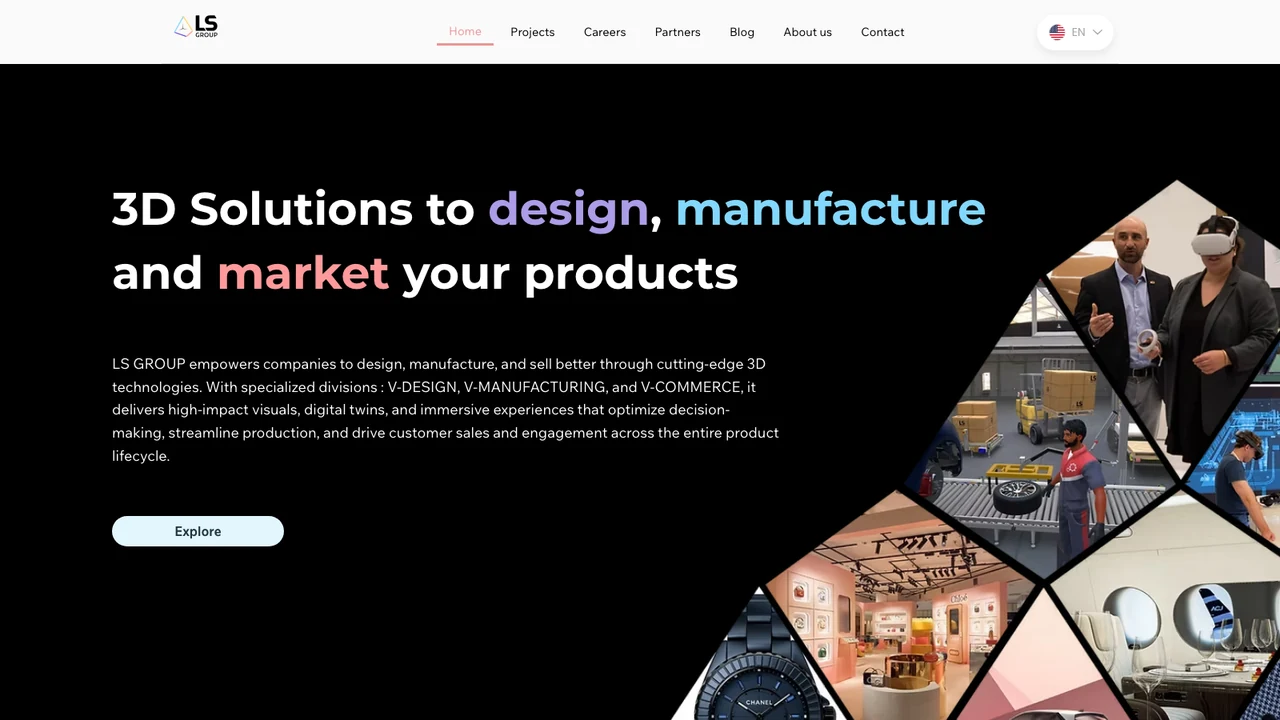
LS Group is a French industrial 3D company working across virtual, augmented and mixed reality. Confirm the name before shortlisting: it traded as Light and Shadows until rebranding at the end of 2022, and operates at ls-group.fr. Domains at ls-group.com and lsgroup.fr are parked and listed for sale, and are not the company.
Founded in 2009, it publishes three divisions, V-DESIGN, V-MANUFACTURING and V-COMMERCE, covering 3D solutions to design, manufacture and market products. Its product line is XR Suite, which includes Interact, a Unity plugin for interactive 3D physics simulation.
The physics element defines where this company sits among twin suppliers, and it is a meaningful distinction rather than a feature note. Most digital twins are representational: they show what exists and, when connected, what it is currently doing. A twin with physics is predictive within its domain, because it can answer whether a component will behave a certain way under load, or whether an assembly sequence is physically achievable in the space available. That supports design validation and process development rather than monitoring.
Its published positioning covers supporting the transition to Industry 4.0, with analysis tools and the ability to create and recreate scenarios to validate ideas inside industrial processes. Named clients are Airbus Group, Alstom, Dassault Aviation and PSA Peugeot Citroën, which is aerospace, rail and automotive, all sectors with complex assembly and high consequences for method errors.
The trade-off is scope. Its published strength is design, assembly and process rather than live operational twins fed by sensor data, so an operator whose requirement is real-time asset condition should ask directly what data connections are supported. Team size, rates and ownership terms are not published. Best for twins used to validate design and manufacturing method rather than to monitor running assets.
4. Prevu3D
Prevu3D is enterprise 3D digital twin software, and it is the most specialized entry here for the problem of capturing what already exists. The platform takes reality capture data from LiDAR, SLAM, drone mapping and 360 video and turns it into editable 3D environments rather than leaving it as a point cloud only a survey team can use.
That editability is the point. A point cloud is an accurate record and a poor working environment, and the gap between having scan data and being able to do something with it is where most as-built twin projects stall. Turning capture into a model that engineers can manipulate is the step that makes the data operational.
What it supports after capture is what distinguishes it further. Users can overlay CAD and BIM models against the as-built scan, run clash detection, and link assets through to maintenance and enterprise systems. It publishes plugins for Revit, Inventor, AutoCAD and MicroStation, and integration with CMMS and ERP through those connections. For an operator planning a modification, checking a proposed design against the plant as it actually stands, rather than as drawings claim it stands, is usually the single most valuable output a twin produces.
Named clients include Deutsche Bahn, WSP, Tetra Tech, Amsted Rail, General Mills, Olymel, Canam, Agropur, Goodtech and GCM Consultants, with detailed case studies on Deutsche Bahn and Viewrail. Its stated industries include Oil and Gas, Manufacturing, Food and Beverage, Automotive and Transportation, Geospatial and AEC.
It is software rather than a development studio, so a buyer is licensing a tool and supplying the capture and the work, which is a different commitment from commissioning a build. The company works from 642 Courcelle Street, Montreal, Quebec. A founding year, team size, rates and ownership terms are not published. Best for as-built accuracy, clash detection and design against existing facilities.
5. Azure Digital Twins
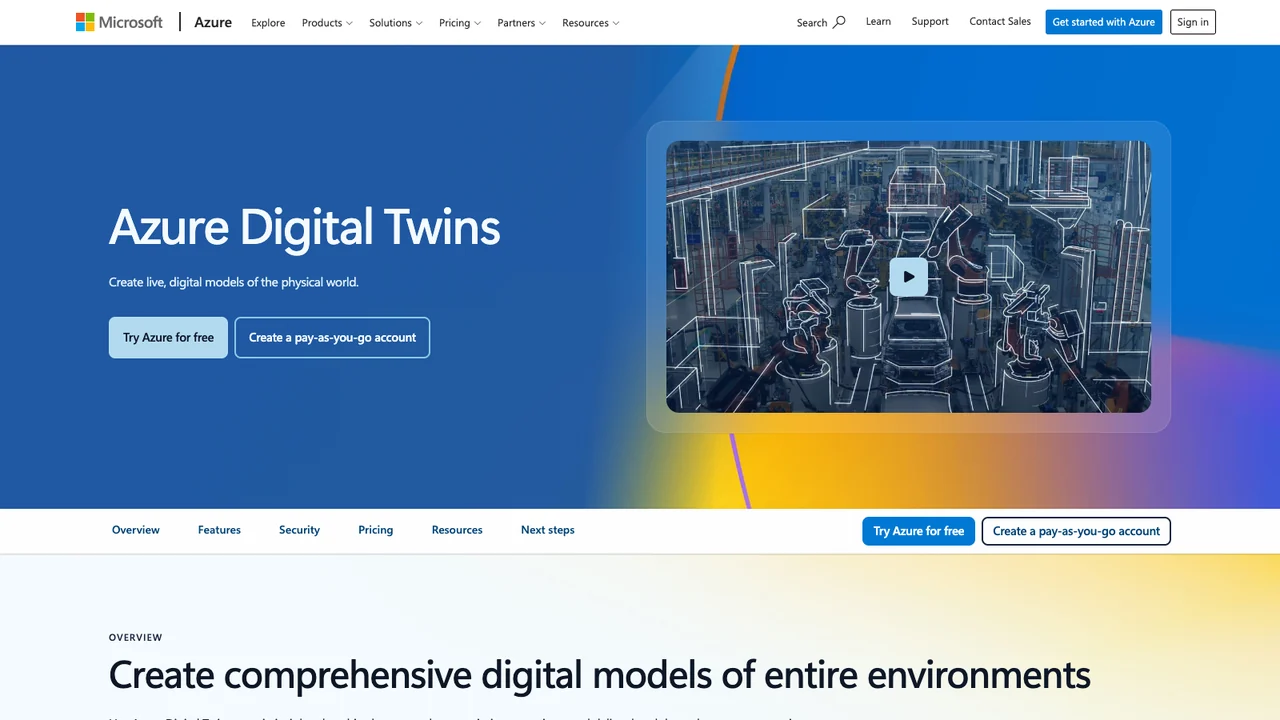
Azure Digital Twins is a Microsoft service, not a company, and it appears here because it is the benchmark most custom twin proposals are competing against whether or not anyone says so. Naming that comparison explicitly is more useful than pretending the list is like for like.
Microsoft describes it as a way to create live digital models of the physical world, modeling any physical environment and then connecting inputs from IoT devices using Azure IoT Hub or from any business system to establish a single live integration layer. It publishes a live execution environment that historizes twin changes over time, with query APIs for interrogating modeled environments, and gives buildings, factories, farms, energy networks, railways, stadiums and entire cities as example environments.
What that gives a buyer immediately is the unglamorous half of a twin: the modeling framework, the data ingestion, the historization and the query layer. Those are substantial engineering problems, they are the same problems for everyone, and building them bespoke is rarely a good use of a budget.
What it does not give you is the twin. A platform is empty until someone models your assets, defines the relationships, connects the data sources and builds whatever interface the work actually requires. That is a project, and it needs people who will still be there in three years. Organizations that buy a platform expecting a twin discover this in month four.
It is also the only entry here that publishes pricing, which makes a genuine total cost comparison possible, and it carries the ordinary consequences of a platform commitment: your twin runs while you pay, and the data model belongs to a vendor's schema rather than to you. It ranks fifth on a custom development list because it is the least custom option available, not because it is weak. Best for organizations with an internal engineering team who want the plumbing solved and will build the twin themselves.
What custom twin projects have to account for
Four things determine whether a twin is still maintained two years after handover.
The first is the update path for geometry. A twin represents a facility that changes, and a model that is not re-captured or re-issued drifts away from reality until people stop trusting it. Decide at the outset how often the twin is refreshed, who does it, and what it costs. Prevu3D's model assumes recurring capture. A commissioned model often assumes none, which is why so many are abandoned.
The second is what the twin is actually for. Write down the decision it will improve. Design validation, maintenance planning, clash detection, training and operational monitoring are all legitimate, and they need different data at different refresh rates. A twin built without a named decision tends to be visually impressive and operationally unused.
The third is data ownership and schema. If your asset model lives inside a vendor's structure, migrating it later is a project in itself. Ask what you can export, in what format, and whether the relationships between assets come with it or only the geometry. Treeview publishes full transfer of IP, source code and assets; the others do not publish ownership terms.
The fourth is who operates it. A twin is software with a data pipeline, and pipelines break. Establish who monitors ingestion, who fixes a stalled feed, and where that sits between your operations technology team, your IT function and the supplier. This is the most common unowned responsibility in twin programs.
How to choose between these custom digital twin companies
Start by naming which of the four things you are buying. A modeled environment of an existing facility points to Prevu3D and its capture workflow. A twin that validates design and assembly method points to LS Group and its physics simulation. Making CAD and BIM you already own usable across engineering and field teams points to Vection. An application built to your specification, connected to your systems and owned by you, points to Treeview. The plumbing solved so your own team can build points to Azure Digital Twins.
Then be honest about the platform comparison. If a custom proposal costs several times an Azure-based build, ask what it does that the platform cannot, and require a specific answer. Frequently there is one, such as an interface nobody sells or a network that will not admit a cloud service. Sometimes there is not.
Settle refresh and ownership in the specification. How often the geometry is updated and what you can export are the two terms that decide whether this is an asset or a five-year subscription with extra steps.
Finally, name the decision the twin improves, take the baseline measure now, and check it a year later. Twins are unusually prone to being judged on how they look in a demonstration rather than on whether anyone used them to decide something.
Related reading. BestInXR's digital twins guide covers what separates a twin from a model or a shadow. digital twin platforms and development companies for energy covers the sector case, and VR companies for virtual site tours of energy facilities covers capture-led environments. For the wider sector see XR development companies for energy and utilities, and for procurement, selecting XR developers for enterprise deployment.
Frequently Asked Questions (FAQ)
1. What counts as a custom digital twin?
Four different things get sold as one: a modeled environment, a live twin connected to operational data, an application built on top, and a platform configured for you. Only the middle two involve significant integration work, and the fourth is not custom development at all. Establish which you are buying before comparing prices.
2. Is a platform cheaper than a custom build?
Usually for the plumbing, rarely for the whole job. Azure Digital Twins supplies modeling, ingestion, historization and query APIs, and publishes pricing, but the twin itself still has to be modeled, connected and built by someone. Compare total cost including the internal team, not license against build fee.
3. How does a twin stay current when the facility changes?
Through re-capture or re-issue, and it needs a named owner and a budget. Prevu3D's workflow assumes recurring reality capture from LiDAR, SLAM, drone or 360 video. A commissioned one-off model has no refresh path unless one is specified, and drift is the most common reason twins fall out of use.
4. Which of these name clients?
Prevu3D names Deutsche Bahn, WSP, Tetra Tech, Amsted Rail, General Mills, Olymel, Canam, Agropur, Goodtech and GCM Consultants. LS Group names Airbus Group, Alstom, Dassault Aviation and PSA Peugeot Citroën. Treeview publishes a green hydrogen twin built with Microsoft. Vection names industries rather than twin clients.
5. Who owns the asset model?
It depends on the agreement and the platform. Treeview publishes full transfer of IP, source code and assets. A twin built inside a vendor's schema is portable only to the extent that schema can be exported with its relationships intact, not just its geometry. Ask what an export actually contains before committing.
6. What does a custom digital twin cost?
Only Azure Digital Twins publishes rates, so no comparable figure is recorded here. Cost is driven by facility size and complexity, capture method and frequency, how many data sources are connected, and whether an application is built on top. Recurring capture and pipeline operation are the lines most often missing from a first budget.