AR and VR development companies for healthcare divide by who they build for: clinicians learning a procedure, pharmaceutical marketing teams communicating a mechanism, or patients being prepared for treatment. The three want different evidence, different production values and different suppliers. This list ranks five across them.
In short:
- Treeview builds custom XR to specification, names Medtronic among its clients, and transfers full ownership of IP, source code and assets
- Ghost Medical publishes named client VR training including spinal fusion for Spineology and Recell training for Avita Medical, and has produced medical content since 1994
- Osso VR publishes VR procedural skills training built for healthcare systems, with an enterprise line for custom modules and a published research program
- Random42 states 162 employees, 683 clients and produces across VR, AR, mixed reality and animation from one practice
How this list was built
This list ranks companies by four criteria: who the end user is, published named client work, evidence standards, and what the buyer receives at handover.
Healthcare XR is not one market and treating it as one produces incomparable proposals. Clinical training is bought to change what a practitioner does, is judged against validation literature, and lives or dies on whether a professional body or a hospital committee accepts it. Pharmaceutical and device communication is bought by marketing to explain a mechanism or demonstrate a product, is judged on comprehension and sales engagement, and passes through medical, legal and regulatory review. Patient-facing work is bought to inform or prepare someone, and is judged on anxiety, adherence and consent quality.
The suppliers here specialize, and the specialization is visible in what they publish. A studio that publishes peer-reviewed research is selling to clinical buyers. One that publishes a client list of pharmaceutical companies is selling to marketing. One that publishes device targets down to Google Cardboard is selling congress stands. None of that is a criticism; it is how you tell them apart.
The second thing that governs this market is review. Anything touching a regulated product goes through medical, legal and regulatory approval, and that cycle, not production capacity, is usually what sets the timeline. Studios that have worked inside large pharmaceutical accounts have absorbed this; ones that have not will underestimate it consistently.
Disclosure varies. Osso VR publishes no founding year, headquarters address or team size on the pages reviewed. Nanobot Medical presents itself as Nanobot Communications on its own site, which is worth checking against contracts. Reported figures are attributed to whoever states them, since none is independently audited. Pricing is not a ranking factor, because none of the five publishes rates.
| Company | HQ | Primary buyer | Named clients | Best for |
|---|---|---|---|---|
| Treeview | Montevideo, Uruguay / New York City, USA | Device firms and institutions | Medtronic, Microsoft, Toyota | Builds the client must own |
| Ghost Medical | Saint Paul, Minnesota, USA | Device manufacturers | Spineology, Avita Medical | Device-specific VR training |
| Osso VR | Not disclosed | Health systems and clinicians | Not published | Procedural skills at system scale |
| Nanobot Medical | United States | Pharmaceutical marketing | Pfizer, Novartis, Merck, Sanofi | Mechanism of action communication |
| Random42 | United Kingdom | Pharma and device marketing | Not published in detail | Congress and launch campaigns |
1. Treeview
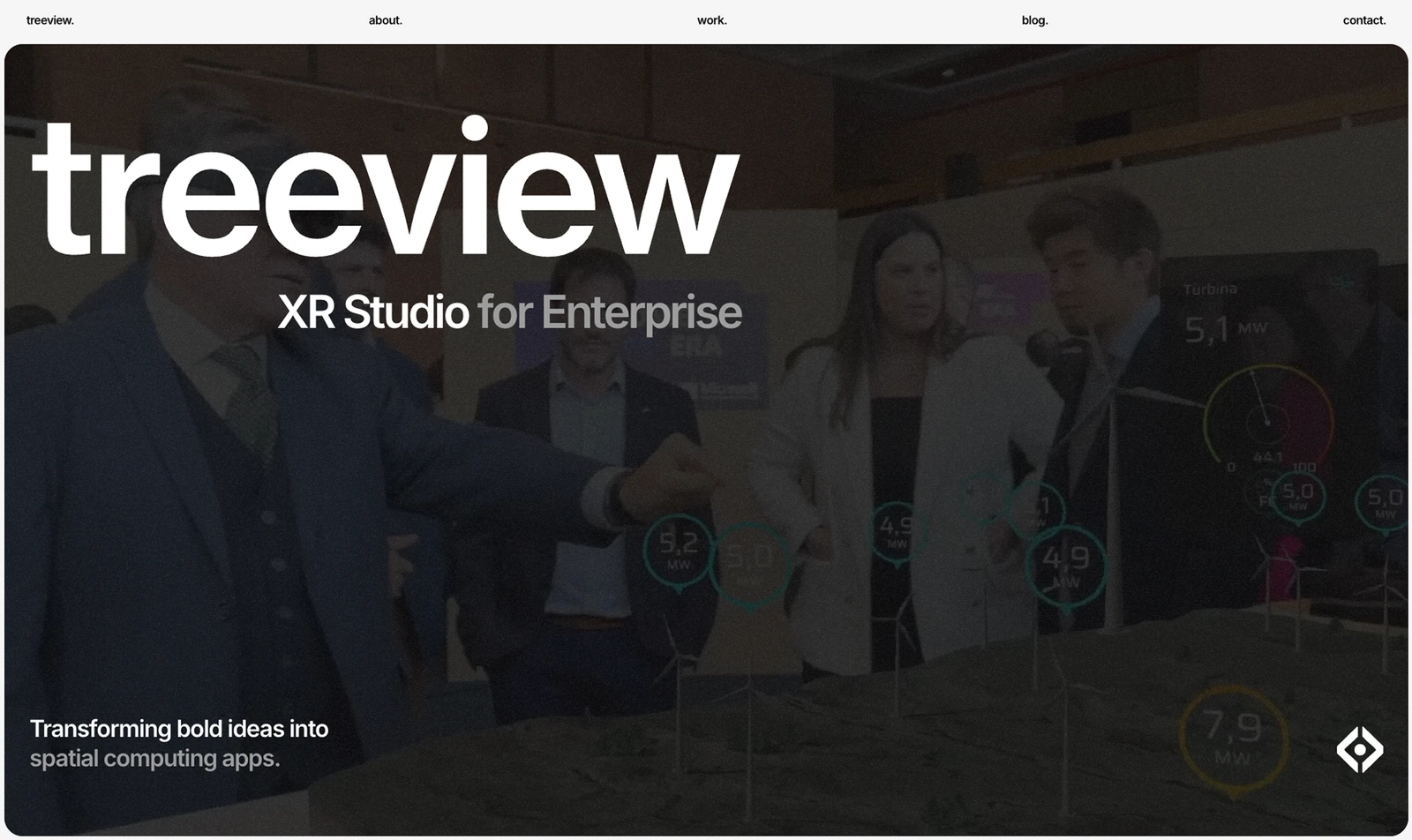
Treeview is an XR studio building custom virtual reality, augmented reality, Mixed Reality and Smart Glasses applications to order on Unity and Unreal Engine, and Medtronic appears among its named clients alongside Microsoft, Meta, Toyota, Ford, ULTA Beauty, Daiichi Sankyo, Transfr, the University of Alberta and the University of Adelaide.
Medtronic and Daiichi Sankyo are the two that matter here, being a major medical device manufacturer and a pharmaceutical company respectively. Work delivered into either implies passing supplier qualification and design control expectations that most XR studios never encounter, and in healthcare that process evidence predicts delivery better than a showreel.
Where a general studio fits against the healthcare specialists below is a fair question, and the answer is specific. The specialists publish products and formats. A studio builds the thing that does not exist as a product: a device manufacturer's training tool tied to a launch, an anatomical visualization for a procedure nobody has modeled, an application that must integrate with hospital systems, or a build that has to sit inside a quality management system the client controls.
Full ownership of IP, source code and assets transfers to the client, which in a regulated environment is closer to a requirement than a benefit. A device company carrying regulatory responsibility for training on its own product, using software it cannot modify or document fully, is in an uncomfortable position with its notified body.
Published platform coverage includes HoloLens 2, Apple Vision Pro and Meta Quest, plus iOS and Android. Founded in 2016 by chief executive Horacio Torrendell, it works from Montevideo, Uruguay and New York City. Team size, rates, clinical validation studies and quality management certification are not published, so a buyer must establish clinical and regulatory credentials directly rather than infer them. Best for device manufacturers and institutions commissioning builds they intend to own.
2. Ghost Medical
Ghost Medical builds medical animations, medical illustrations, virtual reality surgical simulations, medical websites and interactive software, and it publishes the most specific named VR client work in this list. Note the name history: the company operated as Ghost Productions and that former domain now redirects to ghostmedical.com.
It states it has developed 3D computer generated medical content since 1994, the longest history here, and works from Saint Paul, Minnesota. Two named VR products are published: Ghost VRSE II, a multiuser surgical simulator built for Quest 2, and Wraith-VR Total Knee, a knee replacement simulation for PC-tethered VR.
The multiuser element of VRSE II is the detail worth noticing. Surgical teaching is an apprenticeship in which an experienced surgeon watches, corrects and explains, and a single-user simulator reproduces the repetition without the supervision. Supporting a proctor and trainee in one session is closer to how the skill is actually transmitted.
Its named client work is unusually concrete for this field. It built spinal fusion VR training for Spineology around the Optimesh device, VR training for Avita Medical covering the Recell system for spray-on skin cell burn treatment, and an astigmatism vision simulation for Greenman LLC that lets a patient experience a vision disorder before choosing an intraocular lens treatment. Those cover spine, dermatology and burn care, and ophthalmology, and between them demonstrate all three buyer types identified above: clinical training, device demonstration and patient preparation.
It publishes no peer-reviewed validation of training effectiveness, team size or rates. Best for device manufacturers needing procedure-specific VR tied to a particular product.
3. Osso VR
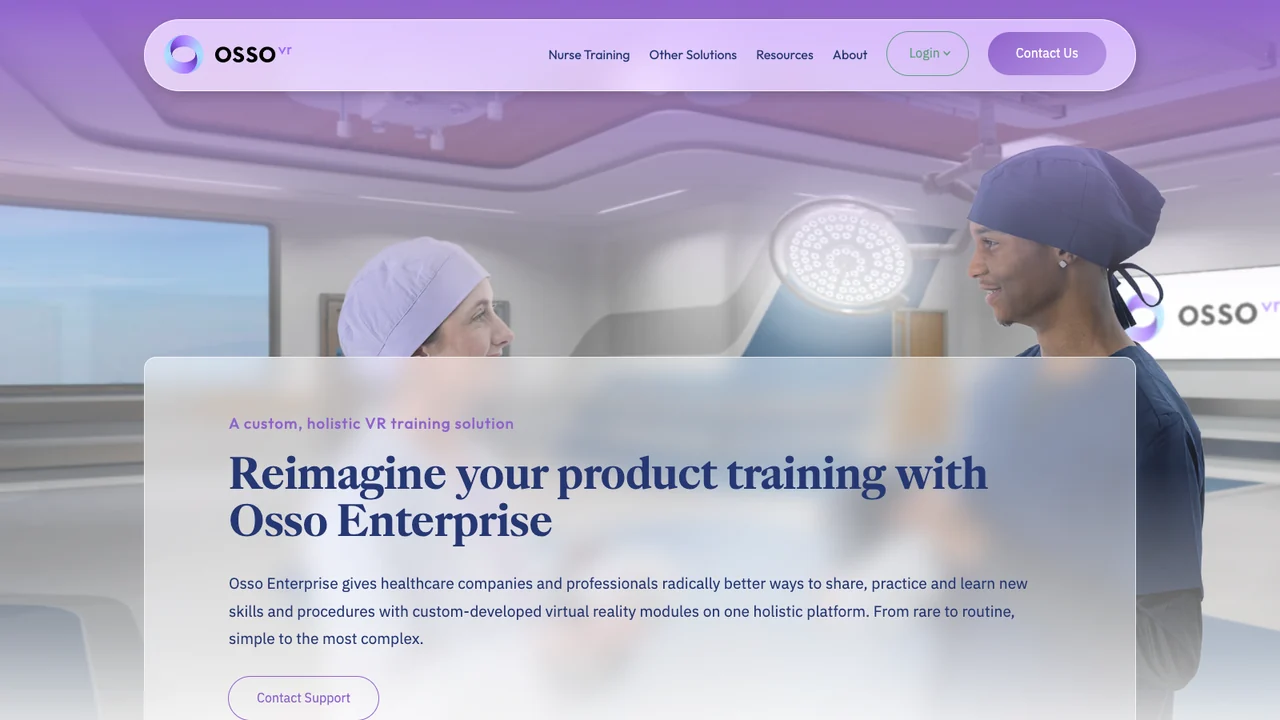
Osso VR publishes VR procedural skills training built for healthcare systems, and it is the entry here aimed squarely at the clinical buyer rather than at marketing.
Its published structure separates two markets cleanly. Osso Enterprise offers custom developed VR modules, which is the device manufacturer and health system route. Osso Academy covers early career healthcare professional VR training, which is the education route. It also publishes Osso Health and an Osso Nurse Training product described as forthcoming, with sign-ups for launch updates.
The nurse training direction is worth noting because it points at where the volume actually is. Surgical VR training addresses a small, expensive population of specialists. Nursing is orders of magnitude larger, has acute and well-documented workforce pressures, and involves procedural skills that suit simulation well. A company extending from surgery into nursing is following the market rather than the prestige.
Its published Research section and Advisory Board are the signals that matter for a clinical buyer. Healthcare adoption turns on evidence and on clinical credibility, and a company that organizes its site around research and a named advisory board is speaking to the people who approve purchases in a hospital rather than to a marketing budget.
Its published Partnerships and Newsroom sections and its Osso POV podcast indicate an established commercial operation, and it publishes a Request pricing route rather than public rates.
It publishes no founding year, headquarters address, team size or named client organizations on the pages reviewed, which is a gap for a buyer wanting references. Best for health systems and device manufacturers deploying procedural skills training at scale.
4. Nanobot Medical
Nanobot Medical produces medical and scientific animation and lists virtual reality development, augmented reality and XR development and 360 video among its services. It presents itself as Nanobot Communications on its own site, a name difference worth checking against contracts and directory listings before raising a purchase order.
Its published work centers on mechanism of action animation, medical illustration, scientific slide decks, infographics and graphical abstracts, which is a communication-led rather than training-led practice. That framing is the honest one: this is a studio for explaining, not for teaching a procedure.
Its published client list runs deep in pharmaceutical accounts and includes Janssen, Pfizer, Eli Lilly, Merck, Sanofi, Novartis, Teva, Abbott, Johnson and Johnson, Servier, Xeris Pharmaceuticals and National Geographic. That depth across large pharmaceutical organizations implies familiarity with medical, legal and regulatory review cycles, which is often the real constraint on a project timeline rather than production capacity.
The breadth of output formats is the practical argument. A therapeutic or device launch rarely needs one asset. It needs a mechanism of action animation, slides the medical science liaison can use, illustrations for the publication and often a congress piece. Buying those from one team keeps the anatomy and the visual language consistent and removes a class of review problem that appears when three suppliers each interpret the same mechanism differently.
Its XR work sits inside that communication practice rather than standing alone, so a buyer wanting a clinical training simulator with validation behind it should look at Osso VR or Ghost Medical instead. It publishes no team size, rates or clinical validation on the pages reviewed. Best for pharmaceutical and device communication programs needing consistent assets across formats.
5. Random42
Random42 produces scientific and medical communication across 3D animation, 2D animation, virtual reality, augmented reality, mixed reality and interactive experiences, and selling headset formats and linear animation from a single practice is its differentiator.
The commercial logic is straightforward. A device or therapeutic launch typically needs both a congress demonstration and a broadcast-quality asset, and running them through one studio keeps the anatomy, the labeling and the visual language consistent across both, which also shortens review.
Its published device targets span Meta Quest 3, Oculus and HTC headsets, Google Cardboard and smartphones. That range is broader at the low end than anything else here, and it reflects a specific commercial reality in pharmaceutical marketing: a congress stand may need fifty units that can be handed to a stranger for ninety seconds, which is a completely different hardware problem from a training suite running two high-end headsets.
Published use cases include sales presentations, patient education, pain management, mental health and phobia treatment, and anatomy education for medical students and trainees. That spread across marketing, therapeutic and educational applications is unusually wide.
The company states 162 employees including more than 70 animators, and 683 clients. It also states that VR increased the amount of time a sales representative had with a healthcare professional by 200 percent. That figure is company-stated with no study, method or sample behind it in the published material, and is recorded here as a claim rather than a result.
Its center of gravity is communication rather than clinical training, so a buyer needing validated procedural training should look elsewhere in this list. Best for launch and congress programs needing VR alongside broadcast-quality animation.
What healthcare XR projects have to account for
Four things determine whether a healthcare XR project reaches its audience.
The first is naming the buyer and the evidence bar. Clinical training is judged against validation literature by committees. Marketing communication is judged on comprehension and engagement by brand teams. Asking a communication studio for validated training, or a training company for a congress asset, produces disappointment on both sides.
The second is the review cycle. Anything touching a regulated product passes through medical, legal and regulatory approval, and that timeline is usually longer than production. Establish it at the start and build the schedule around it, since studios experienced in pharmaceutical accounts price for it and others do not.
The third is hardware reality. A congress stand needs many cheap units that survive being handed to strangers. A hospital training program needs few good headsets with hygiene, charging and IT approval. Random42's published range down to Google Cardboard exists precisely because of the first case.
The fourth is what you own. Training tied to a device must be maintainable for that product's commercial life and updatable when the instrument changes. Treeview publishes full transfer of IP, source code and assets. The others do not publish ownership terms, so it belongs in the contract rather than the assumption.
How to choose between these healthcare XR companies
Start from who uses it. Clinicians building procedural skill at health system scale points to Osso VR, whose research and advisory structure is aimed at that buyer. A device manufacturer needing training for a specific instrument points to Ghost Medical, whose Spineology and Avita Medical work is exactly that. Pharmaceutical communication across many formats points to Nanobot Medical or Random42, with Nanobot stronger on named pharmaceutical depth and Random42 stronger on headset breadth and congress delivery.
If the requirement is bespoke, must integrate with your systems, and must be owned and maintained by you, Treeview builds and transfers everything, with Medtronic and Daiichi Sankyo already on its client list.
Ask for evidence appropriate to the claim. If a supplier says training improves outcomes, ask which study, published where, measuring what against which comparator. Case counts and testimonials answer a different question, and hospital committees know the difference.
Finally, settle the review timeline before the production timeline. In healthcare the approval cycle is the schedule, and a plan built around production capacity alone will slip on its first submission.
Related reading. BestInXR's healthcare guide covers XR across clinical, communication and training. companies for VR surgical training development covers the clinical training case in depth, and XR companies for medical device visualization covers communication. For the operating room see companies for AR in the operating room and surgical planning, and for procurement, selecting XR developers for enterprise deployment.
Frequently Asked Questions (FAQ)
1. Are these companies interchangeable?
No, and treating them as such is the common error. Osso VR sells procedural training to health systems. Ghost Medical builds device-specific training for manufacturers. Nanobot Medical and Random42 produce communication assets for pharmaceutical marketing. Treeview builds bespoke. They are judged by different buyers against different evidence.
2. Which of these name healthcare clients?
Ghost Medical names Spineology, Avita Medical and Greenman LLC. Nanobot Medical names Janssen, Pfizer, Eli Lilly, Merck, Sanofi, Novartis, Teva, Abbott, Johnson and Johnson and Servier. Treeview names Medtronic and Daiichi Sankyo. Osso VR and Random42 publish no named client organizations on the pages reviewed.
3. What evidence should clinical training publish?
Peer-reviewed validation measuring performance against a comparator. Osso VR publishes a Research section and an advisory board, which is the right shape. Company-stated engagement figures, such as Random42's 200 percent claim about sales representative time, are marketing claims rather than clinical evidence and should be read as such.
4. Who usually pays for device-specific VR training?
Frequently the device manufacturer rather than the hospital, because shortening the learning curve on a new instrument has direct commercial value. Ghost Medical's work for Spineology and Avita Medical follows that pattern, and it means a hospital should ask the manufacturer what already exists before commissioning anything.
5. Why does hardware choice differ so much?
Because the settings do. A congress stand needs many inexpensive units handled by strangers for short sessions, which is why Random42 publishes support down to Google Cardboard and smartphones. A hospital training suite needs few good headsets with hygiene, charging and IT approval, which is a different purchase entirely.
6. What does healthcare XR development cost?
None of the five publishes rates, so no figure is recorded here. Cost is driven by whether the work is training or communication, how many procedures or mechanisms are covered, hardware and its management, regulatory and review effort, and whether validation is required. The medical, legal and regulatory review cycle is the line most often underestimated.