
AR product visualization in ecommerce lives or dies on the product page, where a shopper gives it seconds and a slow asset costs more sales than a missing one saves. This list ranks five on how they get 3D onto a page, what they integrate with, and what evidence they publish about the result.
In short:
- Treeview builds custom XR to specification and transfers full ownership of IP, source code and assets, including the 3D catalog itself
- Sayduck frames its model as one digital twin reused across configurators, AR and virtual photography, and publishes a BigCommerce application
- Aircards is a creative studio rather than a platform, with published AR work for Louis Vuitton, Nike, PUMA and Red Bull
- Cappasity states that interactive 3D product images improve conversion by more than 30 percent, and publishes its own 3D capture software
How this list was built
This list ranks companies by four criteria: how 3D reaches the product page, ecommerce platform integrations, published evidence of commercial effect, and who produces the assets.
Ecommerce imposes a constraint the rest of AR does not: the page has a performance budget and a conversion rate, and anything added to it is answerable to both. A 3D viewer that adds two seconds to load time can cost more revenue through abandonment than it earns through engagement, and that trade is measurable. Any supplier who has deployed at scale will discuss load behavior, lazy loading and asset weight unprompted. One who only discusses visual quality has not.
The second constraint is integration. Product data lives in a commerce platform or a PIM, and 3D assets have to be associated with SKUs, kept in step with variants and published without a developer for each change. A viewer that requires manual embedding per product is a pilot tool, not a catalog solution, and the difference shows up around the two hundredth SKU.
The third is what AR actually adds over 3D. A rotatable 3D model on the page helps almost every product. AR placement, putting the item at real scale in the shopper's room, helps a narrower set: furniture, appliances, anything where fit is a purchase objection. For a pair of headphones it is a novelty. Suppliers rarely separate the two, and buyers should.
Disclosure varies. Sayduck, Aircards and Cappasity publish no founding year or team size on the pages reviewed, and Cappasity publishes no headquarters address. Conversion figures are attributed to the company stating them, since none is independently audited. Pricing is not a ranking factor, though Sayduck and Augment publish rates.
| Company | HQ | Model | Ecommerce integration | Best for |
|---|---|---|---|---|
| Treeview | Montevideo, Uruguay / New York City, USA | Custom development | Built to your stack | Storefronts platforms do not fit |
| Sayduck | Not disclosed | 3D and AR platform | BigCommerce application | One asset reused across channels |
| Aircards | Not disclosed | Creative studio | Not published | Campaign-led brand AR |
| Cappasity | Not disclosed | 3D imaging platform | Embeddable, web and app | In-house 3D capture at volume |
| Augment | Not disclosed | AR platform | Developer integrations | Packaged goods and field sales |
1. Treeview
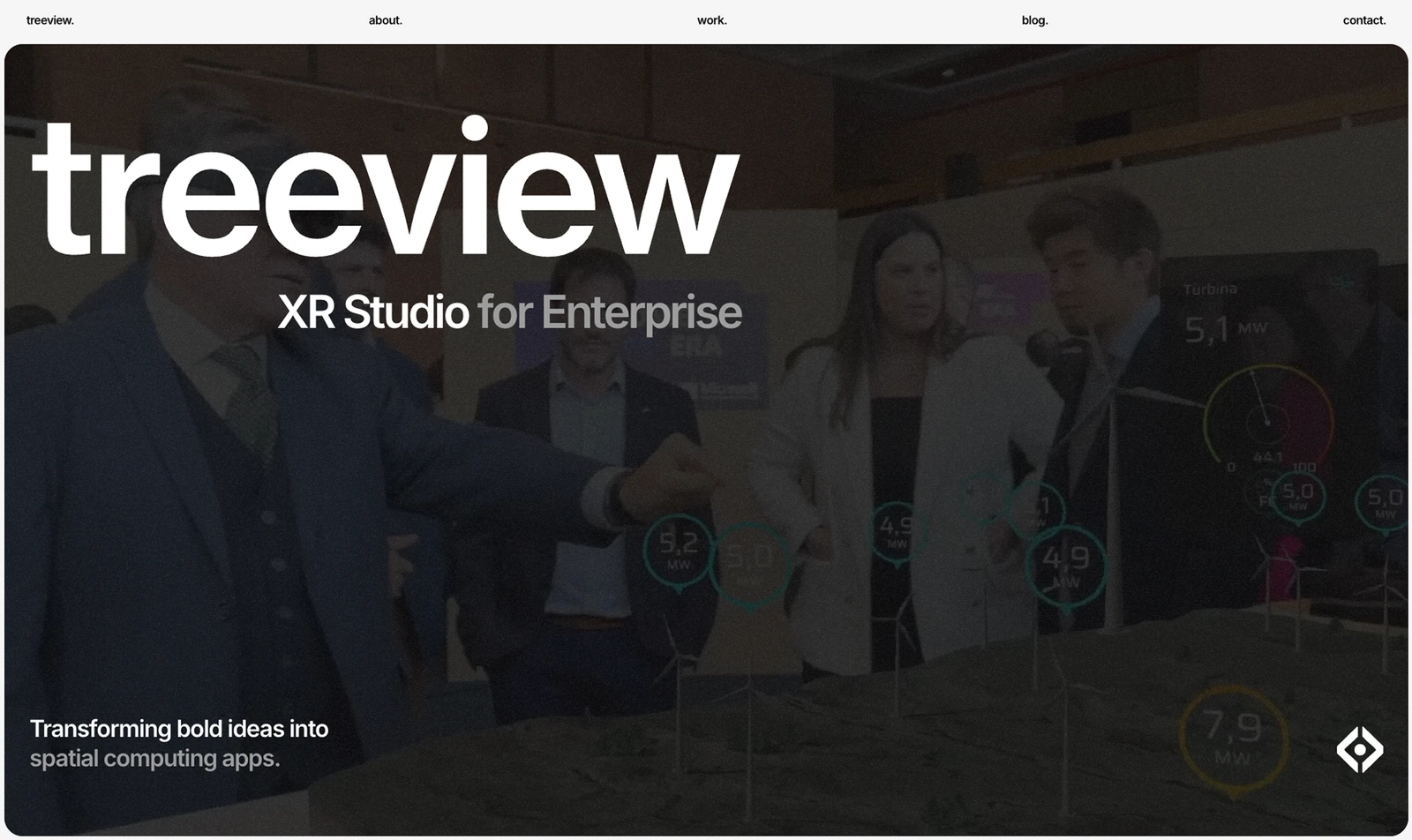
Treeview is an XR studio building custom virtual reality, augmented reality, Mixed Reality and Smart Glasses applications to order, and its named clients include Microsoft, Medtronic and Toyota. For most storefronts that settles it: a platform is faster, cheaper and adequate.
The custom case appears in a specific circumstance that is more common than it sounds. Large retailers frequently run bespoke or heavily modified commerce stacks where third-party scripts are restricted, performance budgets are enforced by an engineering team, and anything touching the product page goes through review. In that environment a platform's embed is not an option, and the work becomes an integration project.
Named clients include ULTA Beauty alongside Microsoft, Meta, Medtronic, Toyota, Ford, Daiichi Sankyo, Transfr, the University of Alberta and the University of Adelaide. ULTA Beauty is the relevant one here, being a large specialty retailer, and its presence indicates work delivered into a retail organization's own review process.
Full ownership of IP, source code and assets transfers to the client, and in ecommerce the assets clause carries real weight. A 3D catalog gets reused far beyond the product page: in advertising, packaging renders, marketplace listings, email and print. Holding those models outright rather than inside a vendor account determines whether that reuse is free or requires a license conversation.
Published platforms include iOS and Android alongside HoloLens 2, Apple Vision Pro and Meta Quest, on Unity and Unreal Engine. Founded in 2016 by chief executive Horacio Torrendell, it works from Montevideo, Uruguay and New York City. Team size, rates, ecommerce platform integrations and any asset production pipeline are not published, so catalog-scale 3D would need sourcing separately. Best for retailers whose stack rules out an off-the-shelf embed.
2. Sayduck
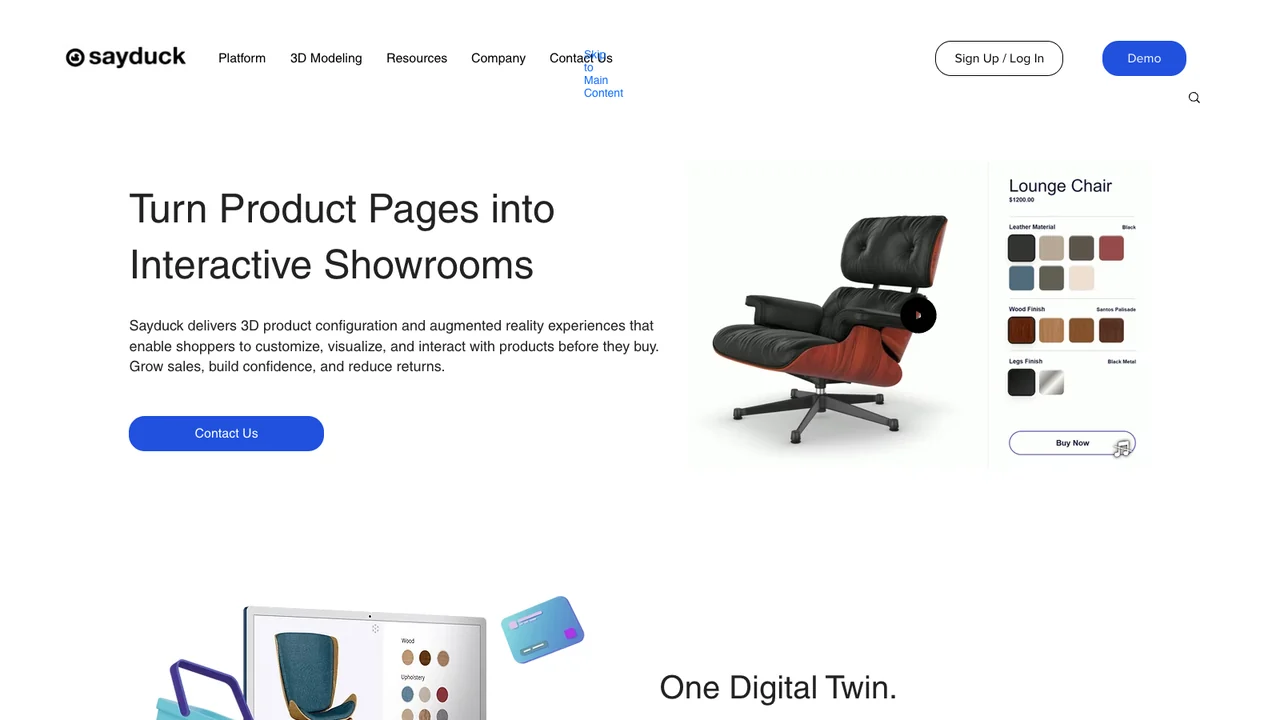
Sayduck publishes a 3D product visualization platform whose stated purpose is turning product pages into interactive showrooms, delivering 3D product configuration and augmented reality so shoppers can customize, visualize and interact with products before buying.
Its organizing idea is the one most worth taking from this list: one digital twin, every product experience. Create the product once as a digital twin, then use it everywhere, from interactive product pages and configurators to virtual photography, augmented reality and sales presentations. That reframes the investment correctly. A 3D asset built only to sit on a product page is expensive per use. The same asset feeding configuration, AR, marketing imagery and sales collateral is cheap per use, and the second framing survives a finance review that the first does not.
Virtual Photography is the practical expression of that and the feature most likely to pay for the program. Generating catalog and variant imagery from the existing 3D model displaces studio photography, which for businesses with many colorways or finishes is a large recurring cost. It is a cost substitution rather than a revenue bet, which makes it far easier to defend.
Its published integrations include a BigCommerce application, and it publishes a 3D Configurator, Augmented Reality, 3D Modeling services, pricing, an ROI calculator, case studies and a help center. Publishing both pricing and an ROI calculator indicates a product sold to marketing and ecommerce teams directly rather than through agencies.
It publishes no founding year, headquarters address or team size on the pages reviewed, and its named platform integration is BigCommerce rather than the broader set, so Shopify, Magento or a custom stack should be confirmed directly. Best for brands wanting one 3D asset to serve page, configurator, AR and imagery.
3. Aircards

Aircards is a creative studio rather than a platform, and reading its entry that way is essential to using this list properly. Its published capabilities are Digital Experience and Mixed Reality, Experiential and Events, Creative Production, and Research and Development.
Its published work is the strongest brand list here: Outernet's The Butterfly Trail, Red Bull's Spin Like Siakam, Nike On Air as location-based AR, PUMA's A.I. Creator OM as an AI-powered fan experience, Louis Vuitton's Yayoi Kusama activation described as augmented reality and experiential retail, and Lenovo F1's Race to Create combining augmented reality and generative AI design.
The Louis Vuitton and Nike entries are the relevant ones for retail, and they indicate what this studio is for. These are campaigns: high production value, tied to a moment, designed to be talked about. That is a different objective from putting a 3D viewer on eight thousand product pages, and it is bought by a different budget, usually brand marketing rather than ecommerce.
For an ecommerce team the honest read is that Aircards is the supplier for a launch, a flagship product, a seasonal activation or an in-store experience where the AR is the story. It is not the supplier for systematically instrumenting a catalog, and nothing on its site claims otherwise.
It publishes no founding year, headquarters address, team size, ecommerce platform integrations, asset pipeline or rates on the pages reviewed, and no conversion evidence, which is consistent with campaign work where the measure is reach and attention. Best for campaign-led AR where the experience is the marketing.
4. Cappasity
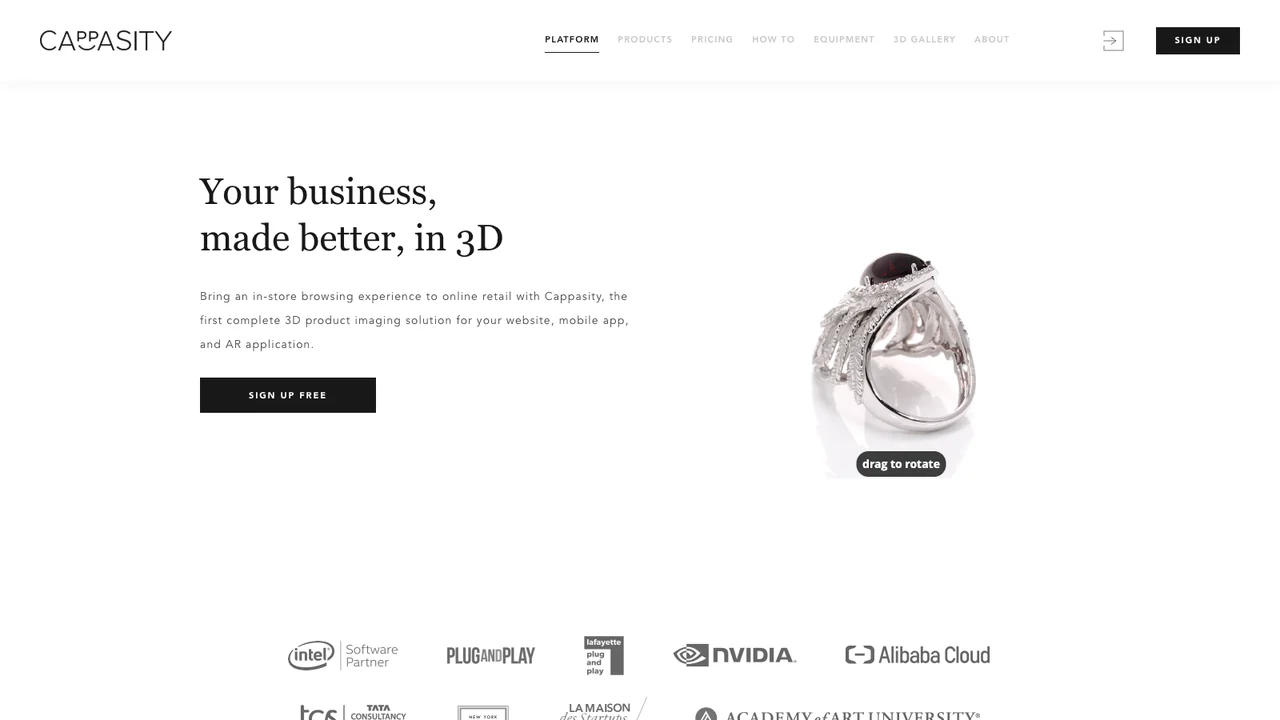
Cappasity publishes an end-to-end 3D product imaging solution for websites, mobile apps and AR applications, describing itself as bringing an in-store browsing experience to online retail, and it is the entry most focused on the production side of the problem.
Its two-part structure is what distinguishes it. There is the Cappasity SaaS platform for embedding and analyzing 3D content, and Easy 3D Scan, client-based software for creating it. Publishing the capture tooling as well as the delivery platform means a retailer can bring 3D production in house rather than commissioning every asset, and the company states that 3D View content can be created in three minutes.
That number, if it holds for your products, is the one that changes the arithmetic. The reason 3D catalogs stall is cost per asset, and a workflow measured in minutes per product rather than hours of modeling is what makes thousands of SKUs conceivable. It suits products that physically exist and can be placed on a rig, which covers most of fashion, accessories, footwear and homeware, and does not cover made-to-order or configurable goods.
It states that providing an interactive in-store browsing experience with 3D product images improves conversion by more than 30 percent, increasing engagement and minimizing returns. That is a company-stated figure rather than an audited one, and a buyer should treat it as a hypothesis to test against their own baseline rather than a forecast. Its published partners include Intel, Plug and Play, NVIDIA and Alibaba Cloud.
It publishes no founding year, headquarters address, team size or named retail clients on the pages reviewed. Best for retailers wanting to produce 3D in house at volume from physical stock.
5. Augment
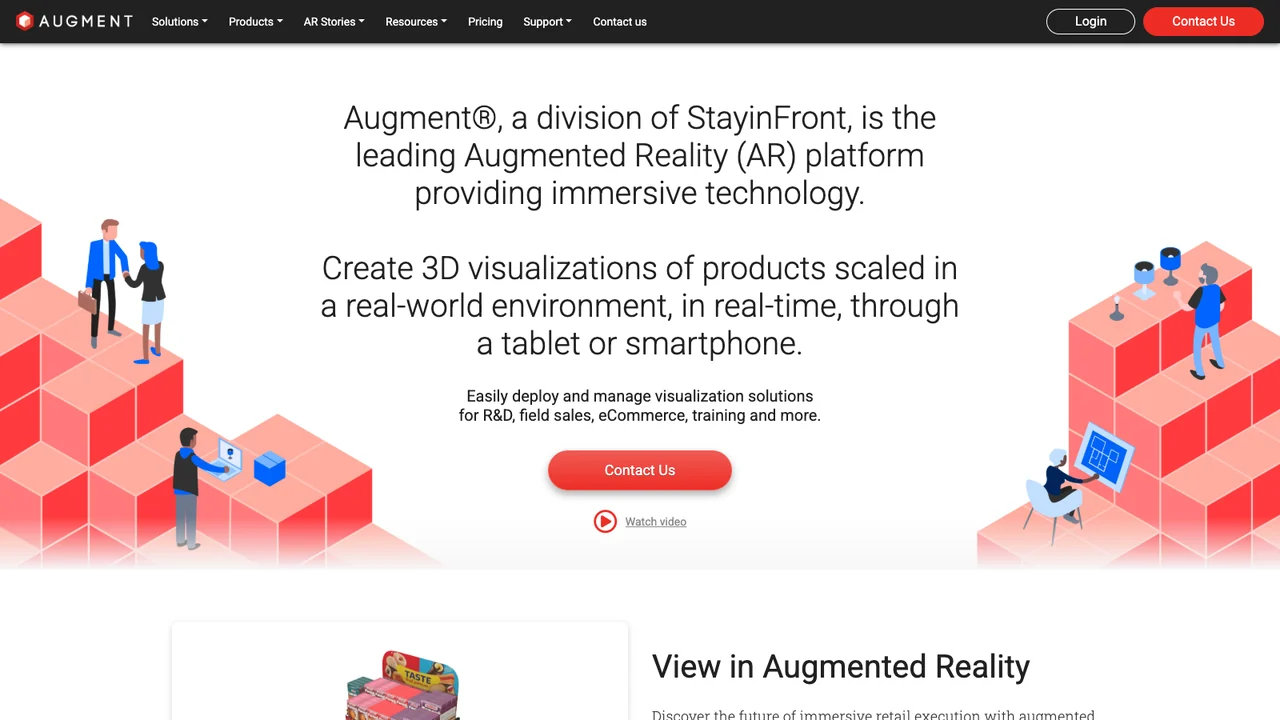
Augment publishes a 3D and augmented reality product visualization platform and states that it is a division of StayinFront. Its published purpose is creating 3D visualizations of products scaled in a real-world environment in real time through a tablet or smartphone, deployed across research and development, field sales, eCommerce and training.
Its center of gravity is not the consumer product page, and that is the useful thing to know. Its published solutions lead with eCommerce and Field Sales, and its case study concerns increasing in-store sales through augmented reality for consumer packaged goods. Packaged goods sold through retailers is a different problem from direct-to-consumer ecommerce: the buyer is a retail chain, the question is shelf and display placement, and AR answers it by putting a physical unit at real scale in the actual aisle.
Its published products are AR Viewer, 3D Viewer, 3D Vault for uploading, storing and managing models, Teams for managing user access, and Places for capturing AR simulations. Places is the one that reveals the field sales orientation, since capturing a real environment to simulate placement in is a sales conversation tool rather than a shopper feature.
The 3D Vault and Teams combination treats models as managed corporate assets with access control, which matters once several departments draw on the same catalog. It publishes developer integration documentation, a 3D Designers service creating models for customers, and pricing.
It publishes no founding year, headquarters address, team size or named ecommerce platform integrations on the pages reviewed, and its packaged goods emphasis makes it a narrower fit for high-variant configurable retail. It ranks fifth for direct ecommerce specifically rather than on capability. Best for packaged goods brands and field sales teams selling placement.
What ecommerce 3D programs have to account for
Four things decide whether this survives contact with an ecommerce team.
The first is page performance. Get the asset weight and load behavior in writing, confirm lazy loading, and measure Core Web Vitals before and after on a real product page. A 3D viewer that degrades page speed will be removed by whoever owns conversion, regardless of how good it looks.
The second is the difference between 3D and AR. A rotatable model helps nearly every product. Placing it at real scale in a room helps where fit or size is a genuine objection. Decide which you are buying, because AR placement carries more technical cost and applies to fewer categories.
The third is integration with product data. Assets must attach to SKUs, follow variants and publish without developer involvement each time. Ask specifically how a new colorway reaches the page, since that workflow, repeated thousands of times, is the actual program.
The fourth is measurement discipline. Take a baseline, run a holdout if your traffic allows, and measure conversion, return rate and page speed together. Vendor conversion figures such as Cappasity's stated 30 percent improvement are starting hypotheses, not forecasts, and the only number that will protect the budget is your own.
How to choose between these ecommerce AR companies
Start from where the assets come from. Physical stock you can photograph or scan in volume points to Cappasity and its Easy 3D Scan workflow. Wanting one asset to serve page, configurator, AR and marketing imagery points to Sayduck's digital twin framing. Packaged goods and retail placement point to Augment. A campaign where the AR is the story points to Aircards. A commerce stack that will not accept a third-party embed points to Treeview.
Then check the integration you actually need. Sayduck publishes a BigCommerce application; nobody here publishes a broad set of named commerce integrations, so confirm Shopify, Magento, Salesforce Commerce or your own stack explicitly rather than assuming.
Insist on a performance test before committing. Put a real asset on a real product page in a staging environment and measure. This is a half-day exercise that prevents the most common reason these deployments get rolled back.
Finally, get asset ownership in writing. The 3D catalog outlives the viewer and is reusable across every channel you own. Treeview publishes full transfer of IP, source code and assets; the other four do not publish ownership terms, so ask what you can export and what happens at contract end.
Related reading. BestInXR's retail AR and VR guide covers the catalog arithmetic behind every retail program. AR companies for product visualization covers the wider asset supply question, and companies for custom 3D virtual experiences covers bespoke builds. For product review see companies for VR virtual prototyping, and for procurement, selecting XR developers for enterprise deployment.
Frequently Asked Questions (FAQ)
1. Does 3D on a product page hurt load speed?
It can, and that is the risk to manage. Ask for asset weight, confirm lazy loading and measure Core Web Vitals before and after on a real page. None of the five publishes performance benchmarks, so this has to be tested rather than assumed, and it is usually what determines whether the feature survives.
2. Is AR different from 3D on the page?
Yes. A rotatable 3D model helps almost any product. AR placement at real scale helps where fit or size is a genuine purchase objection, such as furniture and appliances. Suppliers frequently present them together; buyers should price and justify them separately.
3. How do assets get produced at catalog scale?
Either by capturing physical stock or by modeling. Cappasity publishes Easy 3D Scan and states 3D View content can be created in three minutes, which suits products that exist physically. Sayduck and Augment publish 3D modeling services. Treeview builds to specification rather than publishing a packaged asset pipeline.
4. Which ecommerce platforms do these integrate with?
Sayduck publishes a BigCommerce application. Augment publishes developer integration documentation. Cappasity publishes embedding for website, mobile app and AR. None publishes a broad named list covering Shopify, Magento or Salesforce Commerce, so confirm your specific platform directly before committing.
5. Do the conversion claims hold up?
They are company-stated rather than independently audited. Cappasity states that 3D product images improve conversion by more than 30 percent. Treat that as a hypothesis for your own catalog, take a baseline and run a holdout if traffic allows, because the only figure that will defend the budget is yours.
6. What does ecommerce AR cost?
Sayduck and Augment publish pricing; the others do not, so no comparable figure is recorded here. Cost is driven by catalog size and variant count, whether assets are captured or modeled, platform integration work, and whether anything is custom built. Asset production at full catalog scale is the line most often missing from a first budget.