AR and VR development for retail covers two businesses that barely overlap: the physical store, where the technology is a fixture someone has to maintain, and the digital storefront, where it is software on a product page. This list ranks five across both, and is candid about one entry that is neither a company nor retail.
In short:
- Treeview builds custom XR to specification, names ULTA Beauty among its clients, and transfers full ownership of IP, source code and assets
- Outform is a retail experience agency that engineers, ships, installs and maintains in-store technology across ten cities on three continents
- Perfect Corp publishes ISO 27001 certified beauty AR with try-on across ten makeup and eyewear categories
- Vuforia Studio Partners is a PTC partner ecosystem rather than a company, and Vuforia Studio is industrial AR rather than retail
How this list was built
This list ranks companies by four criteria: whether they serve physical or digital retail, published retail evidence, what they deliver and support afterwards, and what the retailer owns.
The split between store and storefront runs through this whole category and decides who you should even be talking to. In-store AR and VR is hardware in a public place: a mirror, a kiosk, a display, a projection. It has to be manufactured, shipped, installed, powered, updated and repaired, across however many stores you have, and the recurring cost of keeping it working usually exceeds the cost of building it. Digital retail AR is software: it ships instantly, scales to every visitor and has no field maintenance at all.
Those are different suppliers with different skills. An agency that can install five hundred units across a chain and keep them running is a logistics and engineering business. A studio that builds a try-on experience is a software business. Very few do both, and a retailer that briefs one expecting the other will discover the gap late.
The second thing to establish is which retail problem you are solving. Beauty and eyewear have try-on, where AR maps a product to a face and answers whether it suits you. Furniture and appliances have placement, where the question is whether it fits. Everything else has visualization, where the question is what it actually looks like. These are unrelated technologies.
Disclosure varies. Outform, Perfect Corp and Gravity Jack publish no founding year on the pages reviewed, though Gravity Jack states it has worked in AR and VR since 2009. Engagement figures are attributed to whoever states them, since none is independently audited, and unverified superlatives are reported as company claims rather than repeated as fact. Pricing is not a ranking factor, because none publishes rates.
| Entry | HQ | What it is | Store or storefront | Best for |
|---|---|---|---|---|
| Treeview | Montevideo, Uruguay / New York City, USA | Custom XR studio | Storefront, built to spec | Retail software you own |
| Outform | Union City, Chicago and Miami, plus EMEA and APAC | Retail experience agency | Store, end to end | In-store hardware at chain scale |
| Perfect Corp | Not disclosed | Beauty AR and AI vendor | Both, productised | Beauty, skincare and eyewear |
| Gravity Jack | Not disclosed | AR and VR development studio | Storefront and events | Custom builds and trade shows |
| Vuforia Studio Partners | PTC program | Partner ecosystem, not a company | Industrial, not retail | Reference only, see entry |
1. Treeview
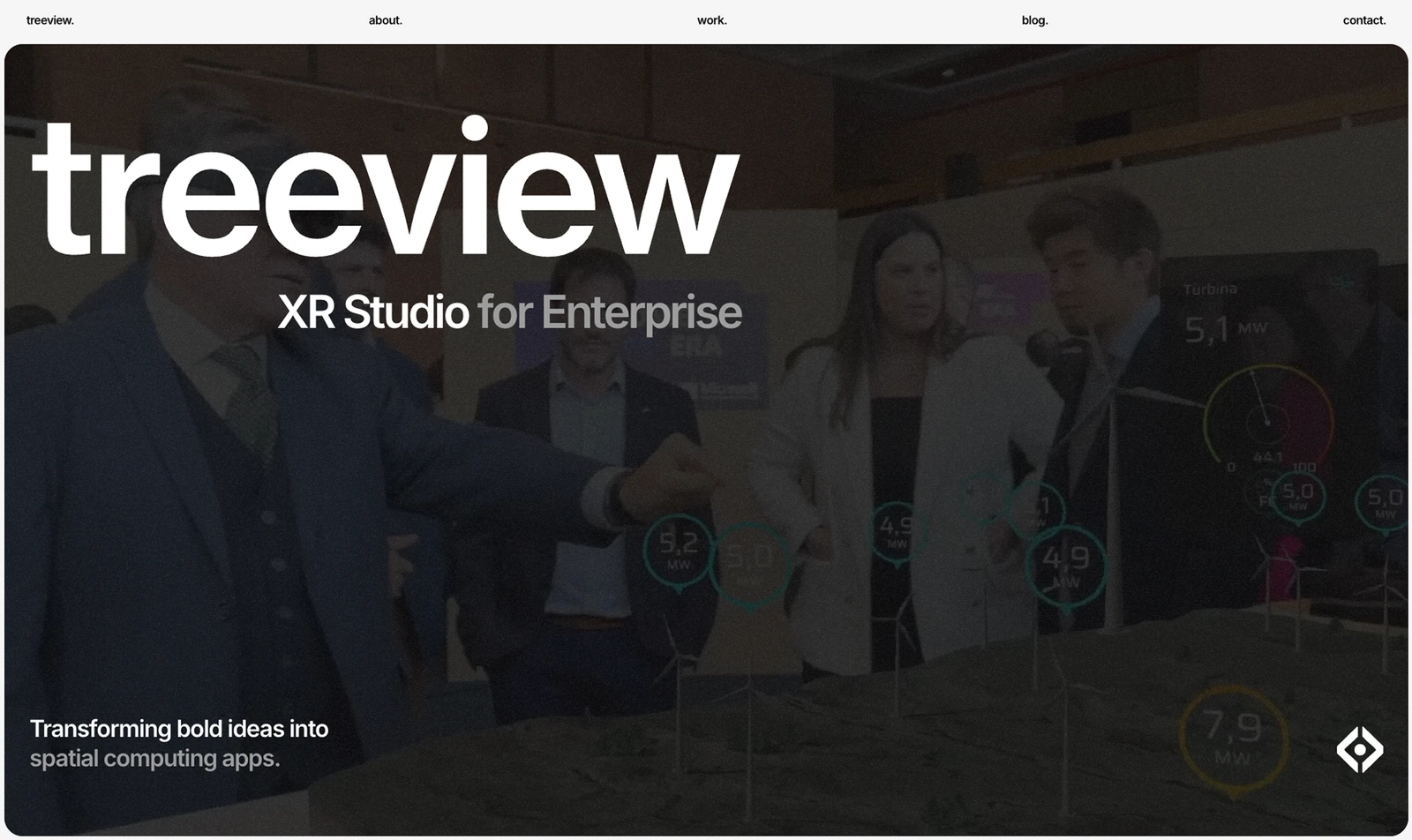
Treeview is an XR studio building custom virtual reality, augmented reality, Mixed Reality and Smart Glasses applications to order on Unity and Unreal Engine, with published iOS and Android coverage alongside headset platforms.
Its retail reference is ULTA Beauty, alongside Microsoft, Meta, Medtronic, Toyota, Ford, Daiichi Sankyo, Transfr, the University of Alberta and the University of Adelaide. ULTA Beauty is a large specialty beauty retailer, and beauty is the retail category where AR has the strongest established commercial case, so that is a relevant reference rather than a decorative one.
Where a custom studio fits in retail is on the storefront side and at the edges the productised vendors do not reach. A retailer with its own app, a bespoke commerce platform, an unusual loyalty integration or a performance budget policed by engineering cannot always drop in a third-party script, and in those cases the work becomes a development project rather than a subscription.
Full ownership of IP, source code and assets transfers to the client. In retail the asset half compounds: 3D models of products get reused across the site, marketplace listings, advertising, packaging renders, in-store screens and email, and a catalog held in a vendor account is licensed rather than owned.
Its stated services span strategy and discovery, 3D content creation, development, system integration, testing, deployment and support, with 3D content creation relevant since asset supply is the usual constraint. Founded in 2016 by chief executive Horacio Torrendell, it works from Montevideo, Uruguay and New York City. Team size, rates, commerce integrations and any in-store hardware capability are not published, so physical installations would need a different supplier. Best for retail software built to your specification and owned outright.
2. Outform
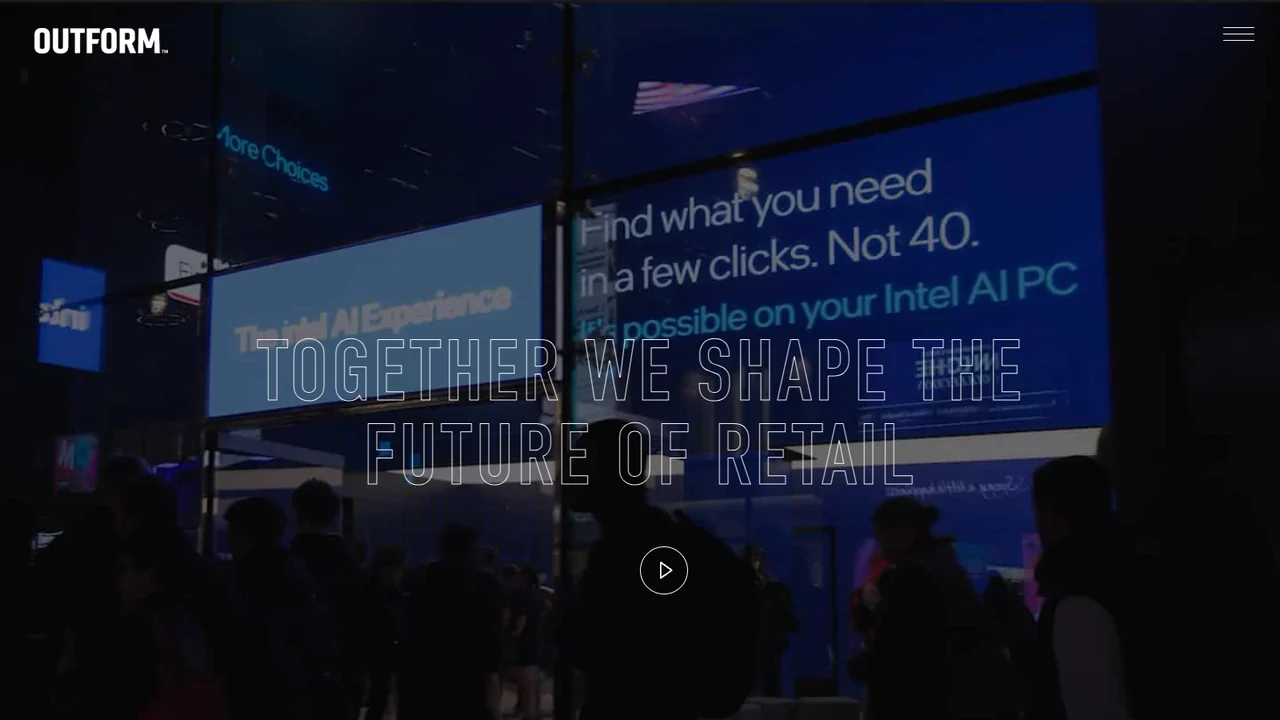
Outform is a retail experience innovation agency, describing itself as leading the future of in-store shopping with design and technology and transforming ordinary retail spaces into immersive brand stories. It is the only entry here built for physical retail, and that makes it the most distinctive.
Its published operating model is the substance of the entry, summarized as Think, Make, Run. Its own site describes a sequence running from "cutting-edge engineering" to "seamless global logistics" and on to "efficient deployment and ongoing maintenance".
Every word of that sequence matters and it is what separates in-store work from software. A retail technology fixture has to be designed, then physically manufactured, then shipped to hundreds of locations, then installed by someone, then kept running through the daily abuse of a public space, then eventually removed. The Run part is the one retailers underestimate and the one that determines whether an in-store program lasts a season or three years.
Its published footprint supports that claim. It states dedicated local teams across North America in Union City, Chicago and Miami; Europe and the Middle East in London, Fleet, Amsterdam, Lodz and Tel Aviv; and Asia Pacific in Shenzhen, Jiaxing and Shanghai. Shenzhen and Jiaxing are manufacturing locations, which is consistent with a company that actually builds hardware rather than specifying it. Local teams across three continents matter because installation and maintenance are inherently local.
It publishes a weekly Future Retail newsletter, verticals and a work portfolio. It publishes no founding year, team size, named clients or rates on the pages reviewed, and it is not the supplier for a product page widget. Best for in-store technology programs that must be built, deployed and maintained at chain scale.
3. Perfect Corp
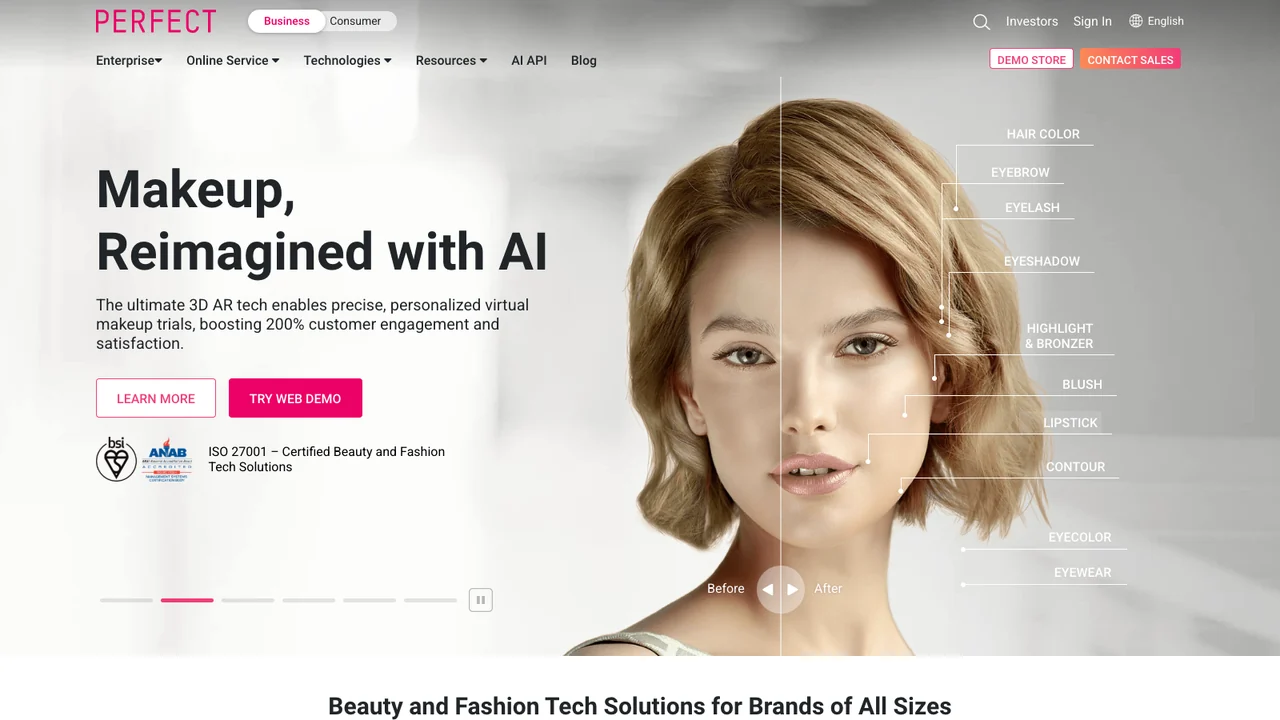
Perfect Corp publishes beauty AR and AI skin technology for beauty ecommerce, describing itself as an AI powerhouse for beauty, skincare and fashion tech, with AR and AI SaaS solutions offered as custom services for brands or as a self-service skin analysis platform for medical aesthetic clinics.
Its published try-on coverage is unusually specific and it is what makes the entry credible: eyewear, eyeshadow, eye color, blush, hair color, eyebrow, eyelash, highlight and bronzer, contour and lipstick. That granularity matters because each of those is a distinct technical problem. Tracking a lip and applying a color that responds to lighting is different from placing eyewear that must sit correctly on a nose bridge, and different again from recoloring hair convincingly.
Beauty is the retail category where AR try-on has the clearest commercial argument anywhere, because the entire purchase decision is whether a shade suits a particular face, and no photograph answers that. It is also a category with high return rates driven by exactly that uncertainty.
Its published ISO 27001 certification is worth noting and is rare in this market. Try-on processes images of customers' faces, which is sensitive personal data with regulatory consequences, and a certified information security management system is a meaningful answer to the question a retailer's legal team will ask first.
Its published Investors section indicates a listed company whose financials can be read before a long commitment. It states that its 3D AR technology boosts customer engagement and satisfaction by 200 percent and describes itself as number one in AR beauty tech; both are company claims rather than audited figures and are recorded as such. It publishes no founding year, headquarters address or team size on the pages reviewed, and its scope is beauty, skincare and eyewear rather than retail generally. Best for beauty, cosmetics and eyewear retailers wanting proven try-on.
4. Gravity Jack
Gravity Jack states that it has been creating augmented reality and virtual reality experiences since 2009, which is the longest stated history in this list, and invites clients to join its record with Fortune 500 customers.
Its published solutions cover augmented reality, virtual reality, AR and VR for the medical industry, AR and VR for manufacturing, AR for marketing, AR for training, Apple Vision Pro, mobile apps and websites. Its published industries are Marketing, Department of Defense, Gaming, Medical, Trade Show, Industrial and Training.
Retail is not among those industries, and that should be read directly rather than glossed over. The two closest are Marketing and Trade Show, and Trade Show is the more interesting for a retail buyer. Trade show and event AR is a real and adjacent discipline: a temporary, high-traffic physical environment where an experience has to work for large numbers of untrained people over a few days. Retail activations and pop-ups have the same shape.
Its longevity is the credential worth weighing. A studio continuously delivering AR and VR since 2009 has survived several cycles of hardware and platform churn, which is unusual and predicts a certain resilience. Its published Apple Vision Pro capability indicates it has kept current rather than settling on one generation.
It also publishes its own products, including WarTribe as an augmented reality title, which shows the studio builds original work as well as client projects. On the pages reviewed it publishes a founding reference of 2009 but no headquarters address, team size, named retail clients, commerce integrations or rates, and its industry list points away from retail. Best for custom AR and VR builds and event or trade show work rather than retail systems.
5. Vuforia Studio Partners
This entry needs correcting rather than reviewing, and the correction is the useful content.
Vuforia Studio Partners is not a company. Vuforia is PTC's enterprise augmented reality platform, and Vuforia Studio is one product within it. Any partner listing associated with it is a PTC ecosystem of implementation firms rather than a supplier you can engage directly, so there is nothing here to shortlist against the four entries above.
The second correction matters more for this particular list. Vuforia Studio is industrial AR, not retail. PTC publishes it as augmented reality for industrial enterprise, positioned around modernising training and work instructions, transforming existing CAD and IoT data into augmented reality experiences that give critical information to front-line workers, and delivering 3D AR training, instructions and visualizations that increase worker productivity, reduce the cost of errors, waste and accidents, and improve customer experience. PTC describes itself as leading the industrial AR market with step-by-step 3D overlays and digital twins for front-line workers.
Front-line workers, work instructions, CAD and IoT data and digital twins are the vocabulary of factories and field service. None of it describes a shopper. A retailer evaluating AR for stores or ecommerce would be looking at the wrong product even if it were a company.
Where this is genuinely relevant is if your retail organization has an industrial side, which large retailers do: distribution centers, logistics operations, refrigeration and equipment maintenance, and store fit-out engineering. Vuforia Studio addresses that work directly, and PTC publishes a quiz to route buyers to the right Vuforia offering.
For the retail brief this post covers, it is a reference rather than an option, and it is recorded here so a shortlist inherited from elsewhere does not carry it forward unexamined. Best understood as the industrial AR route, engaged through PTC and its implementation partners.
What retail XR programs have to account for
Four things decide whether retail XR earns a second year.
The first is the running cost of anything physical. In-store hardware needs power, network, cleaning, software updates, repairs and eventual removal, across every location. Outform publishes Run as a stage of its model for exactly this reason. Budget the operating cost per store per year before approving the build, because that number, multiplied by your estate, is the real program.
The second is matching the technology to the actual objection. Try-on answers whether it suits you and belongs in beauty and eyewear. Placement answers whether it fits and belongs in furniture and appliances. Visualization answers what it looks like and applies broadly. A brief that says retail AR without naming the objection will attract incomparable proposals.
The third is data protection where faces are involved. Try-on processes biometric-adjacent personal data, and the questions about storage, consent, retention and jurisdiction arrive from legal rather than marketing. Perfect Corp publishes ISO 27001 certification, which is the kind of answer that shortens that conversation considerably.
The fourth is who owns the 3D. Retail asset libraries outlive every viewer, platform and campaign they are built for. Treeview publishes full transfer of IP, source code and assets. The others do not publish ownership terms, so establish what you can export before the second season.
How to choose between these retail XR companies
Start from store or storefront, because it splits this list cleanly. Physical installations that must be manufactured, deployed and maintained across many locations point to Outform, and nothing else here does that. Software on your site or app points to the others.
Then match the category. Beauty, cosmetics and eyewear point to Perfect Corp, whose try-on coverage is specific and whose ISO 27001 certification answers the data question. A custom build inside your own systems, owned outright, points to Treeview. Event, trade show and activation work, or a bespoke build from a long-established studio, points to Gravity Jack.
Ignore the Vuforia Studio Partners entry for retail purposes, unless the requirement is actually your distribution centers or maintenance operations, in which case it is the right technology and the route is PTC.
Finally, cost the second year before approving the first. In-store technology is judged on whether it is still working and still switched on twelve months after the launch photos, and that outcome is decided by the maintenance arrangement rather than by the build.
Related reading. BestInXR's retail AR and VR guide covers the catalog arithmetic behind every retail program. companies for VR virtual showrooms and stores covers virtual retail spaces, and AR development companies for ecommerce covers online retail. For customization see AR companies for retail product customization, and for industrial AR, AR work instruction and guided work companies. For a retail brand taking a product to a trade show rather than a store, the activation technology framework picks the format from the visitor task.
Frequently Asked Questions (FAQ)
1. Is Vuforia Studio Partners a company?
No. Vuforia is PTC's enterprise AR platform and Vuforia Studio is a product within it, so any partner listing is a PTC implementation ecosystem rather than a supplier. It is also industrial AR for work instructions and front-line workers, not retail technology, so it does not belong on a retail shortlist.
2. What is the difference between in-store and online retail XR?
In-store XR is hardware in a public place that must be manufactured, shipped, installed and maintained across every location, and its running cost usually exceeds its build cost. Online retail XR is software that ships instantly with no field maintenance. Different suppliers, different skills, different budgets.
3. Which of these name retail clients?
Treeview names ULTA Beauty. Outform describes itself as a retail experience agency with local teams across ten cities but names no clients on the pages reviewed. Perfect Corp serves beauty brands and publishes an investor section. Gravity Jack names Fortune 500 clients without listing them and does not include retail among its industries.
4. Is AR try-on safe from a data protection view?
It processes images of customers' faces, so it raises consent, retention and jurisdiction questions that legal teams ask early. Perfect Corp publishes ISO 27001 certification, which is a recognized information security standard and the most direct answer available here. The others publish no security certifications.
5. Which retail categories does AR genuinely help?
Beauty and eyewear through try-on, where the whole decision is whether something suits a face. Furniture and appliances through placement, where fit is the objection. Broader categories through visualization, where the question is what an item really looks like. Outside those, AR tends to be decoration.
6. What does retail XR cost?
None of the five publishes rates, so no figure is recorded here. Cost is driven by whether hardware is involved, how many stores are covered, catalog size for 3D assets, integration with commerce systems, and the annual maintenance commitment. For in-store programs, the yearly running cost per location is the line most often left out.