Brand activation technology: choosing VR, AR, spatial apps and smart glasses
Choose brand activation technology by the visitor action, available time and delivery responsibilities. Headset VR, mobile AR, spatial applications, smart glasses and shared screens offer different ways to explain or experience a product. Compare them against the same brief, including staffing, accessibility, connectivity and reuse, before committing to a device or supplier.
In short:
- The task decides: exploration, product comparison and image creation need different technology.
- The full cycle decides capacity: setup and turnaround can outweigh the content duration.
- The purchase model matters: custom software, platform licensing and event production are distinct commitments.
- Reuse needs scope: code, assets, interfaces and hosting terms determine the life after the activation.
What should decide the technology choice?
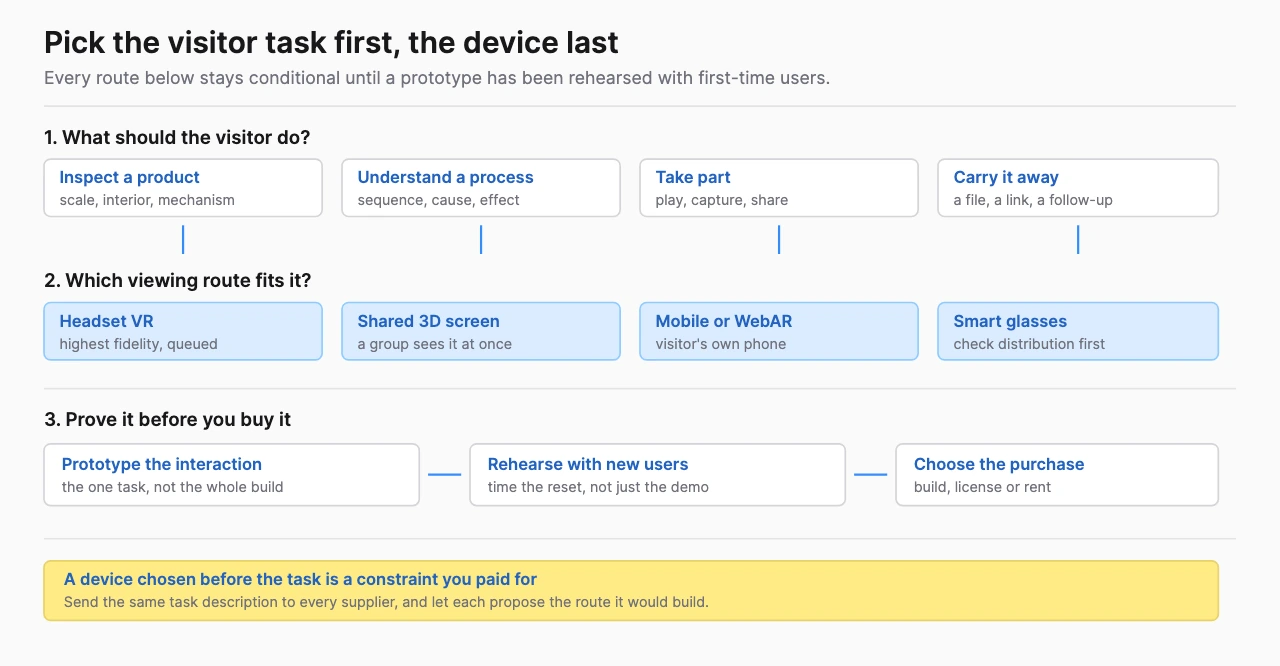
The required visitor action should decide the initial shortlist. State whether someone needs to inspect a component, compare a configuration, experience a place, create media or receive guidance. Then identify the constraints that can change the format.
A buyer inspecting a complex mechanism may benefit from a guided model. A crowd looking for a brief shareable moment may need a camera installation with rapid entry and clear media delivery. An innovation team testing hands-free instructions may need a controlled smart-glasses pilot. Calling each one “immersive” hides those differences.
Set a time allowance for the entire visitor cycle and a definition of successful completion. Estimate the volume of arrivals, identify how many staff are available and decide whether the experience must remain useful when disconnected. Those inputs can narrow the choice before a creative team designs an environment.
Use a decision sequence: identify the task, choose the viewing route, prototype the key interaction, rehearse the operating cycle and compare delivery models. Keep the device decision revisable until the prototype and rehearsal support it.
How do the main technology families compare?
Compare formats on the work they require, not a single attractiveness score. The table is a planning framework, not a measured ranking of hardware.
| Format | Useful when | Main operational work | Alternative to retain |
|---|---|---|---|
| Headset VR | A simulated environment helps explain an inaccessible place or process | Fitting, controls, comfort, reset and cleaning | Presenter-controlled screen route |
| Headset spatial app | A model arranged in space clarifies a product | Guest setup, tracking, input and supervised area | Shared 3D view |
| Mobile/WebAR | Visitors can inspect or place content on phones | Compatibility, loading, permissions and help | 3D viewer or staffed tablet |
| World-tracked AR glasses | Hands-free, spatial interaction is central | Hardware access, tracking, distribution and operators | Tablet or headset prototype |
| Camera/audio or glanceable-display glasses | Connected guidance or short information is the task | Pairing, application access, audio and consent | Phone guidance |
| Shared screen or touchscreen | Several people need a product explanation together | Visibility, reachable controls and presenter tools | Approved static or video explanation |
Spatial computing is a description of interaction with content in space, not a device procurement category with one operating model. A headset can run full VR or a passthrough spatial experience. A touchscreen displaying a 3D model is not automatically AR. The W3C's XR user-needs work is useful for examining the input/output implications across formats.
Meta's wearables FAQ also distinguishes display and displayless glasses and their development routes. Verify the exact capability your concept requires. A text display does not by itself provide a world-anchored product model.
When does VR earn its station time?
VR earns consideration when the virtual environment carries information that a simpler view cannot. Entering a remote facility or demonstrating a sequence across a large system can justify the headset cycle. Rotating a small object may be better served by a shared screen if the context adds little.
Prototype the decisive interaction before building the full environment. Ask a first-time visitor to complete it, then test whether a representative can explain the product as well through a screen version. Compare understanding, assistance and cycle time using the same task.
Keep simulated performance within the approved product story. A scripted scenario shows a product behaving the way the brand is willing to stand behind, which is the reason to build one. It is not evidence that the format sells more, so treat any uplift figure in a supplier case as that supplier's own measurement until you have seen the method. The VR trade-show guide develops product concepts and a worked station-capacity example.
When does AR improve access to the experience?
AR can improve the entry route when the audience's phones and the supported browser interaction fit the task. Product placement, a component reveal or a short stop-based story can retain a view of the surroundings. A phone route still needs a readable start, support matrix and assisted option.
Choose the distribution route deliberately. model-viewer AR documentation demonstrates multiple platform-specific modes. Confirm camera access, tracking and interaction behavior on the devices your audience will bring.
The AR event guide covers the scan-to-completion funnel. Its proposed concepts distinguish a product explanation from a camera effect or route, so the measurement matches the visitor task.
When should a team test smart glasses?
Test smart glasses when wearing the device creates a useful interaction advantage. Hands-free guidance or colocated AR can justify a supported pilot. A short text prompt that works equally well on a phone may call for a simpler delivery route.
Require a device-level prototype and a distribution plan. Snap's Connected Lens documentation describes shared mapping and Spectacles-to-Spectacles sessions. A multiuser concept needs to account for those session rules instead of assuming that mobile users can join the same experience.
Keep public rollout and a controlled demonstration separate in the brief. Meta's FAQ documents development routes while describing broader submission/discovery as forthcoming. The smart-glasses event guide turns that distinction into feasibility questions for a pilot.
Which delivery model should the team buy?
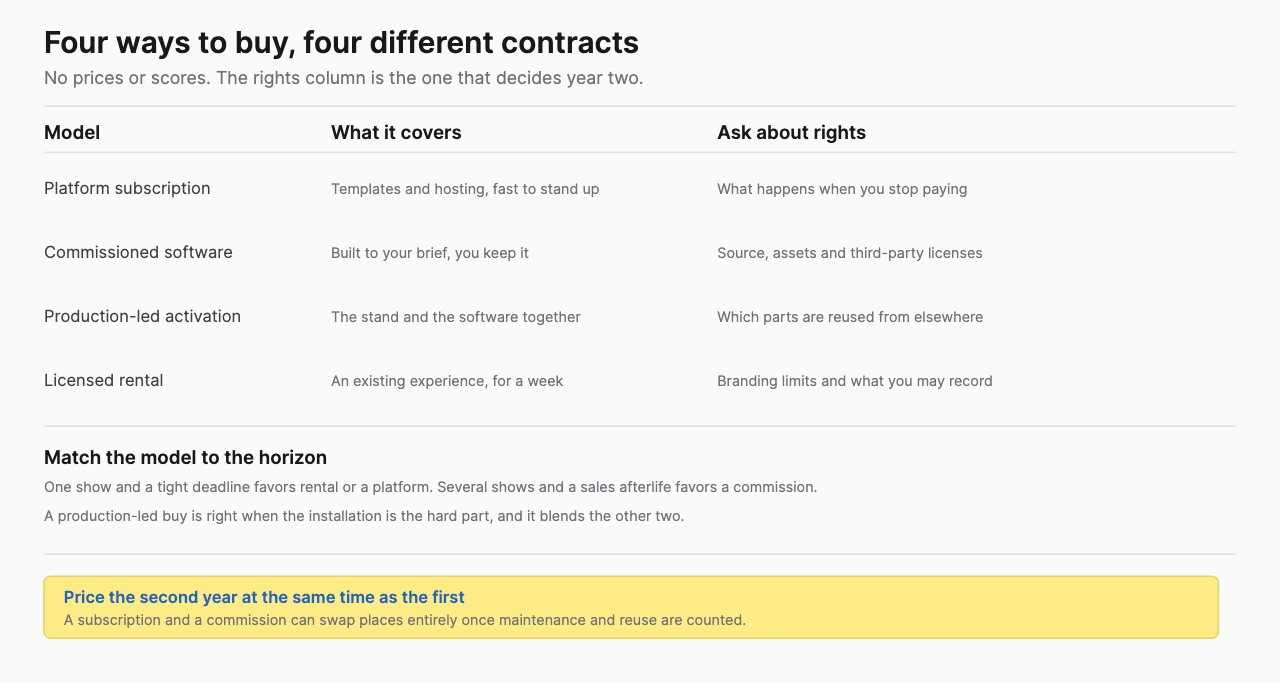
Buy the model that matches control, complexity and operational needs. A platform gives a defined service and its supported capabilities. A commissioned build gives the deliverables and rights assigned in the agreement. A production agency coordinates the physical experience and the services it contracts to provide.
| Model | Appropriate brief | Commercial questions |
|---|---|---|
| Platform/subscription | Supported product views or repeatable sales content | License, seats, hosting, exports and renewal |
| Custom application | Approved product behavior, integrations or specialized interaction | Milestones, source/assets, third-party licenses and support |
| Production-led activation | Installation, fabrication and attendee experience | Venue, load-in, labor, logistics and technical ownership |
| Licensed content/rental | Near-term entertainment or a defined existing demo | Public-use rights, branding, hardware and staffing |
Compare a quote's included work with the requirement. Budget line items should separate creative content, assets, software, equipment, production, operations and ongoing services. A custom build may still depend on licensed components or hosting. IP language should identify those dependencies precisely.
Kaon presents a platform-led trade-show product-experience route. Demodern publishes a trade fair and event practice spanning AR, VR, games and AI. Those alternatives may fit better than a standalone software commission when the brief calls for their particular delivery model.
What should a feasibility prototype prove?
A prototype should prove the interaction and the operating assumptions most likely to change the purchase. It does not need to contain every scene. Use representative content and the intended device so the result informs the production brief.
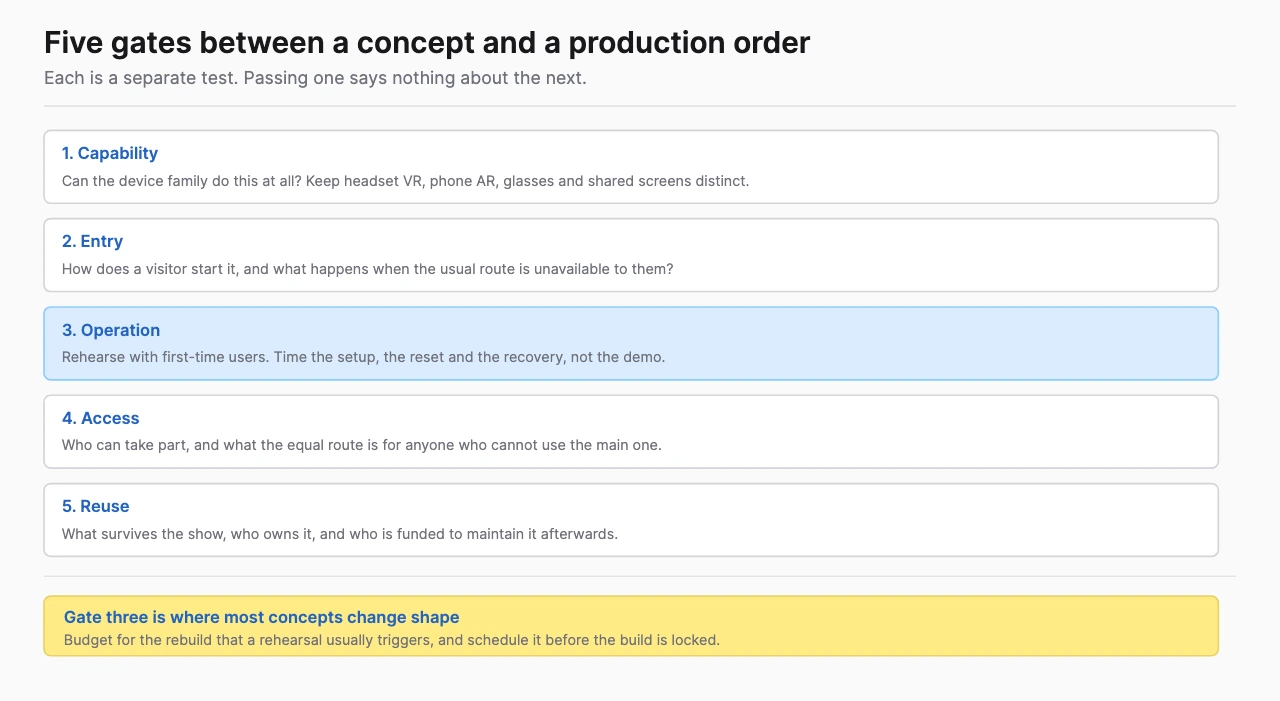
For a proposed hidden-component demo, test the visibility of labels, the input target, the approved reveal and the operator reset. Time a first-use cycle. For a phone route, include permission refusal, loading interruption and the fallback viewer. For a glasses route, include pairing, session entry and loss of tracking.
Ask the supplier to demonstrate connectivity dependencies. Include a cold-launch offline test when offline operation matters. Test audio in event conditions and confirm what the host can see. Apple's Guest User guide records setup and app-access controls that belong in a Vision Pro station test.
Use the result to reduce risk in the quote. Confirm what worked, what changed and what remains conditional. A prototype should help the buyer revise the concept before committing to full content production.
How should technology selection handle privacy and accessibility?
Specify the data and access requirements before selecting the final format. Cameras, microphones, interaction logs and delivered media create different processing choices. An audience using its own phone also differs from a shared fleet.
Write the data flow and obtain review from the organization's privacy owner. Separate participation, recording, delivery and marketing permission. Make a shared-screen explanation available without requiring the wearable route or unnecessary personal data.
Design the product story for equivalent access. Captions, readable labels, alternative controls and presenter assistance belong in the content scope. Care procedures belong in the operating scope: Apple's cleaning instructions show why device-specific procedures matter.
How can the experience remain useful after the event?
Reuse depends on agreed deliverables, not a general promise that the same model works everywhere. Define the post-event interface, asset formats, hosting, maintenance and rights during selection. A sales meeting may need an operator-led mode while a web page needs an independent visitor route.
Treeview's Microsoft work describes mobile and WebGL alongside HoloLens 2, providing relevant cross-device visualization evidence. Its ULTA Beauty work adds custom product-storytelling evidence. Neither case substitutes for a proposal specifying your devices and event operations.
Use the custom event-demo provider shortlist to compare fit. If commissioned interaction and reuse are the key requirements, send Treeview's AR development team the prototype task, event date, approved assets and intended later channels. Ask which version should be built first and what the quote includes for reuse.
Related reading: the event XR planning guide covers the delivery plan, and the VR trade-show demo guide covers the station itself.
Frequently Asked Questions (FAQ)
1. What is brand activation technology?
It is the hardware, software and production used to create a branded visitor interaction. Choose it around the task, operating cycle and delivery responsibilities.
2. Which immersive technology is best for product launches?
The format depends on what visitors need to understand or do. Prototype the decisive interaction and compare its access, assistance and operating requirements before committing.
3. Is spatial computing the same as VR?
Spatial computing describes digital interaction arranged in space. A spatial application may use full VR, passthrough or another supported presentation mode, so specify the device and mode separately.
4. Should a brand commission custom XR or use a platform?
Commission software when the required behavior, integration or control exceeds the platform's supported scope. Choose a platform when its capabilities and commercial terms fit the brief.
5. How should event technology be evaluated before purchase?
Use a representative prototype, a first-use operating rehearsal and a quote with named responsibilities. Include connectivity, access, care and reuse in the acceptance criteria.