
Retail product customization sells the shopper something that does not exist yet, which is commercially attractive and operationally demanding. The visual layer is the easy half. This list ranks five on how they handle personalization at retail scale, and what the customized order does to the business behind it.
In short:
- Treeview builds custom AR to specification and transfers full ownership of IP, source code and assets, including the customization logic
- ZeroLight publishes cloud streaming through OmniStream, which delivers identical photoreal quality regardless of the shopper's device
- Kaon Interactive serves complex B2B products where customization is a specification exercise rather than a shopping one
- Hapticmedia frames its work around high return rates and purchase anxiety on complex products, which is the honest commercial case
How this list was built
This list ranks companies by four criteria: how customization options are modeled and constrained, the visual fidelity delivered to a shopper, what the customized order connects to, and published retail evidence.
Customization changes retail economics in three directions at once, and a program that accounts for only the first will disappoint. It raises margin, because personalised goods carry a premium and are rarely discounted. It reduces returns for fit and preference, because the customer specified what arrived. And it removes the ability to hold stock, since nothing is made until someone orders it, which pushes the entire burden onto production and lead times.
That third effect is what separates a successful program from an expensive one. The visual experience is bought by marketing and the consequences are absorbed by operations, so a customization project that has not involved manufacturing and fulfillment before launch is usually storing up a problem that surfaces at the first busy period.
The second axis is fidelity, and in customization it does more work than elsewhere. A shopper choosing a finish is making an aesthetic judgement from a screen, and if the delivered item does not match what they approved, the return is guaranteed and the complaint is justified. Color accuracy, material response to light and finish rendering are commercial requirements here rather than polish.
Disclosure varies. ZeroLight, Kaon Interactive, Hapticmedia and Expivi publish no founding year or team size on the pages reviewed, and none publishes a headquarters address. Pricing is not a ranking factor, because none of the five publishes rates.
| Company | HQ | Fidelity approach | Retail focus | Best for |
|---|---|---|---|---|
| Treeview | Montevideo, Uruguay / New York City, USA | Built to spec | Not published | Customization logic nobody sells |
| ZeroLight | Not disclosed | Cloud streamed, device independent | Premium and automotive | High-value considered purchases |
| Kaon Interactive | Not disclosed | Device-based | B2B rather than consumer | Specifying complex equipment |
| Hapticmedia | High-end web 3D | Luxury, retail, manufacturing | Not disclosed | Luxury goods where finish sells |
| Expivi | Not disclosed | Web-based | Made-to-order manufacturing | Personalised orders reaching production |
1. Treeview
Treeview is an XR studio building custom virtual reality, augmented reality, Mixed Reality and Smart Glasses applications to order on Unity and Unreal Engine, with published iOS and Android coverage.
It publishes no customization product, so this is a build rather than a license, and for most retailers a platform will be faster and cheaper. The custom case arrives where the personalization itself is unusual: engraving or embroidery that must be previewed exactly as it will be produced, customization driven by customer-supplied data such as measurements or images, or logic that a rules engine cannot express because it depends on simulation rather than selection.
Its named clients include ULTA Beauty alongside Microsoft, Meta, Medtronic, Toyota, Ford, Daiichi Sankyo, Transfr, the University of Alberta and the University of Adelaide. ULTA Beauty is the retail reference and beauty is a category where personalization is increasingly the proposition.
Full ownership of IP, source code and assets transfers to the client, and for customization that clause covers something valuable. The rules encode what your business will and will not make, which combinations are viable, and what each costs. That is commercial knowledge rather than software, it changes as your range and costs change, and owning it means you can change it.
Its stated services include 3D content creation alongside strategy and discovery, development, system integration, testing, deployment and support. Founded in 2016 by chief executive Horacio Torrendell, it works from Montevideo, Uruguay and New York City. Team size, rates, and any commerce or production integrations are not published, so the downstream half would be built. Best for personalization that no product on the market models.
2. ZeroLight
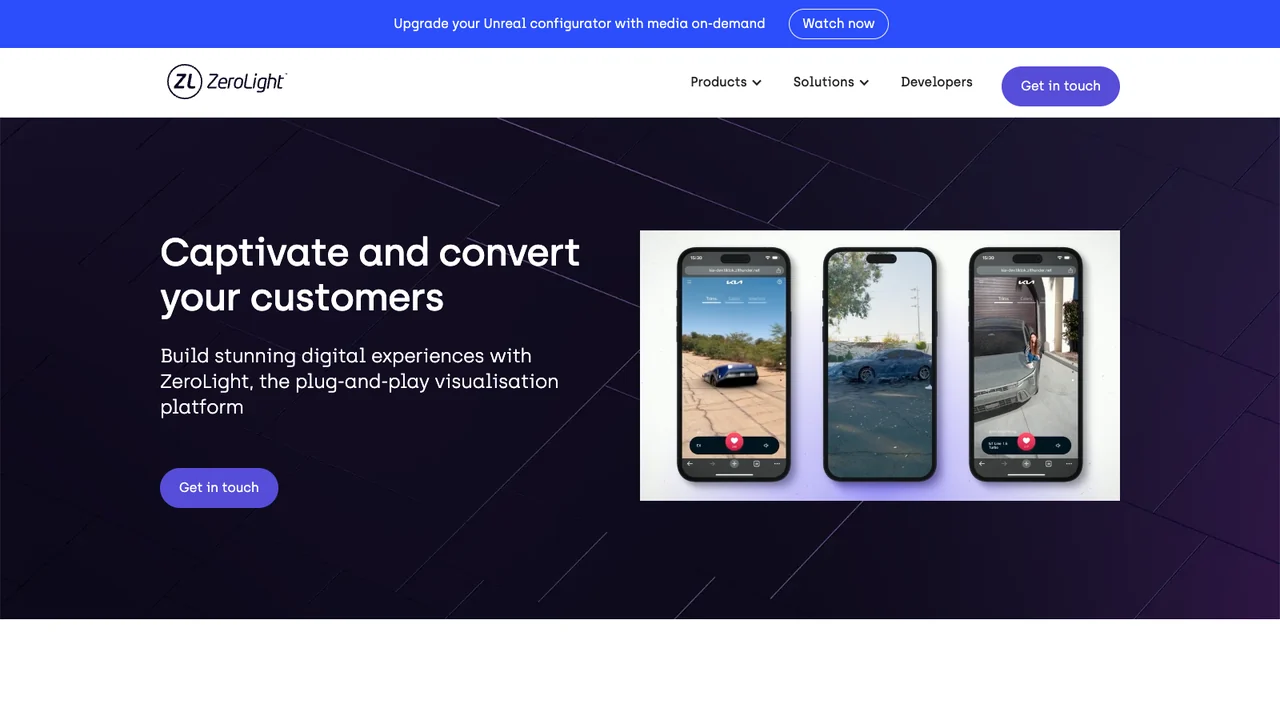
ZeroLight publishes a plug-and-play visualization platform whose architecture directly addresses the fidelity problem that customization creates.
Its OmniStream product streams ZeroLight, Unreal, Unity, VRED and Windows applications from the cloud as an enterprise standard, and Palette SDK provides plug-and-play APIs for integrating and enriching a cloud-based configurator with advanced features, 3D streaming, omnichannel buying journeys, insights and personalization.
Streaming matters more in customization than anywhere else in retail, and the reason is specific. When a customer approves a finish, they are approving what they see, and what they see is whatever their device could render. Device-based rendering means a customer on a five-year-old phone sees a flatter, simpler version of the material than a customer on a new laptop, and both believe they have seen the product. Streaming renders once on a server, so everyone approves the same image, and that image can be the same asset quality the brand uses in advertising.
Its published support for VRED points at automotive specifically, since VRED is design visualization software used by vehicle manufacturers, and its invitation to upgrade an existing Unreal configurator points at organizations that already hold real-time assets.
Its published emphasis on insights and personalization alongside omnichannel buying journeys indicates the configurator is treated as part of a sales funnel rather than as a standalone toy, which is the right framing for high-value goods where the online session precedes a dealer or showroom visit.
The economics are the caveat. Per-session cloud rendering suits considered purchases and does not suit high-traffic low-value catalogs. It publishes no founding year, headquarters address, team size, named clients or rates. Best for premium products where the finish is the purchase.
3. Kaon Interactive
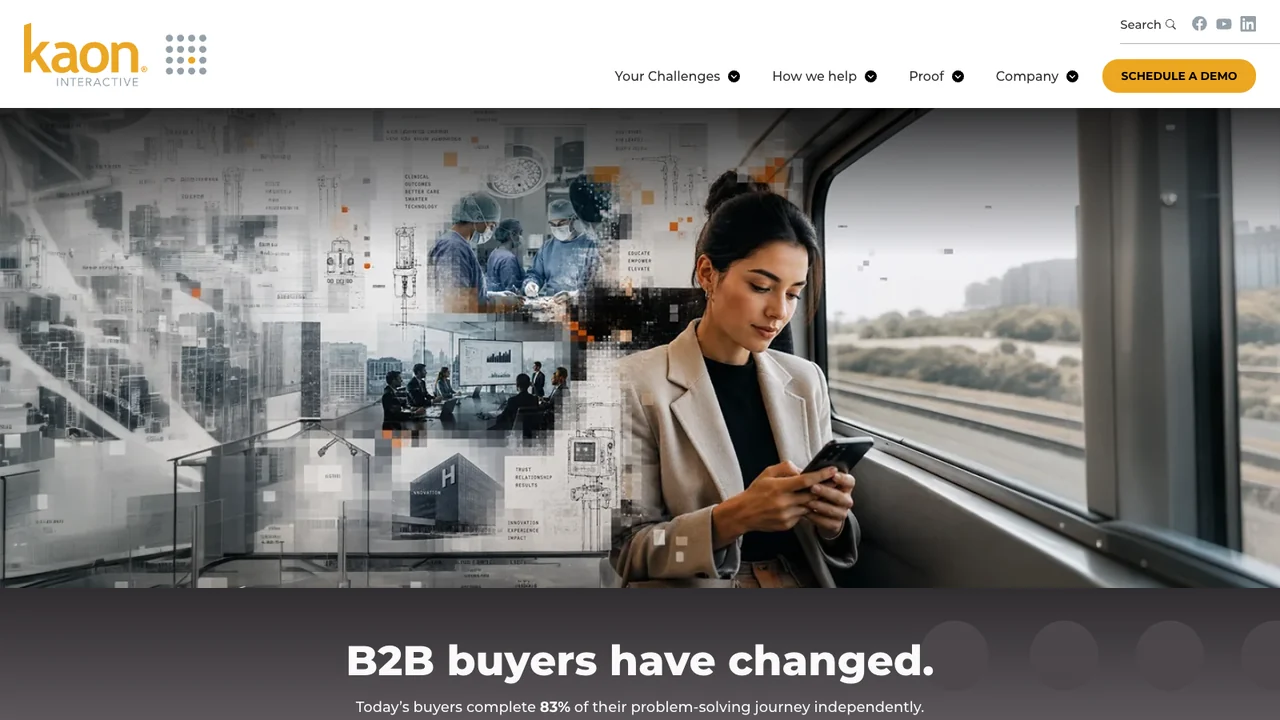
Kaon Interactive builds digital customer engagement for B2B, framed around buyers completing 83 percent of their problem-solving journey independently and the difficulty of telling a complex product story when your team is not present.
On a retail customization list it is the outlier, and understanding why clarifies the rest. Its stated industries are Life Science, Information Technology and Industrial Manufacturing, and its buyers are Marketing Leaders, Sales Enablement and C-Suite and Revenue Leaders. Nobody in those categories is personalising a consumer product. They are specifying equipment.
Specification and customization are the same activity with different stakes. A customer selecting modules, capacities and options for a laboratory instrument or a data center configuration is customizing, but the output is a proposal rather than a basket, the process involves a specialist, and the constraints are technical rather than aesthetic.
Its published tools reflect that: 3D Product Tours, Demo360, Kaon v-Draw, a Design Tool, B2B Augmented Reality and B2B Virtual Reality, inside a content experience platform with collaboration tools. v-Draw and the Design Tool support building a solution with a customer rather than for one, which is how complex equipment is actually sold.
For a consumer retailer this is the wrong supplier, and its own positioning says so clearly. For a manufacturer whose products are configured in conversation rather than in a checkout, it is aimed precisely at that. It publishes case studies and buyer engagement resources but no founding year, headquarters address, team size, production integrations or rates. Best for B2B specification rather than consumer personalization.
4. Hapticmedia
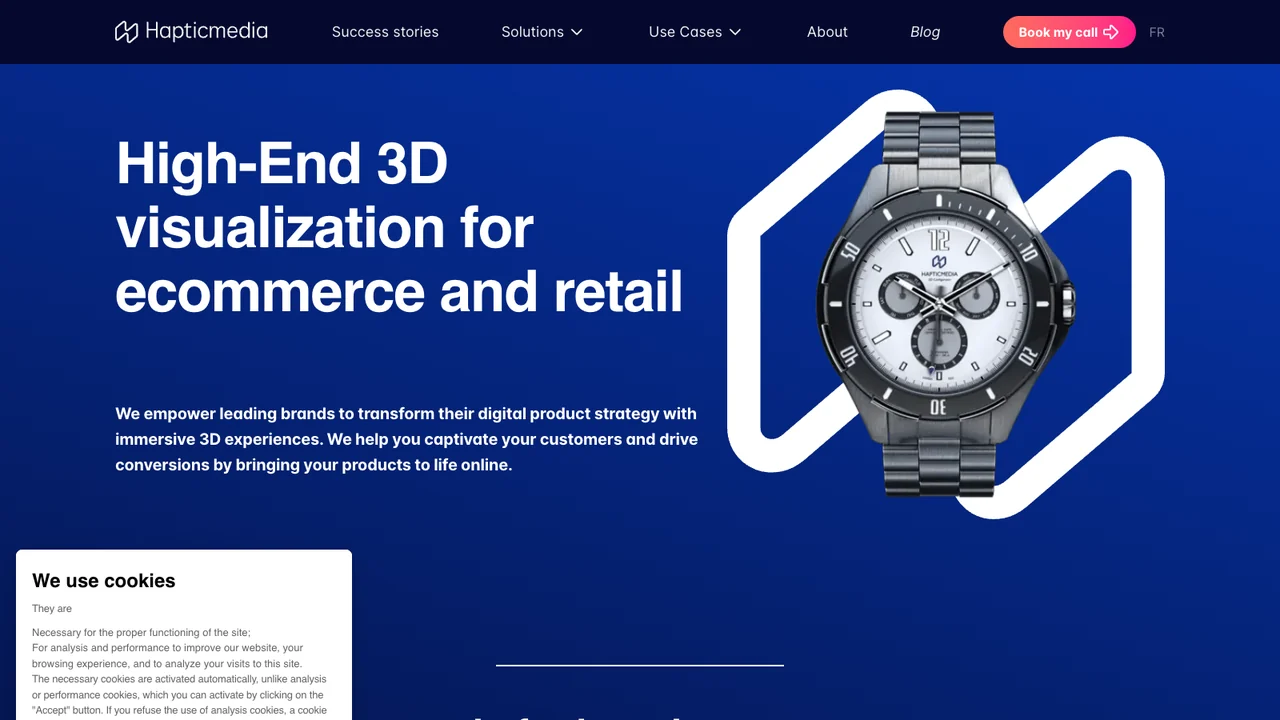
Hapticmedia publishes high-end 3D visualization for ecommerce and retail, stating that it empowers leading brands to transform their digital product strategy with immersive 3D experiences and bring products to life online.
Its published framing of the problem is the most commercially honest in this list, and worth quoting for what it targets. It asks whether product pages are costing conversions through poor clarity and weak impact, whether high return rates are eating margins because customers cannot truly understand products, and whether complex products create purchase anxiety that kills online sales.
Those three questions name the actual business case for customization visuals better than any feature list. Returns driven by misunderstanding are a margin problem with a measurable size. Purchase anxiety on complex or expensive items is why high-value goods under-convert online relative to stores. Both are addressable by showing the product properly, and both can be measured before and after.
Its stated focus areas are Luxury, Manufacturing and Retail experience, and its published services center on 3D ecommerce, adding 3D experiences to a store, and developing customer experiences through 3D products and digital innovation. Luxury is the category where this argument is strongest: a customer choosing a case material, dial and strap is making a decision entirely on appearance, at a price where a return is expensive for everyone.
It publishes success stories, solutions, use cases and a blog, and invites contact with a 3D expert or digital strategist, which indicates a service-led engagement rather than self-service. It publishes no founding year, headquarters address, team size, named clients, integrations or rates on the pages reviewed. Best for luxury and considered goods where finish and material carry the sale.
5. Expivi
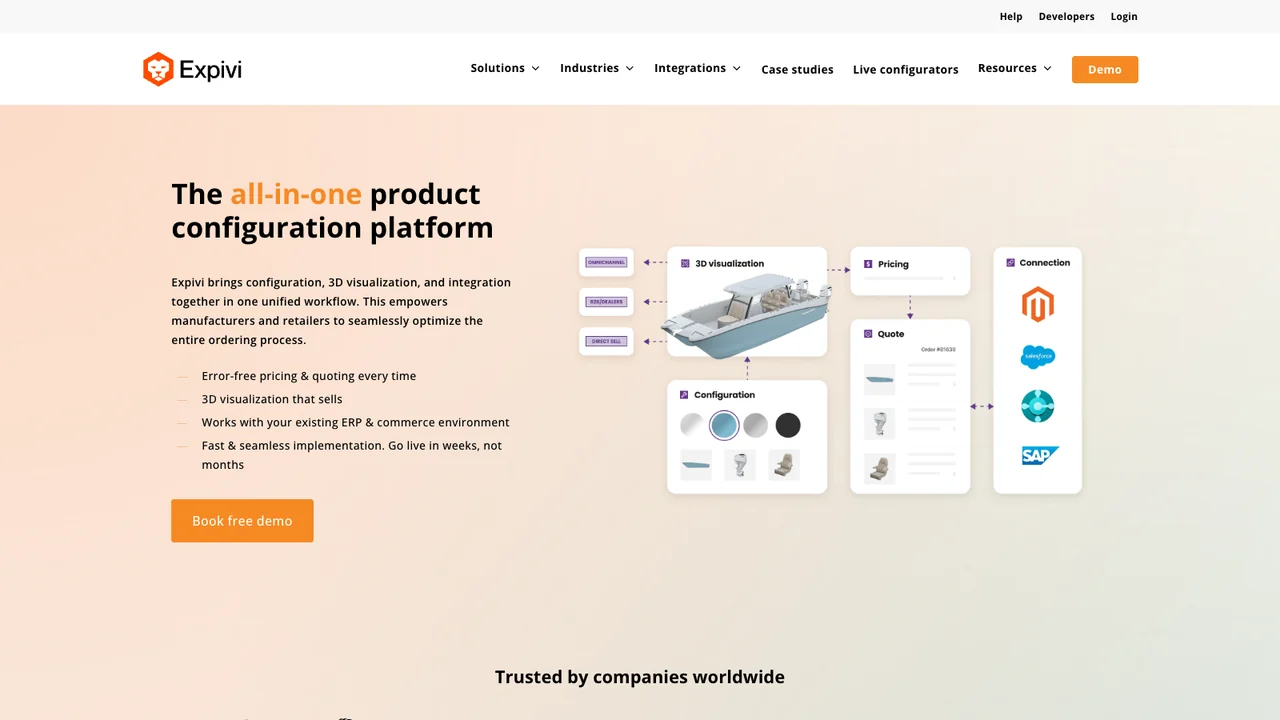
Expivi publishes an all-in-one product configuration platform bringing configuration, 3D visualization and integration into one workflow, and it is the entry that addresses what happens after the customer has finished customizing.
Its published features are a 3D product configurator, Visual CPQ, Design to print, Guided selling and a Modular configurator. Design to print is the one that matters most for retail personalization and the one most often missing elsewhere. Personalised goods frequently carry printed or engraved elements, and the customer's design has to reach production as artwork that can actually be output, at the right resolution, in the right position, with the right color profile. A preview that looks correct and produces an unusable print file has solved nothing.
Its published integrations are the broadest here: an API, WordPress, Magento, Shopify, SAP, Shopware, Sana Commerce and Salesforce. For a retailer that means personalised orders can reach both the commerce system and the systems that run production and fulfillment, which is the operational half that determines whether a customization program scales past its launch.
Its stated industries are Furniture, Sporting Goods, Construction and outdoor, Jewelry and fashion, Merchandise, Workwear, Mobility and Printing. Jewelry and fashion, merchandise and workwear are all high-personalization retail categories, and workwear in particular is a volume business built entirely on customization with logos and sizing.
Guided selling is worth noting for retail specifically, since customers presented with unlimited options frequently choose nothing, and a guided path through the choices addresses the paralysis that open-ended customization creates.
It publishes case studies, live configurators, developer documentation and a partner program, but no founding year, headquarters address, team size or rates. Best for retailers whose personalised orders must reach production cleanly.
What retail customization programs have to account for
Four things decide whether customization makes money rather than work.
The first is involving operations before launch. Customization removes stock and replaces it with lead time, and the people who absorb that are manufacturing and fulfillment. A program designed entirely by marketing tends to discover its constraints during its first peak trading period, which is the worst possible moment.
The second is color and material accuracy. The customer approves what they see, so if the delivered finish does not match the render, the return is deserved. Ask how color is managed end to end, and validate by producing physical samples of the trickiest finishes and comparing them against the screen on several devices.
The third is what production receives. Ask to see the artefact that reaches manufacturing from a completed customization, and whether anyone re-keys it. Expivi's Design to print addresses this for printed personalization, and it is the step where errors become physical goods.
The fourth is choice architecture. Unlimited options reduce conversion, because customers who cannot decide leave. Guided paths, curated presets and sensible defaults consistently outperform a blank canvas, and Expivi publishes guided selling for this reason. Design the decision, not just the renderer.
How to choose between these retail customization companies
Start from what the customization produces. If it becomes a manufacturing or print order, Expivi's Visual CPQ, Design to print and SAP and Salesforce integrations are the shortest route. If it is a high-value purchase where the finish is the decision, ZeroLight's streamed fidelity means every customer approves the same image. If the goods are luxury and the case rests on clarity and returns, Hapticmedia frames the problem exactly that way.
If your buyer is a specialist configuring complex equipment rather than a shopper, Kaon Interactive is built for that conversation. If the personalization logic is genuinely unusual or must live in your own systems, Treeview builds it and transfers ownership.
Validate fidelity physically before committing. Produce samples of your hardest finishes, compare them against the rendered version on a range of devices, and decide whether device-based rendering is good enough or whether streaming is warranted. This is a cheap test that prevents an expensive returns problem.
Finally, model the operational load honestly. Work out what happens when personalised orders arrive at ten times the pilot volume, and confirm production and fulfillment can absorb it before the marketing campaign that creates it.
Related reading. BestInXR's retail AR and VR guide covers the catalog arithmetic behind every retail program. companies for custom 3D product configurators covers the rules and integration layer, and AR companies for furniture and home goods placement covers configurable furniture. For asset supply see AR companies for product visualization, and for online retail, AR development companies for ecommerce.
Frequently Asked Questions (FAQ)
1. What does customization do to retail operations?
It removes stock and replaces it with lead time, because nothing is made until someone orders. That burden lands on manufacturing and fulfillment rather than on marketing, which is why customization programs designed without operations tend to fail at their first peak period rather than at launch.
2. Why does rendering fidelity matter more here?
Because the customer approves a finish from a screen and then receives the physical item. If they do not match, the return is justified. Device-based rendering means different customers approve different-looking images. ZeroLight's OmniStream renders on a server so everyone sees the same thing.
3. What reaches production after a customer customizes something?
Whatever you specify, and it should be checked. Expivi publishes Design to print for personalization that must become artwork, and integrations with SAP and Salesforce. Ask to see the actual artefact manufacturing receives, and whether anyone re-keys it, since that step turns errors into physical goods.
4. Does more choice sell more?
Generally not. Unlimited options create decision paralysis and customers leave, which is why guided paths, presets and defaults tend to outperform a blank canvas. Expivi publishes guided selling for this reason. Design the decision path deliberately rather than exposing every possible combination.
5. Which of these serve consumer retail rather than B2B?
Hapticmedia publishes Luxury and Retail experience focus, and Expivi publishes Jewelry and fashion, Merchandise and Workwear among its industries. ZeroLight is premium and automotive. Kaon Interactive is explicitly B2B, serving Life Science, Information Technology and Industrial Manufacturing, and is the wrong fit for consumer personalization.
6. What does retail customization cost?
None of the five publishes rates, so no figure is recorded here. Cost is driven by the number of customizable attributes, rendering approach and traffic, integration with commerce and production systems, and asset creation for every material and finish. Operational change in fulfillment is the cost most often left out entirely.