A human digital twin is a computational model of a person or a population, used to predict how a body will respond before anything is tried on a real one. It has almost nothing in common with the industrial twins that share the name, and the companies building it are simulation and clinical science firms rather than XR studios.
In short:
- Treeview builds custom XR to specification and transfers full ownership of IP, source code and assets, and its named clients include Medtronic and Daiichi Sankyo
- Virtonomy publishes v-Patients, digital patient twins built on a database of real clinical data covering anatomical variability, demographic diversity and pathological conditions
- Dassault Systemes frames a virtual twin as simulating behavior and evolution rather than mirroring an object, with a published Life Sciences and Healthcare line
- Unlearn.AI applies patient digital twins to clinical trials and states a 33 percent control arm size reduction, with a published AbbVie case study
How this list was built
This list ranks companies by four criteria: whether they model a human body rather than a machine or a building, what the twin is used to decide, published clinical or regulatory evidence, and who the buyer is.
The first thing to settle is what this category actually is, because the phrase digital twin has been stretched to cover very different things. An industrial twin represents a machine or a facility, is fed by sensors, and answers questions about the asset's current state. A human digital twin represents a body, is built from clinical and anatomical data, and answers questions about how that body would respond to an intervention that has not happened.
That difference is not one of subject matter but of purpose. An industrial twin mostly reports. A human twin mostly predicts, and it is judged on whether its predictions hold. That single distinction rules out most of the companies that appear on digital twin lists, including nearly all of the XR studios, and it is why this list is populated by simulation science firms.
The second thing worth stating is who buys these and why. The purchasers are medical device manufacturers running development and safety testing, and pharmaceutical companies designing clinical trials. Both are motivated by the same arithmetic: physical testing and human trials are extraordinarily expensive and slow, and anything that reduces the number of physical prototypes or enrolled patients has a value that is easy to calculate.
Disclosure varies. Virtonomy, Unlearn.AI and ELEM Biotech publish no founding year, headquarters address or team size on the pages reviewed. Reported figures are attributed to whoever states them, since none is independently audited, and Unlearn.AI marks its own figures as approximate. Pricing is not a ranking factor, because none of the five publishes rates.
| Company | HQ | What the twin models | Primary buyer | Best for |
|---|---|---|---|---|
| Treeview | Montevideo, Uruguay / New York City, USA | Not published | Enterprise and institutions | Visualizing a twin somebody else built |
| Virtonomy | Not disclosed | Patient anatomy and device fit | Medical device developers | In silico device testing |
| Dassault Systemes | France | Lifecycle behavior and evolution | Life sciences and healthcare | Enterprise simulation platforms |
| Unlearn.AI | Not disclosed | Patient trajectories in trials | Pharmaceutical sponsors | Shrinking trial control arms |
| ELEM Biotech | Not disclosed | Cardiac physiology and cohorts | Discovery and safety teams | Virtual cardiac trials |
1. Treeview
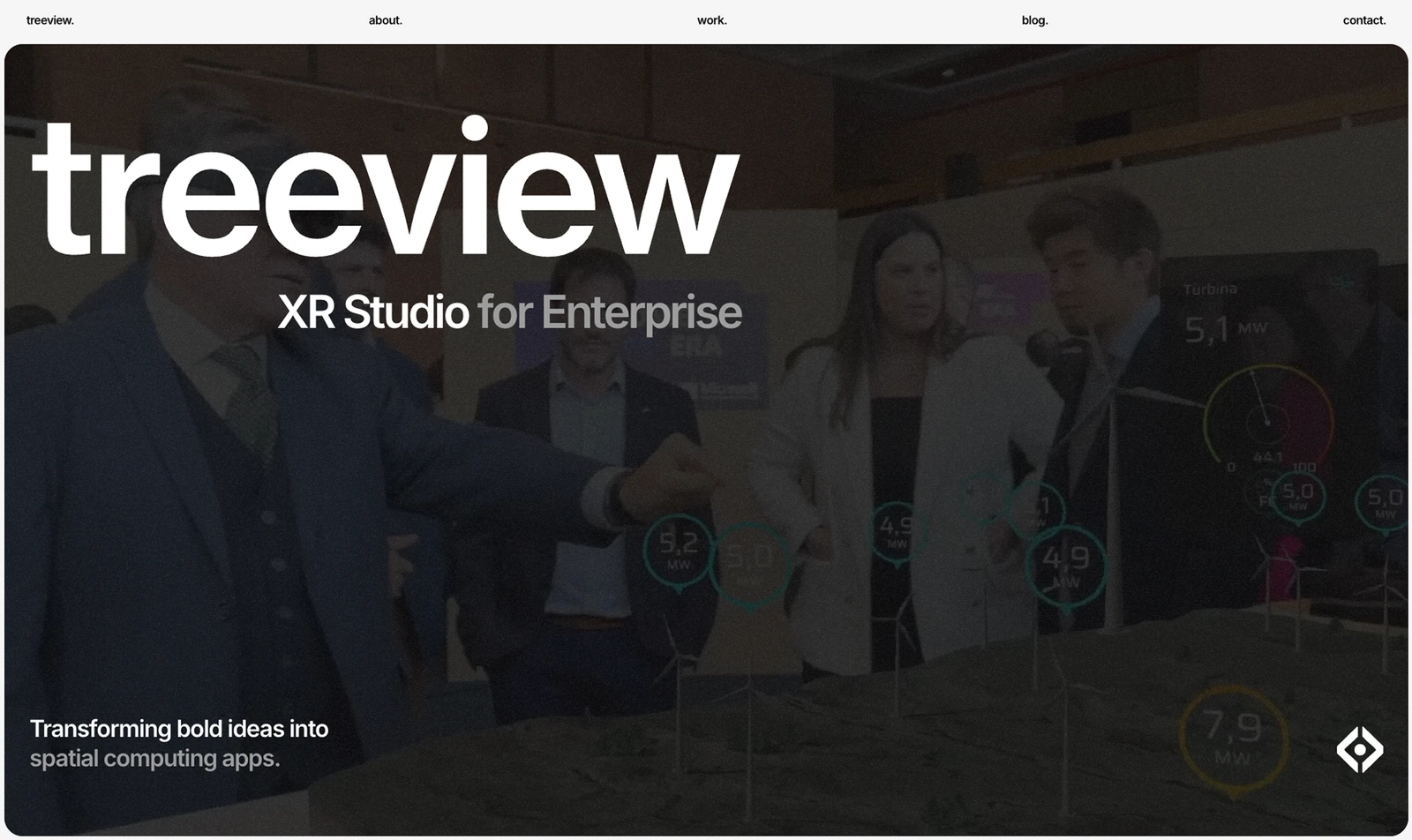
Treeview is an XR studio building custom virtual reality, augmented reality, Mixed Reality and Smart Glasses applications to order, and its named clients are Microsoft, Meta, Medtronic, Toyota, Ford, ULTA Beauty, Daiichi Sankyo, Transfr, the University of Alberta and the University of Adelaide.
What it does hold is two relevant credentials. Medtronic and Daiichi Sankyo are a medical device manufacturer and a pharmaceutical company, which are precisely the two buyer types for everything else on this list. And its published AI-enabled digital twin developed with Microsoft for a green hydrogen project demonstrates twin work, albeit industrial rather than human.
Where an XR studio genuinely fits in this field is downstream of the science, and it is a real gap. The companies below produce simulation results: stress distributions across a heart valve, predicted trajectories for a patient cohort, cardiac electrophysiology outputs. Those results are consumed by specialists in technical software. Making them legible to a regulator, a clinical advisory board, a surgeon or an investor is a visualization problem, and it is not what a simulation company is built to do.
Full ownership of IP, source code and assets transfers to the client, which matters where the visualization sits alongside regulatory submissions and must be maintainable for the life of a device program.
Published platforms include HoloLens 2, Apple Vision Pro and Meta Quest, plus iOS and Android, on Unity and Unreal Engine. Founded in 2016 by chief executive Horacio Torrendell, it works from Montevideo, Uruguay and New York City. Team size, rates, and any physiological modeling, simulation or regulatory capability are not published, and it should not be shortlisted to build the twin itself. Best for making somebody else's simulation results comprehensible.
2. Virtonomy
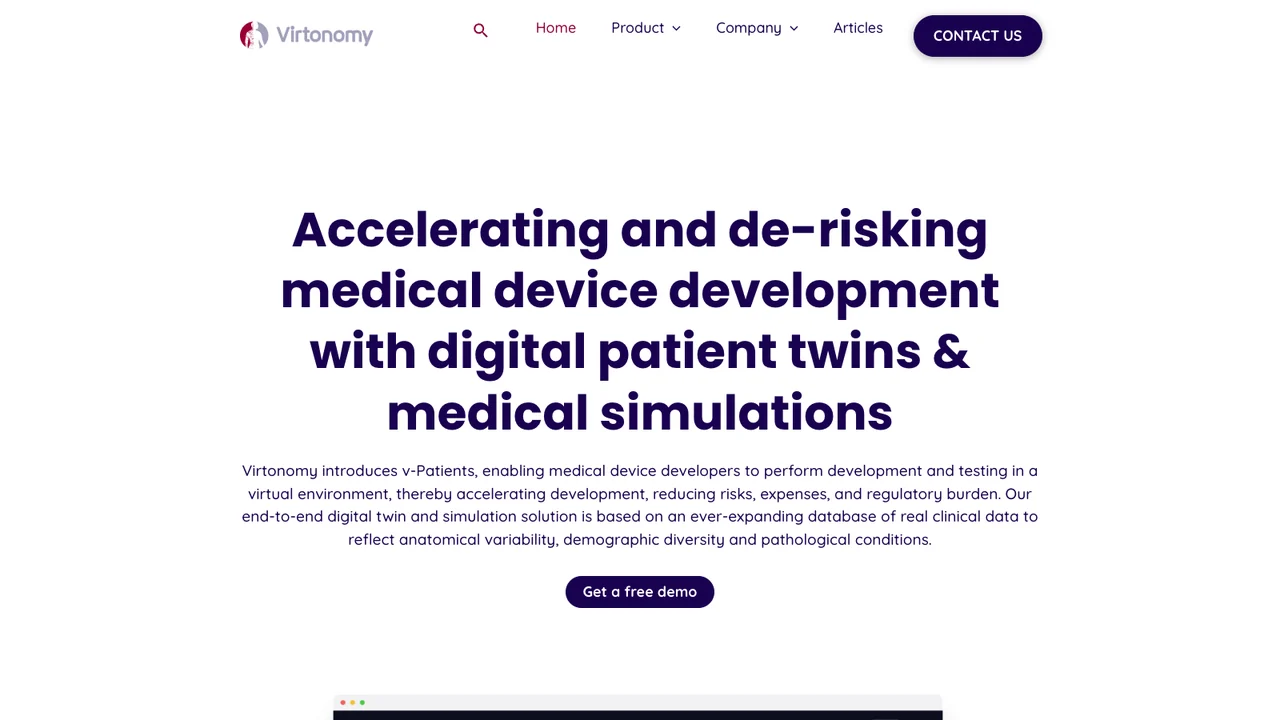
Virtonomy publishes data-driven clinical trials on virtual patients, and it is the most precisely on-topic entry in this list. Its stated purpose is accelerating and de-risking medical device development with digital patient twins and medical simulations.
Its published product is v-Patients, which it describes as enabling medical device developers to perform development and testing in a virtual environment, thereby accelerating development and reducing risks, expenses and regulatory burden. The regulatory burden claim is the significant one, because it points at where this technology has genuine institutional traction: regulators have become receptive to computational evidence supplementing physical and clinical testing, and a device program that can substitute simulation for some bench testing saves both time and money.
Its stated foundation is an ever-expanding database of real clinical data reflecting anatomical variability, demographic diversity and pathological conditions. That sentence contains the hardest problem in this field. A twin built from one idealised anatomy tells you how a device performs in a patient who does not exist. Real populations vary enormously in anatomy, and the value of a virtual cohort lies in covering that variation, including the outliers where devices actually fail.
Its published device coverage is specific. For heart valves, it describes anticipating anatomical and positional changes during the cardiac cycle to significantly reduce the risk of implant failure. For total artificial hearts and heart assist devices, it describes simulating blood flow dynamics and anatomical variations. Both are cardiovascular, high-risk and expensive to test physically, which is exactly where in silico methods pay first.
It publishes how it works, use cases, simulation features, founders and events sections, and offers a free demo. It publishes no founding year, headquarters address, team size, named clients or rates on the pages reviewed. Best for medical device developers testing designs against anatomical variation.
3. Dassault Systemes

Dassault Systemes is a listed software vendor rather than a specialist twin company, and it publishes the most developed conceptual framework in this field alongside a named Life Sciences and Healthcare line.
Its published distinction is that a virtual twin goes beyond a digital twin by not only mirroring physical objects but also simulating their behavior and evolution in real time. Applied to a body, that is the whole proposition: a static anatomical model is a picture, and a model that simulates how tissue behaves under load or how a system evolves over time is a predictive instrument.
Its published Life Sciences and Healthcare section describes advancing patient care, research and medical innovation with virtual twin technology, and its wider framing covers the full lifecycle from a 3D model capturing shape, dimensions and properties, through simulations that optimize design and materials while documenting decisions for traceability.
Traceability is the word worth noticing for anyone working toward a regulatory submission. Simulation evidence is only useful to a regulator if the chain from model to result to decision is documented and reproducible, and a platform that treats decision documentation as a first-class feature is aligned with how this evidence has to be presented.
Its as-designed, as-made and as-used framing also transfers usefully to medicine, where the equivalent distinction is between an idealised anatomy, a specific patient's anatomy, and how that anatomy changes over time under treatment.
The caveats are those of any large platform vendor. This is a broad portfolio rather than a human twin product, implementation typically runs through partners, and committing means committing to an ecosystem. As a listed company it publishes quarterly results, so its finances can be read before a long engagement. It publishes no rates for this work. Best for organizations wanting simulation capability across an enterprise rather than a single application.
4. Unlearn.AI
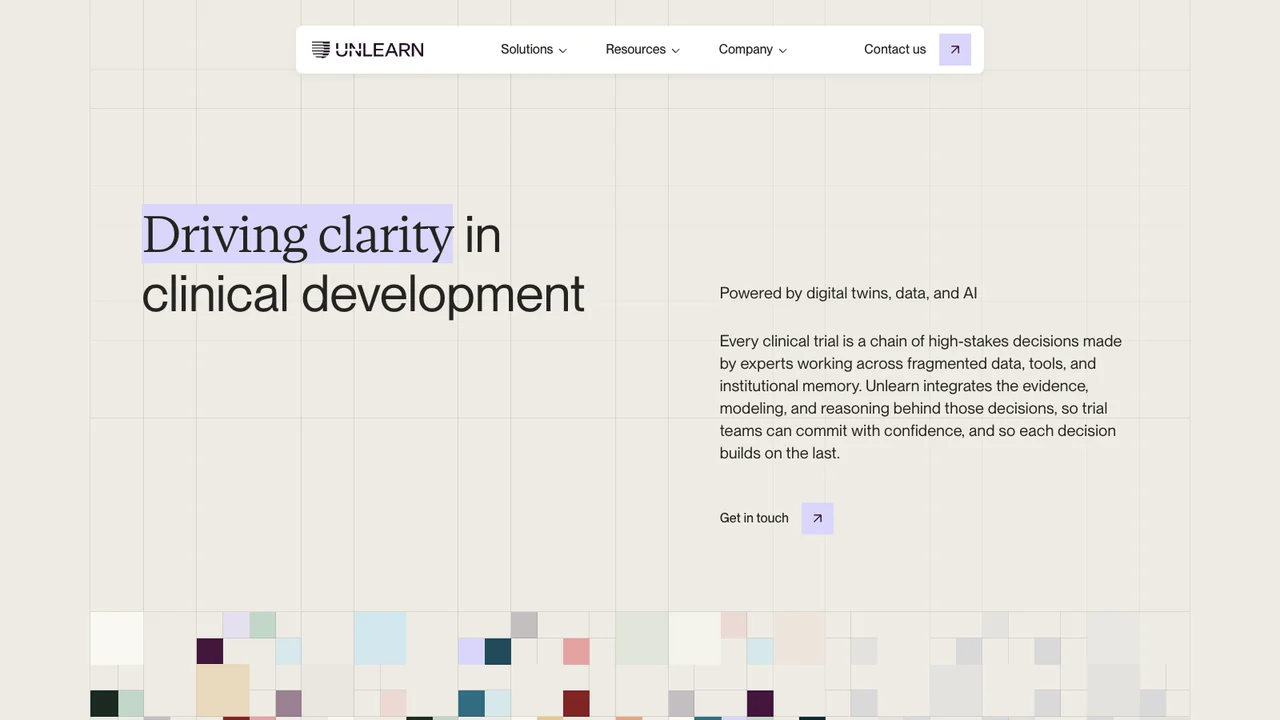
Unlearn.AI applies digital twins of patients to clinical development, and it is the entry here whose value is measured in trial economics rather than in engineering.
Its published approach is creating digital twins of trial participants, so that a patient's likely trajectory under control conditions can be predicted rather than observed. That allows a smaller control arm, because some of the control information comes from the model rather than from enrolled people. Its published figures state a 33 percent control arm size reduction and 4 or more months of enrollment time saved, both marked as approximate values by the company itself.
If those figures hold, the implications are substantial and not only commercial. A smaller control arm means fewer participants receiving placebo in a trial of a potentially effective treatment, which is an ethical argument as much as an economic one, and it is the reason regulators and ethics committees have engaged with the method rather than dismissed it.
Its published platform is organized around decisions rather than features, with Plan, Monitor and Analyze as connected stages, framed around trials being a chain of high-stakes decisions made across fragmented data, tools and institutional memory. That framing is unusually honest about where trial risk actually sits.
Its published therapeutic areas are neuroscience, immunology and metabolic disease, with a highlighted case study on accelerating clinical development in Alzheimer's disease and a named AbbVie case study. Alzheimer's is a shrewd published focus, since trials in that area are famously long, large and expensive, which is where control arm reduction is worth the most.
It publishes Evidence and Research sections alongside its blog, which is the appropriate posture for a company whose method must satisfy statisticians and regulators. It publishes no founding year, headquarters address, team size or rates on the pages reviewed. Best for pharmaceutical sponsors seeking smaller or faster trials.
5. ELEM Biotech
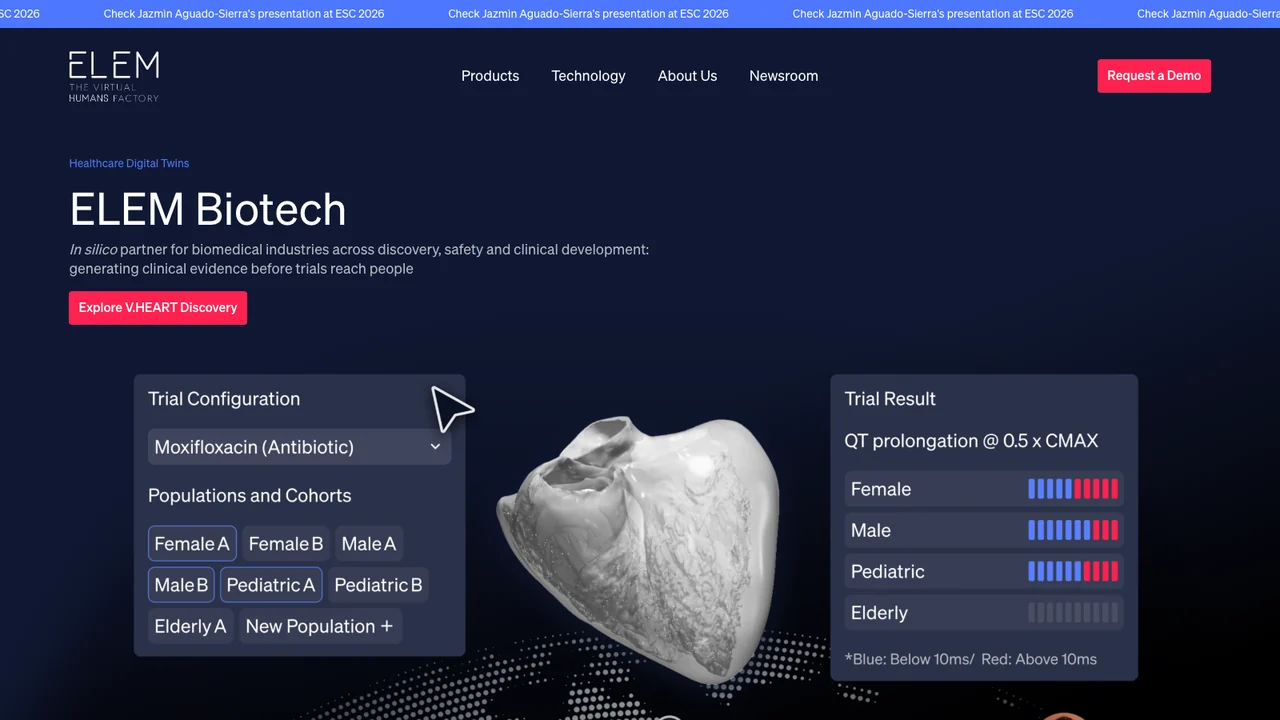
ELEM Biotech publishes healthcare digital twins and describes itself as an in silico partner for biomedical industries across discovery, safety and clinical development, with a published focus on cardiac work.
Its products are V.HEART Trials, described as configuring, running and analyzing virtual clinical trials on the cloud, and V.HEART Discovery, described as selecting candidates with human QT prolongation. The second is narrower and more revealing than it looks. QT prolongation is a cardiac electrophysiology effect that can cause fatal arrhythmias, and screening for it is a mandatory safety hurdle for a great many drug candidates. A company offering to predict it computationally is targeting one of the most expensive and consequential gates in drug development.
Its published trial configuration interface shows populations and cohorts spanning female, male, paediatric and elderly groups. That cohort structure is the substantive point. Cardiac risk differs markedly between demographic groups, and paediatric and elderly populations are systematically under-represented in physical trials for practical and ethical reasons. A virtual cohort can include them, which addresses a real and long-standing gap rather than merely reproducing a conventional trial faster.
Cloud delivery matters here more than it might elsewhere. Cardiac electrophysiology simulation is computationally demanding, historically the domain of institutions with substantial high-performance computing, and delivering it as a cloud service puts it within reach of organizations that could not otherwise attempt it.
It publishes a Technology section, a newsroom and conference activity including a presentation at the European Society of Cardiology, which indicates engagement with the clinical scientific community rather than only with industry. It publishes no founding year, headquarters address, team size, named clients or rates on the pages reviewed, and its published scope is cardiac rather than whole-body. Best for cardiac safety and virtual trial work in discovery and development.
What human twin projects have to account for
Four things determine whether a human digital twin program produces evidence anyone accepts.
The first is regulatory acceptance, and it should be established before the modeling rather than after. Computational evidence is used in device and drug submissions, but what counts, how it must be validated and how it is documented depends on the regulator and the specific claim. Ask any supplier which submissions their work has supported and in which jurisdictions.
The second is population coverage. A twin built on idealised or narrow anatomy predicts performance in patients who may not resemble yours. Virtonomy publishes a database reflecting anatomical variability, demographic diversity and pathological conditions, and ELEM Biotech publishes paediatric and elderly cohorts. Ask specifically which populations are represented and which are not, because the gaps are where devices fail.
The third is validation against reality. A model is a hypothesis until it is checked against physical bench data or clinical outcomes. Establish what the model has been validated against, by whom, and what the agreement was. Without that, simulation output is a confident number with no standing.
The fourth is who interprets the result. Simulation produces output that requires expertise to read correctly, and the risk in this field is a decision made from a compelling visualization by someone who does not understand its assumptions or error bounds. Decide who is qualified to interpret and what is documented alongside every result.
How to choose between these human digital twin companies
Start from what you are trying to decide. Testing whether a device performs across the range of real anatomies points to Virtonomy and its v-Patients. Reducing the size or duration of a clinical trial points to Unlearn.AI. Screening candidates for cardiac safety, or running virtual cardiac trials with cohorts you cannot recruit physically, points to ELEM Biotech. Building broad simulation capability across an enterprise points to Dassault Systemes.
None of those is an XR purchase, and that is the most useful thing this list can tell you. Treeview belongs here only for the layer above: making simulation output comprehensible to people who are not simulation specialists, which is a real need and a different contract.
Ask about regulatory precedent early and specifically. The value of this technology depends on whether its output is accepted by the body that governs your product, and a supplier with submissions behind it is in a materially different position from one with a compelling method and no precedent.
Finally, establish validation before you rely on a result. Every company here is selling prediction, and prediction is only worth what its track record against reality says it is worth.
Related reading. BestInXR's digital twins guide covers what separates a twin from a model or a shadow. companies for custom digital twin development covers industrial twins, and companies for digital twin data visualization covers making simulation output legible. For healthcare XR see AR and VR development companies for healthcare, and for medical simulation, companies for custom medical simulation in VR.
Frequently Asked Questions (FAQ)
1. What is a human digital twin?
A computational model of a person or population, built from clinical and anatomical data, used to predict how a body would respond to an intervention that has not happened. It differs from an industrial twin in purpose: industrial twins mostly report current state, human twins mostly predict, and are judged on whether predictions hold.
2. Are these XR companies?
No, and that is the most useful correction this list offers. The companies genuinely building human twins are simulation and clinical science firms. XR appears only in the layer above, making simulation output legible to non-specialists. A shortlist of XR studios for this work would contain no one who can do it.
3. Do regulators accept simulation evidence?
Computational evidence is used in device and drug submissions, but what is acceptable depends on the regulator, the claim and the validation behind it, and none of the five publishes a general answer. Virtonomy states that its approach reduces regulatory burden. Ask which submissions a supplier's work has supported and where.
4. How is a virtual patient population built?
From real clinical data covering anatomical and demographic variation. Virtonomy publishes a database reflecting anatomical variability, demographic diversity and pathological conditions. ELEM Biotech publishes cohorts spanning female, male, paediatric and elderly groups. Coverage of outlier anatomies is where the value sits, since that is where devices fail.
5. Can this really shrink a clinical trial?
Unlearn.AI states a 33 percent control arm size reduction and 4 or more months of enrollment time saved, marking both as approximate. Those are company-stated rather than audited. The ethical corollary is fewer participants on placebo, which is part of why the method has been engaged with rather than dismissed.
6. What does human digital twin work cost?
None of the five publishes rates, so no figure is recorded here. Cost is driven by the anatomical or physiological scope, how many populations are represented, validation work against physical or clinical data, and any regulatory documentation required. Validation is the line most often underestimated.