Best VR Companies for Rehabilitation and Physical Therapy
VR rehabilitation suppliers sit at four different points on the regulatory ladder, and the words used to describe them are routinely interchanged. FDA registered, cleared, authorized and approved mean four different things, and only one company on this list holds a De Novo authorization. This list ranks five suppliers by what each has actually shipped and what regulatory status it actually holds.
In short:
- Registered is not cleared. Registering a device with the FDA is a listing step. It is not a review of safety or effectiveness, and several suppliers in this market are described as cleared when their own sites say registered.
- AppliedVR holds the only De Novo authorization here, granted November 2021 for RelieVRx, a prescription VR therapeutic for chronic lower back pain.
- Penumbra is absent because it exited. The company permanently ceased sales of its immersive healthcare products in the third quarter of 2024 and took $115.3 million in impairment charges.
- Clinical evidence and regulatory status are different things. A supplier can hold a published trial and no FDA status, or a registration and no trial.
How this list was built
This list ranks companies by four criteria: the regulatory status each supplier actually holds, published clinical evidence, what the product does at the point of care, and who operates it in practice.
Regulatory status is weighted first because it is the criterion most often misstated in this market, and because the four terms are legally distinct. Registration means a company has listed itself and its device with the FDA. It involves no review of safety or effectiveness. Clearance is the 510(k) route and means a device was found substantially equivalent to one already on the market. Authorization through the De Novo pathway means the FDA reviewed a novel device and created a new classification for it. Approval is the premarket approval route and is the highest bar. A list that calls all four "FDA-approved" tells a buyer nothing.
Clinical evidence is assessed separately, because the two do not travel together. A supplier may publish a randomised trial and hold no FDA status at all, which is a legitimate position and a different one from holding a registration and publishing nothing.
Pricing is not a ranking factor, because none of the five publishes rates. Headcount and project counts are not ranking factors, because the figures available for this market come from self-reported directory profiles that nobody audits. Where a fact could not be confirmed from the supplier's own documentation, a regulator or a published study, it is recorded as Not disclosed rather than estimated.
| Company | What it supplies | Regulatory status, as stated by the company or regulator | Best for |
|---|---|---|---|
| Treeview | Custom XR built to specification | None claimed; builds to the client's regulatory pathway | A protocol no off-the-shelf platform covers |
| AppliedVR | RelieVRx, a prescription VR therapeutic | FDA De Novo authorization, November 2021 | Chronic lower back pain, in-home and prescribed |
| XRHealth | Devices, apps and licensed clinical care | FDA-registered devices; acquired Swing Therapeutics and its FDA-authorized Stanza | A managed service rather than a product |
| Neuro Rehab VR | Smart Therapy, a clinic-deployed platform | States FDA-registered and HIPAA-compliant | Hospitals, outpatient clinics and skilled nursing |
| Firsthand Technology | VR pain and wellness software, plus consulting | None claimed | Pain management with a published hospital study |
1. Treeview
Treeview builds custom XR applications to a client's specification rather than licensing a rehabilitation catalog, which places it in a different purchase category from the other four. Where a therapy protocol is specific to one institution, or where an existing platform does not cover the condition, a commissioned build is the only route, and this is the segment it serves. BestInXR's healthcare guide sets out why custom and catalog are different purchases with different budgets.

The company names Medtronic among its clients and publishes full transfer of IP, source code and assets at handover, which is the clearest ownership position among the suppliers reviewed across BestInXR's healthcare lists. That matters more in rehabilitation than in most segments, because therapy content tied to a protocol has to be maintainable when the protocol is revised. Treeview claims no FDA status, which is consistent with a custom studio: the regulatory pathway belongs to the client commissioning the work. Best for an institution with a protocol that no licensed platform covers, and the capacity to own what results.
2. AppliedVR
AppliedVR holds the only De Novo authorization on this list. RelieVRx, originally named EaseVRx, received FDA De Novo authorization in November 2021 as the first VR-based prescription therapeutic for chronic lower back pain, having previously received Breakthrough Device Designation. It is a self-guided eight-week in-home program combining pain education, breathing training, mindfulness and cognitive behavioral techniques.
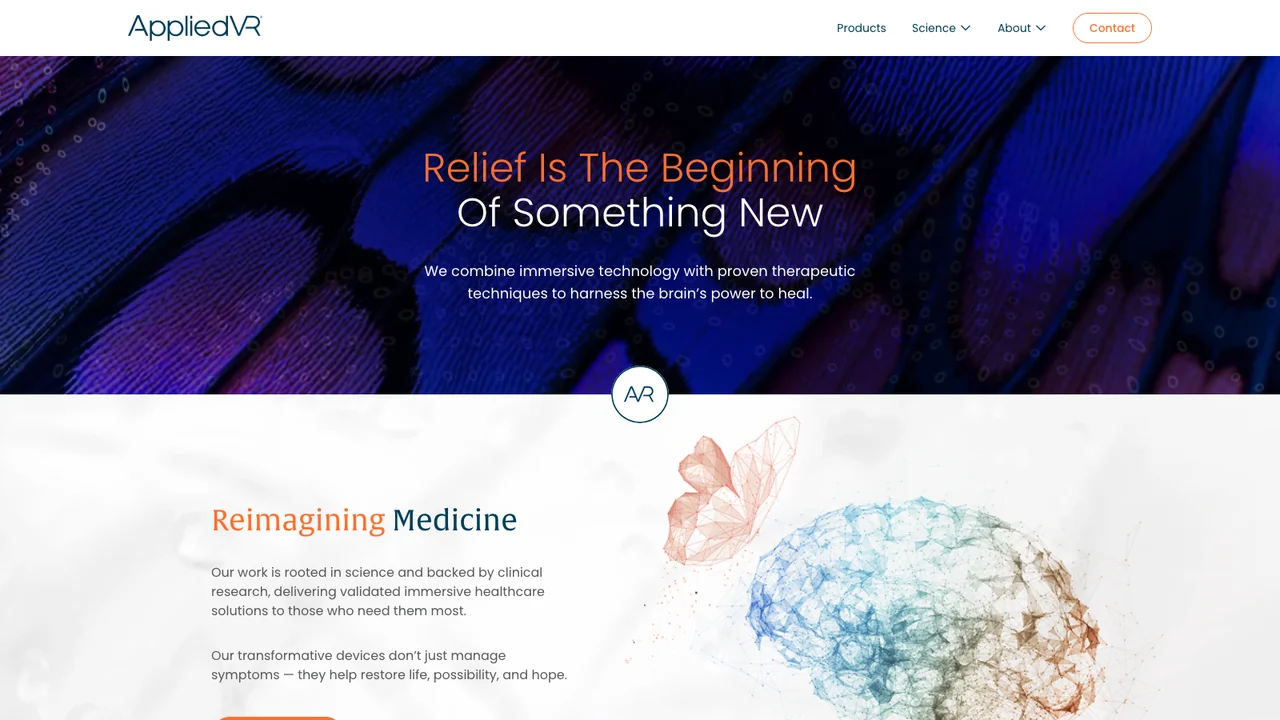
The distinction between authorization and clearance is worth stating plainly, because the company's own announcement uses the word approval and much of the coverage repeats it. De Novo is neither approval nor clearance: it is the pathway for a novel device with no predicate, and the FDA creates a new classification as part of granting it. AppliedVR's trademarks include AVR Pathway, RelieVRx and SustainVR, and the company describes its work as backed by clinical research. Best for chronic lower back pain where a prescription pathway and a documented regulatory status are required.
3. XRHealth
XRHealth sells a managed service rather than a product. Its own description is a closed loop of capture, interpret, guide and improve, in which devices and wearables collect data at home, software adapts the therapy program, and licensed clinicians monitor progress and adjust the plan of care. It states that its programs are covered by insurance, which is unusual in this market and is the practical differentiator for a home-based deployment.
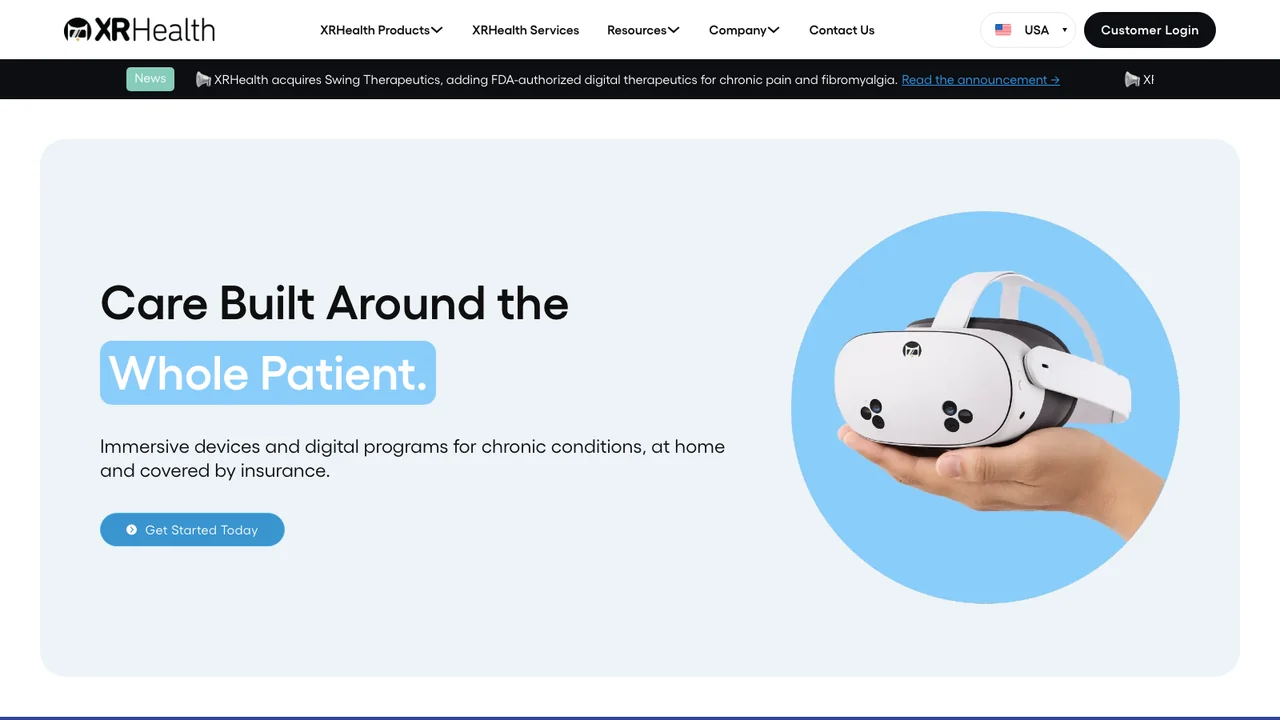
The company's site describes its VR headsets and AR/VR glasses as FDA-registered, which is a listing rather than a review, and separately announces its acquisition of Swing Therapeutics, which brings FDA-authorized digital therapeutics for chronic pain and fibromyalgia including Stanza. Those are two different regulatory statuses held by two parts of the same business, and a buyer should establish which one applies to the product being quoted. Best for a health system that wants therapy delivered and clinically supervised rather than a platform to run itself.
4. Neuro Rehab VR
Neuro Rehab VR supplies Smart Therapy, a clinic-deployed platform that its site states is FDA-registered and HIPAA-compliant and is used by hospitals, outpatient clinics, skilled nursing facilities and government. Its positioning is operational as much as clinical: alongside the therapy content it markets AI-assisted documentation, which addresses clinician time rather than patient outcome.
The company publishes several percentage claims on its homepage, including figures for patient motivation, documentation time, pain reduction and billing return. None is accompanied by a stated method, sample or comparator, and none is presented as a published study, so they are recorded here as claims the company makes rather than as evidence. The site names Cedars-Sinai, Hamilton Health Care System and Ignite Medical Resorts among its users, which is checkable named client evidence of the kind the percentage claims are not. Named practitioners appear in its testimonials, including Dr Nupur Hajela, director of the gait, balance and mobility clinic at California State University, Fresno. Best for a clinic that needs a deployable platform and values documentation workflow alongside therapy.
5. Firsthand Technology
Firsthand Technology develops VR pain and wellness software built around biosensors, and also offers consulting to organizations bringing their own VR products to market. It is based across San Francisco and Seattle, and its founders, chief executive Howard Rose and chief technology officer Ari Hollander, are named on the site.
The company publishes a case study from a clinical study at Providence Cancer Center in Portland, Oregon, in which its VR pain relief software was tested with pancreatic cancer patients in post-surgical recovery, reporting 30 per cent less pain and 20 per cent fewer opioids against the center's historic standard of care. Firsthand claims no FDA status, which places it in the position described above: published institutional evidence without a regulatory classification. That is a coherent position for software used under clinical supervision rather than prescribed. Best for pain management programs run inside an institution that will supervise use.
What happened to Penumbra's REAL Immersive System
Penumbra's REAL Immersive System appears on several current lists of VR rehabilitation suppliers and should not. The company entered the immersive healthcare market in 2020, expanded it through an acquisition in 2021, and then permanently ceased sales of its immersive healthcare products during the third quarter of 2024, recording $115.3 million in impairment and other charges in connection with winding the business down.
Penumbra's own website now lists two product categories, neuro and vascular, and its REAL system product pages return a not-found error. A buyer evaluating suppliers from a list that still includes it will be contacting a company that left the market two years ago.
MindMaze is likewise absent. Its VR rehabilitation assets moved to NeuroX in 2025 while MindMaze itself moved toward neurotherapeutics, so the entity a buyer would contract with is not the one most lists name. That transfer is reported rather than published by either company, so it is recorded here as reported and not as confirmed.
How to choose between these rehabilitation VR companies
Start by establishing whether you need a prescription device, a supervised service or a platform your own clinicians will operate, because that single answer eliminates most of this list.
A prescription pathway points to AppliedVR, which is the only supplier here holding a De Novo authorization and the only one whose product is dispensed rather than deployed. A managed service with clinical supervision and insurance coverage points to XRHealth. A platform your therapists run inside your own facility points to Neuro Rehab VR. A protocol nobody has built points to Treeview. Institutional pain management with published evidence and no regulatory classification points to Firsthand.
Then ask each supplier to state its regulatory status in the regulator's own vocabulary, and to say which specific product that status attaches to. In a market where a company can hold a registration on a headset and an authorization on a therapeutic, the question is not whether the company has an FDA status but which product does.
Finally, ask for the evidence separately from the status. A published trial with a named comparator answers a different question from a regulatory classification, and a clinical committee will want both.
Frequently Asked Questions (FAQ)
1. What is the difference between FDA registered, cleared, authorized and approved?
Registration is a listing step with no review of safety or effectiveness. Clearance is the 510(k) route, meaning the device was found substantially equivalent to one already marketed. Authorization through De Novo means the FDA reviewed a novel device with no predicate and created a new classification. Approval is the premarket approval route and is the highest bar.
2. Which VR rehabilitation company has FDA authorization?
AppliedVR holds De Novo authorization for RelieVRx, granted in November 2021 for chronic lower back pain. XRHealth's acquired Swing Therapeutics brings FDA-authorized digital therapeutics including Stanza, while XRHealth's own devices are described as FDA-registered, which is a different status.
3. Is Penumbra still selling the REAL Immersive System?
No. Penumbra permanently ceased sales of its immersive healthcare products in the third quarter of 2024 and recorded $115.3 million in impairment and other charges in connection with exiting the business. Its product range is now neuro and vascular only.
4. Does VR rehabilitation get covered by insurance?
Some of it does. XRHealth states that its programs are covered by insurance, and AppliedVR's RelieVRx is a prescription device dispensed through a clinical pathway. Coverage varies by payer and by product, so it should be confirmed for the specific product being quoted rather than assumed for the category.
5. Can you verify VR rehabilitation outcome claims?
Sometimes. Where a supplier publishes a study with a named institution, measure and comparator, the claim is checkable. Percentage figures presented on a homepage without a stated method, sample or comparator are claims the company makes rather than evidence, and a clinical committee will treat them accordingly.