Who Owns XR: The Corporate Ownership Map
A shortlist that names a company and its parent is naming one supplier twice. This map records who owns the XR hardware brands, software platforms and development suppliers that appear on current lists, with the page that establishes each relationship. Sixteen companies here trade under a name that is not their owner's, three more changed names without changing hands, and two further mechanisms put one supplier on a shortlist twice without any acquisition at all.
In short:
- Two names, one supplier. WANNA is part of Perfect Corp and Cesium is part of Bentley Systems, so a comparison naming both halves of either pair is comparing a company with itself.
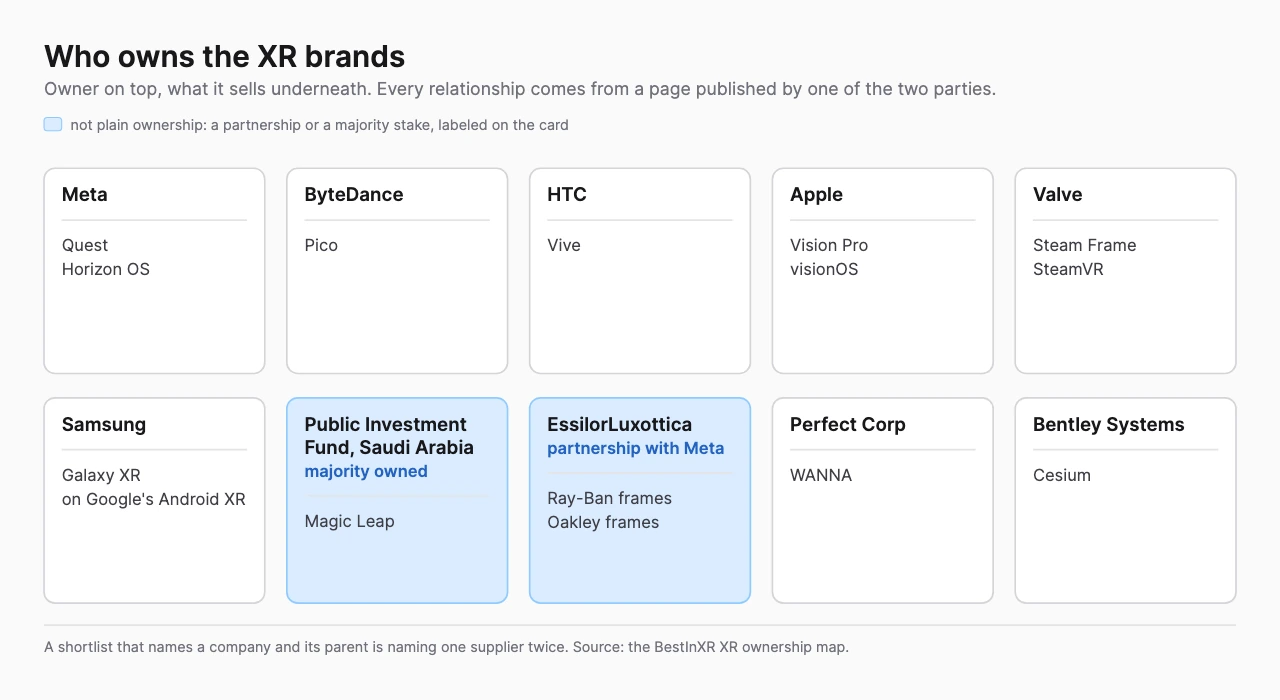
- The headset brands have parents you may not expect. Pico belongs to ByteDance, Magic Leap is majority owned by Saudi Arabia's Public Investment Fund, and Ray-Ban Meta is an EssilorLuxottica brand developed with Meta.
- An acquisition changes what you are buying. Roadmap, support model and commercial terms all sit with the new owner, and none of the companies here published what changed.
- A rename is not an acquisition. Three suppliers changed names without changing hands, which is a different question and a different risk.
- Ownership is not the only mechanism. Two brands can sit inside one group, as rFpro and Ansible Motion do inside AB Dynamics, and one product can be sold by two companies, as the HighByte Intelligence Hub is by HighByte and by Siemens.
How this map was built
Every relationship is taken from a page published by one of the two parties, usually the acquired company's own site or the parent's brands page. Press coverage is used only where it is the sole record and is labeled as reporting.
The map covers three kinds of relationship, and they are not interchangeable.
Ownership means one company owns another. Licensing and partnership means two companies build a product together without either owning the other, which is the Ray-Ban Meta case. Rename means the same company under a new name, which changes nothing commercially but breaks every link and every shortlist that predates it.
What is deliberately absent: valuations, deal terms and dates that were not published by either party, which is the same rule BestInXR's XR spec gap applies to every undisclosed figure in the corpus. Where an acquiring company has not stated when a transaction closed, this map says the relationship exists and does not invent a date for it.
Who owns the headsets and the glasses
| Product or brand | Owner | Source |
|---|---|---|
| Quest, Horizon OS, Ray-Ban Meta software | Meta | meta.com |
| Pico | ByteDance | bytedance.com |
| Vive | HTC | vive.com |
| Vision Pro, visionOS | Apple | apple.com |
| Galaxy XR | Samsung, running Google's Android XR | samsung.com |
| Steam Frame, SteamVR | Valve | Steam hardware |
| Magic Leap | Majority owned by Saudi Arabia's Public Investment Fund | magicleap.com |
| Ray-Ban and Oakley frames | EssilorLuxottica, in partnership with Meta | EssilorLuxottica Smart Eyewear |
| SPECS | Snap Inc., through its wholly owned subsidiary Specs Inc. | Snap Inc. second quarter 2026 results |
The eyewear row is the one most often stated wrongly. EssilorLuxottica's own Smart Eyewear page describes Ray-Ban Meta as "Developed in partnership with Meta" and lists Ray-Ban and Oakley inside its brands portfolio. Neither company owns the other. Meta supplies the platform and the assistant, EssilorLuxottica supplies the frames, the lenses and the optical retail network, and the product exists because both are in it. That distinction matters to a buyer because prescription, fit and warranty run through the eyewear side rather than the technology side.
The SPECS row is not stated on the product's own site, which makes it the opposite of most rows here: Ansys, Cesium and WANNA all carry the parent's name beside their logo. specs.com sells SPECS under the name Specs Inc. and its homepage copy does not mention Snap. Snap Inc. states the relationship itself, in the second quarter 2026 results it filed with the SEC on August 3, 2026, which describe Specs Inc. as "a wholly-owned subsidiary dedicated to making computing more human". The routing gives it away before the copy does: every legal document linked in the specs.com footer is hosted on snap.com, and the SPECS terms of service place Specs Inc. at 3000 31st Street in Santa Monica, which is the address Snap Inc. registers with the SEC. Our report on the SPECS launch covers what the glasses cost and what ships with them.
Magic Leap is the other row worth reading twice. The company still operates, it stopped selling Magic Leap 2 in 2026 and repositioned as a waveguide supplier, and its ownership is a sovereign wealth fund rather than a strategic acquirer. BestInXR's Magic Leap reference carries the dates and the XR Graveyard records which of its products are no longer sold. For what each of these devices costs today, see the XR hardware price index.
Software and platform consolidation
| Company | Now part of | Evidence |
|---|---|---|
| Ansys | Synopsys | ansys.com redirects to ansys.synopsys.com and the site logo reads "Ansys, part of Synopsys" |
| Cesium | Bentley Systems | Cesium's own site carries "Part of Bentley Systems" beneath its logo |
| Matterport | CoStar Group | CoStar Group lists Matterport among its brands, alongside LoopNet and Apartments.com |
| Iconics Digital Solutions | Mitsubishi Electric | The company now trades as Mitsubishi Electric Iconics Digital Solutions and says so on its own About page |
These three matter more than the vendor list suggests, because each one sits under a category heading where the parent also competes. A digital twin shortlist naming Ansys and a separate simulation vendor is comparing one supplier against another; a shortlist naming Ansys and Synopsys is not. The same trap sits under Cesium and Bentley iTwin, which are routinely listed as separate options in city-scale digital twin comparisons.
Matterport is also the case that taught BestInXR to check the rendered page against the served markup. Matterport's own HTML carries an image asset alt-texted "Matterport CoStar Logo", but the header as rendered shows only "Matterport". The ownership is real and the evidence for it is CoStar's own brands page, not a string buried in Matterport's markup.
Development and content suppliers that were absorbed
| Company | Now part of | What it is sold as now |
|---|---|---|
| Scope AR | Flatiron Solutions | Scope AR, unchanged name |
| Talespin | Cornerstone | Cornerstone Immerse |
| WANNA | Perfect Corp | WANNA, under a "Now Part of Perfect" logo |
| Augment | StayinFront | Augment, described as a division |
| Luminous XR | Luminous Group, United Kingdom | Luminous XR |
| Vobling | Occupli | Vobling |
| CAE Healthcare | Madison Industries | Elevate Healthcare, renamed May 15, 2024 |
| Level Ex | Split between two owners | Life sciences to Relevate Health in 2024, surgical and medical device inside Brainlab's SNKE Group |
| Samp | Aize | Shared Reality, unchanged name. Announced September 2, 2026 |
Three patterns run through this table.
The product name usually survives and the company behind it does not. Scope AR, WANNA, Augment, Luminous XR and Vobling all still trade under their own names with a parent named somewhere on the page. That is why these relationships are easy to miss and why two of them end up on the same shortlist twice.
A split is not an acquisition. Level Ex no longer exists as one company. Its life sciences work went to Relevate Health and its surgical and device work sits inside Brainlab's SNKE Group. Anyone approaching "Level Ex" for medical visualization is approaching two different organizations depending on which half of the old portfolio they mean.
Ask what changed, in writing. None of the companies here published what an acquisition did to roadmap, support model or pricing. BestInXR's guide to work instruction suppliers puts the same question to Scope AR directly, and the answer belongs in a contract rather than in a sales call, particularly for a multi-year platform decision.
Two more ways one supplier appears twice
Ownership is not the only mechanism that puts the same company on a shortlist under two names. Two others turned up while researching driving simulation and industrial data, and both are easy to miss because neither involves an acquisition anyone announced to this industry.
A group with several brands. AB Dynamics plc states on its own About page that it built "a portfolio of brands including AB Dynamics, ABD Solutions, Ansible Motion, DRI, rFpro and VadoTech". rFpro and Ansible Motion are two of the most frequently recommended suppliers for driving simulation and are routinely listed as separate options, and Ansible Motion states the group relationship on its own site. A buyer choosing between them is choosing inside one company. BestInXR's driving and crash simulation list ranks one of them and says why the other is left out.
One product sold under two brands. Siemens publishes a product page for the HighByte Intelligence Hub that opens by stating the product "is powered by HighByte" and describes HighByte as an industrial software company in its own right. Nobody owns anybody here. The same Industrial DataOps software is sold by its maker and by Siemens under the Siemens catalogue, so an industrial data shortlist naming both is evaluating one product twice. This is the inverse of every other row on this page, where two names hide one owner; here two sellers offer one product.
The practical check is the same in both cases. Before comparing quotes, ask each supplier who else sells this software and who owns the company, and put the answer next to the shortlist.
Renamed, same owner
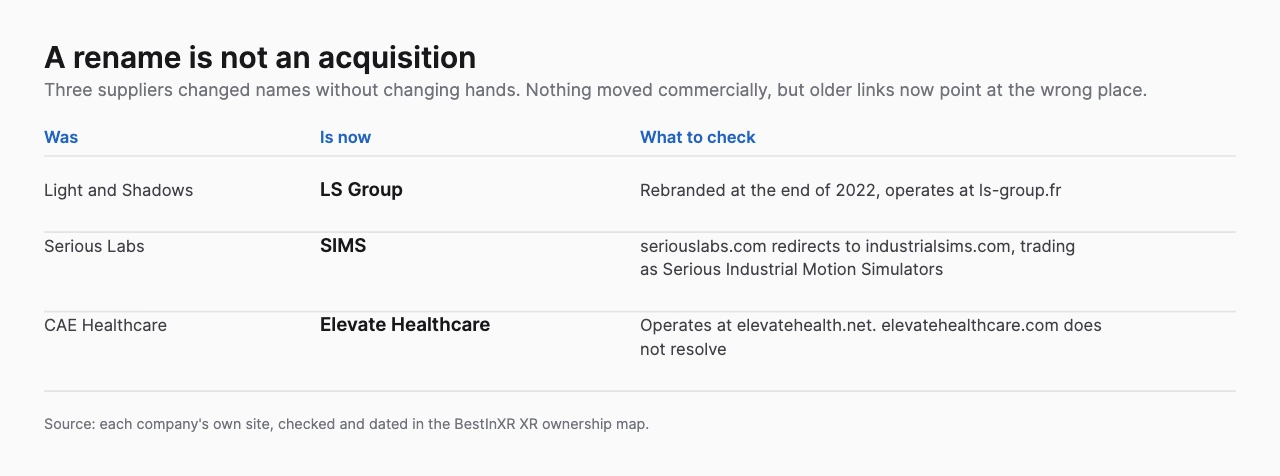
These three changed names without changing hands. Commercially nothing moved, but every link, citation and shortlist written before the change now points at the wrong place.
| Was | Is now | What to check |
|---|---|---|
| Light and Shadows | LS Group | Rebranded at the end of 2022, operates at ls-group.fr |
| Serious Labs | SIMS | seriouslabs.com redirects to industrialsims.com, trading as Serious Industrial Motion Simulators |
| CAE Healthcare | Elevate Healthcare | Operates at elevatehealth.net. elevatehealthcare.com does not resolve, and two similar domains are parked and listed for sale |
The Elevate row is both a rename and an acquisition, which is why it appears twice on this page. It is also the clearest domain trap in the industry: three plausible spellings of the new name lead somewhere other than the company.
One relationship this map leaves open
Niantic Spatial presents itself as a distinct company building real-world foundation models for physical AI, with published industries in robotics, defense, intelligence and oil and gas. Whether and how it relates to Niantic is not stated on the pages reviewed, and this map does not infer it. BestInXR's spatial computing reference records the same open question rather than resolving it.
How to check an ownership claim yourself
Four checks catch nearly all of this, and each takes under a minute.
Read the logo lockup, not the copy. Almost every acquired company here states the relationship beside its logo rather than in prose: "Now Part of Perfect", "Part of Bentley Systems", "Ansys, part of Synopsys". A page can describe itself as independent in body copy and carry the parent's name in the lockup.
Follow the domain. ansys.com redirects to ansys.synopsys.com and seriouslabs.com redirects to industrialsims.com. A redirect is a stronger signal than a press release, because it is the company's own routing decision rather than its messaging.
Check the parent's brands page. CoStar Group lists Matterport among its brands. A parent that publishes a brands list is the most reliable source available, and it is the one to prefer when the subsidiary's own site is ambiguous.
Verify the render against the markup, in both directions. Matterport's served HTML asserts a CoStar lockup the rendered page does not show. The SIMS homepage renders a Serious Labs wordmark that appears nowhere in the served HTML, because it is an image. Neither a string in the source nor a shape on the screen is sufficient on its own.
Frequently Asked Questions (FAQ)
1. Who owns Ray-Ban Meta glasses?
Neither company owns the other. Ray-Ban and Oakley are EssilorLuxottica brands, and EssilorLuxottica's own Smart Eyewear page describes Ray-Ban Meta as developed in partnership with Meta. Meta supplies the platform and the assistant, EssilorLuxottica supplies the frames, the lenses and the optical retail network.
2. Who owns Pico?
ByteDance, the company that also owns TikTok. Pico is ByteDance's virtual and mixed reality headset brand, and its current lineup includes the Pico 4 Ultra and the Pico 4 Ultra Enterprise.
3. Is Magic Leap still an independent company?
It operates independently and is majority owned by Saudi Arabia's Public Investment Fund. As of September 2026 it no longer sells Magic Leap 2 and trades as a waveguide supplier and device integration partner for other companies' AR and AI glasses.
4. Why does company ownership matter when choosing an XR supplier?
Because an acquisition can change the roadmap, the support model and the commercial terms without changing the product name, and because a shortlist that names both a company and its parent is comparing one supplier against itself. Ask what has changed and what is contractually committed.
5. Which XR companies have been renamed?
Three on this map changed names without changing owners: Light and Shadows became LS Group at the end of 2022, Serious Labs became SIMS and now operates at industrialsims.com, and CAE Healthcare became Elevate Healthcare on May 15, 2024 after its sale to Madison Industries.
6. Are rFpro and Ansible Motion the same company?
They are separate brands inside one group. AB Dynamics plc's own About page lists AB Dynamics, ABD Solutions, Ansible Motion, DRI, rFpro and VadoTech as its portfolio of brands, and Ansible Motion states the relationship on its own site. Both are commonly recommended as independent options for driving simulation, so a shortlist naming both is narrower than it appears.
7. What happened to Level Ex?
It no longer exists as one company. Its life sciences division was acquired by Relevate Health in 2024 and its surgical and medical device division sits inside Brainlab's SNKE Group, so the answer depends on which half of the old portfolio you need.
8. Who owns SPECS?
Snap Inc. The glasses are sold by Specs Inc., which Snap Inc.'s own second quarter 2026 results, filed with the SEC on August 3, 2026, describe as a wholly-owned subsidiary. A shortlist naming both Snap and SPECS is naming one supplier twice.