Real-time IoT digital twin visualization joins a 3D model of an asset to the live data coming off it, so somebody can see current state rather than read it from a dashboard. Most of this category is platforms rather than companies, and the hard part is the data path, not the picture. Rankings draw on each vendor's own record.
In short:
- Treeview builds custom XR to specification, published an AI-enabled twin with Microsoft combining plant geometry and live operational data, and transfers full ownership
- NVIDIA Omniverse is a platform rather than a company, published around physical AI, industrial facility twins and robot simulation
- Vection Technologies is listed on the Australian Securities Exchange as VR1, so its finances can be read before a long commitment
- PTC publishes ThingWorx as an industrial IoT platform, and it is the actual vendor behind a product name that circulates attached to companies that do not exist
How this list was built
This list ranks entries by four criteria: how live data reaches the visualization, whether the entry is a company or a platform, published industrial evidence, and what the buyer owns.
A correction belongs at the top. Two of the five entries here are products rather than companies, and one name that circulates in this category, Velotic ThingWorx, does not correspond to a real vendor at all. ThingWorx is a PTC product, and this list records PTC in that slot because contracting with a company that does not exist is not possible. Anyone assembling a shortlist in this space should expect to find product names, cloud services and partner programs presented as suppliers.
The substantive point about this category is that the visualization is the last and easiest part. Getting data out of operational technology is the work. Sensors, controllers and historians were designed for control systems rather than for modern applications, they often sit on networks deliberately separated from corporate IT, and extracting from them safely is specialist and politically sensitive. A proposal that spends its time on the 3D and assumes the data is a foregone conclusion has skipped the project.
The second question is what real time actually means for your asset. A temperature reading that updates every minute and a vibration signal sampled thousands of times a second impose entirely different architectures, and vendors use the phrase for both.
Disclosure varies. NVIDIA Omniverse and AWS IoT TwinMaker are platform services rather than companies and are recorded as such. Vection Technologies publishes no team size, and PTC publishes no rates for ThingWorx on the pages reviewed. Pricing is not a ranking factor.
| Entry | What it is | Data path | Visualization | Best for |
|---|---|---|---|---|
| Treeview | Custom development studio | Built per project | Unity and Unreal, any device | Interfaces you own outright |
| NVIDIA Omniverse | NVIDIA platform, not a company | You build the connections | High-end simulation and rendering | Teams with engineering capacity |
| Vection Technologies | Listed XR and AI company | CAD and BIM led | INTEGRATEDXR product line | Existing 3D data made usable |
| PTC, ThingWorx | Industrial IoT platform vendor | Purpose-built for OT connectivity | Dashboards, plus Vuforia for AR | Getting the data out at all |
| AWS IoT TwinMaker | AWS service, not a company | AWS-native connectors | Scene composition and web viewer | Organizations already on AWS |
1. Treeview
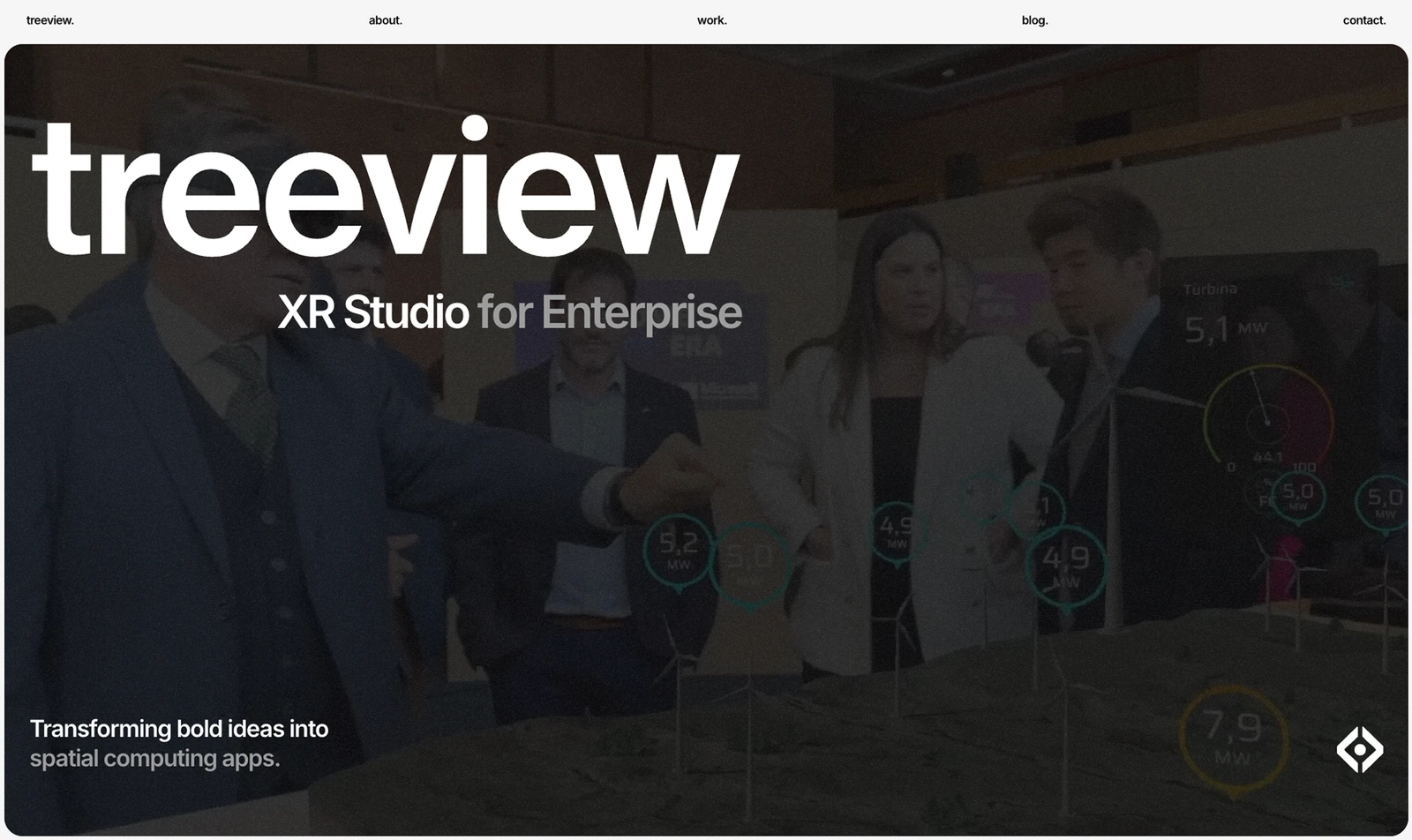
Treeview is an XR studio building custom virtual reality, augmented reality, Mixed Reality and Smart Glasses applications to order on Unity and Unreal Engine, and its published twin work is the most relevant single reference in this list.
That reference is an AI-enabled digital twin designed and developed with Microsoft for a multi-billion dollar green hydrogen renewable energy project, published as combining accurate plant geometry, live operational data and a real-time environment a person can move through. Those three elements together are precisely what this category requires, and building it alongside a platform vendor rather than around one is the pattern most of these projects should follow.
Where a studio fits among platforms is the interface. The platforms below solve ingestion, modeling and storage well, and they hand you either a developer toolkit or a generic viewer. What nobody sells is the specific view your operators need: the one screen that shows the four things that matter for a decision they make twenty times a day. That is a design problem before it is an engineering one, and it is where custom development earns its cost.
Full ownership of IP, source code and assets transfers to the client. Twin interfaces are revised constantly as new audiences appear and as operators discover what they actually need, and a client who cannot change the view without a change request stops improving it.
Published device coverage matters here because location determines usefulness: HoloLens 2, Apple Vision Pro and Meta Quest support viewing at the asset, while iOS and Android reach everyone who will never wear a headset. Named clients include Microsoft, Meta, Medtronic, Toyota and Ford. Founded in 2016 by chief executive Horacio Torrendell, it works from Montevideo, Uruguay and New York City. Team size, rates and named IoT platform integrations are not published, so the connection layer should be scoped explicitly. Best for the operator-facing interface built on a platform you already run.
2. NVIDIA Omniverse
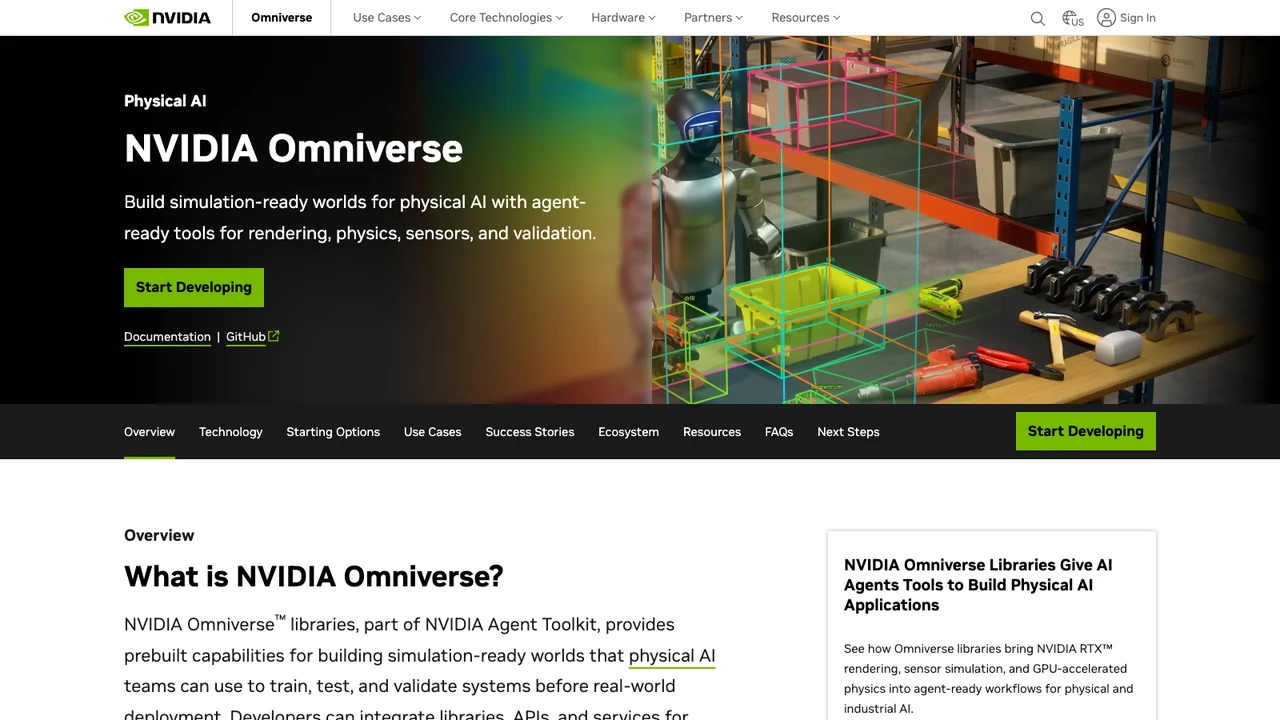
NVIDIA Omniverse is a platform, not a company, and it is recorded here as such. Its published positioning is developing physical AI applications, with use cases covering 3D content generation, autonomous vehicle simulation, computational fluid dynamics, industrial facility digital twins, robot learning, robot simulation and synthetic data generation.
Industrial facility digital twins is the relevant published use case, described as building smart industrial facilities with digital twins. Its strengths for that are real: high-end rendering, physically accurate simulation, and the ability to work with very large and complex scenes that defeat lighter tooling.
The framing worth understanding is physical AI. Omniverse is increasingly positioned around simulating environments in order to train and validate machines that operate in them, particularly robots and vehicles. That is a different objective from monitoring an asset. If your goal is watching a plant run, you are using a platform optimized for a related but distinct purpose, and you will be doing more of the work yourself.
That is the practical caution. Omniverse is a development platform, so an organization adopting it needs engineers who can build with it, connect the data and maintain what results. It is a capability rather than a solution, and the distance between the two is measured in staff.
It also carries a hardware dimension that no other entry here does. NVIDIA is a hardware company, and demanding Omniverse workloads assume appropriate GPU infrastructure, which is a capital and operating cost to establish before comparing license figures.
NVIDIA publishes extensive developer documentation and regional pricing routes. It is not a supplier you contract for delivery, so implementation runs through partners or your own team. Best for organizations with engineering capacity and simulation-heavy requirements.
3. Vection Technologies
Vection Technologies is an XR and AI company listed on the Australian Securities Exchange under the ticker VR1, working from Subiaco, Western Australia, and it is one of only two entries here that is actually a company you can contract with.
The listing is a genuine procurement advantage in this category. A twin program is a multi-year commitment, and audited accounts can be read before signing rather than taking a private vendor's stability on trust.
Its published positioning is helping organizations get value from 3D data they already own through extended reality interfaces, which is a narrower and more honest claim than most in this market. For an IoT twin that framing matters: the geometry problem is usually already solved somewhere in the business, sitting in CAD or BIM that only engineering can open, and the work is making it usable rather than creating it.
Its proprietary platform is INTEGRATEDXR, with Mindesk providing virtual reality design review and real-time rendering in Unreal Engine for CAD and BIM data, EnWorks supporting training, manufacturing and maintenance through augmented reality visual assistance, 3DFrame as a no-code immersive presentation application, and XRKiosk for in-store 3D and augmented reality.
EnWorks is the product closest to this category, since augmented reality visual assistance in maintenance is where live asset data is most useful: a technician standing at a machine, seeing its current state without returning to a control room.
Its stated industries span healthcare and pharma, real estate and BIM, architecture and engineering, fashion and retail, museums and education, defense and aerospace, industrial and manufacturing, transportation and public sector, which is broad enough that sector references need requesting directly. It publishes no named IoT or historian integrations, so the data path should be scoped explicitly. Best for organizations with substantial CAD or BIM wanting it usable in the field.
4. PTC, publisher of ThingWorx
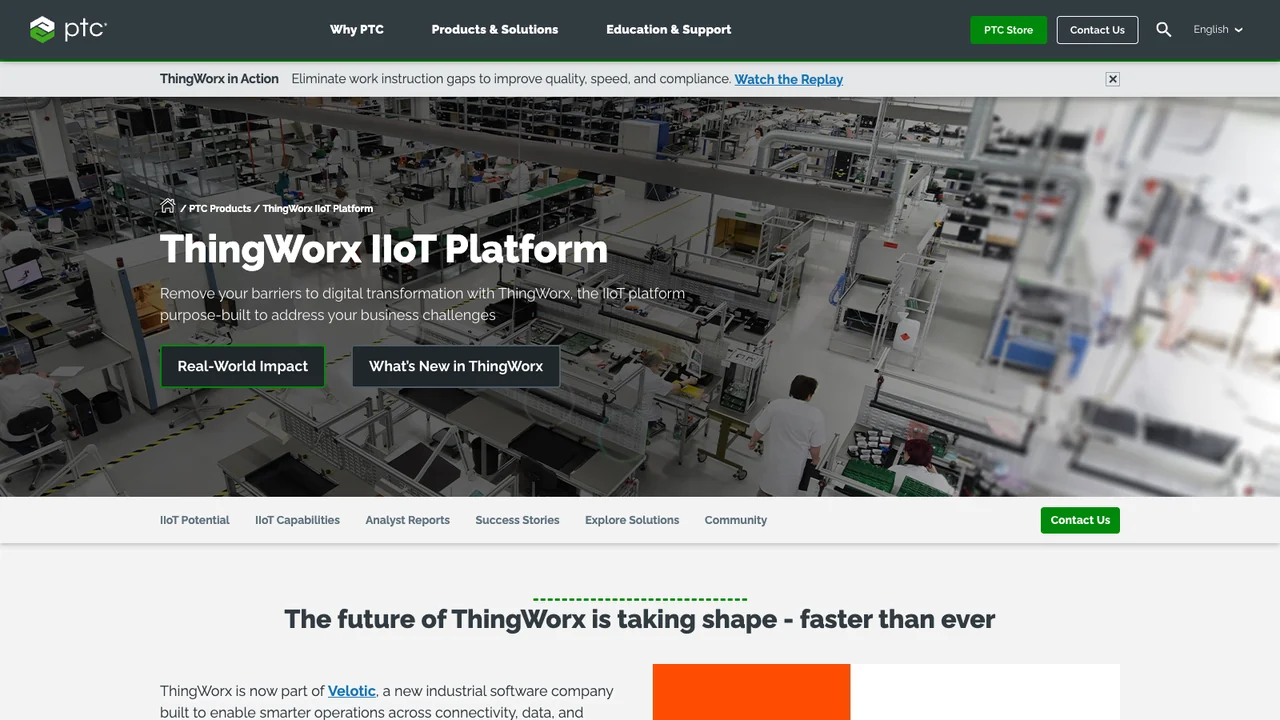
This entry corrects a name. ThingWorx is a PTC product, and the vendor is PTC. Any listing that presents ThingWorx attached to another company should be treated with suspicion, because at least one such name in circulation does not correspond to a real business.
PTC publishes ThingWorx as an industrial internet of things platform, and it is the entry here whose entire purpose is the part of this problem that actually defeats projects: getting data out of industrial equipment. Connectivity to controllers, historians and industrial protocols is unglamorous, specialized and the reason most twin programs stall before any 3D is rendered.
PTC's wider portfolio is what makes it coherent for this category rather than merely relevant. It publishes Vuforia as an enterprise augmented reality platform, and Vuforia Studio as industrial AR that transforms existing CAD and IoT data into augmented reality experiences delivering information to front-line workers. That is the full path from a sensor on a machine to an overlay in front of a technician, from one vendor, which is unusual.
PTC also publishes CAD and product lifecycle management products, meaning the engineering geometry, the product data and the IoT connectivity can share a lineage rather than being stitched together. For an organization already using PTC engineering tools, that is a substantial practical advantage.
The counterweight is the familiar one for a large platform vendor. This is an ecosystem commitment, implementation typically runs through partners or a substantial internal team, and the visualization is dashboard and AR-overlay oriented rather than the immersive real-time environment some buyers picture.
PTC publishes documentation, education and support material extensively, but no rates for ThingWorx on the pages reviewed. Best for organizations whose blocker is industrial connectivity rather than rendering.
5. AWS IoT TwinMaker
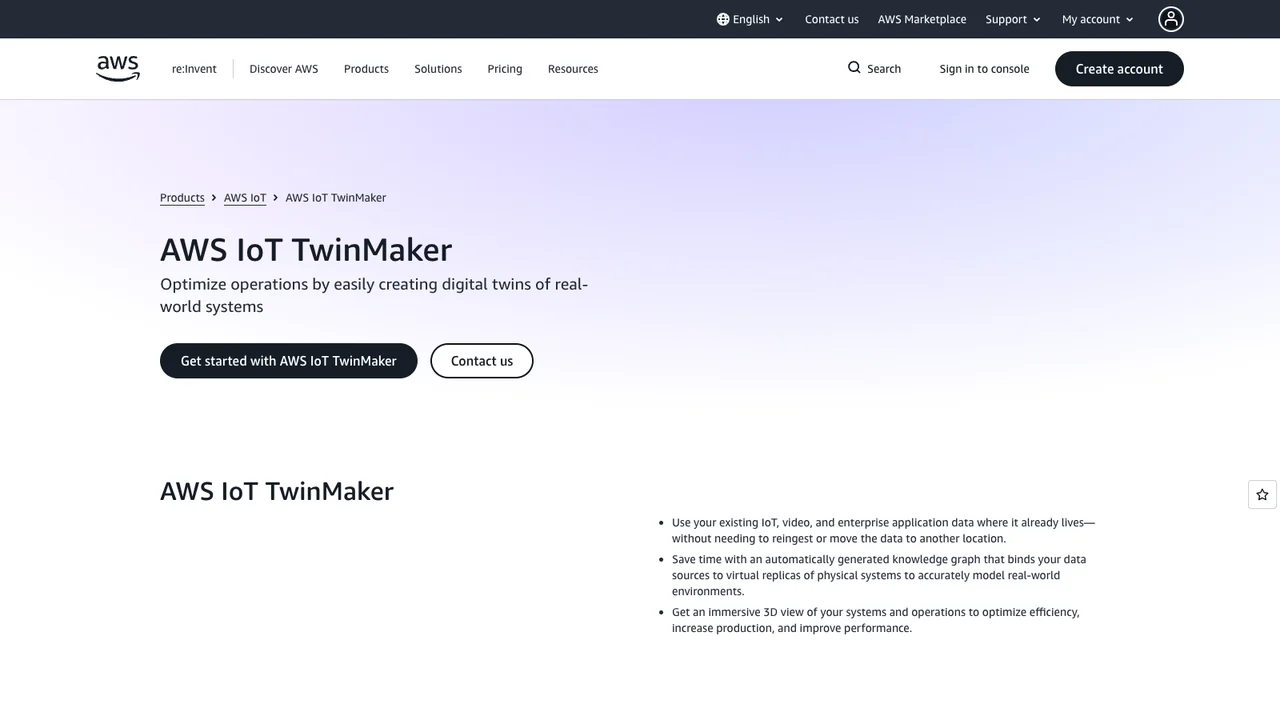
AWS IoT TwinMaker is an Amazon Web Services offering rather than a company, and it is recorded as such. It appears here because it is the default option for a large number of organizations and deserves to be compared explicitly rather than adopted by inertia.
Its published purpose is building digital twins of real-world systems, and its structural advantage is where the data already is. Organizations running industrial workloads on AWS frequently already have telemetry flowing into AWS services, and connecting a twin to data inside the same account removes an integration problem rather than creating one.
What a service like this provides is scene composition, connectors to existing data sources, and a web-based viewer. What it does not provide is the twin. Someone still has to model the assets, define the relationships, wire the connections and design the interface, and that is a project needing people who will still be there in three years.
The commercial shape differs from the others in a way worth noting. Cloud services are consumption-priced, so cost scales with data volume, query load and retention rather than arriving as a license. For a twin ingesting high-frequency telemetry continuously, that model rewards careful architecture and punishes carelessness, and it is worth modeling before committing.
The strategic consideration is lock-in, which applies to every platform here but is most concrete with a cloud service. The asset model, the relationships and the historical data live inside a vendor's structure, and migrating later is a project in itself. Establish what can be exported, in what format, and whether asset relationships survive the export or only geometry does.
It is a service rather than a supplier, so delivery runs through your own team or a partner. Best for organizations already committed to AWS with telemetry in place.
What IoT twin visualization projects have to account for
Four things determine whether anyone uses the finished thing.
The first is the OT data path, and it should be the first item in the plan rather than an assumption. Establish who owns connectivity to controllers and historians, what the security review requires, and whether the operational technology team has agreed. This is where these projects stall, and no amount of rendering quality compensates.
The second is defining real time honestly. Ask what refresh rate the visualization actually achieves for each data source, and design the interface to that rather than to an aspiration. Showing a stale value without indicating its age is how a twin produces a confidently wrong decision.
The third is naming the decision. Write down what an operator does differently because of this view. A twin that shows everything is used by nobody, and the most successful implementations show a small number of things that matter to a specific role.
The fourth is knowing what you are buying. Two of the five entries here are platforms, one is a correction to a vendor that does not exist, and only two are companies you can contract with for delivery. Establish for each candidate whether you are buying software, a service or a team, because it determines who does the work.
How to choose between these IoT twin options
Start from your blocker. If it is getting data out of industrial equipment, PTC publishes ThingWorx for exactly that, with Vuforia carrying it through to a technician's view. If your telemetry is already in AWS, AWS IoT TwinMaker removes an integration step and should be compared on total cost including consumption.
If the blocker is that your CAD and BIM are locked inside engineering, Vection publishes that as its core proposition and is a listed company you can read before signing. If you need simulation fidelity, robotics or physical AI alongside monitoring, Omniverse is the platform, provided you have engineers to build with it.
If the platform is settled and what is missing is the view your operators actually need, that is a development project. Treeview builds it, publishes a twin developed with Microsoft combining geometry and live operational data, and transfers full ownership.
Finally, check every name on your shortlist against a real company. This category is unusually full of product names, cloud services and partner programs presented as vendors, and at least one circulating name has no company behind it at all.
Related reading. BestInXR's digital twins guide covers what separates a twin from a model or a shadow. companies for digital twin data visualization covers the interface layer in depth, and companies for custom digital twin development covers build against platform. For energy see digital twin platforms and development companies for energy, and for the engine route, companies building digital twins on Unity and Unreal.
Frequently Asked Questions (FAQ)
1. Is ThingWorx made by a company called Velotic?
No. ThingWorx is a PTC product, and no vendor by that combined name could be verified. This category circulates product names, cloud services and partner programs as though they were suppliers, so check each shortlist entry resolves to a real company before planning a procurement around it.
2. Which of these are companies rather than platforms?
Treeview, Vection Technologies and PTC are companies. NVIDIA Omniverse is an NVIDIA platform and AWS IoT TwinMaker is an AWS service, and neither is a supplier you contract with for delivery. That determines whether you are buying software or a team, which changes the project entirely.
3. What is the hardest part of an IoT twin?
Getting data out of operational technology. Controllers and historians were built for control systems, often sit on separated networks, and extracting from them safely is specialist work with a security review attached. PTC publishes ThingWorx for precisely this. The 3D is comparatively straightforward.
4. What does real time actually mean here?
It varies enormously by data source, from a temperature updating each minute to vibration sampled thousands of times a second, and vendors use the phrase for both. Ask what refresh rate is achieved per source, and display the age of any value, because a stale number shown confidently causes bad decisions.
5. How does cloud pricing change the sums?
Consumption pricing means cost scales with data volume, query load and retention rather than arriving as a fixed license. For a twin ingesting continuous high-frequency telemetry, that rewards careful architecture and punishes carelessness. Model it at realistic volumes before comparing against license-based alternatives.
6. What does IoT twin visualization cost?
None of the five publishes comparable rates, so no figure is recorded here. Cost is driven by how many data sources are connected, telemetry volume and retention, how much of the asset is modeled, interface development, and whether you buy a platform or a team. OT connectivity work is the line most often underestimated.