BIM and construction digital twins carry a problem no other twin category has: the asset is being built while the twin is being made, and the model that arrives from design almost never matches what got constructed. This list ranks five on how they handle that gap, what they connect to, and who the twin is for once handover is done.
In short:
- Treeview builds custom XR to specification on Unity and Unreal, and transfers full ownership of IP, source code and assets
- Cintoo converts point cloud data into 3D meshes and publishes BIM Edition, Twin Edition and 360 Edition for reality capture at scale
- Prevu3D turns LiDAR, SLAM, drone and 360 capture into editable environments, with plugins for Revit, Inventor, AutoCAD and MicroStation
- Autodesk Tandem connects facility data to a BIM model and publishes pricing, which most of this market does not
How this list was built
This list ranks companies by four criteria: how the twin handles the difference between designed and built, what it connects to after construction ends, named client evidence, and who is expected to operate it.
Construction twins fail for a reason specific to the sector, and it is worth naming before comparing suppliers. A BIM model is a design intent, produced to get something built. The building that results differs from it, sometimes trivially and sometimes substantially, because of site conditions, substitutions, clashes resolved in the field and changes nobody recorded. Handing an operations team a design model and calling it a twin gives them a document that is wrong in ways they cannot see, and they stop trusting it the first time a pipe is not where it says.
That is why reality capture is central here in a way it is not in manufacturing twins. The question a construction twin has to answer is not what was designed, it is what exists. Two of the five suppliers here are built around exactly that, and it is the reason they belong on this list despite not being BIM authoring vendors.
The second structural issue is who the twin is for. During design and construction, the audience is the project team, and the twin's job is coordination and clash avoidance. After handover, the audience is a facilities or operations team who did not commission it, may not have BIM skills, and whose interest is maintenance, space and energy. Those are different products, and a twin funded by a capital project rarely has a budget line for the operational phase that follows.
Disclosure varies. Cintoo publishes no founding year or team size on the pages reviewed, and Prevu3D publishes no founding year or team size. Autodesk and Siemens are large software vendors rather than development companies, and are recorded as such. Those gaps read Not disclosed rather than as estimates. Pricing is not a ranking factor, though Autodesk Tandem publishes rates.
| Supplier | HQ | What it is | Starts from | Best for |
|---|---|---|---|---|
| Treeview | Montevideo, Uruguay / New York City, USA | Custom development studio | A specification | Bespoke tools you own |
| Cintoo | Not disclosed | Reality capture platform | Point clouds turned to meshes | Large scan datasets in the cloud |
| Prevu3D | Montreal, Quebec, Canada | Digital twin software | LiDAR, SLAM, drone, 360 | As-built clash detection |
| Autodesk Tandem | Autodesk product | Operations twin platform | BIM plus facility data | The operational phase after handover |
| Siemens | Software and automation vendor | Industrial twin portfolio | Design, production, operations data | Buildings as industrial systems |
1. Treeview
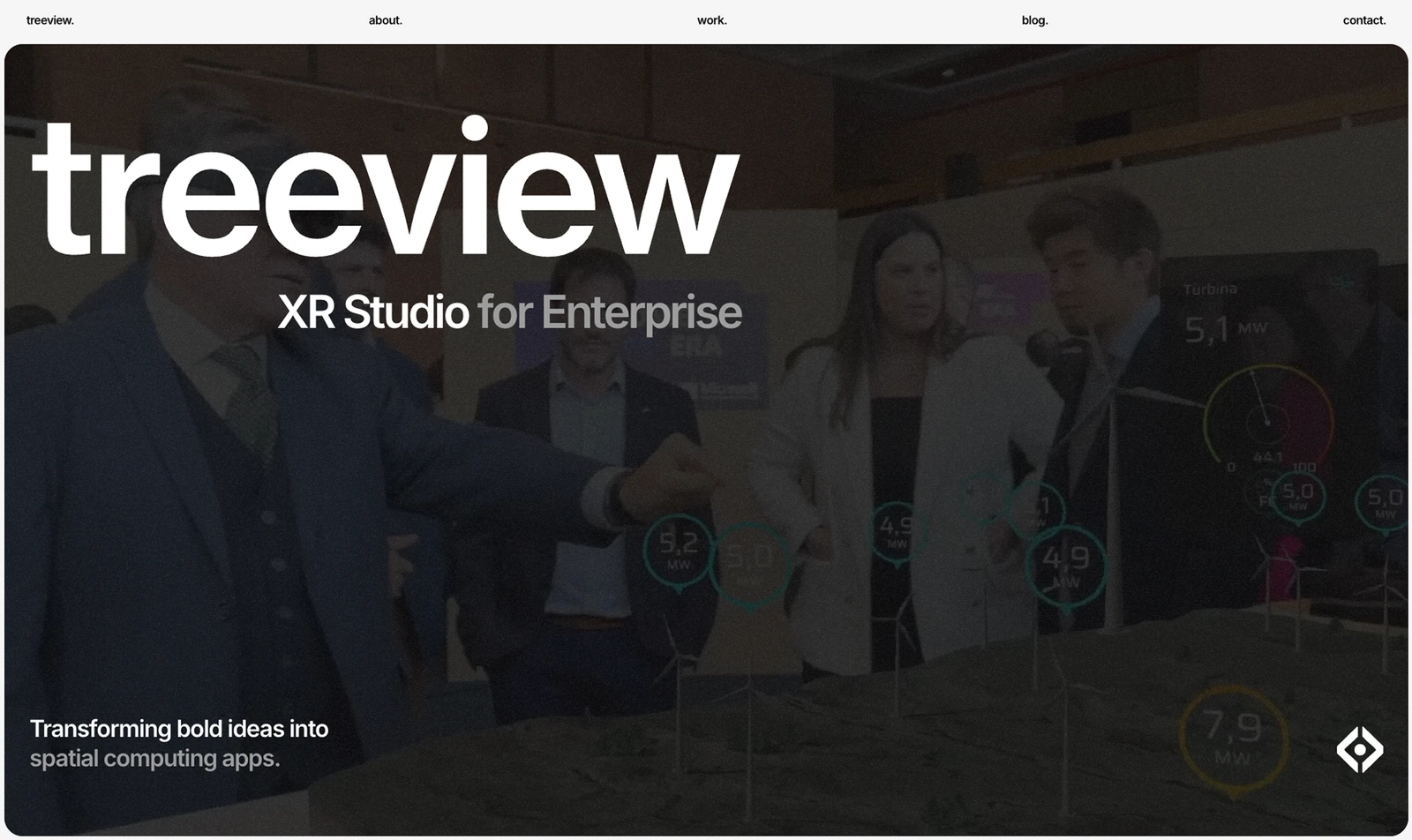
Treeview is an XR studio building custom virtual reality, augmented reality, Mixed Reality and Smart Glasses applications to order. Its named clients are Microsoft, Meta, Medtronic, Toyota, Ford, ULTA Beauty, Daiichi Sankyo, Transfr, the University of Alberta and the University of Adelaide.
Its published twin work is industrial rather than architectural, specifically an AI-enabled digital twin designed and developed with Microsoft for a multi-billion dollar green hydrogen renewable energy project, and augmented reality ski navigation for NEOM's Trojena development. The NEOM work is the closer analogue for construction, since it involves a development under construction and large-area outdoor tracking rather than an interior model.
Where a custom studio fits in this category is narrower than the platform vendors would like and broader than it first appears. The platforms cover the standard workflows well. What they do not cover is the specific tool a project or an operator needs and nobody sells: a stakeholder walkthrough for people who cannot read a drawing, an XR interface onto an existing asset system, a client-facing sales environment for a development still in the ground. Those are build projects.
Full ownership of IP, source code and assets transfers to the client, which in construction matters at a particular moment. Buildings change hands, projects end, and consortium members disperse. A tool tied to a supplier relationship that existed during construction is fragile in a way an owned asset is not.
Published platform coverage includes HoloLens 2, Apple Vision Pro and Meta Quest, plus iOS and Android, on Unity and Unreal Engine, and its stated services span strategy and discovery, 3D content creation, development, system integration, testing, deployment and support. Founded in 2016 by chief executive Horacio Torrendell, it works from Montevideo, Uruguay and New York City. Team size, rates and any BIM software integrations are not published, so Revit or IFC handling is a scoping question. Best for bespoke XR tools around a construction twin rather than the twin itself.
2. Cintoo
Cintoo is a digital twin platform and reality capture software company, and its central technical claim is the one that matters most for construction: it converts point cloud data into 3D meshes with no compromise to accuracy, so teams can do more with scan data.
That conversion is the crux of as-built work. A point cloud from a laser scanner is the most accurate record of what exists, and it is also enormous, slow to move and awkward to work with outside specialist software. Turning it into a mesh that behaves like normal 3D geometry, without losing the accuracy that justified scanning in the first place, is what lets a project team actually use its scan data rather than archive it.
Its published products are BIM Edition, Twin Edition and 360 Edition, plus Workspace, and the split is instructive. BIM Edition addresses the construction phase, comparing what was scanned against what was modeled. Twin Edition addresses the operational phase. 360 Edition addresses panoramic capture, which is cheaper and faster than laser scanning and adequate for many progress and documentation purposes.
It publishes cloud-based processing, describing secure upload, processing, visualization and management of massive 3D scan datasets from anywhere, and states that it is agnostic across capture hardware. Both matter on real projects: scan data outgrows local workstations quickly, and a contractor rarely controls which scanner a subcontractor used. Its site is published in nine languages, which indicates genuine international deployment.
It publishes no founding year, headquarters address, team size, named clients or rates on the pages reviewed, so references and commercial terms need requesting directly. It is a platform rather than a service, so the scanning, the processing decisions and the work all remain yours. Best for projects generating large volumes of scan data that must stay usable across teams.
3. Prevu3D
Prevu3D is enterprise 3D digital twin software built around reality capture, taking data from LiDAR, SLAM, drone mapping and 360 video and turning it into editable 3D environments rather than leaving it as a point cloud only a survey team can use.
Its most relevant capability for construction is overlaying CAD and BIM models against the as-built scan and running clash detection. That is the direct answer to the designed against built problem this category is defined by. Checking a proposed design, a new service run or a retrofit against the building as it actually stands, rather than as drawings claim it stands, prevents the class of error that is discovered on site at maximum cost.
It publishes plugins for Revit, Inventor, AutoCAD and MicroStation, and integration with CMMS and ERP through those connections. The Revit and AutoCAD plugins matter because they meet the industry where it works: a workflow requiring designers to leave their authoring tool tends not to be adopted, however good it is. The CMMS link matters for the operational phase, connecting geometry to maintenance records.
Named clients include Deutsche Bahn, WSP, Tetra Tech, Amsted Rail, General Mills, Olymel, Canam, Agropur, Goodtech and GCM Consultants, with detailed case studies on Deutsche Bahn and Viewrail. WSP and Tetra Tech are large engineering consultancies and Canam is a construction products manufacturer, which is the most directly relevant named evidence in this list. Its stated industries include Oil and Gas, Manufacturing, Food and Beverage, Automotive and Transportation, Geospatial and AEC.
Its published emphasis is industrial facilities rather than commercial buildings, so an architectural buyer should confirm fit for their building type. The company works from 642 Courcelle Street, Montreal, Quebec. A founding year, team size, rates and ownership terms are not published. Best for as-built verification and clash detection against existing structures.
4. Autodesk Tandem
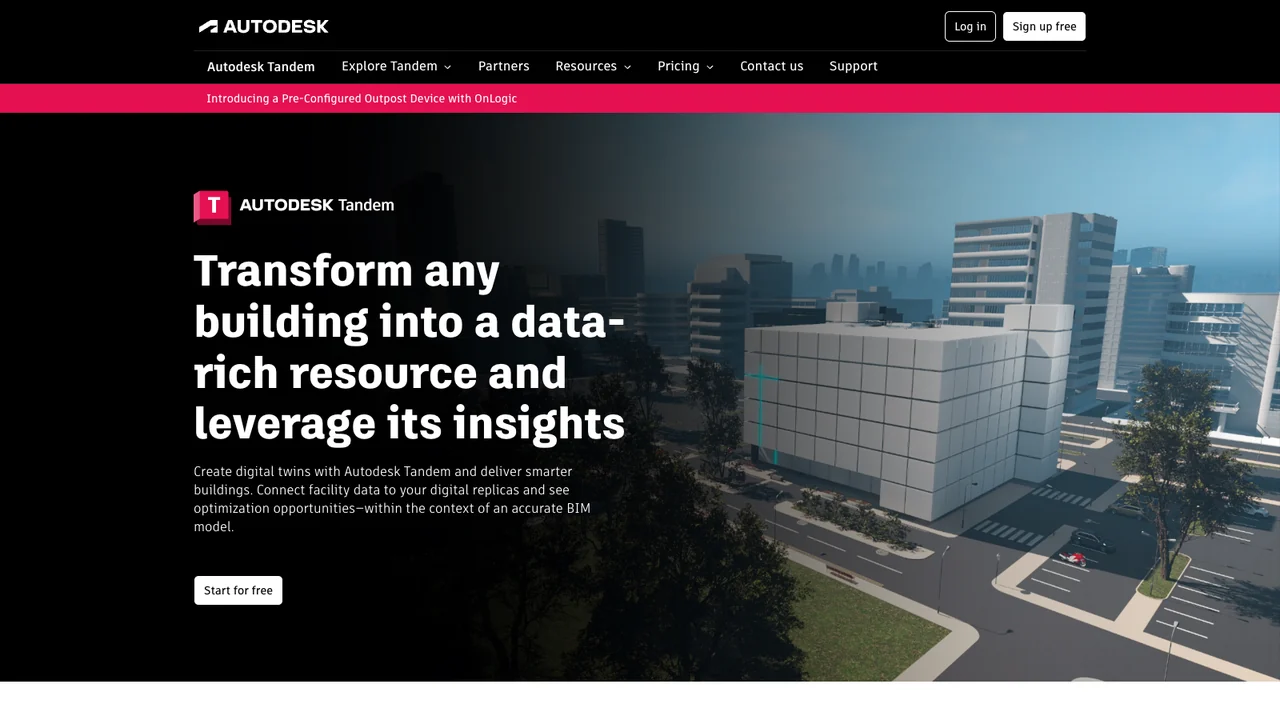
Autodesk Tandem is a product rather than a company, and it is the entry here aimed squarely at the problem the others leave unsolved: what happens after handover. Its published purpose is transforming a building into a data-rich resource, creating digital twins that connect facility data to digital replicas within the context of an accurate BIM model.
Its published structure is Twin Building and Insightful Operations, alongside Tandem Connect and Tandem Insights. The distinction is the useful part. Twin Building is the work of assembling the twin from BIM data with templates, and Insightful Operations is what a facilities team does with it afterwards. Most twin products are strong at the first and vague about the second, which is why so many are handed over and never opened again.
Its structural advantage is where the data already lives. A very large share of the world's building models are authored in Autodesk software, and a twin platform from the same vendor removes the export, translation and fidelity loss that consumes the early phase of most twin projects. Its published note that the interface is similar to other Autodesk software is a real adoption argument for AEC professionals, who do not need retraining.
It publishes pricing and a free tier, which is unusual in this market and genuinely useful, because it allows a real cost comparison and a pilot without a procurement cycle. It also publishes Tandem Connect for operational data and a pre-configured Outpost device with OnLogic for bringing building system data in, which addresses the practical difficulty of getting data out of building management systems.
Two caveats. It is a platform, so the twin is only as good as the model and data you put in, and a poor BIM model produces a poor twin faster. And it deepens a commitment to one vendor's ecosystem, which is a strategic decision rather than a technical one. Best for owners and operators who want the twin to be used after the project team has gone.
5. Siemens
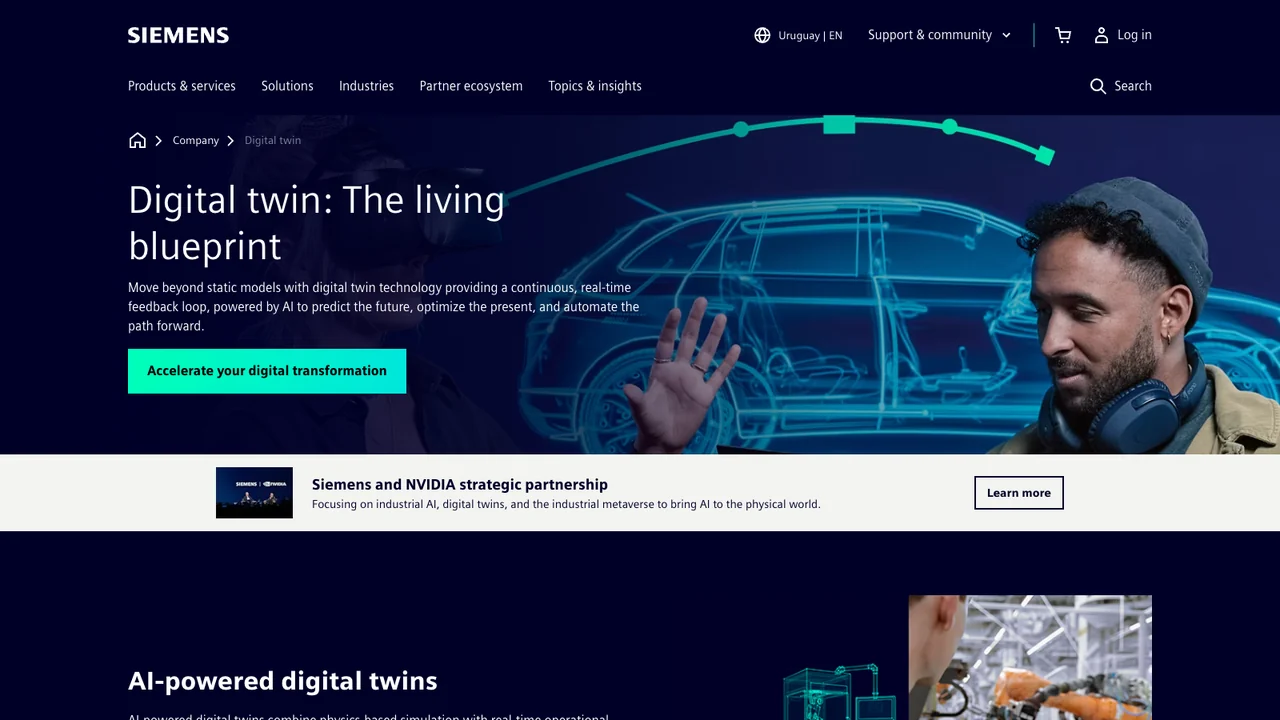
Siemens is a software and automation vendor rather than a development company, and it appears here as the industrial end of the spectrum. Its published position describes digital twin technology providing a continuous, real-time feedback loop, powered by AI to predict the future, optimize the present and automate the path forward, under the heading of a living blueprint.
Its stated approach combines physics-based simulation with real-time operational data to create dynamic representations of products, machines and entire production systems, integrating product and production models spanning mechanics, electronics, software and automation, so systems can be designed, simulated and virtually commissioned before physical build. It publishes a strategic partnership with NVIDIA focused on industrial AI, digital twins and the industrial metaverse.
Virtual commissioning is the concept worth taking from this entry even if you buy elsewhere. Testing that a system works before it is physically built is standard practice in industrial automation and rare in construction, and buildings are increasingly full of the same automation: HVAC control, lighting, access, energy management. A building commissioned virtually before anyone is on site is a genuinely different proposition from one commissioned during handover, which is when most building system problems are found.
Where this fits is narrower than a general construction twin. Siemens is strongest where a building behaves like an industrial system, which means data centers, laboratories, hospitals, manufacturing facilities and heavily serviced infrastructure. For a commercial office or a housing development, the portfolio is oversized and Autodesk Tandem or a capture-led approach is a better match.
It is a large vendor with a broad portfolio rather than a single product, so scoping which parts apply is itself part of the engagement, and it publishes no rates for this. It ranks fifth on a BIM and construction list because its center of gravity is industrial rather than architectural, not because the technology is weaker. Best for highly serviced or industrial buildings where automation and simulation dominate.
What construction twin projects have to account for
Four things determine whether a construction twin outlives the project that produced it.
The first is verifying built against designed. Decide when reality capture happens, how often, and who compares it with the model. A twin handed over without that verification is a design intent wearing a twin's name, and its errors are invisible until they are expensive. Cintoo and Prevu3D both exist to close this gap.
The second is the handover cliff. Capital projects fund construction and end at practical completion, while a twin's value is mostly in the twenty years afterwards. Establish before construction who owns the twin operationally, who pays its running cost, and what skills the receiving team actually has. This is a governance problem rather than a technical one, and it kills more construction twins than any software limitation.
The third is data standards and export. Buildings change ownership, and facilities contracts change hands every few years. Ask what open formats the twin exports, whether IFC survives the round trip with its asset data intact, and what happens to your twin if you stop paying a subscription. Vendor ecosystems are convenient and they are also a long-term commitment.
The fourth is who will open it. A twin requiring BIM skills will be used by people with BIM skills, and a facilities team is generally not that. If the intended user is a building manager, the interface has to suit them, and that should be tested with an actual building manager before purchase rather than assumed.
How to choose between these BIM and construction twin companies
Start from which phase you are funding. During construction, where the question is whether what was built matches what was drawn, Cintoo and Prevu3D are the capture-led answers, with Prevu3D publishing plugins straight into Revit and AutoCAD. After handover, where the question is whether a facilities team uses the thing, Autodesk Tandem is the only entry here designed for that phase.
Then match the building type. Heavily serviced or industrial facilities, where automation and simulation dominate, suit Siemens. Industrial plants needing as-built accuracy suit Prevu3D. Large scan datasets across distributed teams suit Cintoo. A bespoke XR tool nobody sells suits Treeview, with ownership transferring to you.
Make reality capture a scheduled activity rather than a hope. Scanning during construction, while things are still accessible, costs a fraction of scanning afterwards through finished ceilings and walls, and it is the input everything else depends on.
Finally, name the operational owner before construction finishes. A twin without a budget line, a named owner and a receiving team with the right skills becomes an expensive file. That decision is free to make early and close to impossible to retrofit once the project team has dispersed.
Related reading. BestInXR's digital twins guide covers what separates a twin from a model or a shadow. companies for custom digital twin development covers the build against platform decision, and companies building digital twins on Unity and Unreal covers the engine route. For sector twins see digital twin platforms and development companies for energy, and for capture-led environments, VR companies for virtual site tours of energy facilities.
Frequently Asked Questions (FAQ)
1. Is a BIM model a digital twin?
No. A BIM model is design intent, and the built asset differs from it through site conditions, substitutions and undocumented changes. A twin has to reflect what exists, which is why reality capture is central to this category. Handing operations a design model as a twin produces a document that is wrong in ways nobody can see.
2. Which of these verify as-built against design?
Prevu3D publishes overlaying CAD and BIM against as-built scans with clash detection, plus plugins for Revit, Inventor, AutoCAD and MicroStation. Cintoo publishes a BIM Edition and converts point clouds into accurate meshes. Autodesk Tandem builds a twin from BIM plus facility data. Treeview and Siemens publish no capture comparison workflow.
3. Who pays for the twin after construction ends?
Whoever is named before the project finishes, which is frequently nobody. Capital budgets end at practical completion while the twin's value is in the operational decades that follow. Establish the operational owner, the running budget and the receiving team's skills during design, since it cannot be retrofitted once the project team disperses.
4. What happens to the twin if you stop paying a subscription?
That depends on the platform's export terms, and none of the five publishes a full answer on the pages reviewed. Ask what open formats are supported, whether IFC exports retain asset data and relationships rather than only geometry, and what access you keep to historical data. Treeview publishes full transfer of IP, source code and assets for custom builds.
5. Will a facilities team actually use it?
Only if the interface suits them. Autodesk Tandem publishes Insightful Operations specifically for the post-handover phase, and its similarity to other Autodesk software helps AEC users though not necessarily building managers. Test with an actual facilities manager before purchase rather than assuming, since this is where most construction twins quietly stop being opened.
6. What does a construction digital twin cost?
Only Autodesk Tandem publishes rates, and it offers a free tier, so no comparable figure is recorded for the others. Cost is driven by building size and complexity, how often reality capture is repeated, how many building systems are connected, and whether bespoke tools are built. Recurring capture and operational running cost are the lines most often missing from a first budget.