A 3D product configurator is a rules engine with a renderer attached, and buyers consistently evaluate the renderer. The part that decides success is whether the configuration produces something the business can actually build, price and ship. This list ranks five on rules, integration, rendering approach and what the output connects to.
In short:
- Treeview builds custom configurators to specification and transfers full ownership of IP, source code and assets
- ZeroLight publishes Palette SDK for cloud configurator APIs and OmniStream for streaming ZeroLight, Unreal, Unity, VRED and Windows applications
- Kaon Interactive is built for complex B2B products, publishing 3D Product Tours, Demo360 and a design tool
- Expivi publishes Visual CPQ alongside its configurator, with integrations spanning Shopify, Magento, SAP, Salesforce and Shopware
How this list was built
This list ranks companies by four criteria: how configuration rules are modeled, what the configurator connects to downstream, the rendering approach, and what the buyer owns.
Configurators fail in a predictable way, and it is never the graphics. A customer builds something beautiful that cannot be manufactured, or can be manufactured but was priced wrong, or is priced right but reaches the factory as a screenshot rather than a specification. Every one of those is a rules and integration failure, and every one of them is invisible in a demonstration where the vendor has hand-built three valid combinations.
So the useful questions are unglamorous. How are constraints expressed, and by whom. Can a product manager change a rule without a developer. Where does the price come from, and is it the same price the ERP would give. What arrives at the other end when someone orders, and can manufacturing act on it without re-keying.
The second dimension is rendering, and there is a genuine architectural fork. Real-time rendering on the customer's device is cheap to serve and limited by the weakest phone. Cloud streaming renders on a server and sends video, which delivers photoreal quality on any device at a per-session cost that scales with traffic. The right answer depends on whether your product is a fifty-pound chair or a fifty-thousand-pound car.
Disclosure varies. ZeroLight, Kaon Interactive, Expivi and Aircards publish no founding year or team size on the pages reviewed, and none publishes a headquarters address. Pricing is not a ranking factor, because none of the five publishes rates.
| Company | HQ | Rendering | Downstream connection | Best for |
|---|---|---|---|---|
| Treeview | Montevideo, Uruguay / New York City, USA | Built to spec, Unity or Unreal | Whatever is specified | Rules no platform models |
| ZeroLight | Not disclosed | Cloud streaming, OmniStream | APIs via Palette SDK | Photoreal high-value products |
| Kaon Interactive | Not disclosed | Device-based, sales-led | Sales enablement tooling | Complex B2B equipment |
| Expivi | Not disclosed | Web-based | Visual CPQ, ERP and commerce | Made-to-order manufacturing |
| Aircards | Not disclosed | Project-dependent | Not published | Campaign-grade showpieces |
1. Treeview
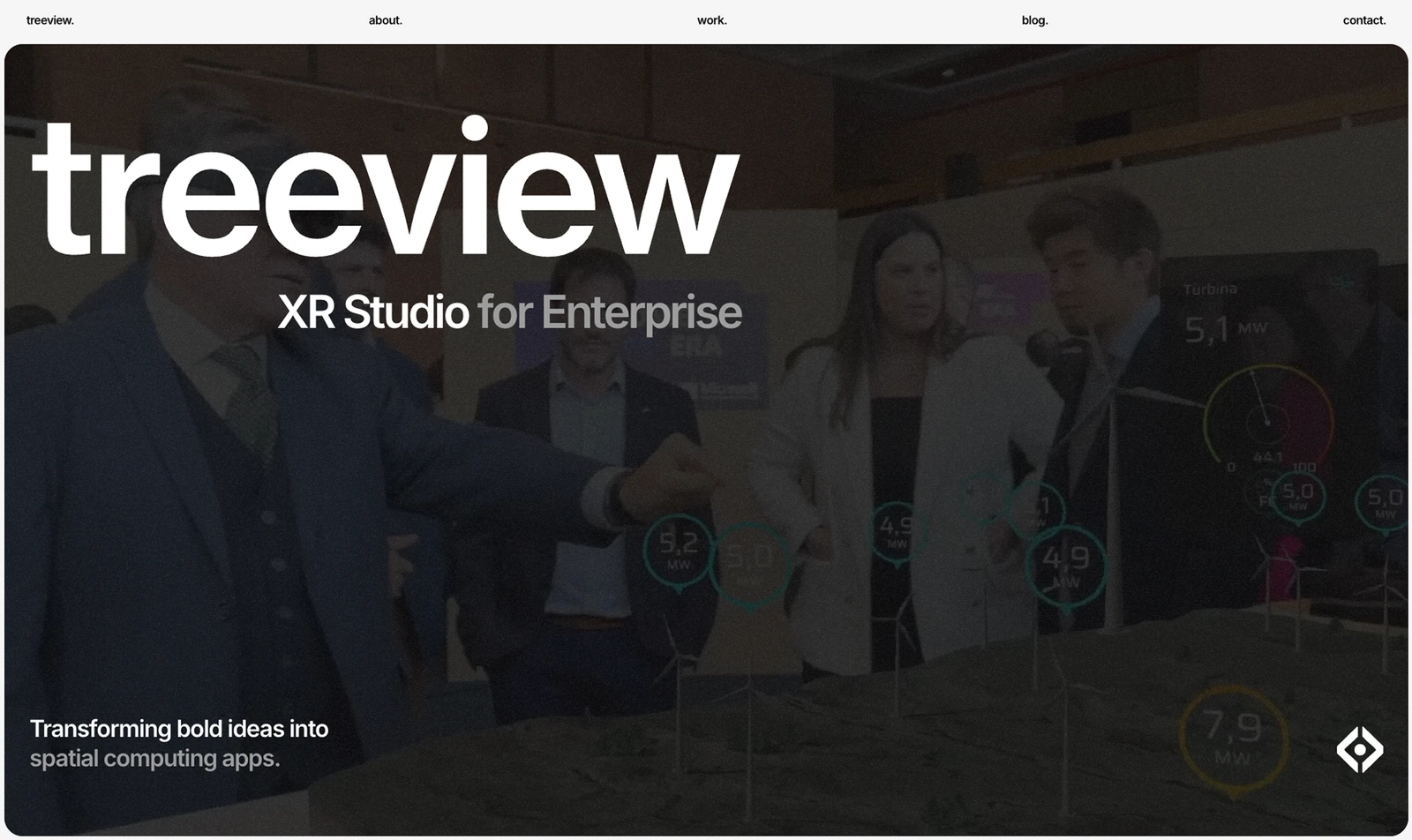
Treeview is an XR studio building custom applications to order on Unity and Unreal Engine, with published coverage across iOS, Android and headset platforms. It publishes no configurator product, so a buyer is commissioning a build rather than licensing a system.
For most configurator requirements that is the wrong choice, and it is worth saying so directly. The platforms below have solved rules modeling, pricing, rendering and commerce integration, and rebuilding that is expensive. The custom case is real but narrow: configuration logic that no rules engine expresses, a product whose behavior is simulated rather than selected, integration with systems that have no connector, or an environment where third-party software cannot be deployed.
Its named clients include Toyota and Ford alongside Microsoft, Meta, Medtronic, ULTA Beauty, Daiichi Sankyo, Transfr, the University of Alberta and the University of Adelaide. Toyota and Ford are relevant because automotive is where configurators are most demanding, and a buyer should ask what those engagements involved.
Full ownership of IP, source code and assets transfers to the client. For a configurator this matters more than usual, because the rules encode commercial knowledge about what your business can build and at what price. That logic is proprietary and it changes constantly as products and costs change, so being able to modify it without a vendor is closer to a requirement than a preference.
Its stated services span strategy and discovery, 3D content creation, development, system integration, testing, deployment and support. Founded in 2016 by chief executive Horacio Torrendell, it works from Montevideo, Uruguay and New York City. Team size, rates, and any CPQ or ERP connectors are not published, so downstream integration would be built rather than configured. Best for configuration logic that no product models.
2. ZeroLight
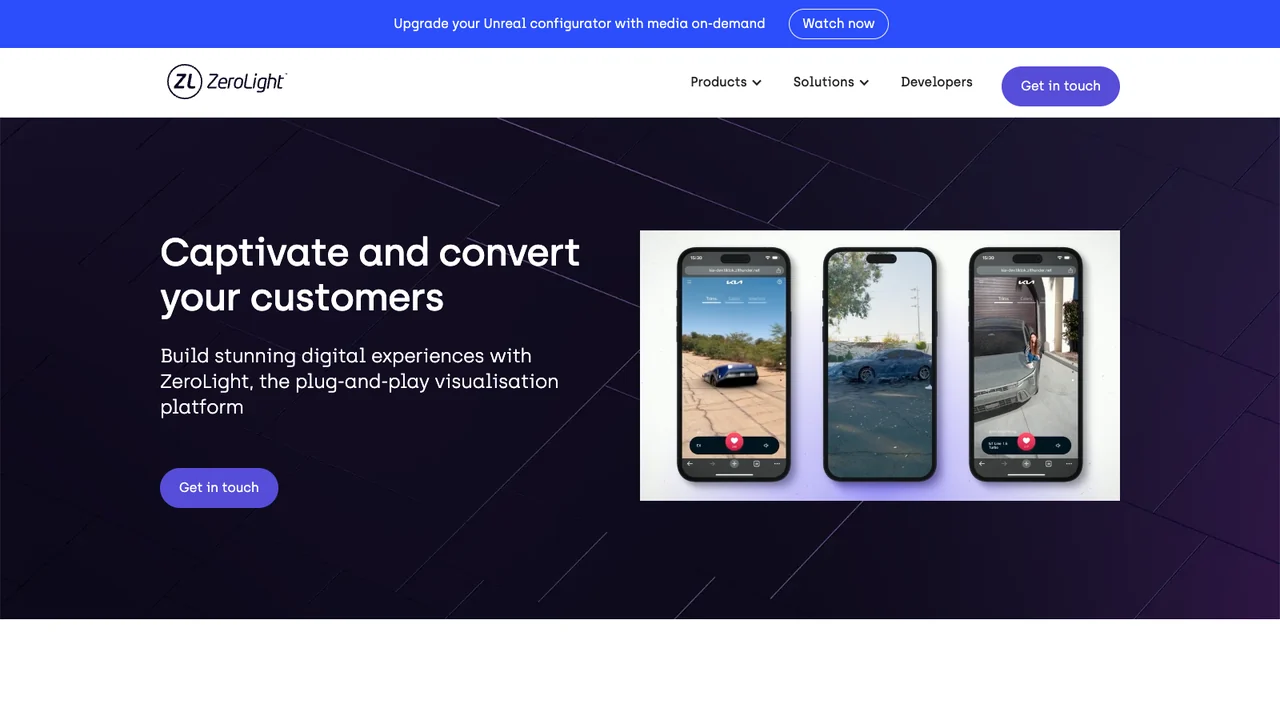
ZeroLight publishes a plug-and-play visualization platform and is the entry here built for the top of the market, where the product is expensive enough that photorealism changes the sale.
Its two published products divide the problem cleanly. Palette SDK provides plug-and-play APIs to integrate and enrich a cloud-based configurator, with advanced features and 3D streaming, omnichannel buying journeys, insights and personalisation, and developer resources. OmniStream streams ZeroLight, Unreal, Unity, VRED and Windows applications as an enterprise cloud streaming standard.
OmniStream is the architecturally interesting part and the reason this company suits high-value goods. Streaming means rendering happens on a server and the customer receives video, so quality is not limited by the customer's phone and the same experience runs on any device. It also means a per-session cost that scales with traffic rather than a fixed hosting bill, which is affordable when each session concerns a car and unaffordable when it concerns a mug.
Its ability to stream VRED is a specific signal. VRED is automotive design visualization software, and supporting it means an OEM can stream the same models its design studio already uses rather than rebuilding them for the web. Its published invitation to upgrade an existing Unreal configurator points the same way, at organizations that already have real-time assets and need distribution rather than creation.
It publishes developer resources and support and frames itself around connected, personalised buying journeys with insights. It publishes no founding year, headquarters address, team size, named clients or rates on the pages reviewed, and its streaming model makes it a poor economic fit for low-value, high-traffic catalogs. Best for automotive and premium goods where visual fidelity carries the purchase.
3. Kaon Interactive

Kaon Interactive builds digital customer engagement for B2B, framed around the observation that buyers complete 83 percent of their problem-solving journey independently, and asking how to tell a complex product story when your team is not in the room.
Its published solutions include Storytelling, 3D Product Tours, Demo360, Fast Launch, Kaon Lab and a Design Tool, alongside Kaon v-Draw, B2B Augmented Reality and B2B Virtual Reality and a content experience platform with integrations and collaboration tools.
Its configuration work sits inside a sales process rather than a checkout, and that is the distinction that decides fit. In Life Science, Information Technology and Industrial Manufacturing, its stated industries, nobody configures a mass spectrometer or a data center rack and clicks buy. A specialist works through requirements with a customer, and the visual tool exists to make a complicated product comprehensible and to move a deal, not to take an order.
The Design Tool and v-Draw entries point at collaborative specification, where customer and salesperson build a solution together. For equipment that is installed rather than delivered, that is the real activity, and it produces a shared understanding rather than a shopping basket.
Its published buyer roles are Marketing Leaders, Sales Enablement and C-Suite and Revenue Leaders, which confirms the sales enablement orientation. It publishes case studies and buyer engagement resources but no founding year, headquarters address, team size, ERP or CPQ integrations, or rates. A manufacturer needing configurations to become manufacturing orders should look at Expivi instead. Best for complex B2B equipment sold through a consultative process.
4. Expivi
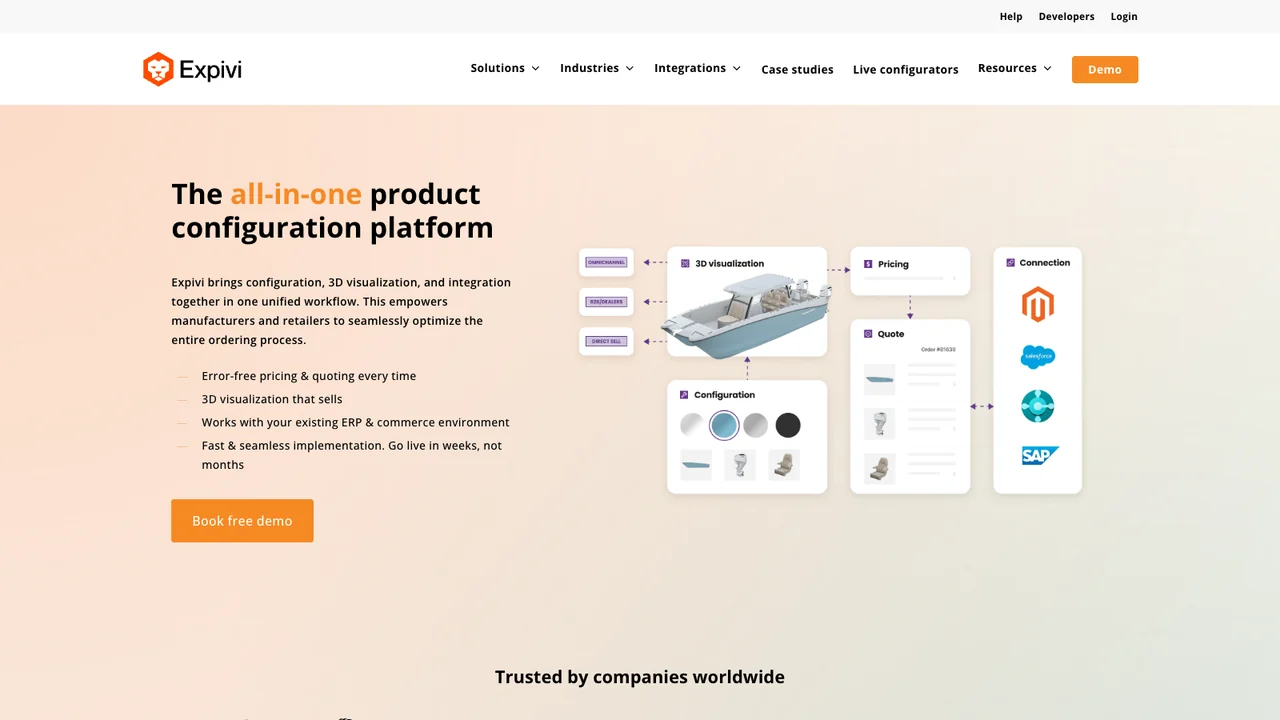
Expivi publishes an all-in-one product configuration platform bringing configuration, 3D visualization and integration together in one workflow for manufacturers and retailers, and it is the entry most directly aimed at made-to-order manufacturing.
Its published platform features are a 3D product configurator, Visual CPQ, Design to print, Guided selling and a Modular configurator. Visual CPQ is the important one, because Configure, Price, Quote is the discipline that connects what a customer selects to what the business will charge and build. A configurator without it is a visualizer that produces wishes.
Its published integrations are the broadest here and they are the practical reason to shortlist it: an API, WordPress, Magento, Shopify, SAP, Shopware, Sana Commerce and Salesforce. SAP and Salesforce matter most. If configured orders must land in the system that runs manufacturing or the one that runs sales, a published connector is the difference between a project and an integration program.
Its stated industries are Furniture, Sporting Goods, Construction and outdoor, Jewelry and fashion, Merchandise, Workwear, Mobility and Printing. Read together these are made-to-order businesses where the customer specifies and the item is then produced, which is exactly where configuration is not a nicety but the only way to sell.
Design to print and the modular configurator address two specific hard cases: personalisation that must reach a printer as production-ready artwork, and products assembled from components with connection rules. Both are places where generic configurators break.
It publishes case studies, live configurators, developer documentation and a partner program, but no founding year, headquarters address, team size or rates. Best for manufacturers whose configured orders must reach ERP and production.
5. Aircards

Aircards is a creative studio rather than a configurator platform, and that framing determines where it belongs on this list. Its published capabilities are Digital Experience and Mixed Reality, Experiential and Events, Creative Production, and Research and Development.
Its published work is brand-led: Outernet's The Butterfly Trail, Red Bull's Spin Like Siakam, Nike On Air, PUMA's A.I. Creator OM described as an AI-powered fan experience, Louis Vuitton's Yayoi Kusama activation, and Lenovo F1's Race to Create combining augmented reality and generative AI design.
The PUMA and Lenovo entries are the ones closest to configuration, and they are instructive about what kind of configuration this is. A fan creating a personalised item, or a participant generating a design, is customization as engagement rather than as commerce. The output is a shareable artefact and a brand moment, not a line on a works order.
That is a legitimate and well-funded use of the technology, and it is bought by brand marketing rather than by operations. A product launch where customers design their own version, a festival activation, a flagship store installation: all of these want production values and a memorable idea rather than a rules engine wired to SAP.
For a buyer the test is simple. If the configured output must be manufactured, priced and shipped, this is the wrong supplier and Expivi or ZeroLight is the right one. If the configured output is a picture the customer shares, Aircards has the strongest brand portfolio here. It publishes no founding year, headquarters address, team size, integrations or rates on the pages reviewed. Best for configuration as a campaign mechanic.
What configurator projects have to account for
Four things determine whether a configurator is used by the business rather than admired by it.
The first is who owns the rules. Products change constantly, and a configurator whose constraints can only be edited by the vendor becomes a bottleneck within months. Ask to see a product manager change a rule during the evaluation, and time it.
The second is whether the price is real. A configurator that computes its own price will eventually disagree with the ERP, and the resulting quotes are worse than no quotes. Establish whether pricing is calculated locally or retrieved from the system of record. Expivi publishes Visual CPQ and SAP and Salesforce integrations for exactly this.
The third is the rendering economics. Cloud streaming, as ZeroLight publishes through OmniStream, gives uniform photoreal quality at a cost per session. Device rendering is cheap to serve and constrained by the weakest phone. Model the cost at your expected traffic before choosing, because the crossover point is a business decision rather than a technical one.
The fourth is what reaches production. Ask what a completed configuration looks like when it arrives at manufacturing, and whether anyone re-keys it. A configurator that ends in a PDF someone retypes has moved the error rather than removed it.
How to choose between these configurator companies
Start from where the configuration ends. If it becomes a manufacturing order, Expivi's Visual CPQ and its SAP, Salesforce and commerce integrations are the shortest path. If it supports a consultative B2B sale of complex equipment, Kaon Interactive is built for that conversation. If it is a high-value purchase where photorealism carries the decision, ZeroLight's streaming architecture is the reason to choose it.
If it is a brand moment where customers personalise something to share, Aircards produces that at a standard the platforms do not aim for. If your rules are genuinely unusual or must live inside your own systems, Treeview builds and transfers ownership.
Test with your hardest product, not your prettiest. Bring the item with the most constraints, the most exceptions and the most awkward pricing, and ask the supplier to model it during evaluation. Configurators are easy to demonstrate and hard to complete, and this is the test that distinguishes them.
Finally, establish who can change a rule and how quickly. Over a five-year life, that single answer will affect the total cost of the system more than the license fee does.
Related reading. BestInXR's retail AR and VR guide covers the catalog arithmetic behind every retail program. AR companies for furniture and home goods placement covers configurable furniture, and AR companies for product visualization covers asset supply. For engineering review see companies for VR virtual prototyping, and for procurement, selecting XR developers for enterprise deployment.
Frequently Asked Questions (FAQ)
1. What actually decides whether a configurator project works?
Rules and integration, not graphics. It works when the configurator enforces what can actually be manufactured, prices from the same source as the ERP and delivers a specification to the factory rather than a screenshot. Every demonstration hides this, because the vendor has hand-built the valid combinations you are shown.
2. Should pricing come from the configurator or the ERP?
From the system of record, otherwise the two will diverge and the quotes become unreliable. Expivi publishes Visual CPQ with SAP, Salesforce, Shopware and Sana Commerce integrations. Establish where the number originates before evaluating anything visual.
3. Cloud streaming or rendering on the device?
Streaming, which ZeroLight publishes through OmniStream, gives photoreal quality on any device at a per-session cost that scales with traffic. Device rendering is cheap to serve and limited by the weakest phone. High-value low-volume products favor streaming; low-value high-traffic catalogs do not.
4. Which of these connect to ERP or CPQ?
Expivi publishes Visual CPQ plus SAP, Salesforce, Shopify, Magento, Shopware, Sana Commerce and WordPress integrations. ZeroLight publishes APIs through Palette SDK. Kaon Interactive publishes sales enablement integrations rather than ERP. Aircards and Treeview publish none, so downstream connection would be built.
5. Can a non-developer change configuration rules?
It varies and it is rarely stated on a website, so test it during evaluation by having a product manager change a real constraint and timing it. Products change continuously, and a configurator that needs vendor involvement for every rule edit becomes a bottleneck quickly.
6. What does a 3D product configurator cost?
None of the five publishes rates, so no figure is recorded here. Cost is driven by rule complexity, the number of components and variants, rendering approach and traffic, integration with ERP and commerce, and asset production. Rule modeling for the hardest products is the line most often underestimated.