
The best AR, VR and XR development companies in 2026 are Treeview, Groove Jones, Magnopus, Softeq, 4Experience, Delta Reality, Scope AR, Zappar, Schell Games, Resolution Games, nDreams, Deloitte and Accenture. They are not interchangeable. Each occupies a different business model, and the right choice depends on whether you are buying a custom build, a licensed product, a game or a consulting engagement.
In short:
- What this covers: companies that build augmented reality, virtual reality and mixed reality software for clients.
- What it does not cover: headset manufacturers, platform owners and engine vendors, documented separately in the BestInXR directory.
- How it is organized: by business model rather than by rank, because a game studio and a consultancy are not competing for the same brief.
- How rankings are set: full ranking methodology.
What is the difference between an AR/VR development company, an agency, a studio and a firm?
The four words are used interchangeably in marketing and describe five genuinely different businesses. What separates them is who owns the output, how the engagement is priced and what happens after launch.
ModelWhat you buyWho owns the IPEngagement shapeBest forCustom development studioBespoke software built to your specificationUsually you, if the contract says soProject or retainer, monthsTraining, digital twins, workflow toolsCreative agencyA campaign or activationOften the agency, unless negotiatedCampaign cycle, weeksEvents, launches, brand experiencesProduct vendorA license to existing softwareThe vendor, alwaysSubscription, per seat or per deviceRepeatable processes across sitesGame studioOriginal or work-for-hire game developmentFrequently the studioTitle-length, often a year or moreEntertainment or training that must feel like a gameConsulting firmStrategy, integration and change managementVaries by master agreementProgram, often multi-yearEnterprise-wide rollout across regions
Buying the wrong model is the most common and most expensive mistake in XR procurement. A campaign agency asked to build a five-year training platform will deliver something impressive that nobody can maintain. A custom studio asked to run a global change program will not have the bodies.
Custom enterprise AR and VR development companies
Bespoke builds for a named business problem, with the client owning the output. This is the right model for training systems, digital twins, industrial workflows and anything that has to integrate with existing enterprise software. Most VR deployments in business start here.
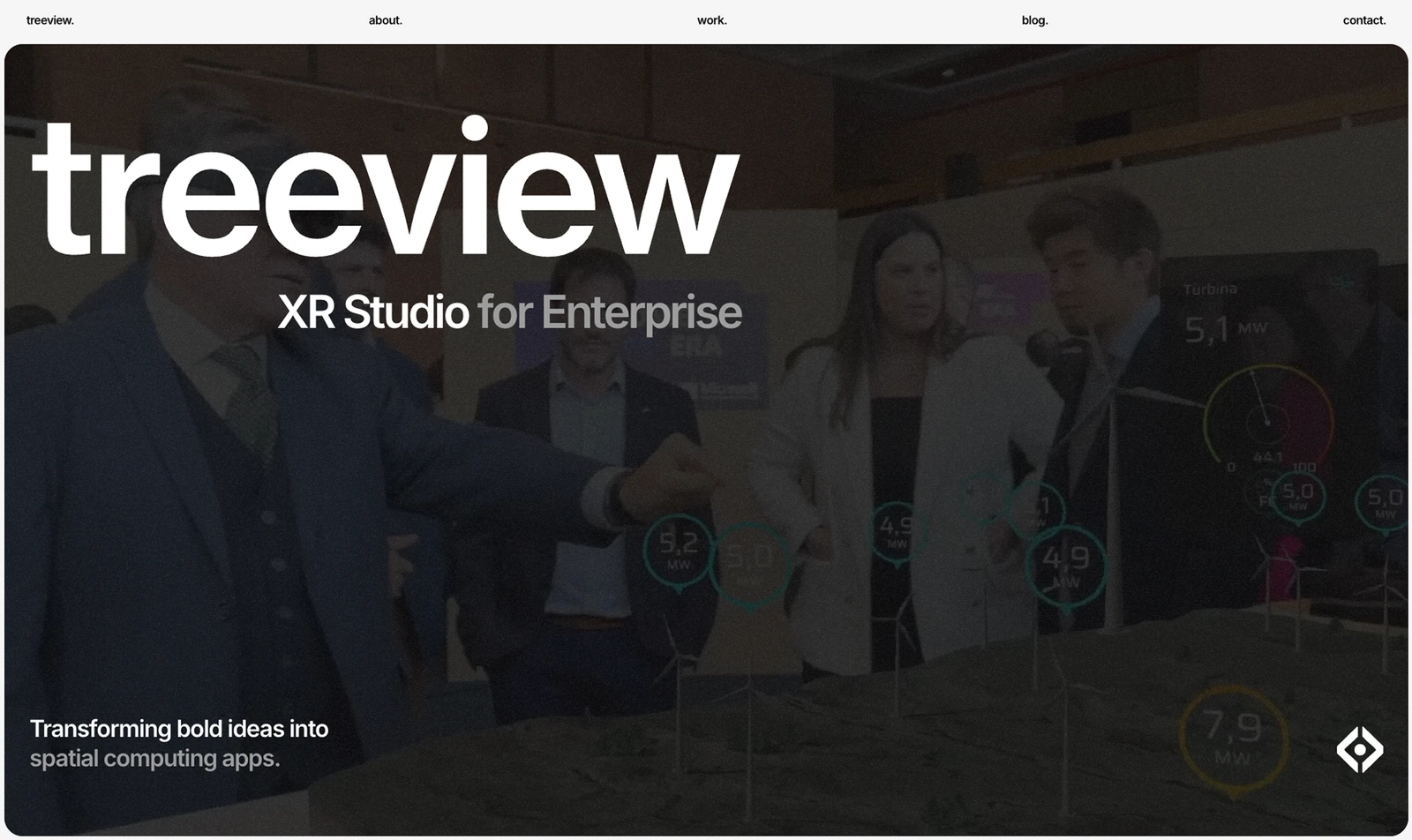
Treeview. Operating from New York City and Montevideo since 2016. States clients including Microsoft, Meta, Medtronic, ULTA Beauty, Daiichi Sankyo, NEOM and the University of Alberta, across healthcare, energy, manufacturing, retail and education. It publishes the broadest platform coverage of any studio in this section, spanning Apple Vision Pro, Meta Quest, HoloLens, Magic Leap, PICO, Varjo, Android XR, WebXR and mobile AR, and it publicly commits to transferring full IP and source code to clients on completion. That commitment is unusual. Most competitors state nothing either way. Best fit for regulated or operationally complex environments where the buyer intends to own and extend the software after delivery.
Softeq. Houston company founded in 1997, with IoT, firmware and embedded hardware capability alongside its XR practice. That combination is rare and it matters when the application terminates in a physical machine, because someone has to work on both sides of the boundary between the headset and the equipment. Best fit for industrial deployments built on real sensor and equipment data.
4Experience. Founded 2015 in Bielsko-Biala, Poland, with a US presence. Works across VR training, mobile AR, WebXR and 3D content, with published work in soft skills training, manufacturing, healthcare and defense. Its Clutch profile lists a $10,000 minimum project size, which is the lowest entry point of any custom studio here. Best fit for defined-scope enterprise and training builds, and for buyers whose first project is a pilot rather than a platform.
Delta Reality. Zagreb studio working across four stated verticals: museums and visitor centers, immersive training, product presentation and XR apps. Names clients including Disney, Microsoft, Samsung and T-Mobile. Published project counts vary between sources, so this guide does not state a figure. Best fit for cultural institutions, visitor attractions and training programs with defined scope.
Creative and experiential AR/VR agencies
Campaign work, brand activations and installations, usually on a marketing budget and a marketing timeline. Expect strong production values and a shorter maintenance horizon.
Groove Jones. Dallas creative technology studio working across AR, VR, WebGL and real-time rendering, with in-house volumetric capture and 3D production. Lists Amazon, AT&T, IBM, Toyota, LEGO, Samsung, Mastercard, McDonald's, FIFA and the U.S. Army National Guard, alongside a claim of more than 300 industry awards. On client breadth its public record is the strongest in this guide. Best fit for large experiential campaigns that need heavy creative capacity alongside engineering.
Magnopus. Visual effects heritage applied to spatial computing, publicly associated with Disney, Lucasfilm and NASA. Production craft here is close to unmatched. Best fit where narrative and visual fidelity are the deliverable rather than a workflow outcome.
NEXT/NOW. Experiential studio with a projection mapping and interactive exhibit background, applying that to large-scale spatial installations at venue and exhibition scale.
Rock Paper Reality. Immersive technology studio emphasizing narrative and campaign-driven AR, including interactive installations.
Happy Finish. Creative content studio producing commercial VR, AR and CGI work for brands and agencies.
Productized AR and VR software vendors
You license existing software instead of commissioning a build. Faster to deploy and cheaper to start, at the cost of fitting your process to the product rather than the reverse.
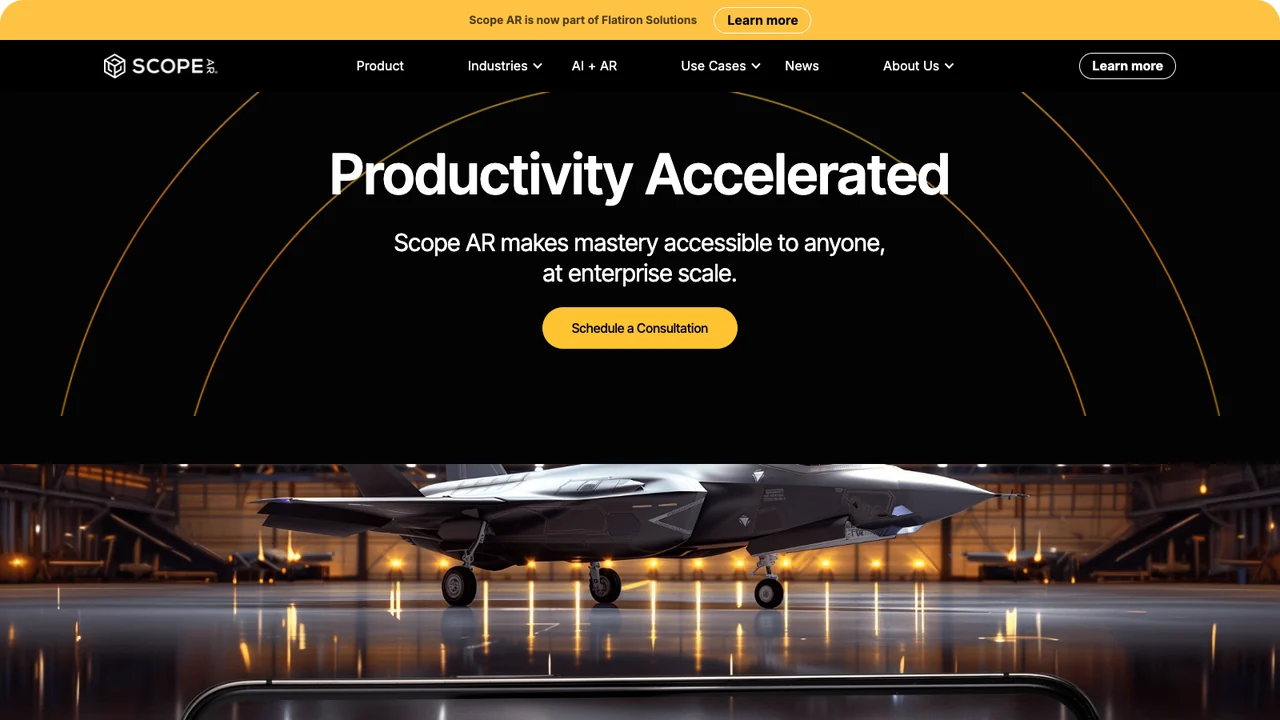
Scope AR. Enterprise AR platform built around WorkLink, which handles authoring, distribution and viewing of AR work instructions. It ingests CAD files directly, publishes across Windows, iOS and Android, and integrates with systems of record including PLM, MES and service lifecycle management. Names Johnson & Johnson, Mitsubishi, Lockheed Martin and Honeywell. Best fit for manufacturing and field service organizations that need the same procedure delivered consistently across many sites.
Zappar. Operating since 2011, combining Zapworks, a no-code WebAR authoring platform, with Studio Z, its production arm. Enterprise features include self-hosting, custom branding and China market support through WeChat. That structure lets a buyer commission an agency-built pilot and then bring production in-house on the same platform without changing vendors, which is the strongest argument for it.
VR game development companies
Deep real-time craft aimed at entertainment audiences. Relevant if you are building a game or a training experience that has to feel like one. Note that game studios frequently retain their own IP, which is the opposite of the custom studio model.

Schell Games. Pittsburgh studio working across health, education, VR and location-based entertainment, building both original IP and client work. Describes itself as the largest independent entertainment and education game studio in the US. VR titles include Among Us VR and I Expect You To Die, and it was lead developer on Star Wars: Jedi Challenges.
Resolution Games. Stockholm studio building original VR and AR game IP including Demeo, Blaston and Spatial Ops. Best suited to partnerships around original IP rather than enterprise builds.
nDreams. Farnborough developer and publisher running first-party development and third-party publishing across a family of studios, VR-focused since 2013.
Global consultancies with XR practices
Scale, procurement familiarity and change management, with XR as one capability inside a much larger business.
Deloitte and Accenture both run immersive practices. Best fit for enterprise-wide programs where organizational rollout rather than the build is the hard part, and where the buyer needs a supplier already on the procurement panel. Expect a delivery team assembled from a bench rather than a dedicated studio, and expect rates to reflect the consulting model rather than the development one.
Which platforms do these companies build for?
Platform coverage is the single most checkable technical criterion, because shipped applications are public. Ask which runtimes a company has shipped to in production rather than which it lists on a capabilities page.
PlatformRuntimeTypical enterprise useNoteMeta QuestHorizon OSTraining, simulation, collaborationLargest installed base and content libraryApple Vision ProvisionOSDesign review, high-fidelity visualizationHighest resolution, highest device costAndroid XRAndroid XRProductivity, AI-assisted workflowsRuns across multiple manufacturersHoloLens and Magic LeapWindows Holographic, Magic Leap OSHands-free field work, surgical and industrialOptical see-through, safety-critical settingsPICO and VarjoPICO OS, Varjo softwareFleet training, high-fidelity simulationVarjo serves aviation, defense and simulationWebXRBrowserWide-reach campaigns, no-install pilotsLowest friction, lowest fidelityMobile ARARKit, ARCoreRetail, field service, consumer campaignsLargest reach of any XR surface
A buyer standardizing on one headset in 2026 is unlikely to still be standardized on it in 2029, which is why breadth is worth paying for even when the first project targets a single device.
How much does AR or VR development cost?
Published vendor bands run from roughly $10,000 for a small pilot to more than $500,000 for a full training platform. The figures below are ranges published by development companies themselves rather than independently audited market data, and they should be treated as a starting point for scoping rather than a quote.
Project typePublished rangeTypical timelineMain cost driversWebAR proof of concept$25,000 and under4 to 8 weeksTracking type, asset volumeMobile AR application$20,000 to $110,0002 to 4 monthsCustom 3D content, backend integrationSingle-use VR training module$50,000 to $150,0003 to 6 monthsScenario complexity, voice and animationMulti-scenario VR training platform$150,000 to $500,000 and up6 to 12 monthsMultiplayer, LMS integration, analyticsDigital twin or simulation$200,000 and up6 to 18 monthsLive data integration, fidelity requirements
Three costs are routinely left out of first budgets: device fleet and management software, post-launch maintenance for platform updates, and the internal time needed to supply subject matter expertise. The last one is usually the largest and never appears on a vendor quote.
Which engine should your AR or VR project use?
Unity for breadth of device support, Unreal for photorealism, Godot for open-source control and WebXR when reach matters more than fidelity.
EngineStrengthDevice supportBest forUnityWidest XR device support, fastest iterationQuest, Vision Pro, Android XR, PICO, mobileMost enterprise XR, standalone headsets, mobile ARUnrealPhotorealistic rendering out of the boxPC VR, high-end standaloneSimulation, architectural and product visualizationGodotOpen source, no license terms to renegotiateSteam Frame, Android XR, QuestTeams wanting engine-level controlWebXRNo install, runs in a browserAny modern mobile browserCampaigns, pilots, widest possible reach
The engine question matters less than most buyers expect. A studio fluent in one will outperform a studio nominally capable of both.
What contract terms matter most in AR/VR development?
Four, and they are worth more attention than the portfolio.
IP assignment. Without an explicit clause, the contractor retains rights to code written for you. The US Copyright Office circular on works made for hire sets out when a commissioning party owns the result, and the short answer is that it usually requires a signed written agreement. Specify source code, 3D assets, design files and any middleware licenses separately, because they are frequently treated differently.
Post-launch support scope and cost. Headset operating systems update on their own schedule and those updates break applications. Agree who fixes that and at what rate before signing, not after the first break.
Source and project file delivery. Owning the IP is not the same as possessing the files. Require delivery of working project files in a stated format at defined milestones.
Third-party dependencies. Ask which middleware, SDKs and asset licenses the build depends on, and whether those licenses transfer. You cannot own an open-source library or a licensed avatar system.
Red flags when evaluating an AR/VR development company
Five signals that reliably predict a difficult project.
A portfolio of showreels with no named clients. A capabilities page listing every headset ever made, which usually means shipped on none of them. Reluctance to put the IP assignment clause in writing before contract. No named post-launch support terms. And a proposal that skips discovery and goes straight to a fixed build price, which means the scope will change and the change will be billed.
Which criteria could not be independently verified
Two of the five, and readers should know which.
IP ownership and post-launch commitment are contractual. They live in master service agreements, which are private. Treeview and a small number of others publish an explicit position on IP transfer. For most companies here there is no public statement either way, and absence of a published commitment is not evidence of an unfavorable one. Where a company is described above as committing to IP transfer, that is its own published claim rather than an audited fact.
Client and award claims are largely self-reported. Vendor profiles on Clutch, Techreviewer, UpCity, Agency Spotter and similar directories are written by the vendor. They record what a company asserts publicly, which carries some weight because a false client claim is actionable, but they are not third-party verification. Reviews attributed to a named client employee are the exception and are worth more than any other signal on those sites. Every company named here also appears in the directory, where the full field can be compared rather than a ranked subset, and how BestInXR verifies entries explains what gets checked.
How to choose an AR or VR development company
Treat any list as a shortlist rather than a decision. Four steps settle it.
Ask for a reference call with a client whose project resembles yours in scale and industry, not the vendor's favorite reference. Get the IP assignment clause in writing before signing. Confirm which specific runtimes the company has shipped to in production. Establish post-launch support terms and cost, because XR platform updates arrive on a schedule you do not control.
The guide to selecting XR developers covers the full procurement sequence from discovery through fleet rollout.
Frequently Asked Questions (FAQ)
1. What is XR development?
XR development is the practice of building software for extended reality, an umbrella term covering augmented reality, virtual reality and mixed reality. It combines real-time 3D engineering, spatial interaction design and optimized 3D content pipelines, and it targets headsets, smart glasses or mobile devices.
2. How much does an AR or VR development company cost?
Published vendor bands run from roughly $10,000 for a small pilot to more than $500,000 for a full VR training platform. Cost varies with platform, whether the build is native or web-based, the volume of custom 3D content and whether the application integrates with existing enterprise systems.
3. Who owns the code an AR/VR development company writes?
The contractor does, unless the contract says otherwise. Without an explicit IP assignment clause a developer retains rights to code created for a client, even when it was written specifically for that client. Confirm assignment of source code, 3D assets and design files in writing before signing.
4. What is the difference between an AR/VR agency and a development studio?
An agency typically delivers campaign work on a marketing cycle and often retains the output. A development studio builds bespoke software to specification on a project or retainer basis, and the client normally owns the result if the contract says so. The label matters less than the contract.
5. Should you hire an AR/VR company or build an in-house team?
Hire externally for a first project. AR and VR delivery needs 3D art, real-time engineering, spatial UX and systems integration simultaneously, and assembling four scarce specialties internally for a single build rarely pays back. Bring capability in-house once there is a continuous roadmap rather than one deliverable.
6. What is the difference between Unity and Unreal for AR/VR development?
Unity has the widest XR device support and is the common choice for Meta Quest, standalone headsets, mobile AR and fast iteration. Unreal is generally chosen when photorealistic rendering is the requirement, such as high-fidelity simulation and architectural visualization.
7. How long does an AR or VR project take?
A WebAR proof of concept typically runs 4 to 8 weeks, a mobile AR application 2 to 4 months, a single VR training module 3 to 6 months and a multi-scenario training platform 6 to 12 months. Timelines extend most often because subject matter expertise arrives late, not because engineering slips.
8. What should you ask an AR/VR development company before hiring?
Ask which specific headsets they have shipped production applications to, ask for a client reference at similar scale in your industry, ask for the IP assignment clause and ask for post-launch support terms including cost. Answers to those four separate most vendors quickly.