


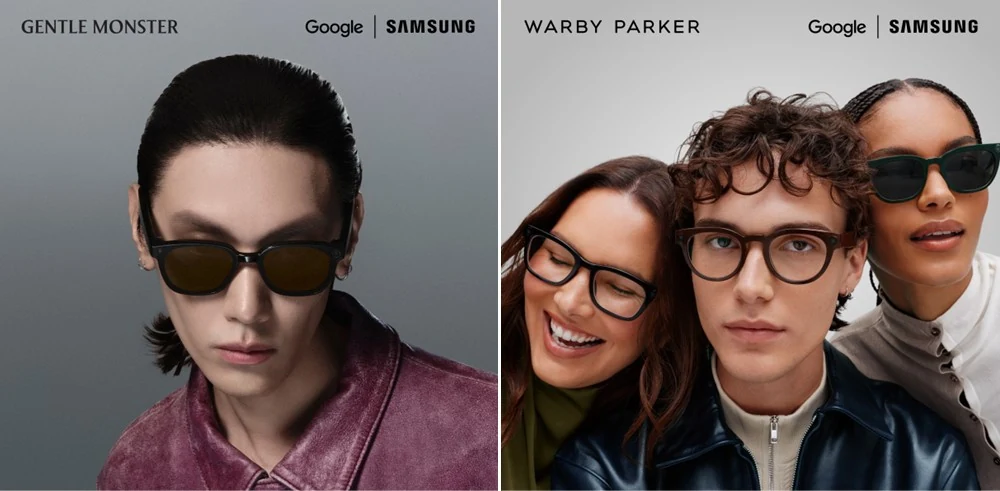
Samsung and Google opened preorders for Intelligent Eyewear on November 12, 2026 and set general availability for December 10 in the United States, with the Gentle Monster collection also launching in South Korea. Warby Parker frames start at $395 and Gentle Monster frames run $449 to $489. The glasses weigh about 41 grams and carry a 12MP camera.
In short:
- What it is: camera and audio glasses with Gemini built in, engineered by Samsung and sold in 30 frame designs across two eyewear brands.
- US prices: Warby Parker from $395, Gentle Monster from $449 to $489, both published by Samsung on November 12, 2026.
- Dates: preorders opened November 12, 2026. General availability is December 10, 2026 in the US and in South Korea for the Gentle Monster collection.
- Often confused with: the color display glasses reported for a later Samsung product, which is a separate device nobody has announced.
What Intelligent Eyewear costs
Samsung's own release gives two US price points. Warby Parker Intelligent Eyewear starts at $395, and Gentle Monster Intelligent Eyewear ranges from $449 to $489 depending on the model. Both figures are list prices for standard lenses, and both companies sell prescription options on top.
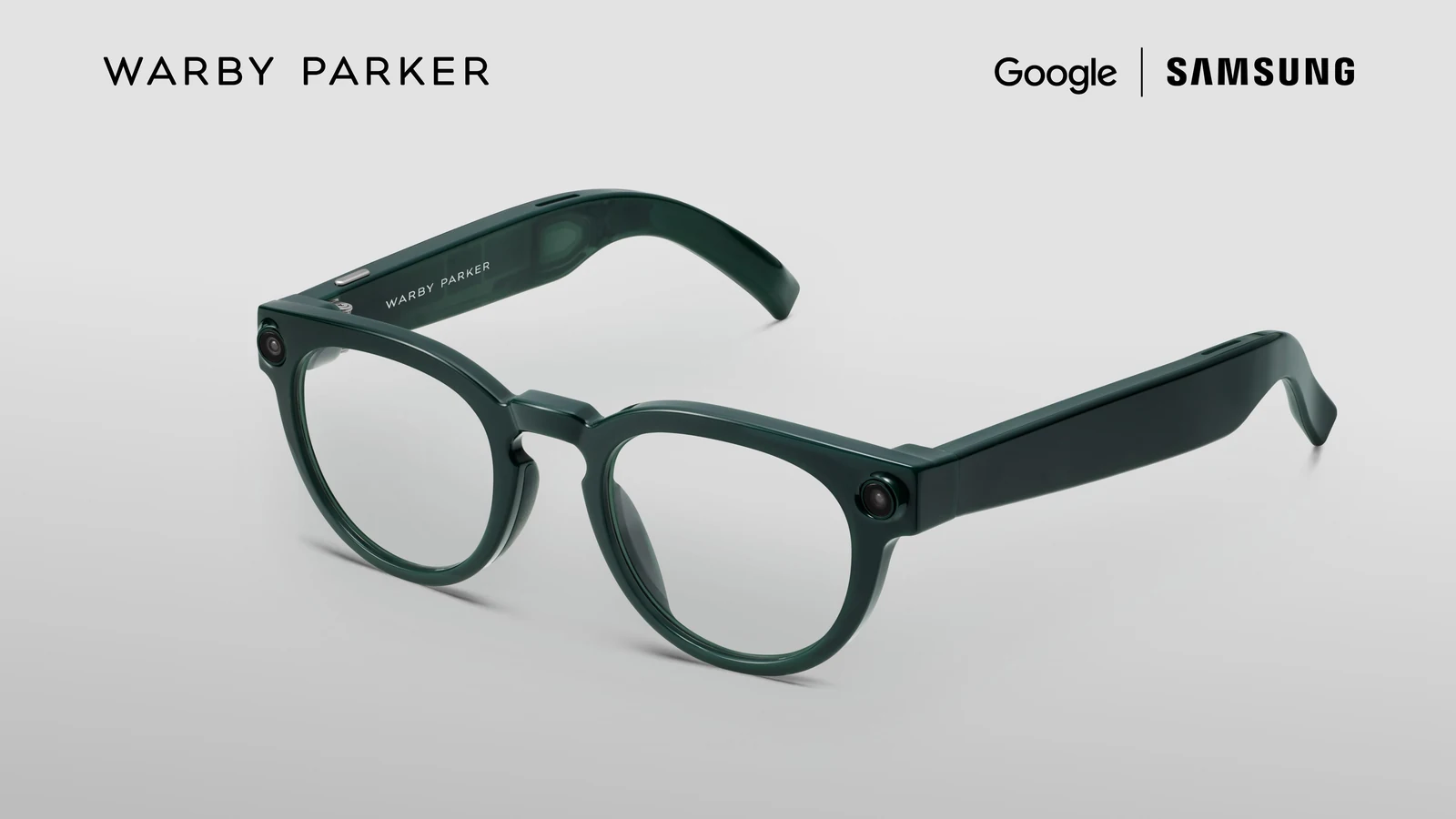
Gentle Monster's shop-all page carried three price points when it was read on November 13, 2026: $449, $469 and $489 across sixteen variations, matching the range in Samsung's release. Google's own announcement gives the same two starting figures and names the three Warby Parker styles as Alden, Reid and Wren, in Pine, Saddle and Jet Black, in optical and sun versions.
Prescription lenses are priced by the frame brand rather than by Samsung or Google. Google's product site says a buyer adds prescription details on the manufacturer's product page to see which lens options are available and points to Warby Parker and Gentle Monster for the detail. Neither Samsung nor Google publishes a figure for that step, so the number a buyer pays sits above the starting price by an amount the frame brand sets.
How many designs each brand sells
Thirty designs in total, split six frame styles to Gentle Monster and three to Warby Parker. Samsung's release counts them by variation rather than by shape: the Gentle Monster collection holds sixteen variations built on its six frame styles, and the Warby Parker collection holds fourteen variations built on its three designs, with a range of width and lens options.

Where a buyer can hold a pair before December 10 differs by brand. Google says hands-on demos run at select Gentle Monster, Warby Parker and Google Store locations, and that customers can book a guided demo at more than 360 Warby Parker retail stores. Samsung adds that its own retail locations begin demonstrations on December 10, the day the glasses go on general sale.
Where the first preorder batch stands
Five of the sixteen Gentle Monster variations had left the first preorder batch within a day of opening. Read on November 13, 2026, Gentle Monster's US shop-all page labelled GGS006 01, GGS006 R15, GGS005 01, GGS003 01 and GGS003 01(BR) as "2nd Pre-order Notify me" rather than offering a preorder button, and the page's product markup carried those five as out of stock while the other eleven carried preorder availability.
The page heading reads "1st Batch Pre-Order" with the date November 12, which is how Gentle Monster describes the allocation. Gentle Monster states that Intelligent Eyewear is available for preorder on its official Korean and US online stores only.
What Samsung publishes as the specification
Samsung's release carries a full specification table. The published figures are below.
| Specification | Samsung's published value |
|---|---|
| Weight, glasses | About 41g. Gentle Monster 39.6 to 43.9g, Warby Parker 40.4 to 42.6g, standard lenses |
| Weight, charging case | Gentle Monster 194.5g, Warby Parker 166.8g |
| Processor | Snapdragon AR1 Gen 1 |
| Camera | 12MP HDR, photos at 3,024 x 4,032, video at 3K 30fps or 2K, HDR video up to 2K |
| Audio | Two open-ear speakers, four microphones |
| Memory and storage | 2GB memory, 64GB storage |
| Battery | Up to 9 hours on a charge, up to 72 hours with a charged case |
| Controls | Touch and voice |
| Assistants | Google Gemini, plus Bixby with Galaxy phones |
| Water resistance | IPX4, glasses only |
| Networking | Wi-Fi 6E, Bluetooth 5.4 |
At about 41 grams the frame weighs what ordinary eyewear weighs, and the battery has to run a full day inside that budget. Samsung says a split-computing system moves part of the processing load to a paired Galaxy phone, and credits that approach together with its component placement, battery design and thermal management for the balance of performance and weight.
Samsung's specification table lists no display, no panel and no optics, and the capabilities the release describes are audio, camera and voice throughout. That places Intelligent Eyewear in the camera glasses category alongside Ray-Ban Meta rather than in the display glasses category.
Which phones the glasses work with
Intelligent Eyewear pairs with Galaxy, Pixel and iPhone. Samsung lists Galaxy S, Galaxy S FE, Galaxy Z Fold, Flip and Fold Ultra series on One UI 9.0 or higher. It also lists Google Pixel 7 series and later on the Android 17 September 2026 update or later, plus iPhone 13 and later with at least 6GB of RAM on iOS 26.6 or later. Google's product site gives the same three lists.
Bixby runs only with Galaxy phones, by Samsung's own footnote, so the assistant layer is thinner on a Pixel or an iPhone than on a Galaxy. Gemini is the assistant on all three.
What the privacy controls do
Both companies published the same four mechanisms, and Google gave them a separate post on the same day.
An outward LED signals capture to people nearby, and both companies state that the glasses are designed to stop capturing if that light is covered, blocked or not working. The wearer gets an inner light and a sound at the same moment. Camera visuals from Gemini on glasses are kept out of Gemini History and out of AI training and ad targeting, and the glasses are designed to redact bystanders' faces before Gemini processes what it sees. A physical switch turns the camera, microphones and Gemini off so the frames work as ordinary eyewear. Samsung adds that the product is designed for users aged 18 and over, with age verification required to activate the device and download the app.
Google says Gemini waits in standby until it detects an activation such as "Hey Gemini", and that a noise resembling the phrase can trigger it too. In standby, by Google's account, the glasses send nothing of what the wearer says to Google or anyone else.
Related reading. Our AI glasses comparison lists the camera and audio glasses already on sale with their checked prices, and the smart glasses guide sets out how the categories divide. Our earlier report covered the preorder date before the price was published.
Frequently Asked Questions (FAQ)
1. How much does Samsung Intelligent Eyewear cost?
Warby Parker Intelligent Eyewear starts at $395 in the United States and Gentle Monster Intelligent Eyewear ranges from $449 to $489, both figures published by Samsung on November 12, 2026. Prescription lenses are priced separately by each frame brand.
2. When does Intelligent Eyewear go on sale?
December 10, 2026, in the United States for both collections and in South Korea for the Gentle Monster collection. Preorders opened on November 12, 2026 through Warby Parker's retail and online channels and Gentle Monster's official online store.
3. Does Intelligent Eyewear have a display?
Samsung's published specification table lists a 12MP camera, two open-ear speakers and four microphones, with no display, panel or optics of any kind. It is camera and audio eyewear, and what the wearer gets back from Gemini comes as sound.
4. Does Intelligent Eyewear work with an iPhone?
Yes. Samsung lists iPhone 13 and later with at least 6GB of RAM running iOS 26.6 or later, alongside Galaxy S, S FE and Z series phones on One UI 9.0 or higher and Pixel 7 and later on the Android 17 September 2026 update. Bixby is the one assistant limited to Galaxy phones.
5. How long does the battery last?
Up to nine hours on a single charge and up to 72 hours with a fully charged charging case, by Samsung's own figures, measured on a mixed-use scenario that may include Gemini conversations, music, video capture and notifications. Google says a charge to 60 percent takes about 30 minutes.
6. What chip is inside Intelligent Eyewear?
The Snapdragon AR1 Gen 1 platform, named in Samsung's specification table. Qualcomm's own July 2026 release states that the same platform powers Samsung and Google's intelligent eyewear, and Samsung says a split-computing system moves part of the processing load to a paired Galaxy phone.


