

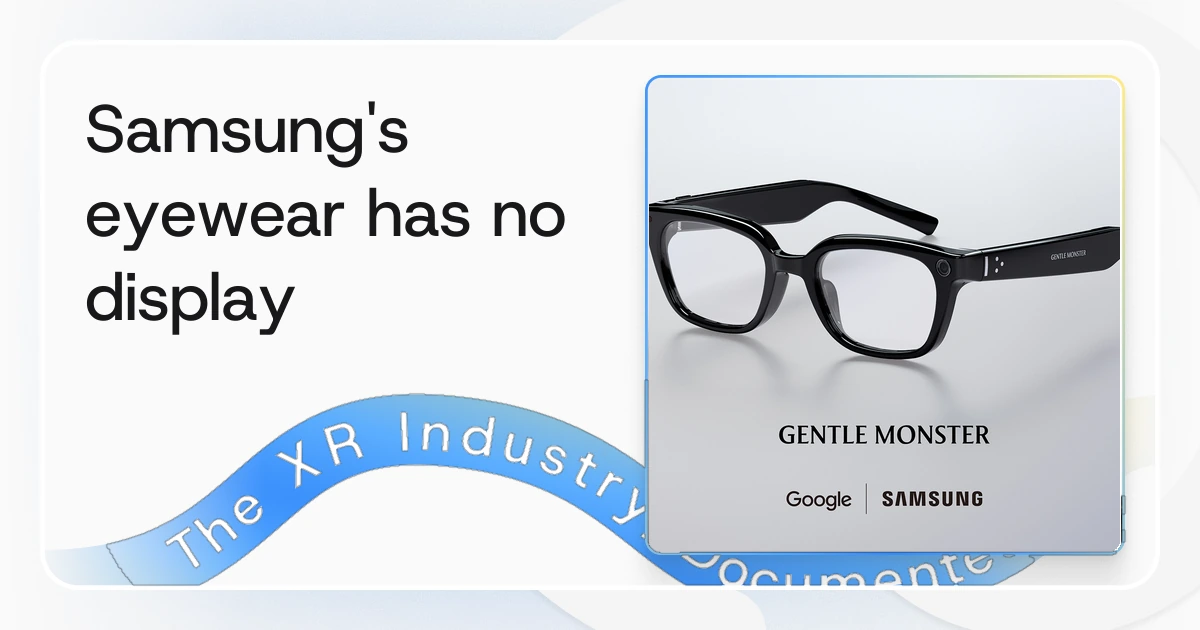
Samsung announced its intelligent eyewear on July 22, 2026, and its own release describes a camera, an assistant and nine hours of battery with no display of any kind. A separate report from the Korean outlet The Elec says Samsung has asked for color microdisplays for a later pair, with late 2027 mentioned. Those are two different products.
In short:
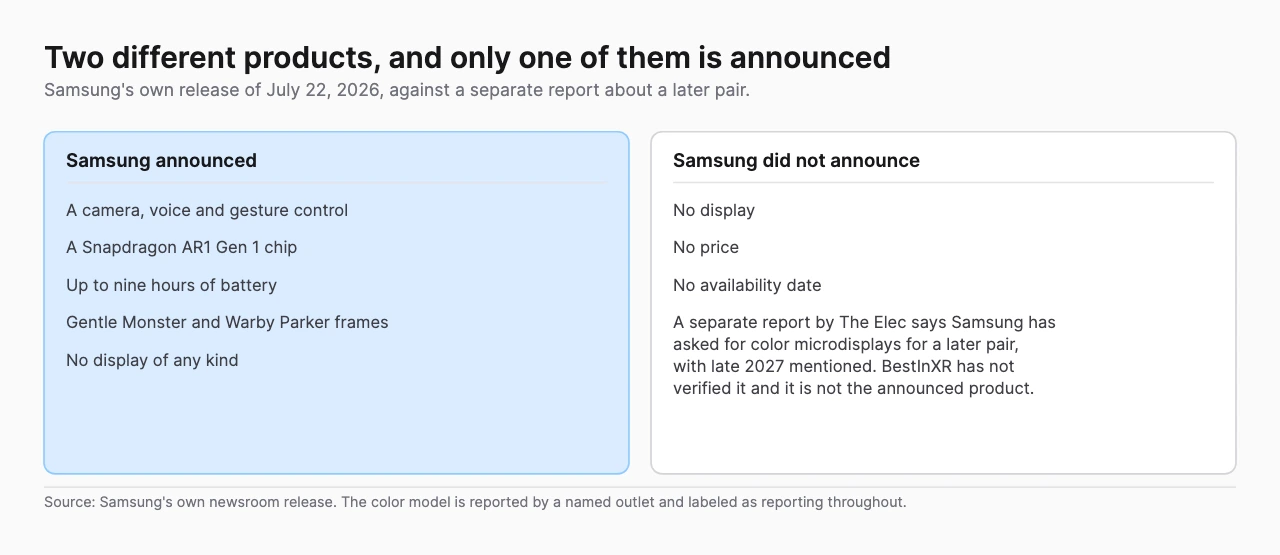
- What Samsung announced: camera, voice and gesture control, a Snapdragon AR1 Gen 1 chip, up to nine hours of battery, in Gentle Monster and Warby Parker frames.
- What Samsung did not announce: a display, a price or an availability date.
- What was reported: The Elec says Samsung has requested color microdisplays of around 0.2 inches for future glasses, timing given as late 2027.
- Why they get confused: both are described as Samsung's Android XR glasses, and only one of them exists.
What Samsung announced in July

Samsung introduced its intelligent eyewear at Galaxy Unpacked in London on July 22, 2026, developed with the eyewear brands Gentle Monster and Warby Parker.
The hardware Samsung lists is specific. A built-in camera brings visual context to the assistant. The Snapdragon AR1 Gen 1 platform handles the processing, with touch interaction, connectivity and thermal management inside the frame. Battery runs up to nine hours on a charge, with up to seven further charges from the case. It runs on Android XR and brings in Gemini.
Won-Joon Choi, chief operating officer of Samsung's Mobile eXperience business, framed it as a new interaction point rather than a screen, saying intelligent eyewear "creates a new point of interaction, bringing more personalized AI assistance naturally into the moments that make up everyday life".
The capabilities Samsung lists follow from that. Summarizing long messages, reading information aloud, live translation, capturing what the wearer is looking at into Notes, route guidance and sharing a point of view on a call. Every one of them is audio, camera, voice or gesture.
Where the announcement stops
The word display does not appear anywhere in the announcement. Neither does any panel, resolution, field of view or optical component.
The only two references to a screen point the other way. Samsung writes that the eyewear brings AI closer to people "without requiring every interaction to begin with a screen", and that hands-free access delivers assistance "without requiring users to stop what they are doing or turn to another screen". The absence is the product position, not an omission.
One phrase cuts against that reading and is worth flagging rather than resolving. Samsung also writes that the eyewear "brings AI directly into the user's line of sight". No display hardware is listed anywhere in the release, so on the published evidence that phrase describes what the camera sees rather than anything shown to the wearer. Samsung has not clarified it.
Samsung also published no price and no availability date. Sameer Samat, president of the Android ecosystem at Google, said only that the companies were excited to "bring this experience to people soon".
That remained Samsung's published position on October 1, 2026, although the hardware has moved. Both models cleared FCC certification on September 27, 2026, under filings that describe the equipment as "Smart Glasses", list Bluetooth and Wi-Fi with no cellular radio and carry no price and no release date either.
What was reported and by whom
On September 10, 2026, 9to5Google reported that Samsung is working toward glasses that do have a color display, citing the Korean trade outlet The Elec.
By that account Samsung has requested new microdisplays offering color, described as ultra-small panels of around 0.2 inches or less, with performance and price under consideration while Samsung Display develops the form factor. The timing given is late 2027. Whether the design would be monocular or binocular is described as undecided.
Everything in the previous paragraph is a report of a supply chain request. Samsung has published no part of it, and a component request is a long way from a product. BestInXR has not seen the underlying document and is reporting what a named outlet reported.
Why this distinction matters to a buyer
A pair of glasses with no display cannot show a route, a subtitle or a translation. It can speak them. That is a different product, judged on microphone quality, battery, assistant accuracy and whether the frames look like something a person would wear, which is why Samsung led with two eyewear brands rather than with optics.
Glasses with a color display are judged on brightness in daylight, field of view, how much the optics weigh and whether text stays readable. Our smart glasses guide covers that split across the products actually on sale, and the Samsung Galaxy XR reference documents the headset Samsung does sell, with its dated price.
Related reading. Our comparison of current XR headsets lists what is on sale now with checked prices, and the smart glasses guide covers the display and no-display split in more depth.
Frequently Asked Questions (FAQ)
1. Do Samsung's smart glasses have a display?
No. The intelligent eyewear Samsung announced on July 22, 2026 has a camera, audio and an assistant, and Samsung's announcement does not mention a display, panel or optics anywhere.
2. When do Samsung's glasses with a color display arrive?
Samsung has not announced any such product. The Elec reported that Samsung has requested color microdisplays for future glasses, with late 2027 mentioned, and Samsung has published nothing about it.
3. How much does Samsung's intelligent eyewear cost?
Samsung has not published a price. It has also not published an availability date, saying only that the experience would reach people soon, and that was still true on October 1, 2026 after the glasses cleared FCC certification.
4. What chip do Samsung's glasses use?
Samsung names the Snapdragon AR1 Gen 1 platform and says it handles the AI processing, touch interaction, connectivity, power efficiency and thermal management inside the frame.
5. Is this the same as Samsung Galaxy XR?
No. Galaxy XR is a headset Samsung sells, with a published price. The intelligent eyewear is a separate glasses product with no display, and neither one is the reported color display glasses.


