
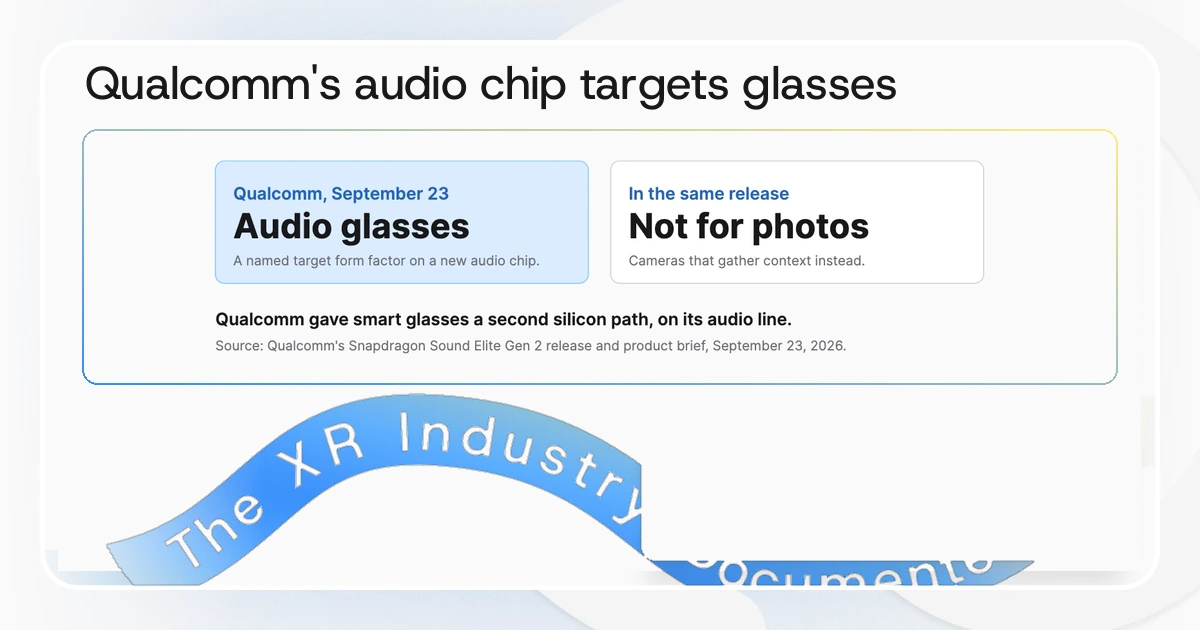
Qualcomm announced Snapdragon Sound Elite Gen 2 on September 23, 2026, an audio platform that names audio glasses and camera buds among its target form factors. It describes camera-equipped wearables that gather context rather than capture photos, and Wi-Fi that reaches the cloud without a phone. No device and no date were announced.
In short:
- What it is: an audio platform Qualcomm calls its first purpose-built for personal AI, combining audio processing, an on-device AI accelerator and integrated Wi-Fi 6E on one part.
- Why it belongs in glasses coverage: Qualcomm's own product brief lists audio glasses and camera buds as target form factors, and the release comes from the executive who runs XR at Qualcomm.
- The line worth reading twice: the release describes camera-equipped devices that "help gather context on the users' environment, rather than capturing photos".
- The published numbers: up to 128 GOPS of AI acceleration, up to 40% lower power and up to 30% smaller footprint, all measured against the Snapdragon S7 Gen 1 platform.
- What is missing: no availability date, no price, no OEM product. The one named partner showed a concept.
What Qualcomm announced
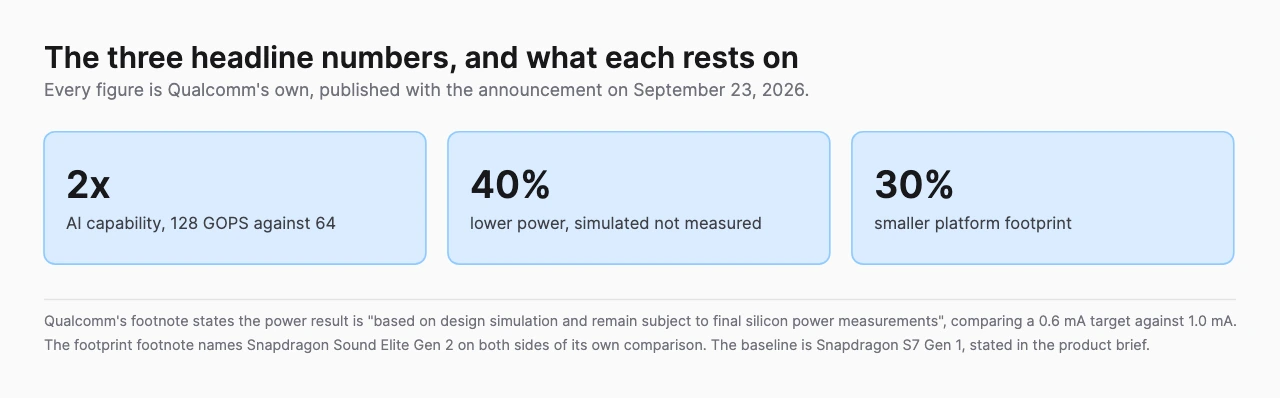
Qualcomm announced the Snapdragon Sound Elite Gen 2 platform at Snapdragon Summit 2026, describing it as the first premium audio platform built for personal AI. The release sets out three headline gains over the previous generation: up to twice the on-device AI capability, up to 40% lower power consumption and up to 30% smaller platform footprint.
The published product brief is specific about what is on the part. Processing runs on an Arm Cortex-M55 applications processor, an Arm Cortex-M55 main DSP, two Hi-Fi 5 audio DSPs and a dedicated Hi-Fi 3 low-latency DSP, alongside a Qualcomm eNPU rated at up to 128 GOPS. Connectivity is Bluetooth Classic and LE Audio plus integrated Wi-Fi 6E across 2.4 GHz, 5 GHz and 6 GHz, at up to 86 Mbps PHY rate. The product page gives clock speeds: the M55 applications processor at 300 MHz, the main DSP at 500 MHz, the two Hi-Fi 5 offload DSPs at 500 MHz and the low-latency DSP at 250 MHz.
The target form factor row on the brief's spec page names seven categories: AI earbuds, premium headphones, open-ear audio devices, audio glasses, camera buds, hearing devices and future personal AI wearables.
Why an audio chip listing glasses matters
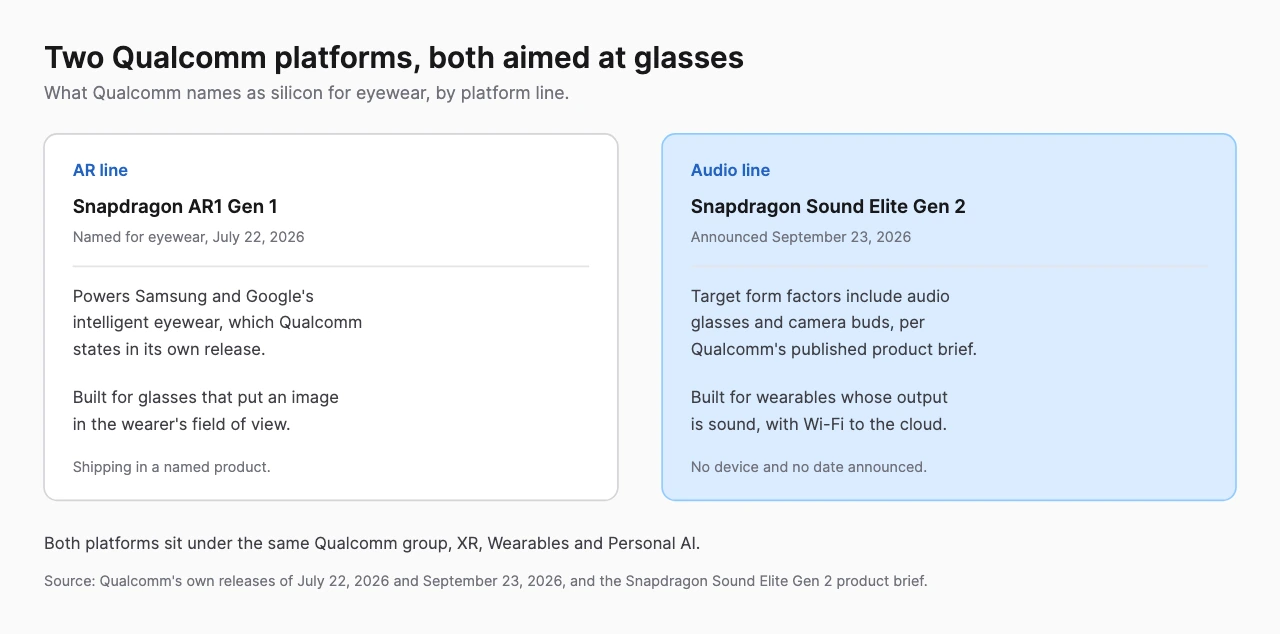
Qualcomm now names eyewear as a target for two different platform lines, and they sit at opposite ends of the company's catalog.
The first is the AR line. Qualcomm's own release of July 22, 2026 states that Snapdragon AR1 Gen 1 powers Samsung and Google's new intelligent eyewear, and that the three companies are expanding their Android XR collaboration "beyond Galaxy XR headsets into intelligent eyewear". That is the silicon inside the pair BestInXR covered as Samsung's intelligent eyewear, which carries a camera and no display.
The second is the audio line, and it is new. Snapdragon Sound Elite Gen 2 reaches the same place on a wearer's face from the earbud side. Qualcomm positions it as the successor to the Snapdragon S7 Gen 1 sound platform, which the product brief names as the baseline for every comparison in the announcement.
Both announcements carry the same executive. Ziad Asghar is quoted in today's release as senior vice president and general manager of XR, Wearables and Personal AI, so this is one organization offering two starting points rather than two divisions competing.
The practical consequence is a fork for anyone building glasses. A pair that has to render an image into the wearer's field of view needs the AR part. A pair that answers out loud, and increasingly one that looks at the world in order to answer, no longer does. That is the silicon version of the split BestInXR has been describing at product level all week, most recently when VONDER shipped a pair with neither camera nor display. The fork does not describe every pair on sale either. Display eyewear that carries no assistant and no microphone, such as the cycling glasses that put a rider's numbers in the field of view, sits outside both descriptions.
The camera that is not for taking photographs
The most interesting sentence in the release is a subordinate clause. Describing what the extra AI capability enables, Qualcomm writes that it allows faster and always-available personal AI experiences, "including on-camera equipped form factors that help gather context on the users' environment, rather than capturing photos".
That is a chip vendor drawing a line between two things a camera can do. One produces a file a person keeps. The other produces a description the assistant uses and discards. Qualcomm is describing the second and saying so before any OEM has to.
The distinction is not academic in this category. Camera privacy is the pressure the whole segment is under. Counterpoint Research named public concern about the privacy implications of cameras as one of two near-term challenges facing intelligent eyewear, and forecast camera-free audio glasses as one industry response. VONDER built exactly that. Qualcomm's answer is a third position: keep the sensor and change what it is for.
Nothing in the release says how that distinction would be enforced on a shipping product, and it is worth being clear that this is a description of intended use rather than a published hardware restriction. The company's quoted framing is broader still, with Asghar describing "multimodal interactions that combine audio, vision, and AI".
Wi-Fi that does not go through a phone
The second structural change is connectivity. Today's AI glasses are companions to a handset, and BestInXR's smart glasses business guide describes a category built on that assumption.
Snapdragon Sound Elite Gen 2 integrates what Qualcomm calls micro-power Wi-Fi 6E for direct-to-cloud connectivity. The product brief puts the point plainly: connect to cloud AI services "without needing to route everything through your smartphone". Qualcomm also claims the same radio carries up to 192 kHz lossless music, and that the bandwidth and latency together enable what it describes as a step change in head-tracking latency for spatial audio.
A pair of glasses that reaches an assistant without a phone in the wearer's pocket is a different product to sell and a different one to support. Qualcomm has published the capability. No device uses it yet.
What the headline numbers rest on
The AI figure is the one with the clearest arithmetic behind it. Qualcomm's footnote gives peak AI compute as 128 GOPS and 256 MACs per cycle for Snapdragon Sound Elite Gen 2 against 64 GOPS and 128 MACs per cycle for Snapdragon S7 Gen 1, both operating at 250 MHz. That is where the doubling comes from, and it is checkable.
The power figure carries its own caveat, stated by Qualcomm rather than uncovered. Qualcomm gives the use case as Wi-Fi-connected idle and compares a simulated 0.6 mA target against 1.0 mA, then states that the results "are based on design simulation and remain subject to final silicon power measurements". A 40% power reduction is the number that decides whether always-on assistance is practical on a frame that has to sit on someone's nose all day, and it has not yet been measured on silicon.
One footnote is easy to misread. The footprint note gives a combined SoC area of 31.185 mm² against 44.2225 mm², but names Snapdragon Sound Elite Gen 2 on both sides of that comparison. The same footnote opens by stating the comparison is to the Snapdragon S7 Gen 1 platform, and the product brief says all comparisons reference that platform, so the baseline is documented. The power footnote reads the same way.
What Qualcomm has not published
No availability date appears anywhere. The words available, availability, shipping and launch do not occur on the product page, read from a fully scrolled capture on September 23, 2026, and the release gives no window. There is no price, which is normal for a component sold to OEMs, and no memory, storage or battery figure, which follows from the same thing.
There is no announced device. The only company named is Cleer Audio, which the release says "offered an early look at a new class of intelligent audio wearables that combine audio, vision and AI" at the summit. The release calls it a concept. Cleer's own site carried no mention of Snapdragon when BestInXR checked on September 23, 2026, so nothing further about that product is published by the company making it.
One inconsistency sits inside Qualcomm's own pages. The specification table on the product page gives the platform's voice and music applications as Bluetooth stereo headphones and headsets, truly wireless earbuds and smart speakers, with no eyewear named, while the feature list on the same page and the target form factor row in the product brief both name audio glasses. Both statements are Qualcomm's, published the same day.
None of this has been measured by BestInXR, and the pattern is the one documented in the XR spec gap: the figures a buyer could act on arrive later than the figures a vendor wants quoted.
Related reading. Our comparison of AI and smart glasses prices the no-display category this silicon targets, and the smart glasses business guide sets out how the processor choice shapes what a pair can do.
Frequently Asked Questions (FAQ)
1. What is Snapdragon Sound Elite Gen 2?
It is an audio platform Qualcomm announced on September 23, 2026 at Snapdragon Summit, combining premium audio processing, an on-device AI accelerator rated at up to 128 GOPS and integrated micro-power Wi-Fi 6E on a single part. Qualcomm describes it as its first audio platform purpose-built for personal AI.
2. Can Snapdragon Sound Elite Gen 2 be used in smart glasses?
Qualcomm's product brief lists audio glasses as one of seven target form factors, alongside AI earbuds, premium headphones, open-ear audio devices, camera buds, hearing devices and future personal AI wearables. No glasses using the platform have been announced.
3. How is this different from Snapdragon AR1 Gen 1?
Snapdragon AR1 Gen 1 is Qualcomm's AR platform, and Qualcomm states it powers Samsung and Google's intelligent eyewear. Snapdragon Sound Elite Gen 2 comes from the audio side of the catalog and targets wearables whose output is sound rather than an image in the field of view. Both fall under the same Qualcomm group, XR, Wearables and Personal AI.
4. When will devices using Snapdragon Sound Elite Gen 2 ship?
Qualcomm has not said. Neither the release nor the product page states an availability date, a shipping window or a named product. Cleer Audio showed a concept at the summit, which the release describes as an early look.
5. Does Snapdragon Sound Elite Gen 2 need a phone?
Qualcomm says no, for cloud AI services. The product brief states that integrated micro-power Wi-Fi lets a device connect directly to cloud-based AI services, agents and applications without routing everything through a smartphone. The platform also supports Bluetooth Classic and LE Audio for a paired handset.