


In-app purchases have passed premium app sales as the largest source of revenue on the Meta Store for the first time, on January to September 2026 figures published by Meta on November 10, 2026. Meta also says each of the top 50 apps took over $1 million after store fees in those nine months and that revenue held steady against the same period of 2025.
In short:
- The finding: in-app purchases are now the largest single revenue source on the Meta Store, by Meta's own account of January to September 2026.
- The context: Meta says that period ran steady against 2025 with no new headset launch, the last being Quest 3S in 2024 and the next being Meta VR Glasses in spring 2027.
- Who published it: Chris Pruett, Director of Games at Meta, on the Meta Horizon OS developer blog.
- Often confused with: Meta's Reality Labs segment results, which cover hardware and the division's operating loss rather than what developers earn on the store.
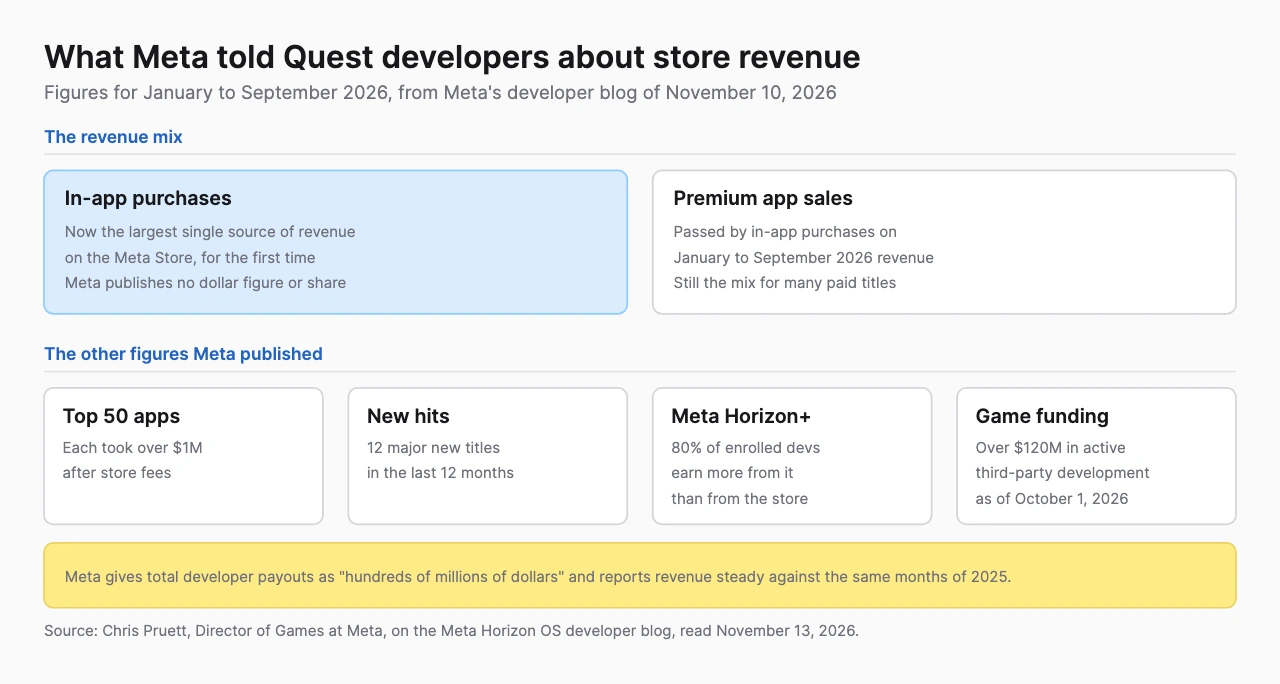
What Meta published about store revenue
Meta published four figures, all scoped to January through September 2026 and all stated without a dollar total. In-app purchases passed premium app sales to become the largest source of revenue on the store. Each of the top 50 apps earned more than $1 million after store fees, with hundreds of further apps earning hundreds of thousands over the same months. Twelve major new titles launched in the last twelve months. Developers in total took home "hundreds of millions of dollars", which is the only size Meta gives for the whole pool.
Meta publishes no share, no dollar figure and no year-on-year change for the in-app purchase line itself. The claim as written is an ordering between two revenue sources, measured over nine months on Meta's own books, and that is the full extent of what the post supports.
Why the timing matters to a developer
Meta frames the period as the gap between hardware launches. The company's last headset launch was Quest 3S in 2024, and its next is Meta VR Glasses in spring 2027, so the nine months in question carry none of the sales spike that Meta says has historically followed a new device. Meta also published the end of feature development for Quest 2 and Quest Pro on November 2, 2026, which BestInXR covered at the time, which takes two older headsets off the feature roadmap during the same window.
Against that, Meta reports revenue steady rather than falling. Pruett writes that store revenue from January through September 2026 was steady compared with the same period a year earlier.
What Meta says about Meta Horizon Plus
For developers enrolled in the Meta Horizon+ program, the subscription has become the main earner. Meta Horizon+ is Meta's games subscription for Quest, priced on Meta's own store page at $7.99 a month or $59.99 a year when read on November 13, 2026. Meta says 80 percent of developers in the program now earn more from Meta Horizon+ than from the store, that the median revenue mix is over 70 percent Meta Horizon+ and that some developers take over 90 percent of their revenue from it.
Those three figures describe the enrolled cohort rather than the catalog. Meta publishes no count of developers in the program and no subscriber number, so the share of the whole store this represents is not in the post.
Which titles Meta names in the top 50
Meta lists the top 50 by revenue in three groups and names titles in each. Multiplayer competitive social games are named first, including HERO x HERO, UG, Gorilla Tag, I am Cat, ROBLOX, Animal Company, Scary Baboon, Yeeps and Beyond Sandbox, which Meta says monetize overwhelmingly with in-app purchases. A second group covers FitXR, GOLF+, PokerStars: Vegas Infinite, Virtual Desktop, WIN Reality Baseball, TRIPP, Real VR Fishing, Walkabout Mini Golf and Dungeons of Eternity, which Meta says earns mostly from premium app sales, with fitness titles doing well on subscriptions and PokerStars earning only from in-app purchases. A third cross-over group names BONELAB, Blade & Sorcery: Nomad, Green Hell, Five Nights at Freddy's: Help Wanted and the military tactical shooters Breachers, Pavlov Shack, Ghosts of Tabor and Tactical Assault VR.
Meta gives no ranking, no revenue figure and no ordering inside the fifty, so the list reads as membership rather than as a chart.
What Meta expects from Meta VR Glasses
Meta forecasts a different kind of buyer. It expects the spring 2027 launch to bring a more diverse group of customers to the store, with games and apps "secondary to entertainment consumption", and says customers who do buy games are likely to want seated, hands-first experiences that are challenging to master but not to play.
Meta also expects most Meta VR Glasses customers to go without Touch controllers, with those who have them able to play supported titles from the Quest catalog. The company's stated advice to developers is to design with hand tracking from the first day rather than to adapt controller inputs, and it says Quest 3 remains the baseline for existing audiences. Meta states it had over $120 million in funding for third-party games in active development as of October 1, 2026.
Related reading. Our Meta Quest reference tracks the headset line with its checked prices, and our XR headset comparison covers what is on sale now across every maker.
Frequently Asked Questions (FAQ)
1. Do in-app purchases now earn more than paid apps on Quest?
Yes, on Meta's own January to September 2026 figures published November 10, 2026. Meta describes in-app purchases as the largest source of revenue on the Meta Store for the first time, and gives no dollar figure or percentage for either source.
2. How much do the top Quest apps earn?
Each of the top 50 apps on the Meta Store earned more than $1 million after store fees from January through September 2026, by Meta's account, with hundreds of further apps earning hundreds of thousands in the same period.
3. Is Quest store revenue falling?
Meta reports it as steady. Store revenue from January through September 2026 ran level with the same period of 2025, which Meta notes came without a hardware launch, the last being Quest 3S in 2024.
4. What is Meta Horizon Plus worth to a developer?
Meta says 80 percent of developers enrolled in the Meta Horizon+ program now earn more from it than from the store, with a median revenue mix above 70 percent and some developers above 90 percent. Those figures cover enrolled developers rather than the whole catalog.
5. What does Meta expect developers to build for Meta VR Glasses?
Seated, hands-first experiences designed for hand tracking from the start, aimed at buyers Meta expects to use the device mainly for entertainment rather than games. Meta VR Glasses ship in spring 2027.


