

Best AR Glasses for a Big Virtual Screen
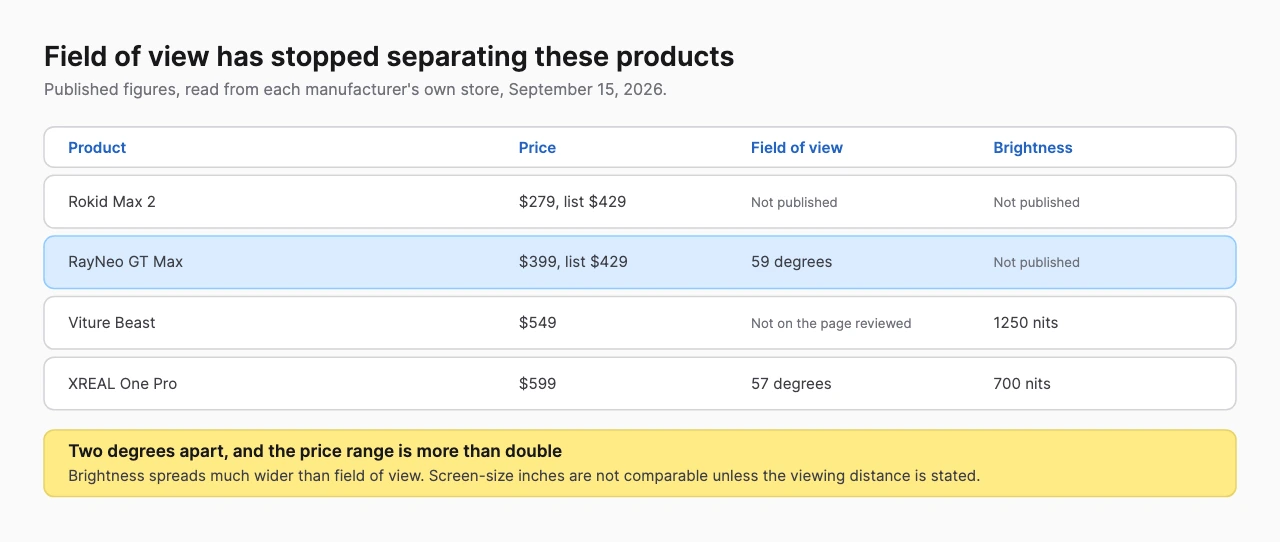
Field of view is the number every one of these companies advertises and the one that no longer separates any of them. XREAL publishes 57 degrees, RayNeo publishes 59 and Viture sits between them. What actually differs is brightness, which runs from 700 to 1250 nits, and price, which runs from $279 to $599 for very similar hardware. Ignore the screen-size inches until you know the viewing distance behind them.
In short:
- They are wearable monitors, not AR. These do not track the room, so digital content does not stay fixed to the world. Our smart glasses guide makes the same distinction.
- The inch figures are not comparable. Viture states a 174 inch screen at 4 meters. RayNeo claims 267 inches and states no distance. Without the distance the number means nothing.
- Brightness is the real spread. 700 nits on XREAL One Pro against 1250 on the Viture Beast, which is what decides whether they work in a bright room.
- The cheapest is not a toy. Rokid Max 2 was $279 against a $429 list when checked.
How this list was built
These are birdbath and prism display glasses: a micro-OLED panel per eye reflected into your view so you see a large floating screen. They are sold as AR glasses and they are not doing augmented reality in the sense the term usually means, because they have no world tracking and the image moves with your head.
That matters because BestInXR's Q2 2026 shipment report found this half of the market growing fastest: birdbath and flat prism viewers took 60% of AR device shipments in the quarter. This list ranks four on four criteria: what it costs, published brightness, published field of view and what you have to plug it into. All prices were read from each manufacturer's own store on September 15, 2026.
| Product | Price | Published field of view | Published brightness |
|---|---|---|---|
| RayNeo GT Max | $399, list $429 | 59 degrees | Not published |
| Viture Beast | $549 | Not stated on the page reviewed | 1250 nits |
| XREAL One Pro | $599 | 57 degrees | 700 nits |
| Rokid Max 2 | $279, list $429 | Not published | Not published |
1. RayNeo GT Max
RayNeo GT Max publishes the widest field of view here and the most aggressive screen claim, and it is the one to start from because of what it costs.
The published specification is a 59 degree field of view, a micro-OLED panel and a 120 Hz refresh rate, at $399 against a $429 list price. RayNeo frames that 59 degrees explicitly against the 46 degrees of earlier glasses, which is a fair comparison to make and a real generational gain.
The screen claim needs reading carefully. RayNeo advertises a 267 inch cinema display, which is the largest number in this comparison by a wide margin, and the page does not state the viewing distance that number assumes. A virtual screen size is meaningless without it: the same optics produce a bigger inch figure simply by assuming the screen is further away. Compare the degrees, which are measured the same way by everyone, and treat the inches as marketing.
RayNeo also sells the cheapest entry into the category, with its AR glasses line starting at $149, and it describes itself as an official Olympic partner. Best for the widest published field of view at a mid-range price.
2. Viture Beast
Viture Beast is $549 and is the brightest thing here by a distance, which is the specification most buyers should be weighting and almost nobody does.
Viture publishes 1250 nits. XREAL publishes 700. That is close to double, and brightness is what decides whether a transparent display is usable in a lit room, on a plane with the window open or outdoors at all. A dim panel in bright surroundings does not look dim, it looks washed out and transparent, and no amount of field of view fixes it.
Viture also states its screen claim properly: a 174 inch screen at 4 meters. Naming the distance is the difference between a specification and an advertisement, and it is the only page in this comparison that does it. The company describes the result as 4K-like, which is its own phrasing rather than a resolution claim.
The line around it is unusually wide. Viture sells Luma at $399, Luma Pro at $499, the Beast at $549 as its 2026 flagship and Luma Ultra at $599, which means the flagship is not the most expensive model. Work out which one you want before going to the site, because the naming does not make the hierarchy obvious. Best for anyone who will use these anywhere brighter than a dark room.
3. XREAL One Pro
XREAL One Pro is $599, the most expensive here, and it is the most completely specified product in the category.
XREAL publishes a Sony 0.55 inch micro-OLED panel, 1080p per eye, a 57 degree field of view, up to a 171 inch virtual image, 120 Hz, 700 nits, three modes of electrochromic dimming, TÜV Rheinland certification and audio tuned by Bose engineers. That is more disclosure than anyone else offers, and the electrochromic dimming is a genuine answer to the brightness problem from the other direction: rather than pushing more light at your eye, it darkens the lens so the screen stands out.
The rest of the lineup matters to the decision. XREAL One sits at $399 and 87 grams. The camera, XREAL Eye, is a separate $99 accessory, and the Beam Pro companion device is listed from $199, though its own product page shows a $249 regular price with the cheapest configuration sold out. None of these glasses generate their own picture, so budget for whatever supplies it.
At 57 degrees against RayNeo's 59, and 700 nits against Viture's 1250, XREAL wins neither headline number. What it offers is the most complete published specification, dimming and a considered audio design, which is a coherent argument at the top of the price range rather than a spec-sheet victory. Best for buyers who want every number published and dimming to handle bright rooms.
4. Rokid Max 2
Rokid Max 2 is the cheapest way into this category from a company that also makes real AI glasses, and its price is the argument.
It was listed at $279 against a $429 regular price, a 35% discount, when checked on September 15, 2026. That is the lowest figure in this comparison by $120, and Rokid's list price sits exactly level with RayNeo's, which tells you where the two companies think the product belongs when nothing is discounted.
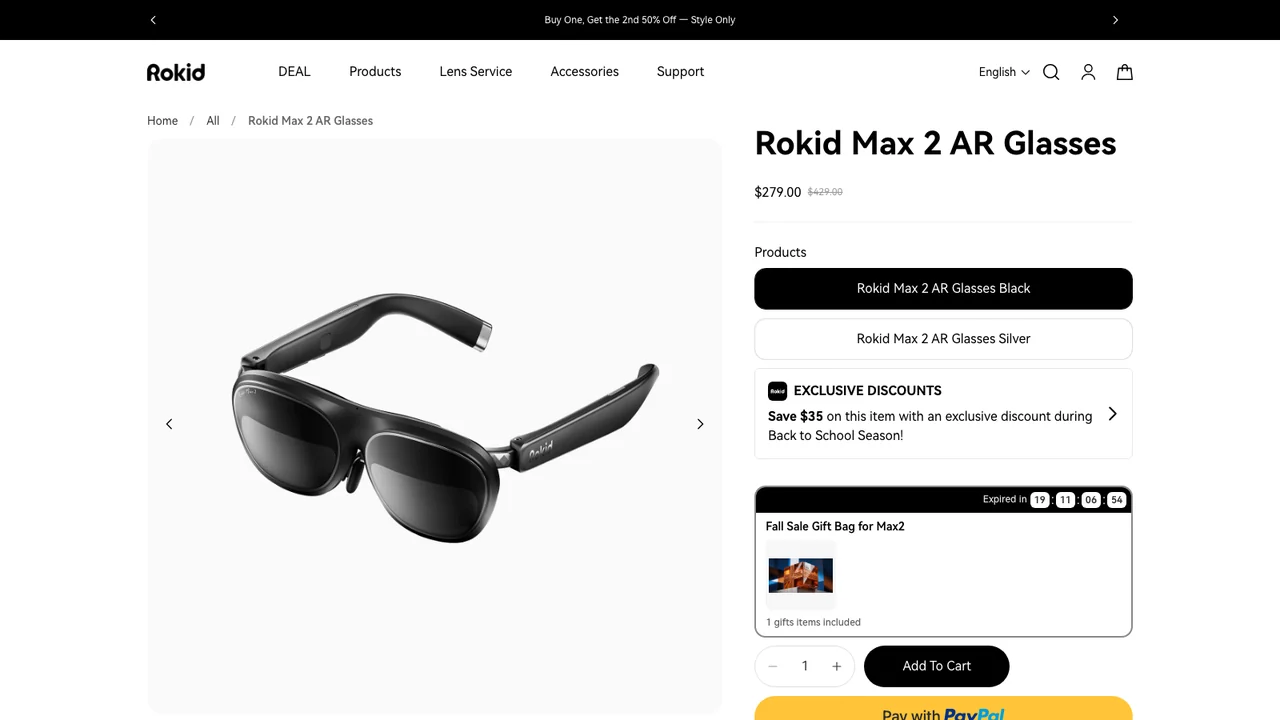
What Rokid does not do is publish specifications on the product page. There is no field of view, no brightness figure and no panel detail in the page as served, only a description of a lightweight ergonomic design with high-definition displays for gaming, entertainment and productivity. The page carries customer reviews quoting brightness figures, and a review is not a specification, so this post does not repeat them.
Rokid publishes practical terms instead, with free US shipping over $60, 30 day returns and a 365 day limited warranty. Its wider line runs to the AR Spatial and AR Joy products, and its AI glasses are covered in BestInXR's AI glasses comparison. Best for the lowest price, if you are willing to buy without published optical specifications.
What the specifications do not tell you
Field of view has converged. 57, 58 and 59 degrees are the same product experience. It was a real differentiator when the spread was 46 to 59 degrees, and among current flagships it is not the number to choose on.
Virtual screen inches are unfalsifiable without a distance. Viture states 174 inches at 4 meters. RayNeo states 267 inches and no distance. Those two figures cannot be compared, and only one of them can be checked.
Brightness is the spec that decides daily use. The spread here is 700 to 1250 nits, a much bigger relative difference than anything in the field of view column.
Nothing here is self-contained. These glasses need a phone, a console, a computer or a dedicated player, and the cables, adapters and companion devices are real costs. XREAL sells a Beam Pro companion device from $199 for exactly this reason.
How to choose AR display glasses
Start by deciding where you will actually wear them. In a dark room almost anything works, and price should decide: Rokid Max 2 at $279 is the cheapest route in. In a lit room, on a plane or anywhere with daylight, brightness decides, and the Viture Beast at 1250 nits is the strongest answer here.
If you want every specification published rather than inferred, and dimming built into the lens, XREAL One Pro is the most thoroughly documented product in the category and priced accordingly.
If field of view genuinely is your priority, RayNeo GT Max publishes the largest at 59 degrees, for $200 less than XREAL.
Then check the boring things that decide whether you keep using them: what device supplies the picture, whether that connection needs an adapter, whether prescription inserts are available and what they cost. BestInXR's AI glasses comparison covers the other half of the eyewear market, the ones with cameras and assistants and no real screen, and our smart glasses business guide sets out the full category taxonomy.
Frequently Asked Questions (FAQ)
1. Are AR glasses the same as a wearable monitor?
For the products in this comparison, effectively yes. They project a large floating screen but do not track the environment, so content does not stay anchored to the real world. True AR glasses that anchor content are a different and much more expensive class of device.
2. How much do AR glasses cost?
Manufacturer prices checked in September 2026 ran from $279 for Rokid Max 2 against a $429 list, through $399 for RayNeo GT Max and $549 for the Viture Beast, to $599 for XREAL One Pro. RayNeo's entry line starts at $149.
3. What field of view do AR glasses have?
Current flagships have converged. XREAL publishes 57 degrees and RayNeo publishes 59, with Viture between them. RayNeo notes that earlier generations were around 46 degrees, so the gain is real but recent and now shared across brands.
4. Why do advertised screen sizes vary so much?
Because a virtual screen size depends on the viewing distance assumed, and most brands do not state it. Viture publishes 174 inches at 4 meters. RayNeo publishes 267 inches with no distance given. Compare field of view in degrees instead.
5. Do AR glasses work on their own?
No. They need a source for the picture, whether a phone, a computer, a games console or a dedicated player such as XREAL's Beam Pro, listed from $199. Check that your specific device is supported and whether an adapter is required.