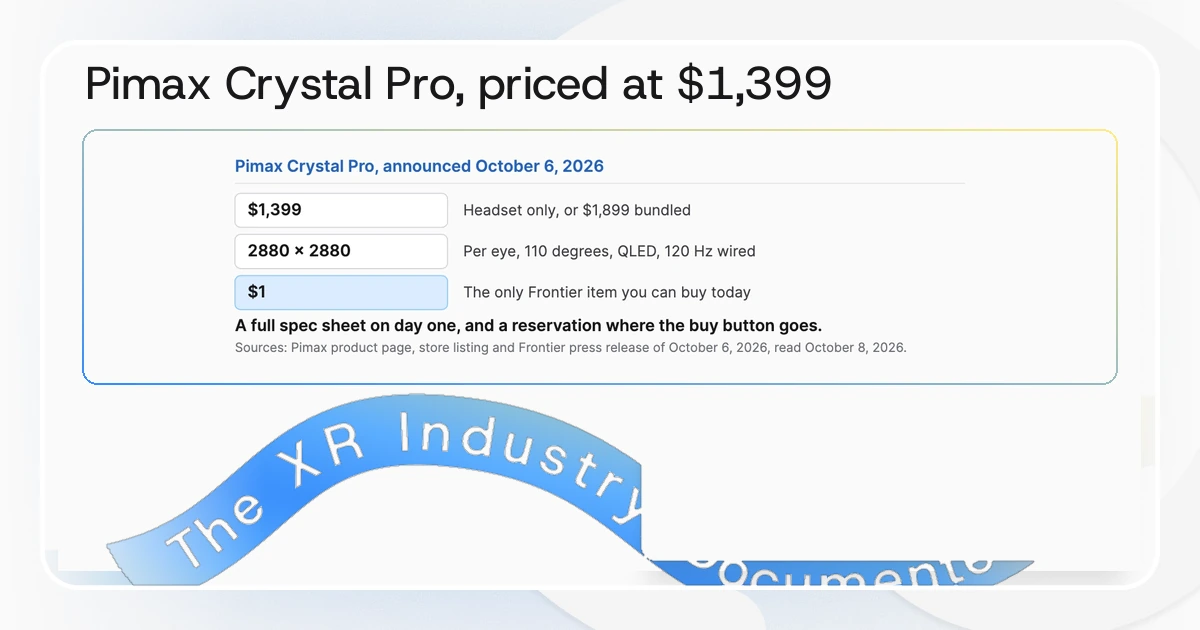
Pimax priced the Crystal Pro at $1,399, or $1,899 bundled with the third-generation 60G AirLink kit, and published a complete specification table the same day: 2880 by 2880 pixels per eye, a 110 degree horizontal field of view, QLED panels with Mini-LED local dimming and optional Lighthouse tracking that survives going wireless.
In short:
- What it is: the Pimax Crystal Pro is a wireless PC VR headset that also runs standalone on a Snapdragon XR2 Gen 1, announced on October 6, 2026 at a Pimax event the company called Frontier.
- What is documented: a full spec sheet, a dated press release and a long launch FAQ, all on announcement day. That is more than most headsets carry at this stage, and it is why this post can be built entirely from Pimax's own pages.
- What you can buy today: a $1 reservation. Both priced configurations appear in Pimax's own store and are marked unavailable.
- The figure worth noting: the panels run 120 Hz on a wired DisplayPort connection, and the uncompressed wireless focus area is quoted at up to 90 Hz. That second number appears in the press release only.
- What to check: three Pimax documents published the same day give three different shipping answers, and no weight is published in any of them.
What does the Pimax Crystal Pro cost?
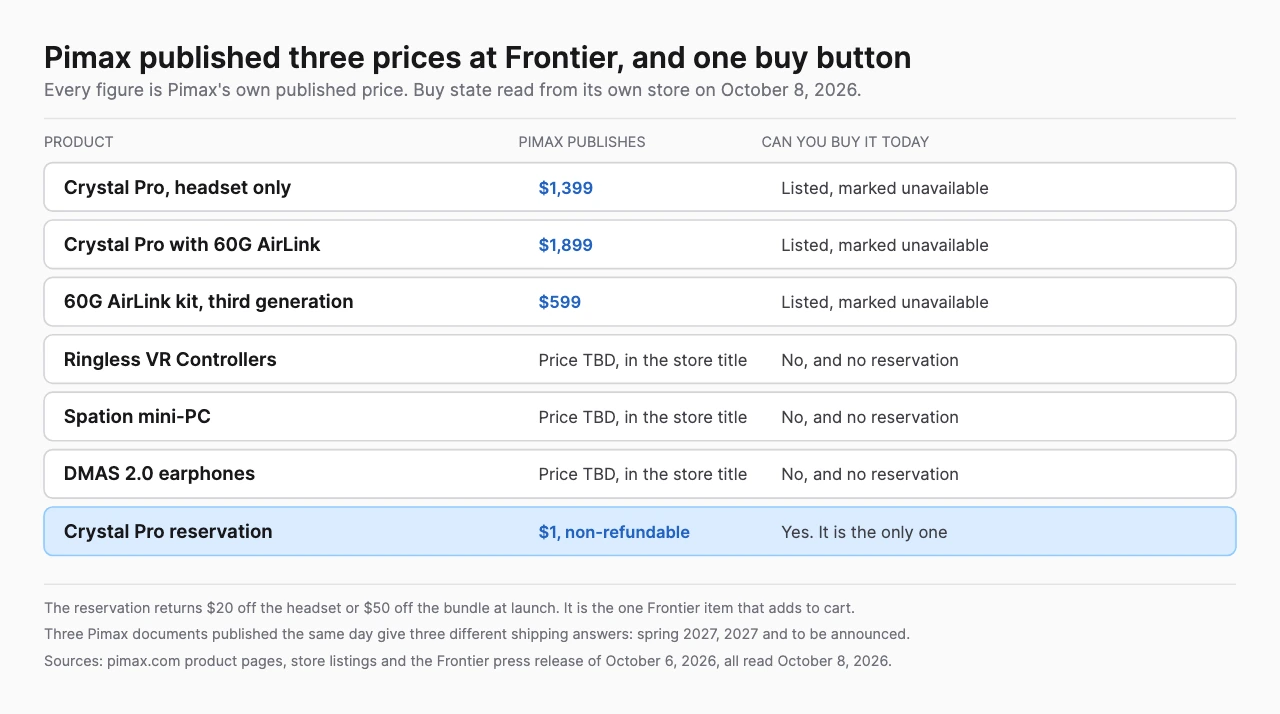
Pimax's press release lists three prices under a heading it calls Availability: $1,399 for the Crystal Pro, $1,899 for the Crystal Pro bundled with the third-generation 60G AirLink kit and $599 for that kit sold separately. The trade press reported the headset at $1,400. The published figure is $1,399.
Those prices are catalog entries rather than buy buttons. Read on October 8, 2026, the Crystal Pro store listing carries all three of its options, and the only one that can be added to a cart is the third: a $1 reservation. Pimax describes it as non-refundable and says it returns $20 off the headset at launch or $50 off the bundle.
Pimax states the reasoning plainly in the release: "Shipping dates for Crystal Pro and the 60G AirLink kit will be announced at a later date." So the company has set what the headset will cost and not yet when it arrives, which is the reverse of the usual order and worth knowing before a reservation looks like a pre-order.
What the Crystal Pro specification table lists
Every figure below is Pimax's own published claim from the Crystal Pro product page, read on October 8, 2026. None carries a stated measurement method.
| Field | Published figure |
|---|---|
| Positioning | PC VR wireless and standalone dual mode |
| Display type | TFT QD-LCD, which Pimax calls QLED |
| Resolution | 2880 by 2880 per eye, around 17 million pixels total |
| Pixels per degree | 35 |
| Horizontal field of view | 110 degrees |
| Refresh rate | 72, 90 and 120 Hz |
| Local dimming | Mini-LED, 576 zones per eye |
| Brightness | 200 nits |
| Lenses | Glass aspheric |
| Eye tracking | Ten infrared emitters per eye, sampling at 120 Hz |
| Standalone chip | Snapdragon XR2 Gen 1 |
| Tracking | SLAM 2.0 inside-out, four cameras, a motion sensor and infrared illumination |
| Optional tracking | Lighthouse base stations, through a swappable faceplate |
| Wired option | DisplayPort 1.4a, cable sold separately |
| Battery | 16,000 mAh external pack, with no battery in the headset |
| Minimum GPU | RTX 2070 or above |
| Recommended GPU | RTX 3080 or RTX 4070 or above |
Two entries are worth reading twice. The standalone chip is a Snapdragon XR2 Gen 1, a part that predates the XR2 Gen 2 in current standalone headsets such as the Pico 4 Ultra, so the standalone mode is a secondary capability rather than the headset's reason to exist. And the eye tracking is there to serve the wireless link as well as the rendering: Pimax names Omnivision as the supplier and uses the same sensor for dynamic foveated rendering and for deciding which part of the frame to send uncompressed.
Pimax also sells the optics as a deliberate choice against the industry default. Its product page argues that pancake lenses "fold light back and forth inside the lens, losing at least 85% of it along the way" while glass aspheric lenses lose under 1 percent, and attributes the headset's brightness and contrast to that. It is the company's own claim and it is published with the numbers attached, which is more than a marketing line usually carries.
How does Native Foveated Streaming work?
Native Foveated Streaming is Pimax's name for sending the part of the frame you are looking at to the headset without compressing it. Eye tracking locates the focus area, the 60 GHz link carries that region straight from the GPU with no encode or decode step, and the rest of the view is streamed conventionally.
The release puts a number on what the link delivers: an image equivalent to 2880 by 2880 per eye at up to 90 Hz in the focus area, with added latency under 2 milliseconds. Read that against the 120 Hz the panels reach over DisplayPort, because the two are not the same mode. The wired connection is the one Pimax says runs the panels at their full rate.
The kit itself is two Room Antennas placed in the play space, two antennas that slot onto the headset and two USB-C cables. Pimax states that the Room Antennas work in a 2x2 MIMO configuration and that this is the first 60 GHz 2x2 MIMO wireless link on a VR headset, which is the company's own claim rather than a position BestInXR has verified. The practical argument for two paths is redundancy as much as bandwidth: if an arm blocks one, the other carries on, and if the 60 GHz link drops entirely, Wi-Fi is the fallback. Pimax quotes up to 6 Gbps combined and a five by five meter play space, and says the signal does not pass through walls, which is a property of the band rather than of this product.
The under 2 millisecond figure measures what the wireless kit adds, not how long the headset takes to turn head movement into light. It is a different quantity from the motion-to-photon figures a handful of manufacturers publish, and it should not be lined up beside them.
Lighthouse tracking on a wireless headset
The Crystal Pro tracks itself with inside-out cameras and accepts Lighthouse base stations through a swappable faceplate, which Pimax says works in wireless mode too. A second MR faceplate adds full-color passthrough with LiDAR depth sensing. Backstrap, audio components and lens inserts come off independently of the faceplate.
Pimax states that this makes the Crystal Pro the only wireless headset on the market with Lighthouse support. That is the manufacturer's claim and BestInXR has not tested the field against it.
What the option costs is the part a spec sheet never shows. Base stations are a separate purchase, they need mounting at height and mains power, and the arithmetic is the same one that decides the full body tracking category: a room with two of them is a room committed to VR. Buyers who already own an Index or Vive setup are being offered a way to keep it. Buyers who do not are being offered a faceplate and a shopping list.
What else Pimax announced at Frontier
Three more products went up beside the headset, and Pimax's own store titles carry their pricing status in the product name.
| Product | What Pimax publishes | Price |
|---|---|---|
| Ringless VR Controllers | Infrared LEDs read by the headset cameras, a motion sensor over 2.4 GHz, wrist pose detection and AI prediction, with latency under 15 ms. TMR joysticks, a linear haptic motor, a 710 mAh battery rated up to 40 hours over USB-C. The two halves clip together into a gamepad for Windows and Steam. | Price TBD |
| Spation | A mini-PC with a Ryzen 7 9800X3D or equivalent, an RX 9070 XT or RTX 5070 Ti, 32 GB of DDR5-6000, a 1 TB NVMe SSD and a 1000 W SFX supply. Wi-Fi 7, Bluetooth 5.4 and 2.5G Ethernet. Supports Windows and SteamOS, with no operating system pre-installed. | Price TBD |
| DMAS 2.0 | Redesigned off-ear earphones for the Crystal Pro, lighter than the previous generation, sold as an optional extra. | Price TBD |
Ringless controllers are not new to the category. Pico already ships them with the Pico 4 Ultra, and Pimax does not claim otherwise. What is specific here is the gamepad mode, which lets the two halves clip together and work on a PC with no headset attached.
The Spation is the entry that reaches furthest outside Pimax's usual business. It is a PC, sold against the problem of not knowing whether your GPU is the bottleneck, and its SteamOS support puts it in the same sentence as Valve's hardware without being a headset. Pimax says a DIY configuration is available and describes it two different ways, which the last section covers.
Separately, Pimax said on October 2 that the micro-OLED optical engine for the Crystal Super is back in production, with a limited batch going on sale October 8 and delivery in late November or December 2026. Orders are verified against a Crystal Super serial number, one engine per headset. Its store listing showed $1,199 and no stock when checked on the morning of October 8. The company also introduced a new brand color it calls Stratosphere Blue and an updated logo.
Where the Crystal Pro sits against Steam Frame
Both are wireless headsets aimed at PC VR and the comparison stops being simple immediately, because they are sold at different stages. Valve shipped Steam Frame on September 14, 2026 at $1,059 for 256GB and $1,299 for 1TB. Pimax has published a price for a headset that ships at some point after this one, and the gap between $1,059 and $1,399 is a gap between a product you can own and a product you can reserve.
On published figures the two headsets are also aimed at different buyers. Steam Frame claims 2160 by 2160 per eye on LCD with a Snapdragon 8 Gen 3 and SteamOS, and Valve publishes a 440 gram figure for the core module and headstrap together, as BestInXR's headset comparison records. The Crystal Pro claims a third more pixels per eye, adds eye tracking, local dimming and a Lighthouse option, and leans on a PC rather than replacing one. It is a prosumer headset in the same line as the Crystal Super, not a standalone console.
The Crystal Pro is not in the BestInXR headset comparison or the XR hardware price index yet. Both document hardware a manufacturer sells new, and a reservation is not a sale. It becomes a candidate row the day it ships.
What to confirm beyond the spec sheet
Three things in Pimax's own documents need a second answer before a buyer can act on them, and all three are checkable today.
The ship date has three published versions. The press release says shipping dates "will be announced at a later date". The launch FAQ says "Hands-on demos start in Q4 2026. Shipping is set to start in spring 2027." The store listing says demos start in Q4 2026 and "shipping starts in 2027". All three were published by Pimax and all three were readable on October 8, 2026. Treat spring 2027 as the most specific thing the company has said and the press release as the most recent word on how firm it is.
The DIY Spation is described two ways. The FAQ says "you bring your own motherboard and GPU". The product page says Pimax supplies the chassis and the customer supplies storage and GPU. A motherboard and a storage drive are not the same commitment, and the difference decides whether the DIY option is a build or an upgrade.
Weight is not published. Pimax gives a 16,000 mAh external battery, a rigid backstrap and an argument about long sessions, and none of the three documents read for this post states what the headset weighs. For a device whose comfort case rests on moving the battery off your head, that is the figure the case is built on. It is also the field BestInXR's record of what XR vendors leave out finds missing most often across the category. The PC requirements table has the same gap in a smaller way: Pimax publishes GPU tiers and lists CPU, RAM, storage and operating system as TBD.
None of this is a reason to discount the specification table, which is unusually complete for an announcement. It is the short list of questions a reader should expect the next Pimax document to answer.
Frequently Asked Questions (FAQ)
1. How much does the Pimax Crystal Pro cost?
Pimax lists the Crystal Pro at $1,399 and the bundle with the third-generation 60G AirLink kit at $1,899, with the kit sold separately at $599. A $1 reservation is the only one of those that can be bought today, and it returns $20 off the headset or $50 off the bundle at launch.
2. When does the Pimax Crystal Pro ship?
Pimax's launch FAQ says hands-on demos start in Q4 2026 and shipping starts in spring 2027, while its press release of the same day says shipping dates will be announced later. The company has published a price without committing to a firm date.
3. What resolution is the Pimax Crystal Pro?
Pimax claims 2880 by 2880 pixels per eye on quantum-dot LCD panels, around 17 million pixels in total, at 35 pixels per degree across a 110 degree horizontal field of view. Refresh rates are given as 72, 90 and 120 Hz.
4. Does the Pimax Crystal Pro work without a PC?
Yes, in a secondary mode. Pimax lists a Snapdragon XR2 Gen 1 for standalone use and says the headset runs Android and OpenXR mobile titles without a PC, but the product is sold as a PC VR headset and its wireless case depends on a GPU.
5. What is Native Foveated Streaming?
It is Pimax's name for sending the region you are looking at to the headset uncompressed, using eye tracking to locate it and a 60 GHz link to carry it straight from the GPU. Pimax quotes up to 6 Gbps, an image equivalent to 2880 by 2880 per eye at up to 90 Hz in that region and under 2 milliseconds of added latency, and it requires the optional 60G AirLink kit.
6. Can the Pimax Crystal Pro use Lighthouse base stations?
Yes, through a swappable faceplate, and Pimax says it keeps working in wireless mode. Base stations are a separate purchase that need mounting at height and mains power, so the option suits buyers who already own a SteamVR setup.