

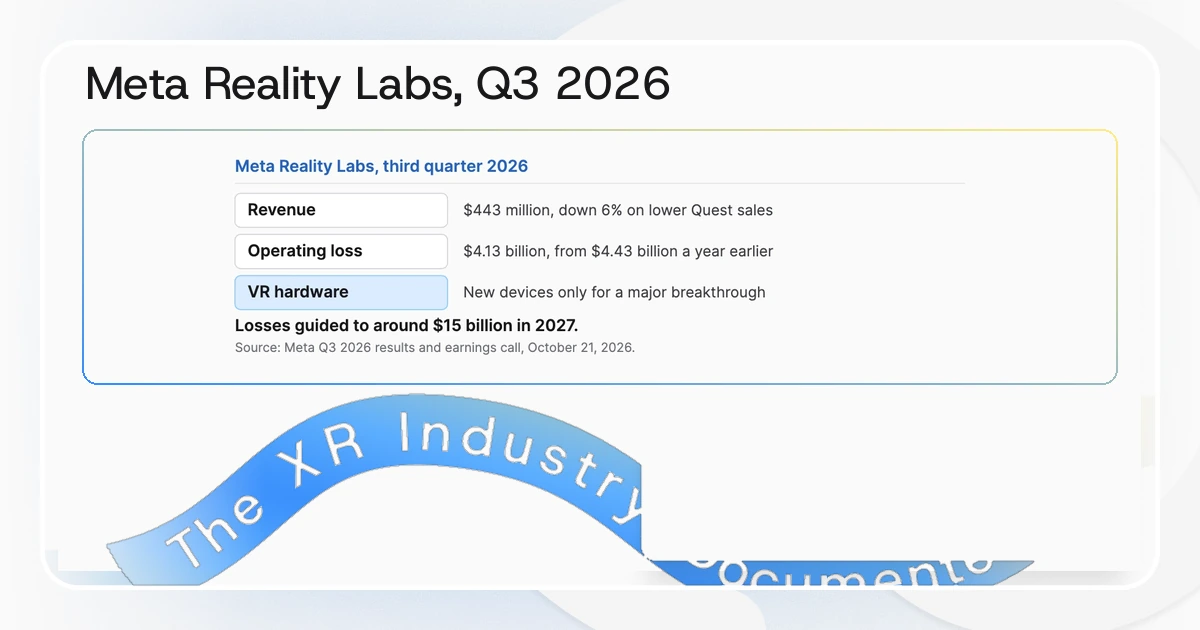
Meta's Reality Labs segment took $443 million in revenue in the third quarter of 2026, down 6% from $470 million a year earlier, which Meta attributed to lower Quest headset sales partly offset by AI glasses. Its operating loss narrowed to $4.13 billion. On the same call Mark Zuckerberg said Meta will now ship new VR devices only when it has a major breakthrough.
In short:
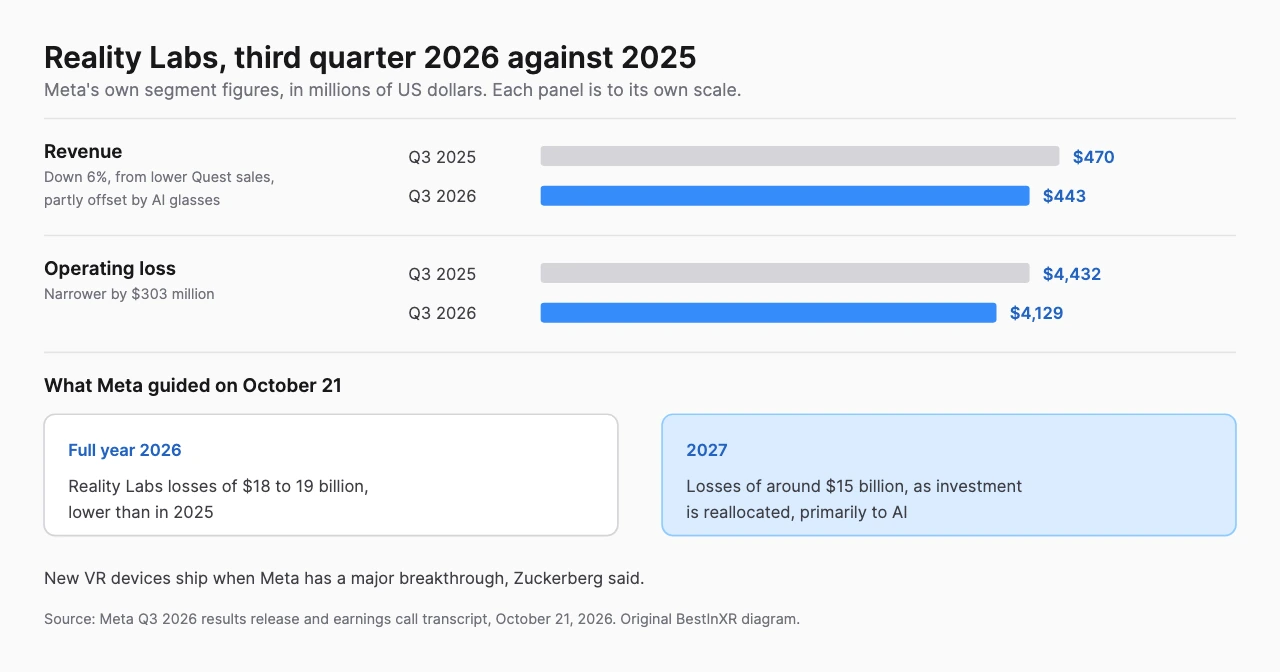
- The quarter: Meta's third quarter 2026 results, released October 21, 2026, put Reality Labs revenue at $443 million and its loss from operations at $4,129 million, against $470 million and $4,432 million in the third quarter of 2025.
- The cause, in Meta's words: CFO Susan Li said revenue was "down 6% due to lower Quest headset sales, which were partially offset by continued strong growth in AI glasses revenue", on the earnings call.
- The VR policy: Zuckerberg said Meta is "changing our approach to virtual reality to only ship new devices when we have major breakthroughs", naming Meta VR Glasses as this year's example.
- The outlook: Meta guided full year 2026 Reality Labs losses to $18 to 19 billion and 2027 losses to around $15 billion.
What Meta reported for Reality Labs
Reality Labs is the Meta segment that carries its "virtual and augmented reality related consumer hardware, software, and content", in the release's own definition. That covers Quest headsets and the glasses lineup together, and the release reports them as one line.
| Reality Labs, in millions of US dollars | Q3 2025 | Q3 2026 | Nine months 2025 | Nine months 2026 |
|---|---|---|---|---|
| Revenue | $470 | $443 | $1,252 | $1,276 |
| Loss from operations | ($4,432) | ($4,129) | ($13,171) | ($12,775) |
The quarter and the year so far point in different directions. Third quarter revenue fell 6%, while nine month revenue is up about 2%, from $1,252 million to $1,276 million. The loss narrowed in both: by $303 million in the quarter and by $396 million across the nine months. Every figure here is from the segment table in Meta's results release, and all of it is marked unaudited.
Why Quest revenue fell while glasses grew
Meta's explanation is the one sentence from Susan Li quoted above: lower Quest headset sales, partly offset by AI glasses. The release and the transcript give the direction of each and keep the split inside the segment total, so the size of the Quest decline is a figure Meta reports only in combination with glasses growth.
Two documented facts sit beside it. Meta raised Quest prices in its April 2026 pricing update, which put Meta Quest 3 at $599.99. Counterpoint Research then put global VR headset shipments 18% lower year over year in the second quarter, which BestInXR's report on Q2 2026 shipments covers in full. Meta's third quarter is the first set of company figures to show the same direction on its own books.
On glasses, Zuckerberg said on the call that "Glasses sales continue to grow rapidly" and that Meta has "priced our devices not to make a large profit on the hardware, but to build a large software and superintelligence business on top of them over time". He also said Muse, Meta's personal AI agent, is "coming to Meta Glasses starting next month", which places it in November 2026. The glasses on sale are listed in BestInXR's Meta Glasses lineup from Connect 2026.
What "only ship new devices when we have major breakthroughs" means for Quest
The statement sets the condition for new VR hardware rather than a schedule. Zuckerberg said it on the call, and said he had first shared it at Connect: "we are changing our approach to virtual reality to only ship new devices when we have major breakthroughs like we had with the Meta VR Glasses this year". He described Meta VR Glasses as "the first VR experience ever in a pair of glasses".
He went on to say that he still believes the path to "the holographic experience of bringing together the physical and digital worlds in everyday glasses will come through VR first", and that Meta "will pace this aspect of our investment more to focus on delivering personal superintelligence first".
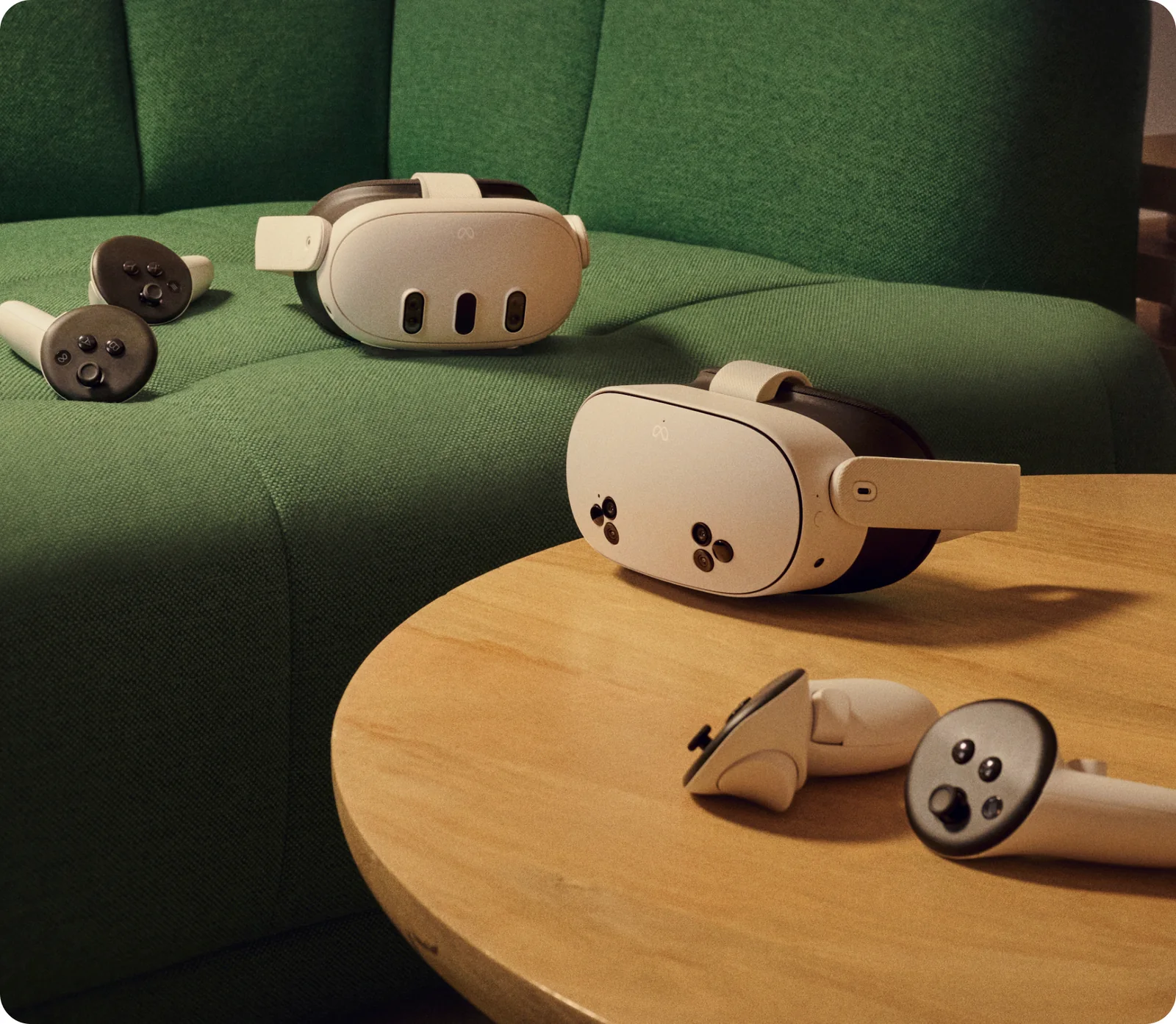
For a buyer, the practical reading is that Quest 3 and Quest 3S remain Meta's current headsets and the next Meta VR device is the one already announced. Meta VR Glasses are a 100 gram device with a tethered compute puck, priced at $1,299.99 for Spring 2027. The Meta Quest lineup reference carries the current models, prices and support policy, and it still stands as written.
What Meta expects Reality Labs to lose in 2026 and 2027
Meta now expects Reality Labs losses for 2026 "to decline compared to 2025 to a range of $18-19 billion", according to the outlook section of the release. For 2027, Susan Li said Meta expects "losses to narrow next year to around $15 billion as we reallocate investment toward other priority areas, primarily AI".
Zuckerberg framed the same number as a direction of travel: "we expect that the P&L of Reality Labs to improve from here, with operating loss coming down to around $15B next year and trending towards profitability from there". That is guidance, and the release carries Meta's standard caution that forward-looking statements may differ from results.
Nine months into 2026 the segment has lost $12,775 million. Reaching the $18 to 19 billion range would put the fourth quarter loss somewhere between about $5.2 and $6.2 billion, which is arithmetic on Meta's own figures rather than a number Meta stated. The fourth quarter includes the holiday period, when Meta VR Glasses are not yet on sale and Quest 3 and Quest 3S are the headsets Meta is selling.
What this means for buyers and developers
A business buying headsets now is buying into a line Meta has said it will refresh only on a breakthrough, which makes the current models the build target for the foreseeable term. That favors planning around Quest 3 and Quest 3S as they are, using the support dates Meta publishes, rather than waiting for a successor the call did not name. BestInXR's guide to Meta Connect 2026 lists everything else Meta announced in September, and the XR hardware price index puts Quest beside the rest of the market.
Frequently Asked Questions (FAQ)
1. How much revenue did Meta Reality Labs make in Q3 2026?
Reality Labs revenue was $443 million in the third quarter of 2026, down from $470 million a year earlier, according to Meta's results release of October 21, 2026. Its loss from operations was $4,129 million.
2. Why did Reality Labs revenue go down?
Meta's CFO said on the earnings call that revenue fell 6% "due to lower Quest headset sales", partly offset by continued strong growth in AI glasses revenue. Meta reports Quest and glasses inside one segment figure.
3. Is Meta making a Quest 4?
The next VR device Meta has announced is Meta VR Glasses. Mark Zuckerberg said on October 21, 2026 that Meta will "only ship new devices when we have major breakthroughs", and named those glasses, due in Spring 2027 at $1,299.99, as this year's example.
4. How much will Reality Labs lose in 2026?
Meta guided full year 2026 Reality Labs losses to $18 to 19 billion, lower than in 2025, and 2027 losses to around $15 billion. Through the first nine months of 2026 the segment lost $12,775 million.
5. When is Muse coming to Meta glasses?
Zuckerberg said on the October 21, 2026 call that Muse is "coming to Meta Glasses starting next month", which is November 2026. Meta announced Muse on September 8, 2026 as a personal AI agent rolling out on iOS, Android and the web.


