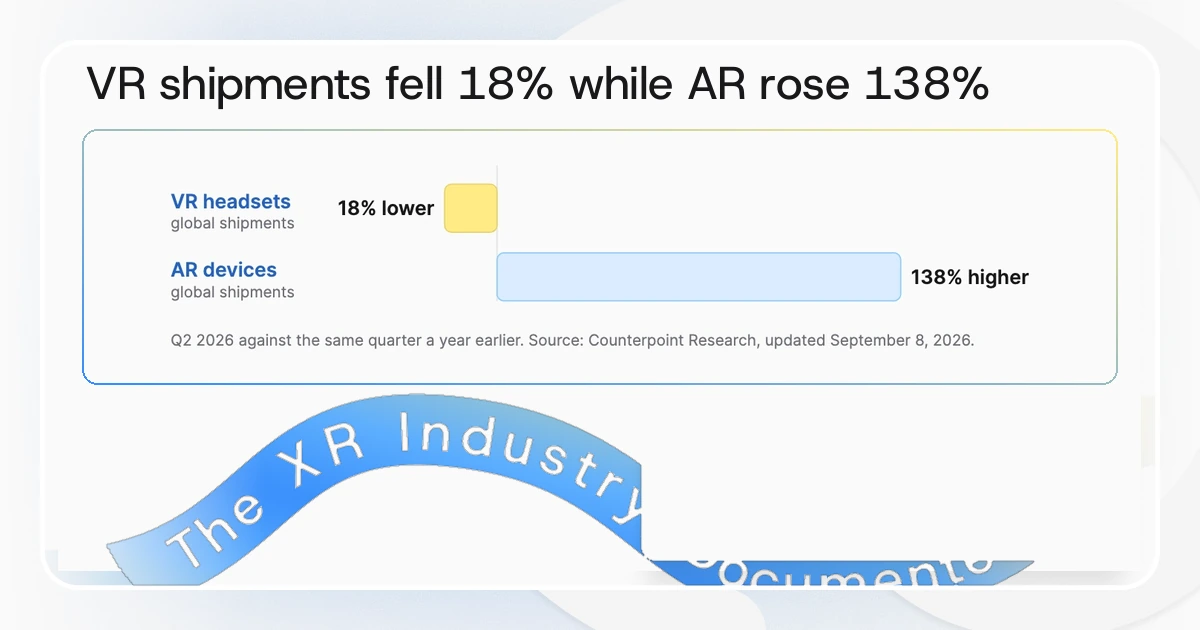
Global VR headset shipments fell 18% year over year in the second quarter of 2026, and 16% against the first quarter, according to Counterpoint Research. Over the same quarter, shipments of AR devices rose 138% year over year. The two halves of the XR market are now moving in opposite directions.
In short:
- What fell: VR headset shipments, down 18% against Q2 2025 and 16% against Q1 2026.
- What rose: AR device shipments, up 138% against Q2 2025 and 10% against Q1 2026.
- What the OEM share table counts: AR and VR together. Two of the five vendors named in it ship no VR headset.
- What is not measured: Counterpoint describes resilient enterprise and robotics demand and publishes no unit figure for either.
What Counterpoint published
Counterpoint Research updated its Global XR market share tracker on September 8, 2026. It reports that global VR headset shipments in the second quarter "declined by 18% YoY (year-over-year) and 16% QoQ (quarter-over-quarter)," and that global shipments of AR devices "surged 138% YoY and 10% QoQ in Q2 2026."
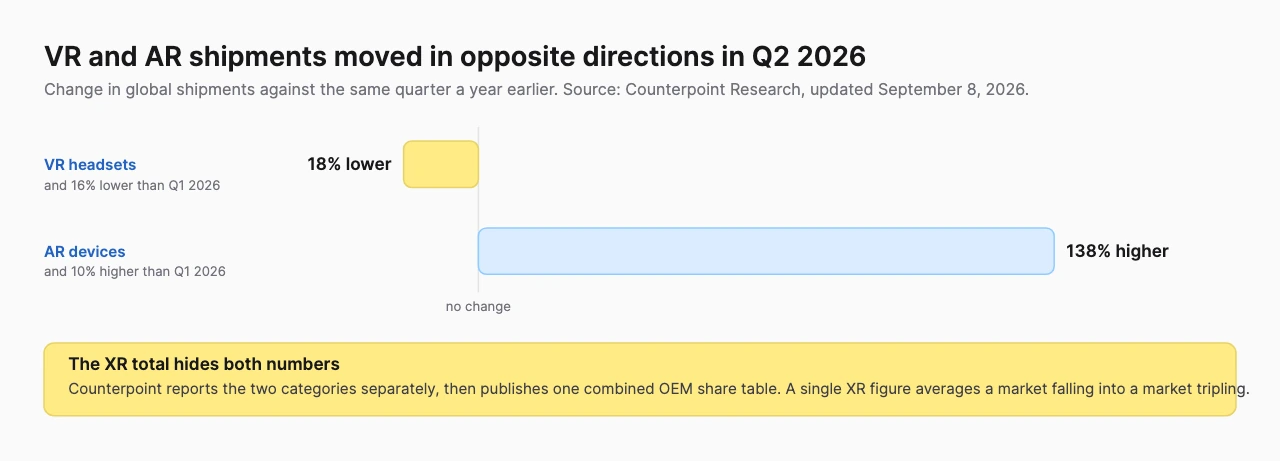
The figures come from a model shipments tracker covering Q1 2020 to Q2 2026, which Counterpoint sells as an Excel file and published in September 2026. What appears on the public page is share percentages and growth rates. No unit volumes are given, so every number below is a rate of change or a share, not a count of headsets.
Why a price increase is part of the explanation
Counterpoint names one cause directly. "Meta's decision to increase VR headset prices amid the global memory price surge added further pressure to an already cooling market," the page says.
Meta announced that increase itself. Its pricing update put the change into effect on April 19, 2026, listing the Meta Quest 3S at $349.99 for 128 GB and $449.99 for 256 GB. The Quest 3 moved to $599.99 for 512 GB. Meta gave component cost as the reason, writing that the global surge in the price of memory chips "is impacting almost every category of consumer electronics, including VR." The same update applied to refurbished units and left accessory prices unchanged.
That was a $50 increase on each Quest 3S tier and $100 on the Quest 3, as documented in our Meta Quest lineup reference.
What the OEM share table actually counts
The share table on the same page ranks AR and VR shipments together, and reading it as a VR table produces the wrong answer.
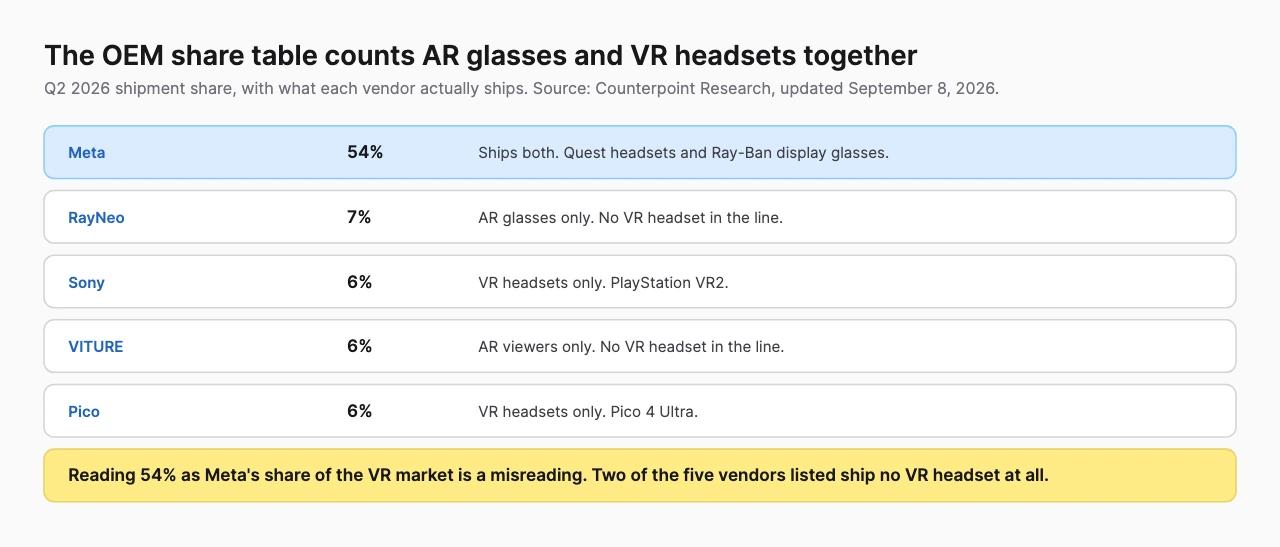
For Q2 2026 the table lists Meta at 54%, RayNeo at 7%, Sony at 6%, VITURE at 6%, Pico at 6% and others at 22%.
RayNeo and VITURE sell AR glasses and viewers. Neither ships a VR headset. Sony and Pico ship VR headsets and no AR glasses. Meta is the only vendor in the table on both sides of the split, which is why Counterpoint describes it as the exception among AR OEMs. So 54% is Meta's share of a combined market, and it is not Meta's share of VR.
Where the published figures disagree
Below the table, the same page carries a list headed "Global Q1 2026 AR/VR OEM market share rankings (based on shipments)" giving Meta 54%, Sony 7%, RayNeo 6%, Pico 6%, VITURE 6% and others 22%.
Two things do not line up. The list's Meta figure matches the table's Q2 2026 column, while the table's own Q1 2026 column puts Meta at 58%. And the list transposes Sony and RayNeo against the Q2 column. This post uses the table, because it carries the full quarterly series back to Q2 2025 and the list does not.
Which demand held up
Counterpoint identifies one part of the market that held up. It describes "resilient demand from the enterprise segment" and says enterprises and governments "are generally less price-sensitive than consumers" when they adopt VR for digital twin and spatial computing work.
It names a second source of demand that has nothing to do with consumer content. Driven by the robotics industry and particularly by China, it expects demand to grow this year for VR headsets used for data collection and remote robot control.
Neither observation arrives with a number. Counterpoint publishes no figure for what enterprise buying represents as a share of the quarter, so both are directions rather than measurements, and they should be held at that weight. The enterprise configurations behind that demand are documented in our Pico headset reference, which lists the business models and their prices.
How this compares with the last two years
The decline is not new, and it has steepened. Counterpoint reported in September 2025 that global VR headset shipments fell 14% year over year in H1 2025, with AR smart glasses up 50% over the same period. A year later the VR fall has widened to 18% and the AR rise has nearly tripled to 138%. Both categories have kept their direction and increased their pace.
What is behind the AR rise
Counterpoint credits new launches, naming models from RayNeo and XREAL, expansion by OEMs outside their home markets and China's mid-year promotional campaigns.
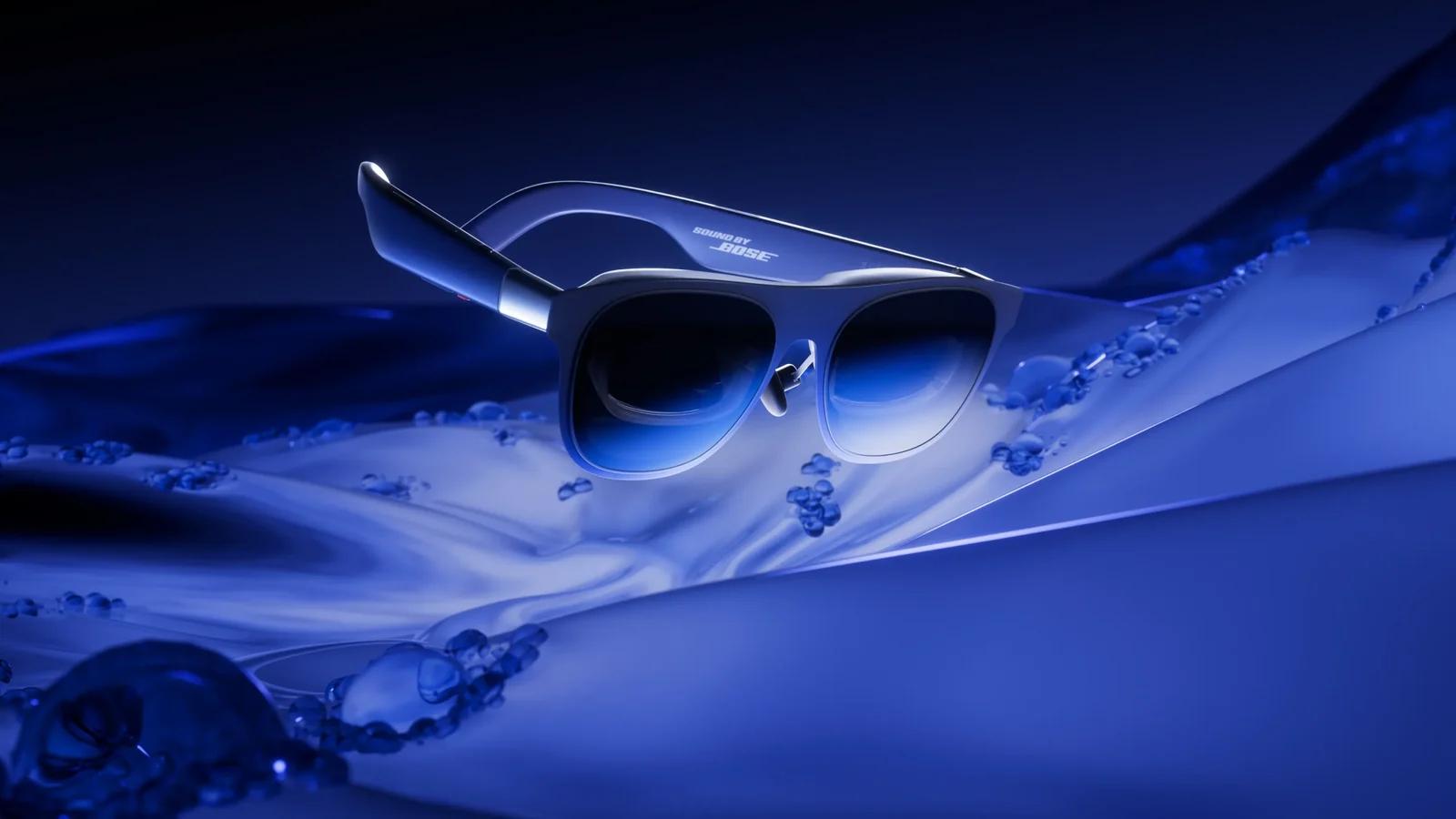
It also reports a shift in optics. Birdbath and flat prism viewers, the media consumption category, took 60% of AR device shipments in Q2 2026, up from 58% the previous quarter. Waveguide glasses settled at about 40%, up from about 20% in Q2 2025. Counterpoint notes that beyond Meta, the leading OEMs commercializing waveguide glasses are headquartered in China, naming Rokid, Even Realities, Alibaba and iFLYTEK.
Related reading. Our comparison of current XR headsets carries claimed specifications and checked prices for the devices in this table, and the smart glasses buying guide covers the AR category that is growing while VR contracts.
Frequently Asked Questions (FAQ)
1. How much did VR headset shipments fall in Q2 2026?
Global VR headset shipments fell 18% against the same quarter in 2025 and 16% against the first quarter of 2026, according to Counterpoint Research's tracker updated on September 8, 2026.
2. Did the whole XR market shrink in 2026?
No. VR headset shipments fell while AR device shipments rose 138% year over year in the same quarter. A single XR figure averages the two and describes neither accurately.
3. Does Meta hold 54% of the VR headset market?
No. The 54% figure is Meta's share of a combined AR and VR shipment table. Two of the five vendors listed in that table, RayNeo and VITURE, sell no VR headset at all.
4. Why did Meta raise Quest prices in 2026?
Meta said a global surge in the price of memory chips was affecting consumer electronics broadly. The increase took effect on April 19, 2026, putting the Quest 3S at $349.99 for 128 GB and the Quest 3 at $599.99 for 512 GB.
5. Is enterprise VR demand still growing?
Counterpoint describes enterprise and government demand as resilient and expects growth in headsets used for robotics data collection and remote control, but it publishes no unit figure for either, so both are directions rather than measurements.