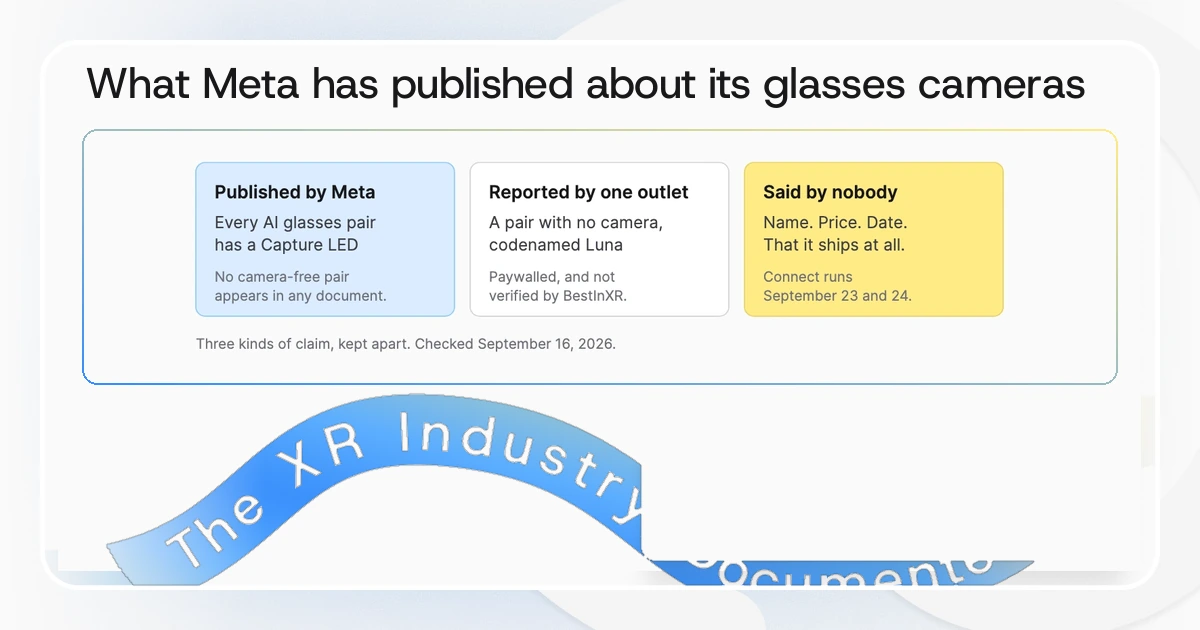
Written on September 16, 2026, before Meta Connect. At that point Meta had published nothing about a pair of smart glasses without a camera, and The Information had reported that one existed, was codenamed Luna and could be shown at Connect the following week. Meta's own privacy page was built entirely around a camera, which is what made the report interesting.
Update, September 24, 2026. Meta announced the product at Connect on September 23 as Ray-Ban Meta Audio, at $349 and shipping October 13. Every reported detail below held: six microphones, a button for Meta AI, the frame names Clubmaster and Burbank and an October ship month. The name Luna never appeared in a Meta document. The privacy page described below was still unchanged when checked on September 24.
In short:
- What Meta had published as of September 16: Connect dates of September 23 and 24, and a privacy page stating that every pair of its AI glasses carries a Capture LED.
- What was reported: a camera-free pair codenamed Luna, with six microphones, speakers and a side button, in two frame styles.
- Who reported it: The Information, carried by three outlets. BestInXR has not read the original, which sits behind a paywall.
- What was unknown then: name, price, date and whether Meta would ship it at all. All four arrived on September 23.
What Meta has published about Connect and about cameras
Meta Connect 2026 runs on September 23 and 24 as a virtual livestream, with the keynote on September 23 and a developer state of the union the following day. Meta's own page describes the event as showcasing "breakthroughs in AI technologies, AI glasses and VR". It names a category and no device, which is exactly what it said before the Project Phoenix images leaked last week.
The more useful document is the one about cameras. Meta's AI glasses privacy page is headed "Privacy, built in every pair" and states that "Each pair of our AI glasses has a bright white light called a Capture LED that blinks to signify when content is being captured for your gallery." It describes the light as designed "solely to let others know you are capturing content", says Meta tested brightness so it stays visible in daylight and sets out a tamper rule: "If the glasses detect the Capture LED light was covered, physically tampered or destroyed, they'll automatically disable the camera."
That page is the whole of Meta's published position on smart glasses privacy, and every sentence of it presumes a camera. A pair without one would be the first Meta AI glasses that none of it describes.
What was reported, and by whom
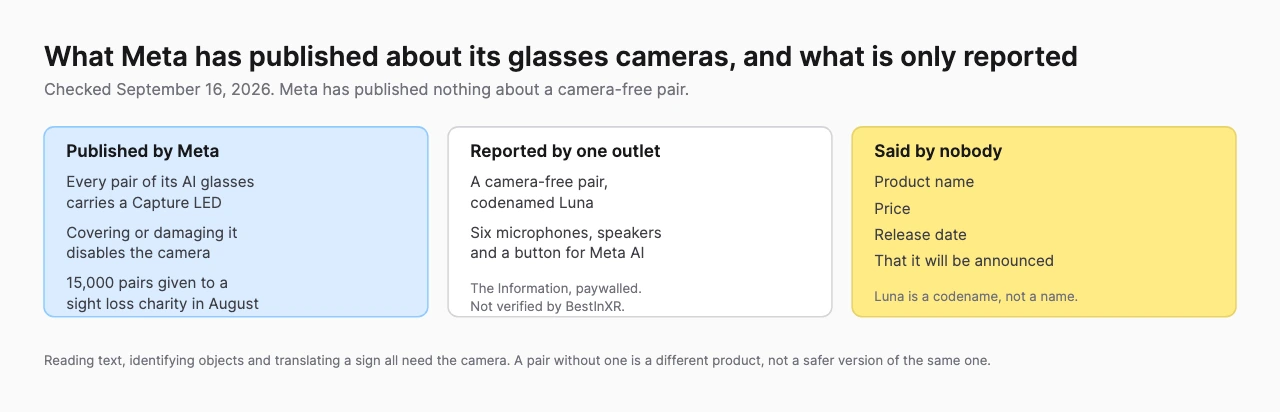
On September 16, 2026, The Information reported that Meta is preparing camera-free smart glasses. The report is paywalled and BestInXR has not read it. What follows is how three outlets that did read it described its contents, and they agree on every detail.
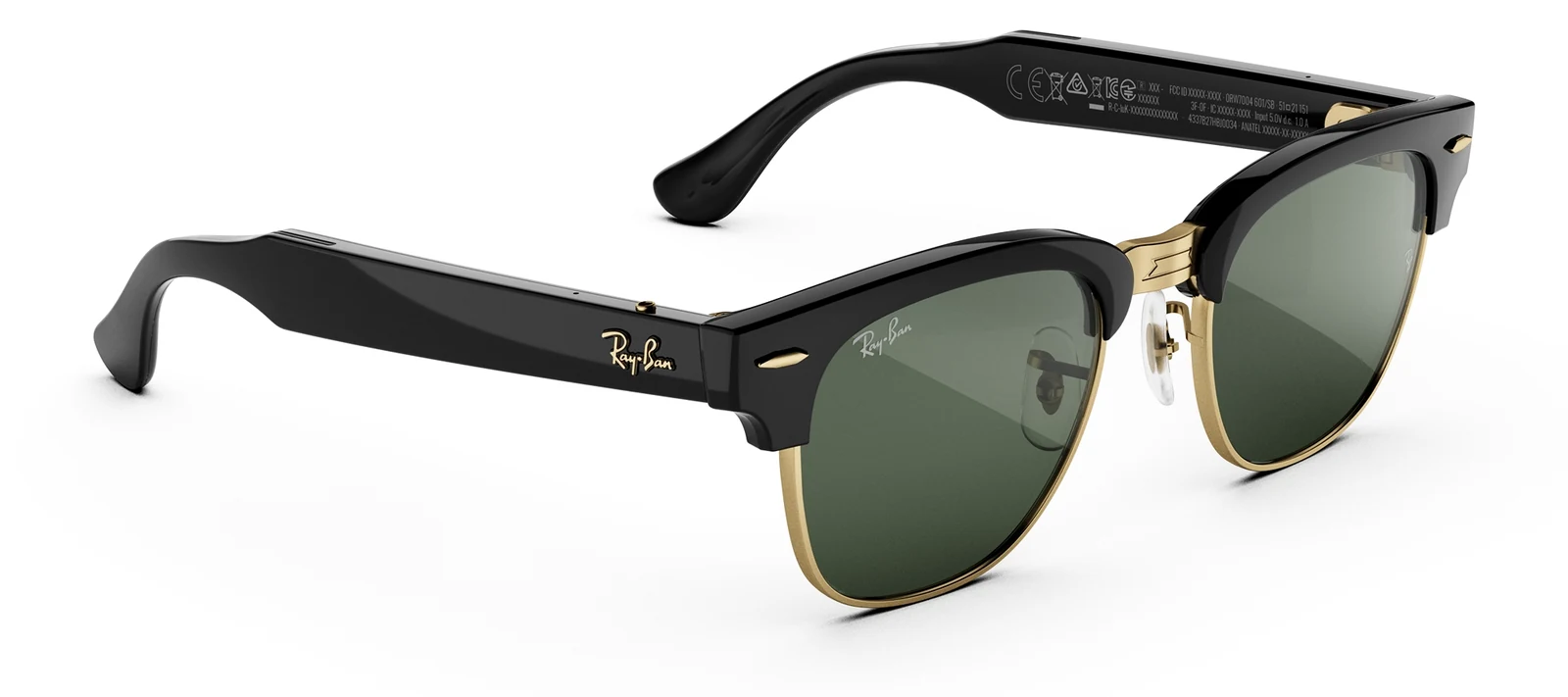
The Verge, Engadget and Road to VR each report the glasses are codenamed Luna, carry six microphones and speakers in place of a camera, add a side button that summons Meta AI and come in two frame styles called Clubmaster and Burbank. Removing the camera is said to have allowed slimmer temple arms. All three give October as the target ship month and Connect as the likely venue for a reveal.
Three outlets reading one report is one source, not three. The value in the agreement is that none of them adds a detail the others lack, which is what you would expect from a single document and not from a rumor passing through hands.
Why an assistant pair is a coherent product for Meta right now
One documented fact makes the reported product make sense. On September 8, 2026, Meta announced Muse, a personal AI agent it describes as running on a dedicated virtual machine and taking actions on a person's behalf. The announcement ends by saying Muse is rolling out on iOS, Android and the web, and is "coming soon to AI glasses".
An agent you talk to needs microphones and speakers. It does not need a camera. Meta has published the software half of the reported device without publishing the device.
What removing the camera would also remove
This is the part the report does not address and the corpus can. Meta's most recent newsroom post about its glasses is not about privacy at all. On August 13, 2026, Meta announced it was donating 15,000 Ray-Ban Meta glasses to Vision Ireland, enough for every blind and visually impaired adult the charity supports. Meta lists the tasks the glasses help with: "reading text, identifying objects and accessing information about the world around them".
Every one of those requires the camera. So does live translation of a sign, and so does asking the assistant what you are looking at. A camera-free pair is a different product from the one in that announcement, not a safer version of it, and a reader deciding between them should be told which capabilities leave with the lens.
Meta currently sells four glasses families on its own store, and our comparison of AI and smart glasses prices the no-display line from $224 to $499 as checked on September 15, 2026. Nothing in that range is sold without a camera.
Apple is reported to be weighing the same decision
The Luna report is the second time this year that a camera-free pair has surfaced as a deliberate design choice rather than a cost saving. Our reference on Apple's reported N50 glasses records Apple weighing two options for the same problem: remove the cameras entirely, or keep them and block user-initiated photo and video so they feed the assistant only.
Two companies reaching for the same answer is worth noting and is not evidence that either will ship it. Apple has confirmed nothing about N50 and Meta has confirmed nothing about Luna. What can be said is that the capture camera has become the contested component in a category that was sold on it, and that the alternative design is now reported at both of the companies with the most to lose.
What Meta confirmed a week later
At the time of writing there was no product name, no price, no release date, no specification and no confirmation that the device would be announced at all. Luna was a codename appearing in one report, not a Meta product name, and Meta had published nothing acknowledging the project.
On September 23, 2026 Meta published all of it. The product is Ray-Ban Meta Audio, it costs $349, it ships on October 13, it weighs 43 grams, it runs up to 12 hours on a charge and it has no camera. Meta's own product page states it is built without a camera. Our coverage of the announcement sets the reported details beside the published ones line by line. Luna was never used by Meta and remains a codename.
The one thing this post flagged that Meta has not acted on is the privacy page. Checked in a browser on September 24, 2026, it still opens "Each pair of our AI glasses has a bright white light called a Capture LED." One pair now has no camera and no such light.
Related reading. Our comparison of AI and smart glasses prices what Meta actually sells today, the smart glasses business guide sets out how the categories divide and the Project Phoenix post covers the other unannounced device attached to the same Connect keynote.
Frequently Asked Questions (FAQ)
1. Has Meta announced smart glasses without a camera?
Yes, on September 23, 2026, as Ray-Ban Meta Audio, at $349 and shipping October 13. Before that the only account was a September 16 report by The Information, carried by The Verge, Engadget and Road to VR, and Meta's own newsroom and store carried no mention of it.
2. What is Luna?
A codename used in that report for the pair of Meta smart glasses that shipped as Ray-Ban Meta Audio. It is not a Meta product name and has never appeared in any Meta document.
3. What would camera-free glasses still do?
By the reporting, talk to Meta AI through six microphones and answer through speakers, with a side button to summon the assistant. They would not do anything that depends on seeing, which includes reading text aloud, identifying objects and live translation of signage.
4. Do all of Meta's current glasses have a camera?
Not since September 23, 2026. Ray-Ban Meta Audio has none. Meta's privacy page still states that each pair of its AI glasses carries a Capture LED that blinks while content is being captured and that the camera is disabled automatically if that light is covered or damaged, and it had not been updated when checked on September 24, 2026.
5. When was Meta Connect 2026?
September 23 and 24, 2026, as a virtual livestream, with the keynote on September 23. Our roundup of everything Meta announced covers the full lineup.