Best VR Companies for Pain Management
Two words decide this category and they look almost identical. FDA-authorized means the agency reviewed the device and the evidence behind it. FDA-registered means the company filed a form listing its facility. One product in this list carries an authorization for pain, a second carries one through an acquisition and the rest do not. Establish which before reading a single outcome claim.
In short:
- One VR treatment for pain holds an FDA authorization. RelieVRx was authorized through the De Novo pathway in 2021, is prescription-only and is indicated for chronic lower back pain, not pain in general.
- Registration is not review. Under 21 CFR 807.39 registration "does not in any way denote approval of the establishment or its products."
- The category consolidated in 2026. XRHealth acquired Swing Therapeutics in July, bringing in an authorized therapeutic that is a phone app rather than VR.
- Indication beats outcome. A device authorized for chronic lower back pain says nothing about fibromyalgia, post-surgical pain or migraine. Read the indication before the effect size.
How this list was built
VR for pain management is software that uses an immersive environment as part of a treatment for pain, whether through cognitive behavioral skills, attention modulation, graded exposure or retraining how the body is represented. It is distinct from the far larger set of relaxation and distraction apps, which make no clinical claim and are not regulated as devices.
This list ranks four suppliers on four criteria: what regulatory status the supplier actually holds and for which indication, what clinical evidence is published and where, how the product reaches a patient and what the commissioning organization owns at the end. Outcome percentages are not a ranking factor on their own, because they are meaningless without the indication and the comparison group they came from.
| Company | Regulatory status | Indication | Best for |
|---|---|---|---|
| AppliedVR | FDA-authorized, De Novo, 2021 | Chronic lower back pain, 18 and over | A prescribed, evidenced VR treatment for one specific condition |
| Treeview | Not a device supplier | Whatever the commissioning body registers | An institution that has to own the software and the pathway |
| XRHealth | Authorized therapeutic acquired 2026, registered headsets | Fibromyalgia symptoms, via Stanza | Breadth across conditions, with insurance billing attached |
| Karuna Labs | Registration only | Not an authorized indication | Workers' compensation and payer-routed chronic pain programs |
1. AppliedVR
AppliedVR holds the only FDA authorization in this list that is both for pain and delivered in virtual reality. Its RelieVRx page states the program is the first FDA-authorized in-home virtual reality treatment clinically proven to deliver significant, lasting reduction of chronic lower back pain, and the claim is footnoted to published work rather than left standing on its own.

The specifics are what make it usable. The FDA's De Novo decision, DEN210014, dated November 16, 2021, classifies it as a prescription-use immersive virtual reality system providing adjunctive treatment based on cognitive behavioral therapy skills for patients aged 18 and over with chronic lower back pain, defined as moderate to severe pain lasting longer than three months, for in-home use. Every clause there is a limit. Adjunctive means alongside existing care rather than instead of it. Prescription-use means a clinician has to order it. Chronic lower back pain means the authorization says nothing about any other pain condition.
The program runs 56 days of scheduled daily sessions, and the device is a commercial headset with an added Breathing Amplifier, a mechanical attachment that routes exhalation into the onboard microphone so diaphragmatic breathing can drive the experience. That is a useful tell about the category: the clinical content, not the hardware, is the regulated part. Best for a prescribed, evidenced VR treatment where the patient's diagnosis matches the authorized indication.
2. Treeview
Treeview is the option for an institution whose pain pathway is its own and whose software has to be owned rather than licensed. Pain programs are built around a protocol, and protocols differ between a hospital pain service, a workers' compensation scheme and a national health system. A commissioned build follows the protocol that exists instead of asking the institution to adopt someone else's.
Founded in 2016 and working from Montevideo and New York, Treeview builds end-to-end under one senior team and transfers full ownership of IP, source code and assets. Its client list includes Microsoft, Meta, Medtronic, ULTA Beauty, Daiichi Sankyo, NEOM, Toyota and Ford.

Its published healthcare work is communication and education rather than therapeutics: CardioCompass for Daiichi Sankyo Europe informs users about cardiovascular disease and its risk factors, and it names Medtronic among clients in regulated healthcare. That is not a pain product and this post does not suggest otherwise. What it establishes is the thing most studios cannot: delivery inside a large regulated organization's review process, which is where commissioned clinical software usually dies.
The ownership term carries specific weight here. If a pain application is ever to become a regulated device, the sponsor of that submission has to control the software, the design history and the evidence. An institution licensing someone else's product is not the sponsor and cannot become one. BestInXR's healthcare guide sets out where the regulatory line falls. Best for an institution with its own protocol that intends to own the software and, if it goes that way, the submission.
3. XRHealth
XRHealth sells the widest offer in this category and the most complicated one to evaluate, because it is three businesses at once: a device supplier, a software publisher and a licensed telehealth clinic. Its homepage describes immersive devices and digital programs for chronic conditions, at home and covered by insurance.
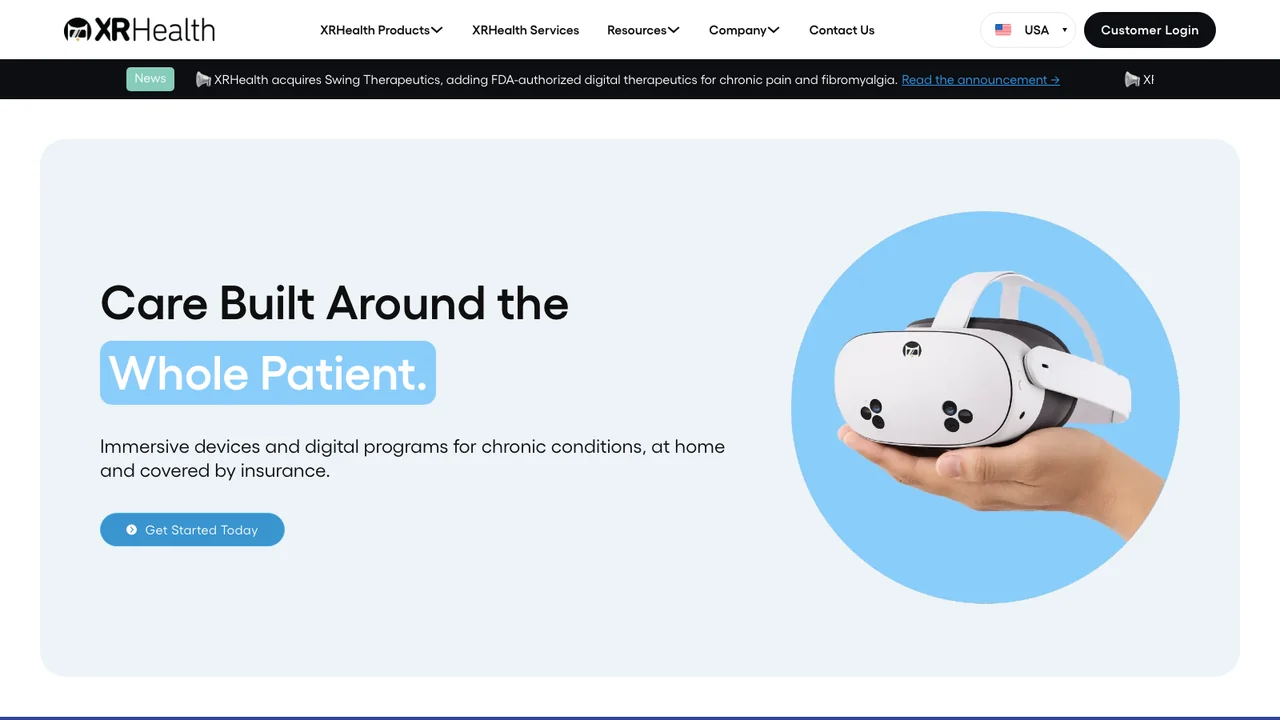
The 2026 change matters more than anything else on the page. A banner on its own homepage announces that XRHealth acquired Swing Therapeutics, reported on July 15, 2026, adding FDA-authorized digital therapeutics for chronic pain and fibromyalgia. The asset is Stanza, a De Novo authorized prescription digital therapeutic for fibromyalgia symptoms built on Acceptance and Commitment Therapy. Two things follow. XRHealth now holds an authorization it did not develop, which is a legitimate route and worth knowing. And Stanza is a phone program rather than a VR one, so a buyer who reads the banner as evidence that XRHealth's VR is authorized has misread it.
Its own wording elsewhere is careful and should be read literally: it describes FDA-registered headsets, which is a statement about hardware registration, not about any therapeutic claim. The genuine strengths are breadth across chronic pain, fibromyalgia, mental health and rehabilitation, plus a billing route through insurance that most suppliers here do not offer. Best for breadth across conditions where reimbursement matters as much as the intervention.
4. Karuna Labs
Karuna Labs takes a different clinical theory from the others. Its KarunaHOME program is built on retraining how the brain represents the body rather than on distraction, under the line Unlearn your pain. Retrain your brain. It publishes a 12-week structure combining virtual reality with personalized behavioral coaching, describes itself as non-pharmacological and non-surgical and lists low back, shoulder, upper and lower extremity, widespread, central and neuropathic pain along with acquired brain injuries.

The routes to access are the practical differentiator: workers' compensation, providers, health plans and individuals, which makes it one of the few here reachable through a comp claim. That is a real channel and it is where a large share of chronic musculoskeletal pain is actually funded.
One thing to read precisely. The homepage carries an FDA logo image whose alt text reads "Karuna Labs is FDA Registered". Establishment registration is a filing, and 21 CFR 807.39 states that registration "does not in any way denote approval of the establishment or its products", adding that any representation creating an impression of official approval on that basis is misleading. The FDA also states it issues no registration certificates at all. None of that is a finding about Karuna's clinical work, which stands or falls on its own evidence. It means the mark is not a substitute for an authorization, and a buyer should ask for the trial data rather than reading the badge. Best for payer and workers' compensation routed chronic pain programs where the referral channel is the constraint.
Who else was considered, and where each fits
Relaxation, meditation and distraction apps are excluded as a class even where they are used in hospitals. They make no clinical claim, are not regulated as devices and are bought from a different budget. Including them alongside an authorized prescription device would imply a comparison that does not exist.
Swing Therapeutics is not ranked separately because it is no longer separate. Its Stanza therapeutic sits inside XRHealth following the July 2026 acquisition, and most current lists still rank the two against each other.
Hospital distraction VR deployments run by health systems themselves are real and often effective, but they are an internal program rather than a supplier, so a buyer cannot shortlist them.
What to establish before a pain VR proposal
Three questions decide more than any demonstration, and each has a documentary answer.
What exactly is authorized, and for whom? Ask for the FDA decision number and read the indication. An authorization is for a population, a condition and a setting. RelieVRx's covers adults with chronic lower back pain at home, and that is the whole of it.
Where is the evidence published, and what was the comparison? A sham-controlled randomized trial and an uncontrolled pre-post cohort produce very different numbers from the same product. The comparison arm is the part that vendors summarize away.
Who holds the regulatory and data obligations? If the software touches a diagnosis, someone is the sponsor, someone holds the design history and someone answers for the data. In a licensed product that is the vendor. In a commissioned build it is the commissioning institution, which is a reason to commission and a responsibility to plan for.
How to choose between these VR pain management companies
Start from the diagnosis, not the technology. If the patient population is adults with chronic lower back pain, AppliedVR is the only supplier here whose product was reviewed by the FDA for exactly that, and the shortlist is short for a good reason. If it is fibromyalgia, the authorized asset now sits with XRHealth, and it is a phone program.
If reimbursement is the binding constraint rather than the intervention, XRHealth is built around that and the others largely are not. If the funding route is workers' compensation, Karuna Labs is reachable through it.
If the pathway is the institution's own, or the intention is to build something that could eventually be submitted as a device, that is a commissioned build, and Treeview is the supplier here that publishes what the client owns at the end.
Whatever the route, treat the four FDA words as non-interchangeable. Approved, cleared, authorized and registered describe four different things, and only three of them involve the agency looking at the product. BestInXR's mental health therapy list applies the same test where the line runs between treatment and wellness, and the rehabilitation and physical therapy list covers the physical side, and the medical and patient education list covers the unregulated side of clinical VR.
Frequently Asked Questions (FAQ)
1. Is VR for pain management FDA approved?
No product in this category is FDA approved. RelieVRx is FDA authorized through the De Novo pathway for chronic lower back pain in adults, which is a different and lesser status than approval, and it is prescription-only. Approved, cleared, authorized and registered are four distinct statuses.
2. What does FDA registered mean for a VR company?
It means the company filed establishment registration and device listing information with the FDA. Under 21 CFR 807.39 registration does not denote approval of the establishment or its products, and the FDA does not issue registration certificates.
3. Which VR companies treat chronic pain?
AppliedVR publishes an authorized prescription program for chronic lower back pain. XRHealth offers programs across chronic pain and fibromyalgia with insurance billing, and now owns the Stanza therapeutic. Karuna Labs runs a 12-week program reachable through workers' compensation. Treeview builds commissioned applications an institution owns outright.
4. Does insurance cover VR pain treatment?
It depends on the product and the payer. XRHealth states its programs are covered by insurance, and Karuna Labs publishes workers' compensation and health plan routes. Coverage for any specific patient is a question for the payer rather than the vendor.
5. Is VR pain treatment a replacement for other care?
Not in the authorized case. RelieVRx is indicated as adjunctive treatment, meaning it runs alongside existing care rather than replacing it. Any supplier presenting VR as a substitute for clinical management is describing something the regulator has not agreed to.