
Snap announced four things about SPECS on September 16, 2026, and the only one a reader can have today is the software. SPECS Intelligence is live on iPhone in the US, and Snap's own page says no SPECS required. The $2,195 glasses still have no ship date.
In short:
- What shipped: SPECS Intelligence, an AI service for iPhone and Mac. Snap's page states "no SPECS required."
- What did not: the glasses. Snap says shipping is expected to begin later this fall in the US, the UK and France, and names no date.
- The price: $2,195 with a $200 refundable deposit, or $2,395 for the bundle that includes the cellular charging case, plus $10 to $20 a month for carrier data.
- The enterprise half: Salesforce, AWS, NVIDIA, Trifork and Hololight named as partners, with no prices and no dates.
- Where to try one: the SPECS First Look at Westfield Century City in Los Angeles, from October 1.
What Snap published on September 16
Snap put out four posts on its newsroom the same day, and they are the primary record of this launch. The main one, Making Computing More Human with SPECS, describes SPECS as "a new kind of computer built into a pair of augmented reality glasses" with "computing hardware built directly into the glasses without a puck or tether." Three others cover SPECS Intelligence, enterprise partnerships and Lenses built with five collaborators including Kaia Gerber, Jimmy Butler and Imogen Heap.
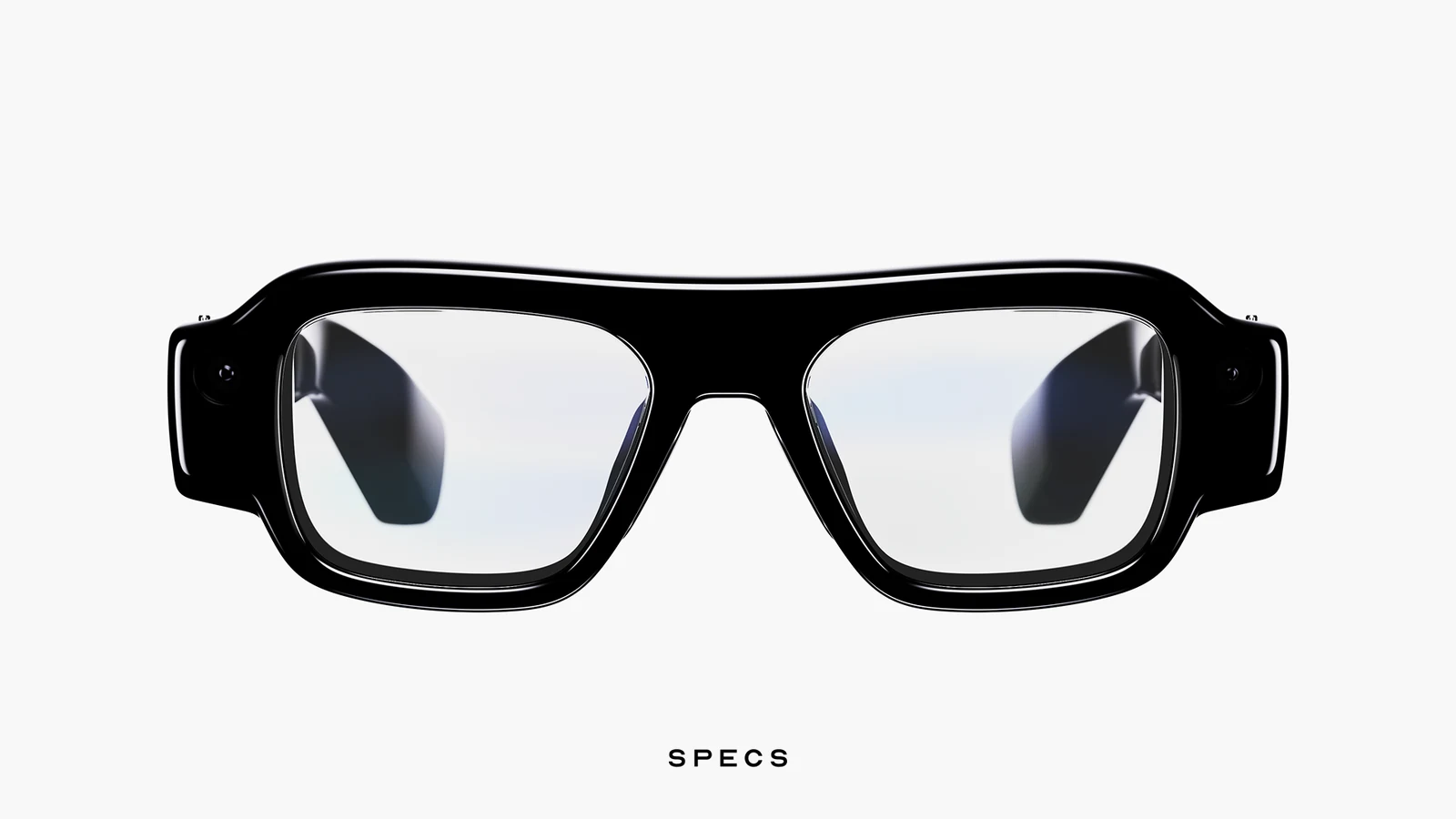
The hardware Snap publishes has not changed since the pre-order opened. The product page gives a 51 degree field of view through transparent waveguides with 16 million colors, dual Snapdragon processors, an adaptive tint driven by an integrated global dimmer and a virtual screen Snap compares to "a 115-inch screen from ten feet away." The Swiss TR90 frame comes in two sizes, and Snap publishes a weight for each: "132 grams at 47mm or 136 grams at 52mm." Prescription inserts are single-vision only, ordered through a partner, non-refundable and listed at checkout as "Price TBD."
What is new is everything around the glasses: the AI service, the enterprise list, a cellular charging case, a Verizon partnership and a physical place to try the product.
What $2,195 actually buys
Snap's own documents give three prices, and the headline figure is the smallest of them.
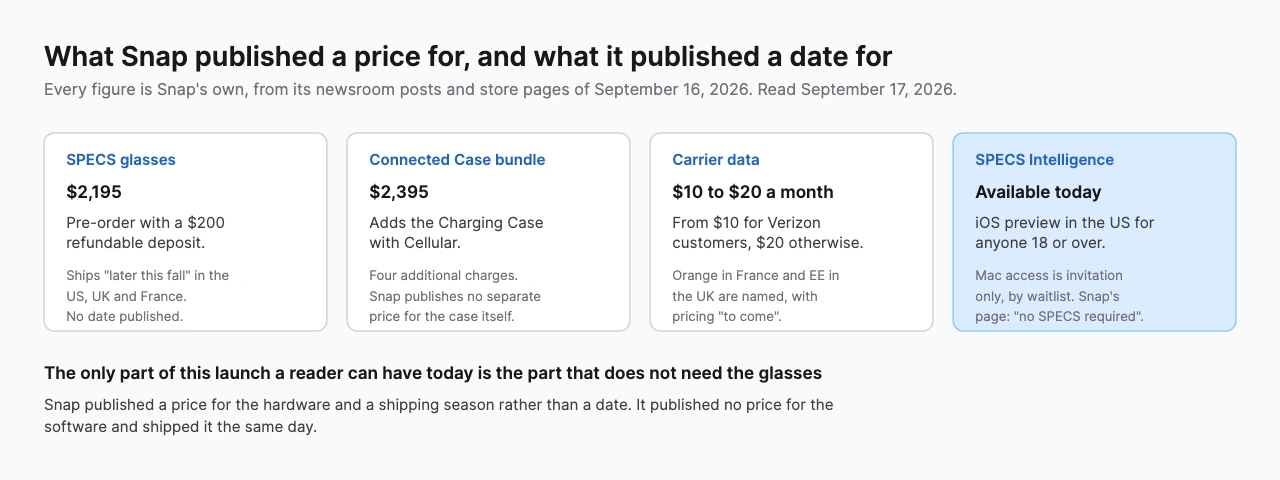
SPECS are $2,195 on pre-order with a $200 refundable deposit. The SPECS Connected Case bundle is $2,395, which adds the new Charging Case with Cellular, good for four additional charges and carrier connectivity. Snap publishes no separate price for the case, so the $200 difference between those two figures is arithmetic across one document rather than a price Snap states.
Then there is the data. Snap says Verizon will offer "Connected Wearable data plans" from $10 a month for Verizon customers and from $20 a month for everyone else, along with a 36 month financing option. Orange in France and EE in the UK are named as partners with "pricing details to come."
This matters because of how Snap positions the product. The pitch is a standalone computer with no puck and no tether, and that is accurate on Wi-Fi. Off Wi-Fi it is a $2,395 pair with a subscription, and the cellular case is the component that makes the standalone claim true outdoors. The pattern is familiar from the rest of the category: our XR hardware price index records the same gap between a headline price and a working system across headsets, trackers and haptics.
For scale, the most expensive pair of smart glasses in that index is Meta's Ray-Ban Display at $799, or $999 with prescription, checked on September 15, 2026. SPECS are more than twice that at the low end.
SPECS Intelligence runs without SPECS
This is the part the launch coverage treated as an accessory to the glasses, and Snap's own pages treat it the other way round.
SPECS Intelligence is described as "a new anticipatory AI service designed to work across iPhone, Mac, and SPECS augmented reality (AR) glasses." It builds context from apps a user connects, organizes life into what Snap calls Corners, tracks Goals and is "designed to anticipate when help would be useful and surface relevant information and actions without waiting for a prompt."
Snap's availability language is precise, and it is the most checkable thing in the whole announcement. Starting September 16 in the US, anyone 18 or over can download the SPECS app for iOS and try a preview. Mac access is invitation-only through a waitlist. And the SPECS Intelligence page says, in its own words, "Get early access to SPECS Intelligence on iPhone and Mac, no SPECS required."
So a glasses company shipped a phone app on the day of its glasses launch, and told buyers they do not need the glasses to use it. Snap published a price for hardware it cannot date and a date for software it has not priced.
That is not a criticism of the product, and there is a coherent reason for it: an assistant that has learned a year of someone's context before the glasses arrive is more useful on day one than one that starts empty. It is worth stating plainly because it changes what a reader is deciding. Trying SPECS Intelligence costs nothing and needs no hardware. Buying SPECS costs $2,195 and a wait of unstated length.
On privacy, Snap states that personal content from connected accounts "will not be used to train or fine-tune Snap's AI models, or to serve personalized ads" and that Snap personnel cannot view it. For the glasses themselves it states that SPECS "do not use facial recognition to identify people," do not continuously record, and light an external LED in the center of the frames when capture is happening. That LED is the same answer Meta reached for, which our report on Meta's camera-free glasses covers in detail.
The enterprise list is the half with names on it
For a site that tracks who builds what, the enterprise post is the substantial one, and it got the least attention.
Snap names five partners and says what each is doing. Salesforce is bringing Agentforce to SPECS so an employee can identify what they are looking at, open a case and update a workflow without a separate screen. AWS work connects SPECS to Amazon Quick. NVIDIA agents built on its XR AI stack are to let SPECS "understand a worker's surroundings, access relevant company data, and provide guidance in real time." Tandem by Trifork is remote expert support with annotations drawn into a technician's view. Hololight turns SPECS into a streamed spatial workstation for tools, documents and 3D models.
Snap also says it is working with device management vendors on deployment, security controls and management at scale.
Read against the rest of the category, none of these is a new idea. Remote expert video, annotated guidance and streamed 3D workstations are the established enterprise use cases, and our smart glasses business guide sets out where each fits. What is new is the display. Those workflows have mostly run on monocular assisted reality devices, and SPECS put them on a binocular waveguide with world-locked content at a consumer price point rather than an industrial one.
What Snap does not publish is any price, availability date or pilot program for any of it. Every enterprise claim in that post is a partnership announcement.
What Snap still has not published
A shipping date. Snap says "later this fall" and its store says "Expected to ship starting Fall 2026," which is the same window that was on the page before the keynote.
A battery life figure. The specification table on Snap's own product page has a row headed "Battery for real-world sessions," and the value beside it reads in full: "Built-in battery and charging case provide reliable, on-the-go power for wherever the day takes you." No hours, and no figure anywhere else on the page. The cellular case is described as four additional charges, which is a multiple of a number Snap has not given. BestInXR's XR spec gap counts this class of omission across the category, and battery life is one of the fields most consistently withheld.
A price for the Charging Case with Cellular on its own, a price for prescription inserts and carrier pricing outside the US. Snap also notes that the cellular case "requires a separate Verizon cellular plan, activate after setup."
Related reading. Our comparison of AI and smart glasses prices the no-display category SPECS sits above, the display glasses reference covers the virtual-screen devices it competes with for media use, and the smart glasses business guide explains why SPECS is classed as AR glasses rather than display glasses.
Frequently Asked Questions (FAQ)
1. Can I buy Snap SPECS today?
No. SPECS are on pre-order at $2,195 with a $200 refundable deposit. Snap says shipping is expected to begin later this fall in the United States, the United Kingdom and France, and has published no date. Its store page says "Expected to ship starting Fall 2026."
2. Do I need SPECS glasses to use SPECS Intelligence?
No. Snap's SPECS Intelligence page states "no SPECS required." As of September 16, 2026, anyone 18 or over in the US can download the SPECS iOS app and use a preview of the service. Access on Mac is invitation-only through a waitlist.
3. What does a connected pair of SPECS cost?
$2,395 for the SPECS Connected Case bundle, which includes the Charging Case with Cellular, plus a data plan. Snap says Verizon plans start at $10 a month for Verizon customers and $20 a month for others. Carrier pricing for Orange in France and EE in the UK has not been published.
4. Is SPECS the same product as Snap Spectacles?
No. SPECS is the consumer product on open pre-order. Spectacles is the earlier developer device, which keeps its own developer documentation, its own developer program and its own support site. SPECS has a separate SPECS Developer Portal. They are two different products and SPECS was not a rename of Spectacles.
5. Which companies are building enterprise software for SPECS?
Snap names Salesforce, Amazon Web Services, NVIDIA, Trifork and Hololight, covering agent workflows, remote expert support and streamed spatial workstations. Snap has published no pricing, availability date or pilot program for any of these, so they are partnership announcements rather than shipping products.