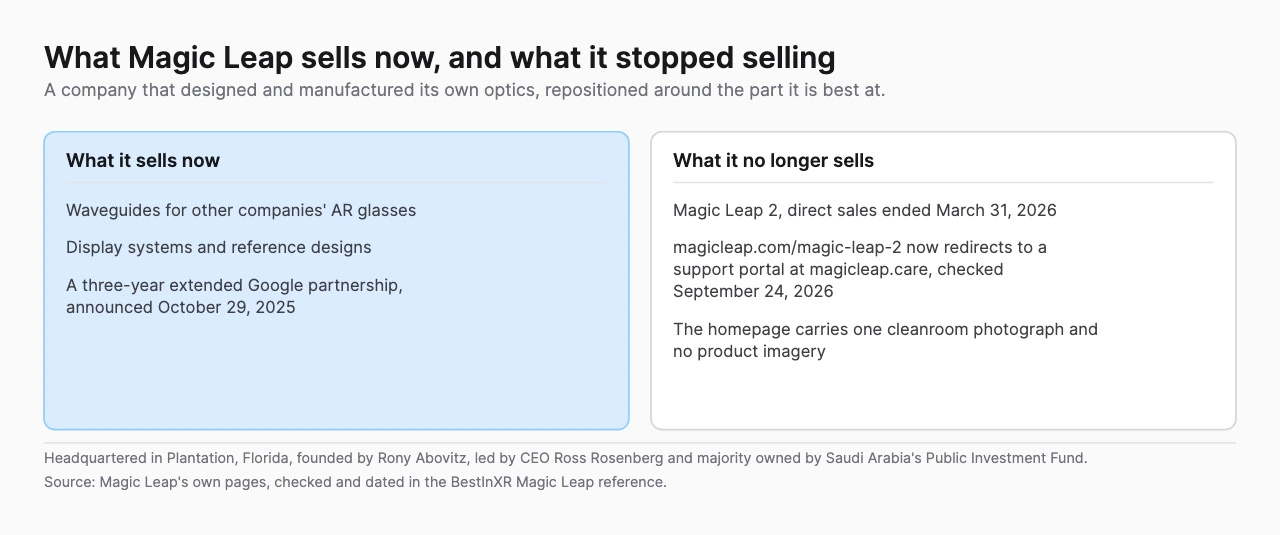
Magic Leap is an augmented reality company headquartered in Plantation, Florida. Founded by Rony Abovitz, majority owned by Saudi Arabia's Public Investment Fund and led by CEO Ross Rosenberg, it built the Magic Leap 1 and Magic Leap 2 headsets. In 2026 it stopped selling Magic Leap 2 and repositioned as a waveguide supplier for AI display glasses.
In short:
- What it is: A US augmented reality company that designed and manufactured its own optics, waveguides and headsets.
- What it makes now: Waveguides, display systems and reference designs for other companies' AR glasses, including a three-year extended Google partnership announced October 29, 2025.
- What it no longer sells: Magic Leap 2. Direct sales ended March 31, 2026 and support runs through December 31, 2027. Magic Leap 1 reached end of life on December 31, 2024.
- Where to find developers: Magic Leap 2 studios are listed in the BestInXR directory.
What is Magic Leap?
Magic Leap is an augmented reality company that develops optics, waveguides, display systems and, until 2026, its own enterprise AR headsets. Its July 9, 2026 press release describes the company as "an Augmented Reality (AR) ecosystems partner" with a track record in AR optics, device prototyping and manufacturing.
The company's 2022 press material says it was founded in 2010. Founder Rony Abovitz announced in May 2020 that he would step down as CEO so a new leader could "commercialize our focused plan for spatial computing in enterprise." Peggy Johnson followed him. Ross Rosenberg, a former Bain Capital operating executive, became CEO on November 1, 2023 and was quoted as CEO in the October 2025 Google partnership announcement. No CEO change has been announced since.
Where is Magic Leap headquartered?
Magic Leap, Inc. is headquartered at 7500 West Sunrise Boulevard, Plantation, Florida 33322, the address in its Magic Leap 2 terms of sale. Its 2025 and 2026 press releases describe the company as "headquartered in the United States with offices in Israel and Switzerland."
Magic Leap Austin and other offices
Magic Leap's about page lists offices in Austin and Boulder alongside the Florida headquarters. The Austin office opened in August 2016 at 9801 Metric Boulevard as a 23,000 square foot research and manufacturing site with 5,000 square feet of clean room, according to Silicon Hills News. The December 30, 2025 Pegatron production agreement was datelined Austin, Texas.
Who owns Magic Leap?
Saudi Arabia's Public Investment Fund (PIF) holds a majority stake. Road to VR reported in January 2023, citing filings from Magic Leap's UK subsidiary, that PIF invested $450 million during 2022, took its holding above 50 percent and gained the right to appoint four of eight board seats. Bloomberg reported in August 2024, again citing UK filings, that PIF had put a further $750 million into the company since the start of 2023. Exact percentages are not disclosed.
What does Magic Leap make?
Magic Leap made two headset generations and now sells waveguides, display integration and reference designs to other manufacturers.
Magic Leap 2 claimed specifications
Magic Leap 2 is a split-architecture enterprise AR headset with a tethered compute pack and a 6DoF controller. It went on sale September 30, 2022 in three editions priced at $3,299 (Base), $4,099 (Developer Pro) and $4,999 (Enterprise). The figures below are the manufacturer's claims from the version 6.2 specification sheet on the Magic Leap Care site and from the developer documentation.
| Specification | Magic Leap 2 (claimed) | Source note |
|---|---|---|
| Field of view | Up to 70 degrees diagonal, 44.6 degrees wide by 53.6 degrees high | Spec sheet v6.2. Developer docs round to 45 by 55 |
| Display resolution | 1440 x 1760 per eye, 1.875 arcmin per pixel | Spec sheet v6.2 and developer docs |
| Refresh rate | 120 Hz, sRGB color | Spec sheet v6.2 |
| Dynamic dimming | 0.3 percent to 20 percent transmission, global and segmented modes | Spec sheet v6.2 and developer docs |
| Headset weight | 260 g | Spec sheet v6.2 |
| Compute pack | 420 g without cable, 106 mm diameter, permanently cabled | Spec sheet v6.2 |
| Processor | AMD 7 nm Zen 2 x86-64, 4 cores and 8 threads, up to 2.4 GHz, RDNA 2 GPU | Spec sheet v6.2 |
| Memory and storage | 16 GB LPDDR5, 256 GB NVMe | Spec sheet v6.2. Developer docs list 128 to 256 GB |
| Battery | Up to 3.5 hours active, 7 hours in sleep mode | Spec sheet v6.2 |
| Operating system | Android Open Source Project, Android 10, API level 29 | Developer docs |
| Launch price | $3,299 Base, $4,099 Developer Pro, $4,999 Enterprise | September 30, 2022 press release |
| Current price | Not disclosed. No longer for sale | Magic Leap Care availability notice |
Magic Leap 1 end of life
Magic Leap 1, first sold as Magic Leap One: Creator Edition, reached end of life on December 31, 2024. The Magic Leap Care site states that as of that date the device "will no longer receive OS updates or Care support," that the device and apps "have reached the end-of-life" and that cloud services are no longer available.
Magic Leap 2 availability and support
Magic Leap 2 is no longer for sale. The terms of sale, last revised February 19, 2026, state that direct sales ended March 31, 2026 and that authorized resellers may deliver stock through December 31, 2026. The Care site says support and warranty for existing devices continue through December 31, 2027. In an April 2026 developer forum reply, Magic Leap staff wrote that "Magic Leap 2 will continue to function after December 31, 2027" because, unlike Magic Leap 1, it has no external dependent system.
What Magic Leap builds in 2025 and 2026
Magic Leap's current products are components and services rather than headsets. On October 29, 2025 the company showed an AI glasses prototype at the Future Investment Initiative in Riyadh that pairs its waveguides and optics with Google's Raxium microLED light engine. Both companies call it an Android XR reference design, not a consumer product. On December 30, 2025 Magic Leap announced an agreement with Pegatron for scaled production of AR components including waveguides.
What is the Magic Leap developer platform?
Magic Leap 2 runs an Android Open Source Project build (Android 10, API level 29) and supports OpenXR, Unity, Unreal Engine and native C development.
Does Magic Leap 2 support OpenXR?
Yes. Magic Leap 2 is a Khronos-conformant OpenXR device. Khronos announced conformance on April 25, 2023, with the runtime certified as of OS release 1.1.0. From OS 1.5.0 the developer documentation supports OpenXR development natively as well as in Unity and Unreal Engine, and it says the legacy Magic Leap SDK is being phased out in favor of OpenXR extensions.
Engines, SDKs and the Magic Leap Hub
Unity development uses Unity's standard OpenXR plugin (com.unity.xr.openxr) with the Magic Leap Unity SDK. Unreal development uses a Magic Leap fork of Unreal Engine 5.3, which the documentation labels a preview. The spec sheet also lists WebXR, Vuforia Engine, MRTK and native Android development in C, C++, Java and Kotlin.
The Magic Leap Hub is a desktop application for Windows and macOS that bundles a device bridge, OS installer, package manager, device streaming and debugging tools. The current line is Magic Leap Hub 3, at version 3.1.30 as of November 11, 2025.
What is Magic Leap's strategy from 2024 to 2026?
Magic Leap moved from selling enterprise headsets to supplying AR optics and integration services to other companies.
- May 30, 2024. Magic Leap and Google announced a strategic technology partnership combining Magic Leap's optics and manufacturing with Google's platforms.
- July 2024. Bloomberg reported, and Magic Leap confirmed, that the company laid off its sales and marketing teams, about 75 roles, and would shift toward licensing its optics technology.
- October 29, 2025. The Google partnership was extended by three years and the companies showed the Android XR glasses reference design in Riyadh.
- December 30, 2025. Magic Leap and Pegatron agreed on scaled production of AR glasses components.
- July 9, 2026. Magic Leap announced it was moving away from making first-party devices to become a waveguide supplier and device integration partner for the technology industry, framed around AI display glasses.
- July 2026. A WARN Act notice reported by Road to VR listed 193 job cuts at the Plantation headquarters effective October 1, 2026, across software, hardware, design, product management, manufacturing engineering and executive leadership roles.
Who uses Magic Leap technology?
Magic Leap's launch material named healthcare, manufacturing, retail and defense as the verticals for Magic Leap 2. The September 30, 2022 availability release named Cisco, SentiAR, NeuroSync, Heru, Taqtile, PTC and Brainlab as partners building on the headset. Its current customers for waveguides and reference designs are technology companies building their own glasses. Google is the only one named in a Magic Leap press release.
Where to find Magic Leap developers
Studios that build for Magic Leap 2 are listed in the BestInXR directory. For a comparison of teams that work across Magic Leap 2, HoloLens 2, Meta Quest and Apple Vision Pro, see mixed reality development companies. Because support ends December 31, 2027, ask any developer about OpenXR portability to other headsets.
Related reading
The other enterprise AR line that stopped selling, and the glasses category Magic Leap now supplies optics into.
- XR headsets compared
- Microsoft HoloLens
- Smart glasses guide
- The XR Graveyard, every dated end of support
- Who owns XR
Frequently Asked Questions (FAQ)
1. What is Magic Leap?
Magic Leap is a Florida augmented reality company that designed the Magic Leap 1 and Magic Leap 2 headsets and now supplies waveguides, display systems and reference designs to other companies building AR and AI glasses, including Google.
2. Is Magic Leap still in business?
Yes. As of September 2026 Magic Leap operates as a waveguide supplier and device integration partner. It stopped selling Magic Leap 2 in 2026, announced 193 job cuts effective October 1, 2026 and holds a three-year Google partnership announced in October 2025.
3. Where is Magic Leap headquartered?
Magic Leap, Inc. is headquartered at 7500 West Sunrise Boulevard, Plantation, Florida. The company also lists offices in Austin, Texas and Boulder, Colorado, plus locations in Israel and Switzerland.
4. Does Magic Leap 2 support OpenXR?
Yes. Magic Leap 2 has been a Khronos-conformant OpenXR device since April 2023, and from OS 1.5.0 the developer documentation supports OpenXR natively, in Unity and in Unreal Engine.
5. Who owns Magic Leap?
Saudi Arabia's Public Investment Fund holds a majority stake, reported at more than 50 percent after a $450 million investment in 2022, with a further $750 million invested from 2023 to mid 2024 according to Bloomberg. Exact percentages are not disclosed.