Written on September 12, 2026, before Meta Connect. At that point Meta had published nothing about a new headset, and on September 10 UploadVR reported that clear images of an unannounced slim headset sat inside an app package Meta distributes through its own store. That is a different class of leak from a supply chain rumor, and it was still not an announcement.
Update, September 24, 2026. Meta announced the device at Connect on September 23 as Meta VR Glasses: about 100 grams, a tethered compute puck, $1,299.99, Spring 2027. The reported shape was right and the negatives below are no longer true. This post is kept as the record of what was documented before the announcement, and the section headed What Meta has not said has been rewritten to say what Meta has now published.
In short:
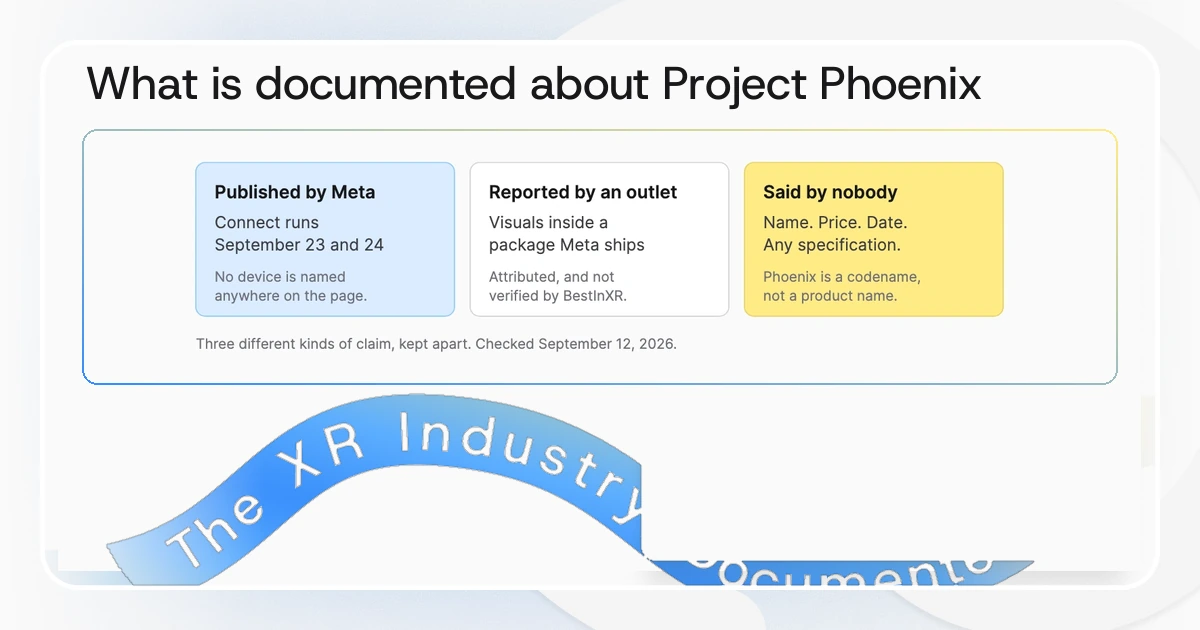
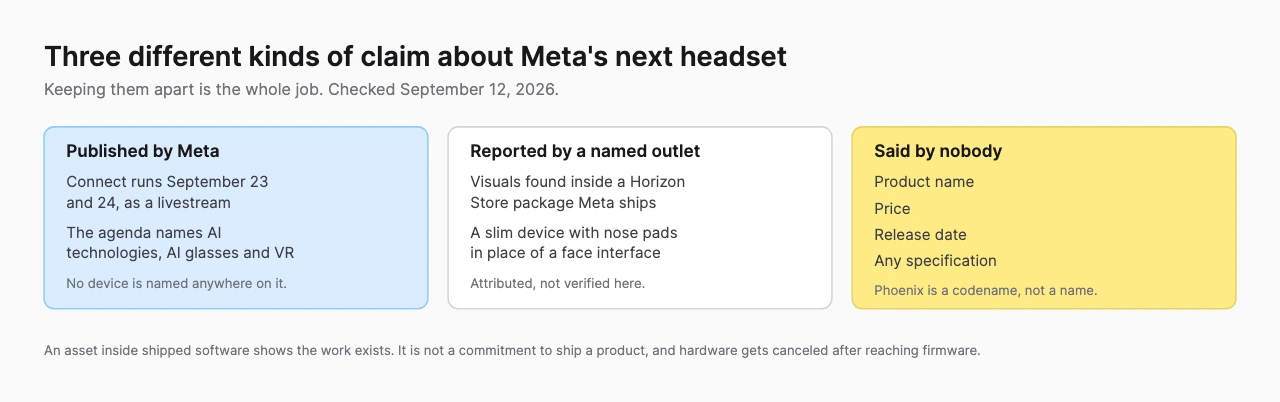
- What Meta had published as of September 12: Connect dates of September 23 and 24, and an agenda naming AI glasses and VR. No headset.
- What was reported: device visuals found inside the HorizonOS Prescription Lens package on the Horizon Store.
- Why the distinction matters: the assets came out of software Meta shipped, not from an anonymous source.
- What was unknown then: name, price, date and specifications. All four arrived with the announcement on September 23.
What Meta had published before Connect 2026
Meta Connect 2026 ran on September 23 and 24 as a two-day virtual livestream, with the keynote on September 23. Meta's own page described the event as showcasing "breakthroughs in AI technologies, AI glasses and VR".
That sentence was the whole of Meta's published position going in. It named a category and not a device. No headset name, no specification, no price and no date appeared anywhere on the page until the keynote.
What was reported and by whom
On September 10, 2026, UploadVR reported finding clear visuals of Meta's next headset inside the HorizonOS Prescription Lens package. By its account the app appeared in the Horizon Store in August 2026, was served to devices as a ZIP file rather than a standard APK, and was updated in September with images showing how prescription lens inserts attach and detach and how their QR code is scanned.
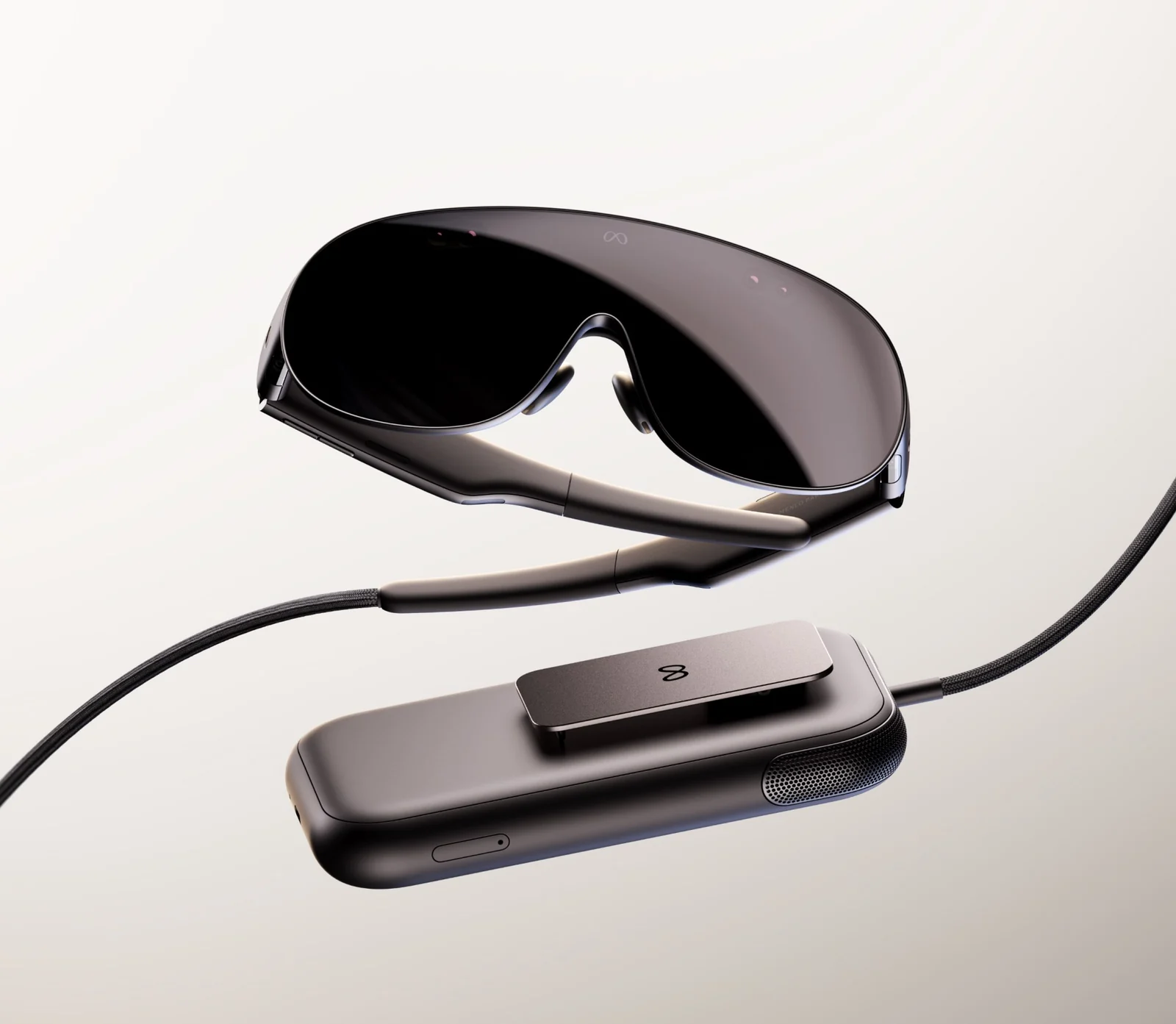
The device in those images is described as slim, with glasses-style nose pads in place of a face interface and sensors visible on the sides and undersides of the temples. UploadVR reports the project has appeared under the codenames Phoenix, Stanley and Loma. It describes a premium ultralight headset with a tethered compute puck.
The Verge covered the images the following day, crediting UploadVR as the source and noting Connect begins on September 23. Road to VR reported the same find.
Why this is a stronger class of leak than most
Most pre-announcement hardware reporting traces back to supply chain contacts, analyst notes or anonymous sources, none of which a reader can check. This does not. The assets were found inside a package Meta published to its own store and shipped to its own devices.
That changes the confidence level without changing the status. An asset in shipped software is evidence the work exists. It is not a commitment to ship a product, a name, a price or a date, and companies cancel hardware that has reached firmware.
One limit belongs in the open. BestInXR did not extract that package. This post reports what a named outlet found and says so, rather than presenting the find as something the site verified.
What Meta has said since
Meta has now published all four things this post recorded as missing. The name is Meta VR Glasses. The price is $1,299.99. The date is Spring 2027. The published specification is about 100 grams for the glasses, a 5K micro-OLED display at 37 pixels per degree, Qualcomm's Snapdragon Reality Elite and up to three hours of media playback from the puck. Our coverage of the announcement sets out what Meta gave and what it still has not, which includes the per-eye resolution, the field of view and the weight of the puck.
What the leak could never have carried is exactly what arrived with the announcement. The package held images of hardware. The price, the date and every number came from Meta. A codename is still not a product name: Phoenix, Stanley and Loma have never been used by Meta in public.
Our own Meta Quest lineup reference recorded on September 3, 2026 that Meta had not announced a new Quest model with a name, price or date, and that remains true. Meta VR Glasses are a separate product rather than a Quest successor, and Meta's own comparison page still lists the same two models.
What the rest of the desk says about the timing
Two documented facts sit underneath this. Meta raised Quest prices on April 19, 2026, citing the global surge in memory chip prices. Counterpoint Research then put VR headset shipments 18% lower year over year in the second quarter, which our report on Q2 2026 shipments covers in full.
A premium headset arriving into a market that is contracting on price is a harder launch than the same device would have been a year ago. That is context for Connect, not a prediction about it.
Related reading. Our coverage of the Meta VR Glasses announcement has what Meta finally published, the comparison of current XR headsets lists what is actually on sale with checked prices, and the Meta Quest lineup reference documents the current models and the April price change.
Frequently Asked Questions (FAQ)
1. When is Meta Connect 2026?
September 23 and 24, 2026, as a virtual livestream, with the keynote on September 23. Meta describes the event as covering AI technologies, AI glasses and VR.
2. Has Meta announced Project Phoenix?
Yes, as Meta VR Glasses, on September 23, 2026. Meta published a price of $1,299.99, a Spring 2027 availability and a partial specification. Phoenix, Stanley and Loma remain codenames that Meta has never used in public.
3. Where did the Project Phoenix images come from?
UploadVR reported finding them inside the HorizonOS Prescription Lens package, an app served through Meta's own Horizon Store as a ZIP file, which it says was updated in September with visuals of the device.
4. Does a leak from firmware mean the product is shipping?
No. An asset in shipped software shows the work exists. Companies cancel hardware that has reached firmware, and nothing about a package listing commits Meta to a product, a price or a date.
5. What did Meta's last price change do?
Meta raised Quest prices effective April 19, 2026, putting the Quest 3S at $349.99 and $449.99 and the Quest 3 at $599.99, and attributed the increase to the global surge in memory chip prices.