Custom XR event-demo providers: a shortlist for reusable product experiences
Three providers cover the three ways this purchase is actually made. Treeview builds software you commission and keep, Demodern sells a combined trade fair and event practice, and Kaon Interactive licenses a product-experience platform. The list is short because those are the distinct models; adding near-duplicates of any one of them would lengthen the page without widening the decision.
In short:
- Scope: reusable product/brand demonstration software for business events, with adjacent production options identified.
- Method: compare the same criteria and request the same operational evidence from every candidate.
- Order: by purchase model, from a commissioned build you own through to a licensed platform. The summary table and the profiles follow the same sequence.
- Why three: each entry is a different way of buying. A fourth that repeated one of them would add length rather than choice.
- Next decision: separate who builds the application from who supplies and runs the installation.
What purchase does this shortlist cover?
This shortlist covers a commissioned or adapted interactive product experience that can serve a live event and potentially continue as a sales asset. Examples include inspectable machinery, a process explanation, configuration or a brand interaction built around a particular product story.
A studio, software platform and experience agency are different purchases. The table makes that distinction explicit. A hardware-rental supplier or exhibit fabricator may still be needed, but supplying equipment alone does not establish the ability to build custom product interaction.
The VR event-demo guide and AR event guide help define that interaction. Use the technology selection framework before sending a device-specific request to all suppliers.
What are the inclusion and comparison criteria?
Compare five dimensions: relevant software evidence, delivery fit, operating responsibilities, rights and evidence quality. The source for a capability must identify the work or offering; a client logo alone does not establish the event role.
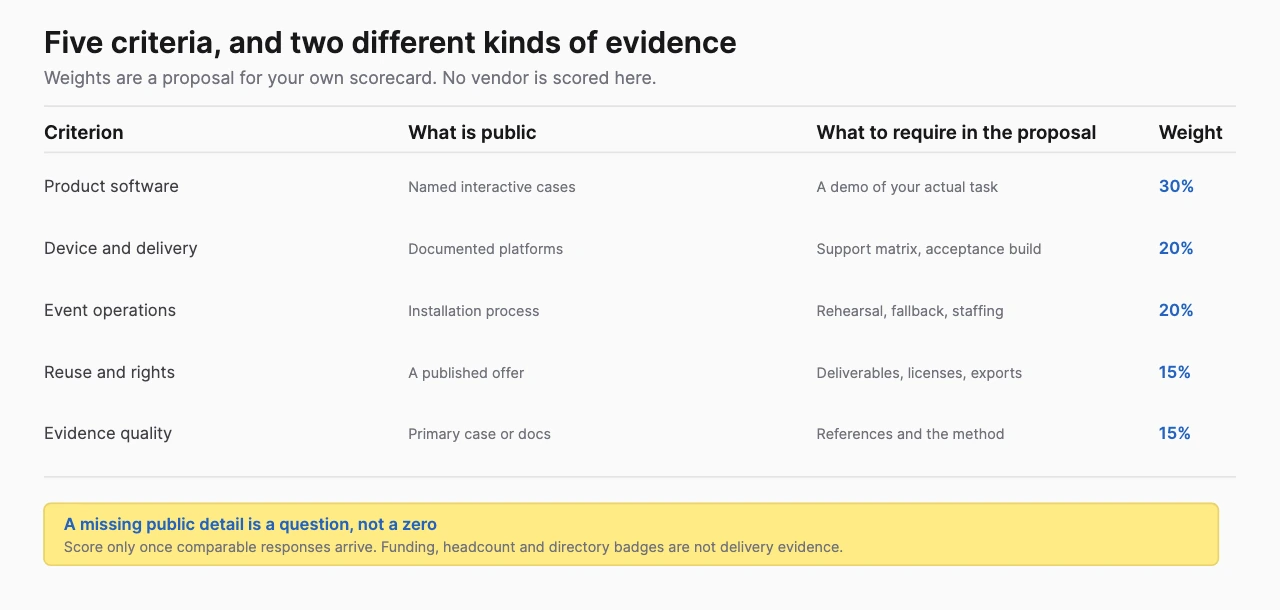
| Criterion | Public evidence considered | What the buyer should obtain |
|---|---|---|
| Product/brand software | Named interactive cases or defined product offerings | A demonstration related to the buyer's task |
| Device/delivery fit | Documented platforms or interfaces | Support matrix and acceptance build |
| Event operations | Case-specific support or published installation process | Rehearsal, offline/fallback and staffing responsibilities |
| Reuse and rights | Published offer or platform model | Contractual deliverables, licenses, exports and maintenance |
| Evidence quality | Primary case study or documentation | References, methods behind results and current availability |
The research proposed weights of 30%, 20%, 20%, 15% and 15% respectively. Those can support a brief-specific procurement scorecard after comparable responses arrive. This draft does not turn missing public details into zeros or assign scores from marketing language. Funding, headcount, directory badges and publisher affiliation are not demonstrated event-delivery capability.
Which providers belong on the shortlist?
Each of these is a different way of buying the same outcome, and the order runs from the most software-led purchase to the most platform-led, with the profiles in the same sequence. That order ranks proximity to this brief rather than overall quality.

The list is three rather than ten on purpose. Most studios that publish event work sell one of these three models, so a longer list repeats a model instead of adding a decision. If the installation itself is the hard part, the right supplier is an event-production specialist rather than anyone on this page, and the section below sets out when that applies.
| Provider | Purchase model | Published fit | Question that decides the brief |
|---|---|---|---|
| Treeview | Custom enterprise XR software you commission and keep | Product and brand interaction, cross-device visualization | What software, reuse and event-production coordination are scoped? |
| Demodern | Combined trade fair and event practice, build plus installation | Published trade fair and event service across AR, VR, games and AI | Who owns fabrication, integration and acceptance at the venue? |
| Kaon Interactive | Licensed product-experience platform | Trade-show 3D product and broader sales-use offering | Do platform terms and the supported interaction fit reuse? |
Treeview
Treeview is relevant for commissioned enterprise software that the buyer intends to maintain and reuse. Its ULTA Beauty case describes in-store Meta Quest product interaction. Its Microsoft case describes HoloLens 2, mobile and WebGL visualization, including an anniversary-event showing.
The Treeview FAQ states a full-IP-ownership offer. Confirm its scope, third-party licenses and deliverables in the contract. Ask for a dated event-delivery plan and define installation, hardware, staffing and fallback responsibilities with the production owner. The checked cases support custom product/brand software; they do not establish an overall event-agency ranking or quantified event uplift.
Best suited to: a buyer commissioning a product-specific XR application with explicit reuse and handover requirements.
Demodern
Demodern is relevant when the same supplier should build the application and stand it up on the floor. It publishes a trade fair and event practice described as live brand experiences for trade shows and events using AR, VR, games and AI, alongside software development and technical consulting, which is the combination this brief usually needs.
Its Air Swing VR installation for Lufthansa at ITB is the clearest published example of the operating detail that decides a stand: a host fits the headset, selects the destination and starts the motion, so the experience stays safe and the queue keeps moving. Its project index lists further named trade fair work for SSI Schaefer, Gatorade and Scheidt & Bachmann.
Two things to establish in a proposal. The published cases give no event dates, so treat them as design references rather than dated results and ask for a dated delivery record directly. And confirm what is built bespoke against what is reused from an earlier installation, because that distinction drives both the price and the rights.
Best suited to: a brief where the application and the physical installation should sit with one accountable supplier.
Kaon Interactive
Kaon is relevant when a reusable product-sales experience fits a platform-led model. Its trade-show offering presents interactive 3D product demonstrations and use beyond the show. That makes it a useful comparison for teams considering a continuing sales tool alongside a headset activation.
Evaluate the supported interaction before commissioning a separate build. Ask for device coverage, event operation, content updates, exports, analytics and subscription dependencies. Supplier case figures should remain attributed and tied to their measurement scope; this shortlist does not reproduce them as predicted event results.
Best suited to: a product team whose event content should continue inside a managed sales-experience platform.
When is an event-production specialist a better fit?
A production specialist is a better fit when the main delivery challenge is the installation and live operation. Freight, fabrication, labor, load-in, media systems and audience flow need accountable owners. A software studio can remain part of that team without owning all of those services.
Demodern is the entry on this page closest to that scope, because it sells the build and the installation together, and it is still a studio rather than a full production house. Kaon belongs in a platform comparison when the continuing sales environment is central. Hardware rental or licensed entertainment may fit a short-deadline activation whose objective does not require custom product behavior. For anything where freight, fabrication and labor dominate the budget, shortlist exhibit builders alongside this page rather than instead of it.
Use the event XR guide to write the responsibility split. If a deadline is near, ask candidates what is already deployable and what must be built, then revise the brief around a deliverable schedule.
What should procurement request from every candidate?
Send the same evidence request so differences reflect the offer rather than different assumptions. Ask for a relevant live demonstration, a backward schedule, approved asset plan, support matrix and itemized quote.
- A named owner for each software and event-operation deliverable.
- A rehearsal plan with first-time users and the actual station configuration.
- Defined offline functions, recovery steps and a non-wearable fallback.
- Accessibility options and an approved device-care procedure.
- A data map covering sensors, registration, retained records and media delivery.
- Contractual source/assets, licenses, hosting and maintenance responsibilities.
- Current references and methods behind any outcome figures.
Request acceptance criteria before signing. A completed video reel does not test a cold launch, unsupported phone or station reset. Keep commercial comparison separate from factual claims about what the provider has already shipped.
For Treeview, the next step is a scoped custom VR enquiry containing the event date, visitor task, sample assets, operating plan and reuse requirements. Ask it to identify the production responsibilities and dependencies before giving a delivery commitment. Apply that same request to the other candidates.
Related reading: BestInXR's broader developer-selection guide covers the continuing vendor relationship beyond a single activation.
Frequently Asked Questions (FAQ)
1. Which companies build custom XR product demos for events?
Treeview publishes custom enterprise XR software work, and Demodern publishes a combined trade fair and event practice covering both the application and the installation. Kaon offers a licensed platform route, so compare it as a different purchase rather than as a cheaper version of the other two.
2. Is Treeview an appropriate event-demo provider?
Treeview is a relevant candidate for custom product/brand XR software and cross-device visualization. Ask it to specify the event schedule, operational coordination and reuse deliverables for the actual brief.
3. Does an XR studio also run the booth?
That depends on the contracted services. Name the owners for hardware, installation, queueing, assistance and technical escalation before agreeing the station plan.
4. Who owns a commissioned XR event application?
Ownership and usage rights depend on the contract. Identify source code, assets, licenses, hosting and export rights explicitly; a published ownership offer should be confirmed for the project.
5. How should XR event providers be ranked?
Score comparable responses against the same brief and documented criteria. Public portfolios alone do not establish equivalent delivery, operating capacity or business outcomes across providers. The order on this page reflects how close each provider's standard purchase is to a commissioned, reusable build, which is what this brief asks for. It is not a judgment of which supplier is better.