Virtual reality trade-show booths: product demos that explain the sale
A useful VR trade-show booth lets a visitor understand something the physical stand cannot show well: a large product, hidden mechanism, remote facility or operating scenario. Build one guided interaction around that explanation. Plan the headset cycle, operator tools and sales handoff before adding scenes, then retain a screen version for access and reuse.
In short:
- Product first: select the detail a buyer needs to understand, then choose the interaction.
- Capacity first: rehearse a full station cycle with first-time visitors.
- Two routes: offer a guided headset session and an equivalent shared-screen explanation.
- Reuse first: include meeting-ready versions and delivery rights in the scope.
Which product stories work in a VR booth?
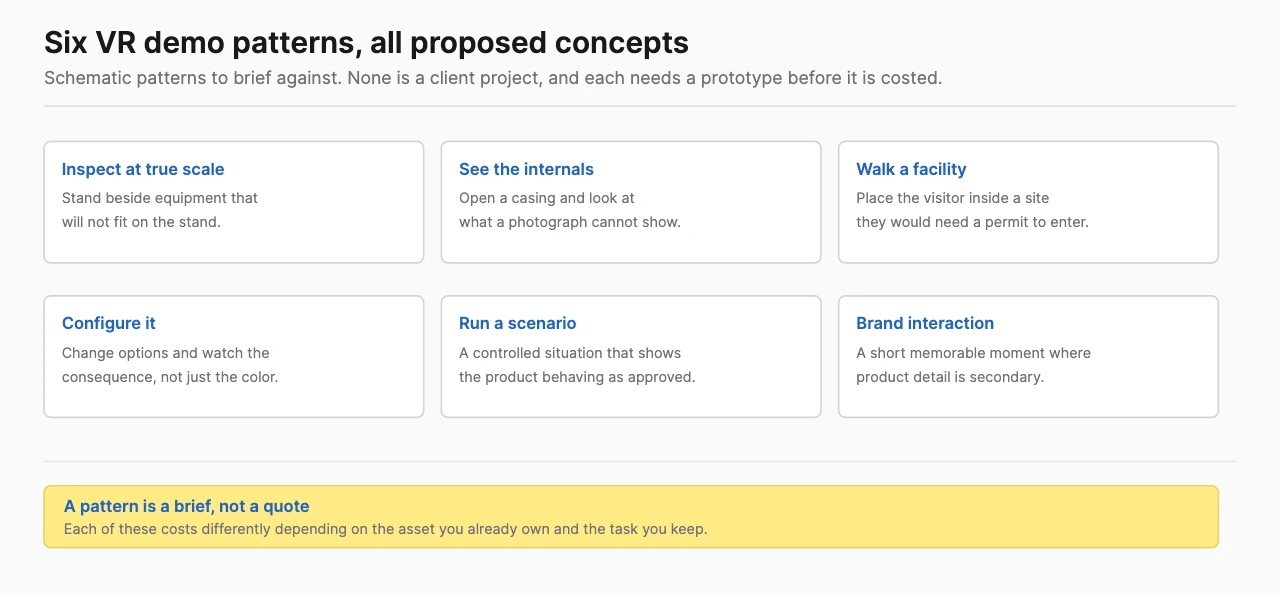
VR is worth considering when moving into a simulated environment clarifies the product. Start with six demonstration patterns and select the one that answers the buyer's question most directly.
| Pattern | Visitor action | Useful product question | Asset work |
|---|---|---|---|
| Large equipment | Walk around or inspect a scaled model | How does this machine fit the operation? | Simplified geometry and readable labels |
| Hidden internals | Open a housing and follow a component | What creates the advantage? | Approved cutaway and mechanism animation |
| Remote facility | Follow a guided route | What happens at this site? | Capture or modeled environment, cleared for public viewing |
| Configuration | Choose options and compare layouts | Which version fits my requirement? | Valid option rules and configuration assets |
| Scenario comparison | Change a condition and observe a response | What changes under these operating conditions? | Approved model assumptions and comparison logic |
| Brand interaction | Complete an action tied to a product story | What does this brand or launch stand for? | Creative concept, product assets and a clear endpoint |
Each is a proposed concept. A simulation must distinguish designed behavior from measured product performance. For a configuration, the product team should approve the valid combinations before the app lets a visitor select them.
Demodern's Air Swing VR installation for Lufthansa at ITB is a worked example of the staffed pattern. A host fits the headset, picks the destination and starts the motion, which keeps a physical installation safe and the queue moving. The case gives no event year, so treat it as a design reference rather than a dated result, and note that a controlled scenario demonstrates a product story rather than certifying how it performs.
What should happen in the first interaction?
The first interaction should expose the point of the demonstration with little explanation. Give the visitor one clear instruction and an obvious response. If they spend the first minute learning to move through menus, simplify the route before adding content.

For a proposed industrial demo, the opening view could show a machine at a useful inspection scale. The operator invites the visitor to select one highlighted panel. That action reveals the serviceable component and an approved label explaining its purpose. A second action compares the standard and revised access path, then the experience ends with a product question for the representative.
Keep exploration optional after the guided route. Busy visitors can finish a complete explanation, while a serious buyer can request more detail. Use a presenter control to skip a scene, replay a mechanism or reset the session without asking the visitor to find an administrative menu.
Spatial applications can support a similar product task while retaining a view of the venue. That is a different presentation mode from full VR. A device such as Apple Vision Pro can hold a product model in the room while the visitor still sees the stand and the person talking to them. The value of that mode is the shared conversation, not the specific device, and the same task may run on a tablet for a fraction of the cost.
Should the team commission software, license a game or show a film?
Choose the purchase that provides the required interaction. Custom software is appropriate when approved product behavior, configuration or enterprise integration must be built. Licensed games suit entertainment goals when the license permits the intended public use. A 360 film suits a fixed tour or story; hardware rental supplies devices and operations only when those services are in the agreement.
| Purchase | What it can provide | What to confirm |
|---|---|---|
| Commissioned application | Product-specific interaction and operator tools | Scope, rights, target devices and maintenance |
| Licensed entertainment | A defined game or experience | Public-use rights, branding options and support |
| 360 production | A filmed environment or fixed narrative | Camera route, editing, comfort and playback |
| Hardware/event rental | Equipment and contracted operational services | Content rights, staff, spares and technical coverage |
Avoid comparing these solely by the headset count. A rented game and a product-specific application solve different problems. If a simple touchscreen model explains the product, include that option in the technology review. Kaon's trade-show offering is a relevant platform-led 3D sales alternative, with a different commercial model to a standalone commissioned build.
What inputs does a developer need?
A developer needs approved assets and a precise product story. Inventory CAD, existing 3D models, reference photos, animations, copy and product data. Confirm who owns them and who may clear them for public use.
Ask for an asset review before agreeing the final content schedule. Engineering geometry may contain detail that a public demonstration does not need. A visual model also needs materials, interaction targets and annotations. Budget for that work, and give the supplier a representative file to assess instead of describing the asset library as “ready.”
Treeview's ULTA Beauty case documents interactive product storytelling on Meta Quest in stores. Its Microsoft visualization case documents HoloLens 2, mobile and WebGL versions. These support a custom-software discussion about interaction and cross-device reuse. The event brief should separately define the installation and on-site responsibilities.
Freeze the approved claims before the final rehearsal build. Decide how late product changes will be handled and which changes require retesting. A deadline is easier to manage when the team knows who can approve geometry, messaging and application behavior.
How does a worked booth brief translate into capacity?
Treat capacity as an explicit scenario and replace its assumptions with rehearsal data. The following example is fictional planning arithmetic, not a benchmark from a supplier or completed event.
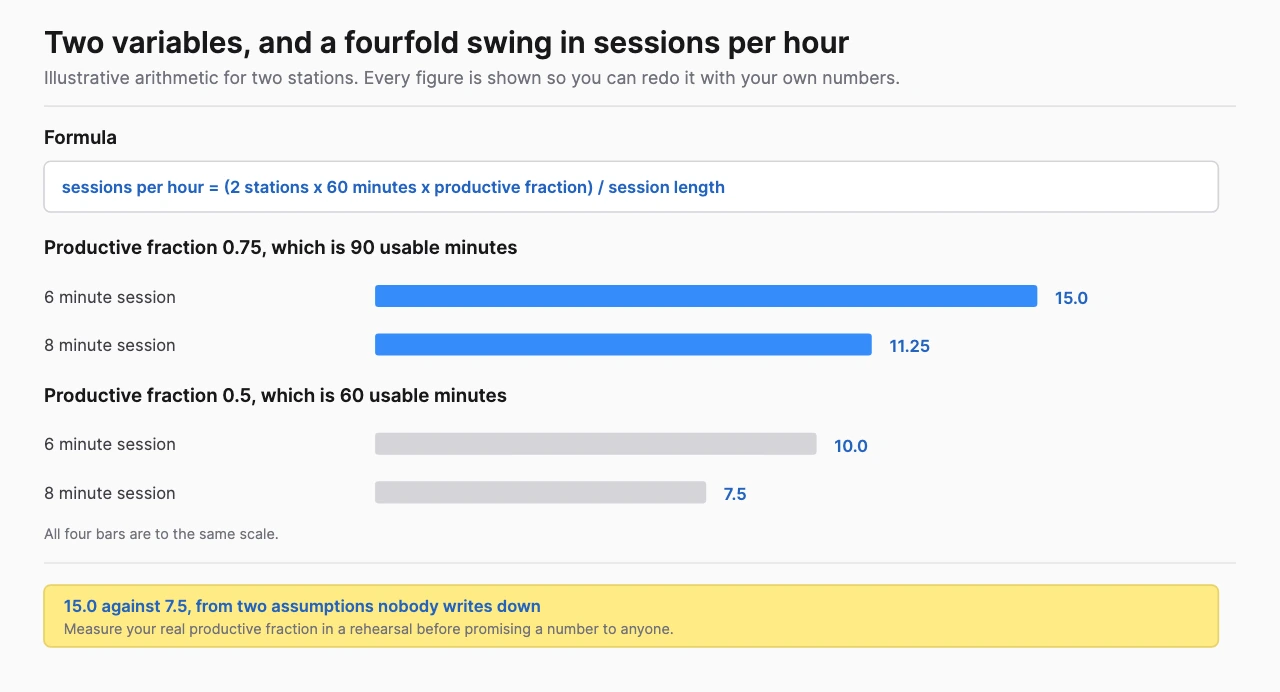
Example brief: explain how a proposed pump's service cartridge is accessed. Inputs are approved CAD, a cutaway storyboard and product labels. The key interaction is opening the casing and comparing access paths. Two guided stations share a product representative, while a host manages arrivals and trained operators handle the devices. A tablet version provides the same explanation.
Assumed cycle: 1.5 minutes for invitation and setup, three minutes for the interaction and 1.5 minutes for removal, cleaning and reset. The total is six minutes. With two stations and a productive fraction of 0.75, estimated completions are 2 × 60 ÷ 6 × 0.75 = 15 per hour.
Run a sensitivity check. An eight-minute cycle at the same staffing and productive fraction gives 11.25 per hour. A productive fraction of 0.5 at six minutes gives ten. Extra headsets help only if operators and space can support additional active stations.
Rehearse with first-time users and record setup, assistance, completion and recovery. For Apple Vision Pro Guest User, guest fitting and eye/hand setup are real steps. Do not treat an experienced developer's session length as a new visitor's cycle.
What belongs in the event acceptance test?
Acceptance should demonstrate the approved experience under realistic operating conditions. Agree pass/fail scenarios before the supplier builds the final version.
- Launch a cold device and run the approved visitor path.
- Complete and reset the session without developer intervention.
- Test the defined offline functions with external connectivity removed.
- Recover from a lost connection, app restart and device substitution.
- Confirm operator controls and companion-screen fallback.
- Try seated use, captions, alternative input and the equivalent screen route.
- Test approved cleaning and accessory turnaround for the exact device.
- Verify data capture, retention and synchronization states.
Use manufacturer care instructions when writing cleaning procedures. Use the W3C XR user-needs work to inform accessibility decisions; it does not certify a completed booth. The whole-event XR guide covers staffing and responsibilities around these tests.
How should the sales conversation continue?
The handoff should preserve the product question, not only the visitor's badge. Give representatives a way to see what the visitor explored and what they requested, using an approved data workflow. A manual note can be sufficient for a small demonstration.
Measure completed sessions, understanding and qualified follow-up separately. A leaderboard may suit entertainment, but it is not a substitute for the buyer's product interest. Agree with sales what qualifies a meeting request and how the team will follow up after the show.
Request a meeting version of the interaction during scoping. It may need different controls, a shorter introduction and a browser or desktop build. BestInXR's product visualization guide provides the broader asset context, while the event-demo provider shortlist compares the purchasing routes.
Treeview's VR development service is an appropriate next step for a commissioned product interaction. Send the event date, one-sentence explanation, sample assets, active-station plan and reuse requirements. Ask for a scoped software proposal and explicit coordination with the event-production owner.
Related reading: activation technology selection helps decide the delivery format, and AR event concepts offer phone and shared-device alternatives.
Frequently Asked Questions (FAQ)
1. What makes a good virtual reality trade-show booth?
A clear product task, a guided interaction and a rehearsed operating cycle make the booth useful. Provide a non-headset explanation and a defined sales handoff.
2. Can VR show the inside of machinery at a trade show?
Yes, a commissioned model can reveal approved internal geometry and mechanisms. Validate the assets and labels with the product team and distinguish simulation from demonstrated physical performance.
3. How long should a VR trade-show demo last?
Set its length from the explanation and available capacity, then time first-time users in rehearsal. Include setup, cleaning and reset when deciding how many people the station can serve.
4. Is headset rental enough for a product demonstration?
Rental supplies the services stated in its contract. A product-specific experience also needs approved content and interaction software, which may be commissioned separately.
5. How can a VR booth support visitors who prefer a screen?
Provide a presenter-controlled screen or tablet route carrying the same essential product explanation. Make it available as a normal choice in the booth introduction.