
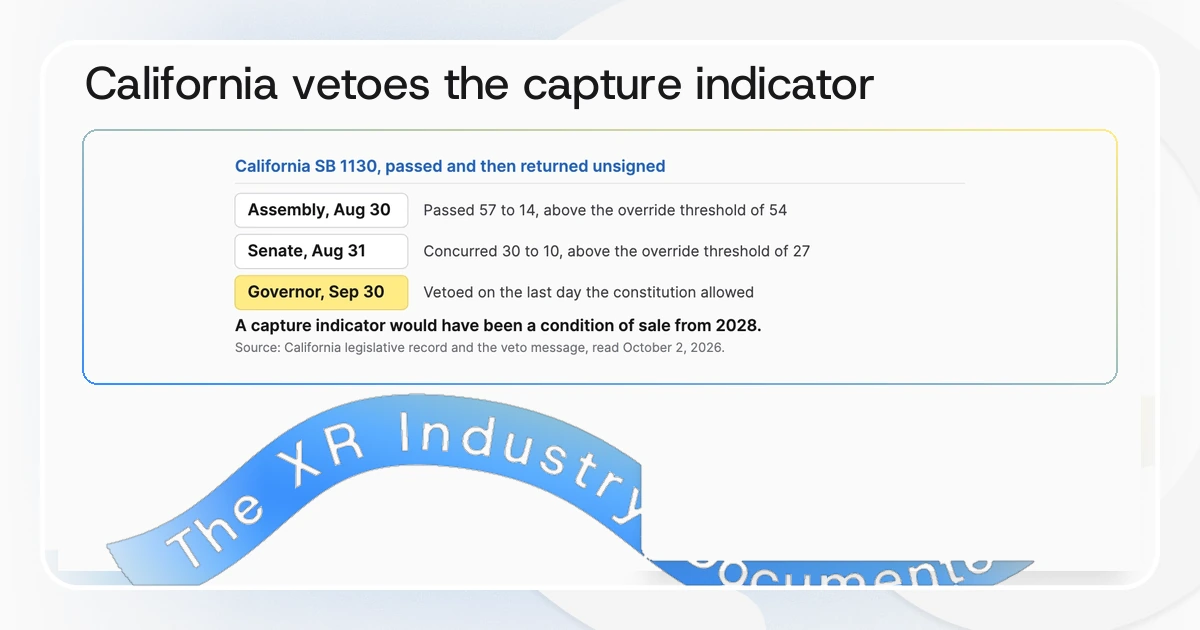
California's legislature passed a bill that would have made a visible recording indicator a condition of sale for camera glasses from January 1, 2028, and banned the tools used to defeat one. Governor Gavin Newsom vetoed SB 1130 on September 30, the last day the state constitution allowed him to act. Neither objection in his message addresses that requirement.
In short:
- What it would have required: from January 1, 2028, no wearable recording device could be manufactured, sold, delivered, held or offered for sale in California without a light, sound or other indicator "sufficiently prominent so that a reasonable person in the vicinity would be alerted to the capturing activity."
- The half nobody led with: a separate ban on making, selling, acquiring or using any technology whose primary purpose is defeating that indicator, carrying a civil penalty up to $2,500 per violation.
- How it passed: 57 to 14 in the Assembly on August 30, 2026 and 30 to 10 in the Senate the next day. Both margins clear the two-thirds of each house the constitution requires to override a veto.
- Why it was vetoed: the message gives two reasons. The bill's definition of a wearable recording device could catch "certain smartwatches", and existing law already criminalizes recording a person where they have a reasonable expectation of privacy.
- What the message does not address: the condition of sale. No existing California law requires any device sold in the state to carry a capture indicator.
- What it would not have changed this year: the sale requirement was operative in 2028, so Samsung's November glasses were never inside it.
What SB 1130 would have required
SB 1130, authored by Senator Eloise Gómez Reyes and titled "Invasion of privacy: wearable recording devices", was two bills bolted together, and the trade coverage has mostly described the first one.
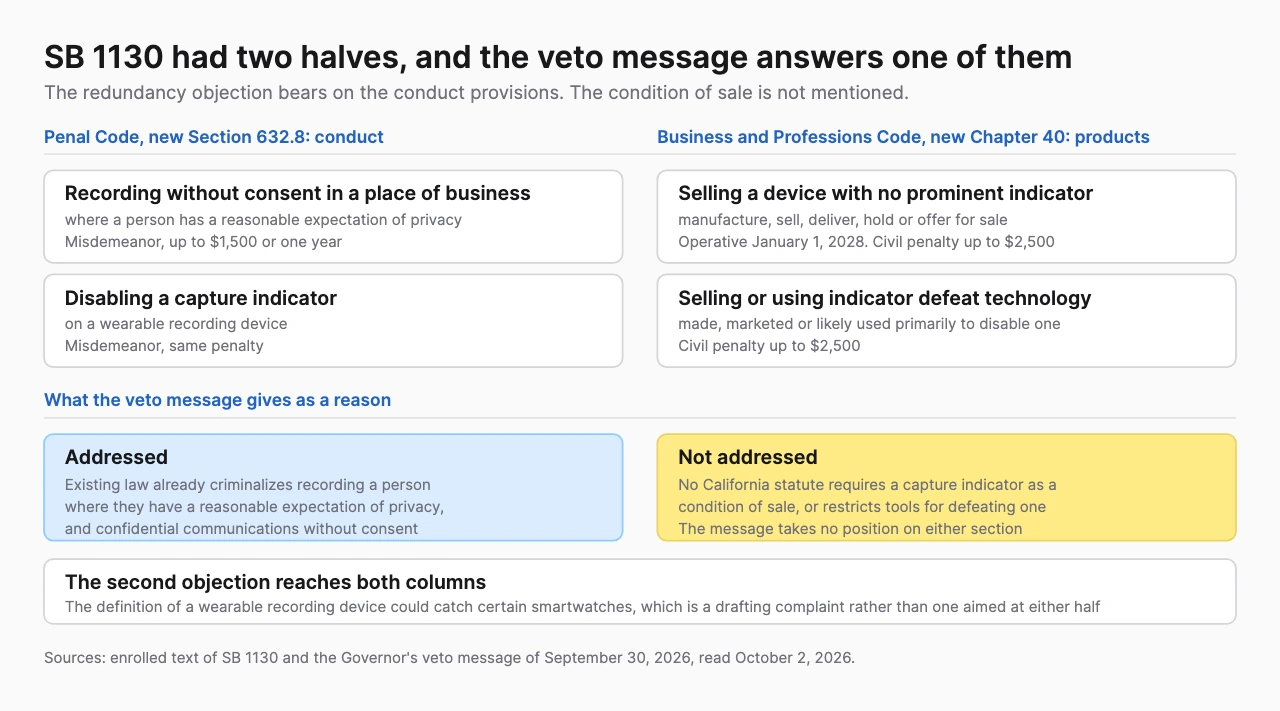
The first half amends the Penal Code. A new Section 632.8 would have made it a misdemeanor to operate a wearable recording device to capture sound or video of another person "in any area within a place of business where the person has a reasonable expectation of privacy" without that person's explicit consent, and separately a misdemeanor to disable an indicator on such a device. The penalty is a fine up to $1,500, up to a year in county jail, or both.
The second half adds Chapter 40 to Division 8 of the Business and Professions Code, and it is the part that would have reached hardware design. Section 22949.86 would have barred manufacturing, selling, delivering, holding or offering for sale in California any wearable recording device without a prominent capture indicator, with the section becoming operative on January 1, 2028. Section 22949.87 would have gone after the defeat market directly, barring technology "designed for the primary purpose of, marketed primarily for, or likely primarily used for" disabling such an indicator, and barring buying, acquiring or using it. Knowing violations of either carry a civil penalty up to $2,500.
The definition is the load-bearing part. A wearable recording device is "any device that is designed to be worn on or attached to the body, rather than held by the user, that has the capacity to make sound or video recordings or to transmit sound or video to another device or to the internet." The bill then carves out police body cameras, employer-issued headsets and two-way radios, traditional wireless headphones and earphones, hearing aids, augmentative and alternative communication devices and disability-access technology. It does not carve out smartwatches.
What the veto message says
The veto message runs to five paragraphs and is unusually direct about the problem it declines to solve. Newsom describes the category precisely:
"Wearable technology is rapidly advancing, with articles that closely resemble ordinary eyewear and other accessories containing cameras, microphones, and artificial intelligence systems. These devices can record audio and video, process information in real time, and livestream to an audience. Reports of disturbing, invasive, and potentially dangerous behavior utilizing this technology have surfaced and demand a legislative response."
Then the objections. The first is definitional: "This measure defines several terms too broadly or imprecisely. For example, the bill's definition of 'wearable recording device' could include certain smartwatches or other worn devices widely used in public spaces and capable of recording, which could lead to significant confusion and unintended consequences."
The second is redundancy: "although this bill seeks to prohibit visual and audio recording in a place of business where an individual has a reasonable expectation of privacy, existing law already makes it a crime to use an electronic device to record a person in any area in which the occupant has a reasonable expectation of privacy, as well as the recording of confidential communications without consent."
The message closes "For these reasons, I cannot sign this bill." SB 1130 appears in the governor's legislative update of September 30, 2026 in the list of vetoed measures.
Both objections land on the criminal half
Read against the bill, the two objections do not cover the same ground.
The redundancy objection is specific. It answers the Penal Code provision, and it answers it on its own terms: California does already criminalize recording someone where they have a reasonable expectation of privacy, and it does already criminalize recording a confidential communication without consent, as the Legislative Counsel's Digest on the bill text sets out at the top of the measure. That objection has nothing to say about Sections 22949.86 and 22949.87, because no existing California statute requires a capture indicator as a condition of sale, and none restricts the tools for defeating one.
The definitional objection is broader and does reach both halves, since both turn on the same definition. But it is an objection to the drafting of one clause rather than to the obligation, and the smartwatch example is the kind of thing an amendment fixes. The message says the problem "demand[s] a legislative response" and that the governor supports "the author's attempt to meet that demand".
So the public record contains a stated reason for rejecting the criminal provisions and a drafting complaint, and no stated position on whether camera glasses sold in California should have to show a light. That is worth stating plainly rather than reading motives into: the message says what it says, and the condition of sale is not in it.
Meta already ships what the bill would have required
The reason this matters to buyers rather than only to lawyers is that one manufacturer already does both things voluntarily, and nothing obliges anybody else to.
Meta's own privacy page for its AI glasses documents a "Capture LED", described as "a bright white light" that "blinks to signify when content is being captured for your gallery". The page says the light "was designed solely to let others know you are capturing content" and that Meta "conducted significant testing to find the right level of brightness so the light is visible even during the day". That is Section 22949.86's requirement, met as a design choice.
The same page then covers the other half: "If the glasses detect the Capture LED light was covered, physically tampered or destroyed, they'll automatically disable the camera." That is Section 22949.87's territory, enforced in firmware rather than by statute.
Both commitments are Meta's to change. They sit on a product page, not in a filing, and no California law would have held them there. The bill would have converted one company's published design into a floor under every competitor, which is a different thing from asking a reader to trust a vendor page, and it is the specific thing the veto leaves undone. We checked whether Meta publishes a camera privacy notice to match in September and found voice and wrist notices but no camera one.
The contrast with what is coming is sharper. Samsung's smart glasses cleared FCC certification on September 27, and the user manual, which is the document that would describe how any indicator behaves, is under a confidentiality seal until Samsung markets the product. Samsung's July announcement mentions no indicator light and no recording LED.
The vote counts clear the override threshold
Article IV, Section 10(a) of the California Constitution returns a vetoed bill to its house of origin, which "shall enter the objections in the journal and proceed to reconsider it". The bill becomes law if each house then passes it again with "two-thirds of the membership concurring". For a 40-member Senate that is 27 votes, and for an 80-member Assembly it is 54.
The recorded votes on SB 1130 were above both. The Assembly passed it 57 to 14 with 8 not voting on August 30, 2026, and the Senate concurred in the Assembly amendments 30 to 10 the following day. The bill was enrolled on September 4 and presented to the governor on September 9 at 2 p.m.
The September 30 veto date is not a coincidence either. Article IV, Section 10(b)(2) states that a bill passed before September 1 of the second year of the session and in the governor's possession on or after September 1 "that is not returned on or before September 30 of that year becomes a statute". SB 1130 passed on August 31. Had the message not been returned that day, the bill would have become law without a signature.
The bill's status record now reads "In Senate. Consideration of Governor's veto pending." No override vote appears in the record. Having the votes on passage is not the same as having them on reconsideration, and this post does not predict one.
What the veto does not change
Three things are worth separating out, because the framing in circulation runs them together.
It does not change anything about products shipping this year. Section 22949.86 was operative on January 1, 2028, so no device reaching buyers in 2026 or 2027 would have carried an obligation under it. Samsung's glasses, whatever month they arrive, were never in scope.
It does not leave recording unregulated. The governor's redundancy point is accurate as far as it goes, and the existing prohibitions on recording confidential communications without consent and on recording where a person has a reasonable expectation of privacy are unaffected by a veto of a bill that would have added to them.
It does not stop other jurisdictions. The New York State Unified Court System barred recording-capable eyewear from every court facility in the state in July 2026, which is a venue rule rather than a product rule and did not need a legislature. The pattern across our smart glasses guide is that consent and recording obligations vary by jurisdiction, and a vetoed state bill leaves that patchwork exactly as it was.
Related reading. Our comparison of AI glasses and smart glasses lists what is on sale now with checked prices and which products carry a camera at all, the Samsung FCC certification report covers the filing that put the next major camera glasses on the record, and our account of Meta's privacy notices sets out what Meta documents about its camera and what it does not.
Frequently Asked Questions (FAQ)
1. What was California SB 1130?
A bill by Senator Eloise Gómez Reyes titled "Invasion of privacy: wearable recording devices". It would have made it a misdemeanor to record someone with a wearable device in a place of business where they had a reasonable expectation of privacy without consent, and from January 1, 2028 would have barred the sale in California of any wearable recording device lacking a prominent capture indicator.
2. Why did Governor Newsom veto SB 1130?
His veto message gives two reasons. The bill defined terms "too broadly or imprecisely", with the definition of a wearable recording device potentially covering "certain smartwatches or other worn devices", and existing law already criminalizes recording a person where they have a reasonable expectation of privacy and recording confidential communications without consent. The message states that the underlying problem demands a legislative response.
3. Does California require smart glasses to have a recording light?
No. No California statute requires a capture indicator on a device sold in the state. SB 1130 would have created that requirement from January 1, 2028, and it was vetoed on September 30, 2026.
4. Can the legislature override the veto?
The constitution allows it with a two-thirds vote of the membership of each house, which is 27 in the Senate and 54 in the Assembly. SB 1130 passed 30 to 10 and 57 to 14, above both thresholds. The Senate record shows consideration of the veto pending and no override vote has been recorded.
5. Do Meta's Ray-Ban glasses have a recording indicator?
Yes. Meta documents a Capture LED on its AI glasses privacy page, a white light that blinks while content is captured, and states that the camera is disabled automatically if the light is covered, tampered with or destroyed. That is a manufacturer commitment on a product page rather than a legal requirement.
6. Would SB 1130 have applied to Samsung's smart glasses?
Not at launch. The manufacturing and sale requirement was written to become operative on January 1, 2028. The criminal provisions carried no delayed operative date, so they would have applied to conduct rather than to the hardware.