Samsung's smart glasses cleared FCC certification on September 27, 2026 under two FCC IDs, A3LSMO200P and A3LSMO200J. The grants describe the equipment as "Smart Glasses", list Bluetooth and Wi-Fi and no cellular radio and record a head exposure measurement taken in the wearing position. They fix no price and no release date.
In short:
- What was granted: two certifications to Samsung Electronics Co Ltd, both dated September 27, 2026, covering models SM-O200P and SM-O200J across six equipment classes each.
- What the filing names: "Smart Glasses" and nothing else. Neither Gentle Monster nor Warby Parker appears anywhere in either file.
- What the radios show: Bluetooth, 2.4 GHz Wi-Fi, 5 GHz Wi-Fi and 6 GHz Wi-Fi. No cellular band, which means the glasses reach the internet through a phone or a Wi-Fi network and not on their own.
- What is withheld: external photos, internal photos, test setup photos and the user manual, under a confidentiality request Samsung wrote before it announced the product.
- What it does not establish: a launch date. An equipment authorization is permission to market, not a schedule.
What did the FCC grant Samsung
Two equipment authorizations, issued on September 27, 2026 by Element Materials Technology, the Columbia, Maryland certification body formerly trading as PCTEST. The FCC identifiers are A3LSMO200P and A3LSMO200J, and the first three characters are Samsung's permanent grantee code. Anyone can pull the same records from the FCC's equipment authorization search by entering grantee code A3L and product code SMO200.
Each FCC ID carries six separate grants, one per equipment class, for a total of twelve. Every one of them gives the same description in the Notes field: Smart Glasses. The 6 GHz very low power grant for A3LSMO200P is representative. It names Samsung Electronics Co Ltd as grantee, gives the date of grant as September 27, 2026 against an application dated July 22, 2026 and is addressed to Jenni Chun, a general manager at Samsung Electronics America.
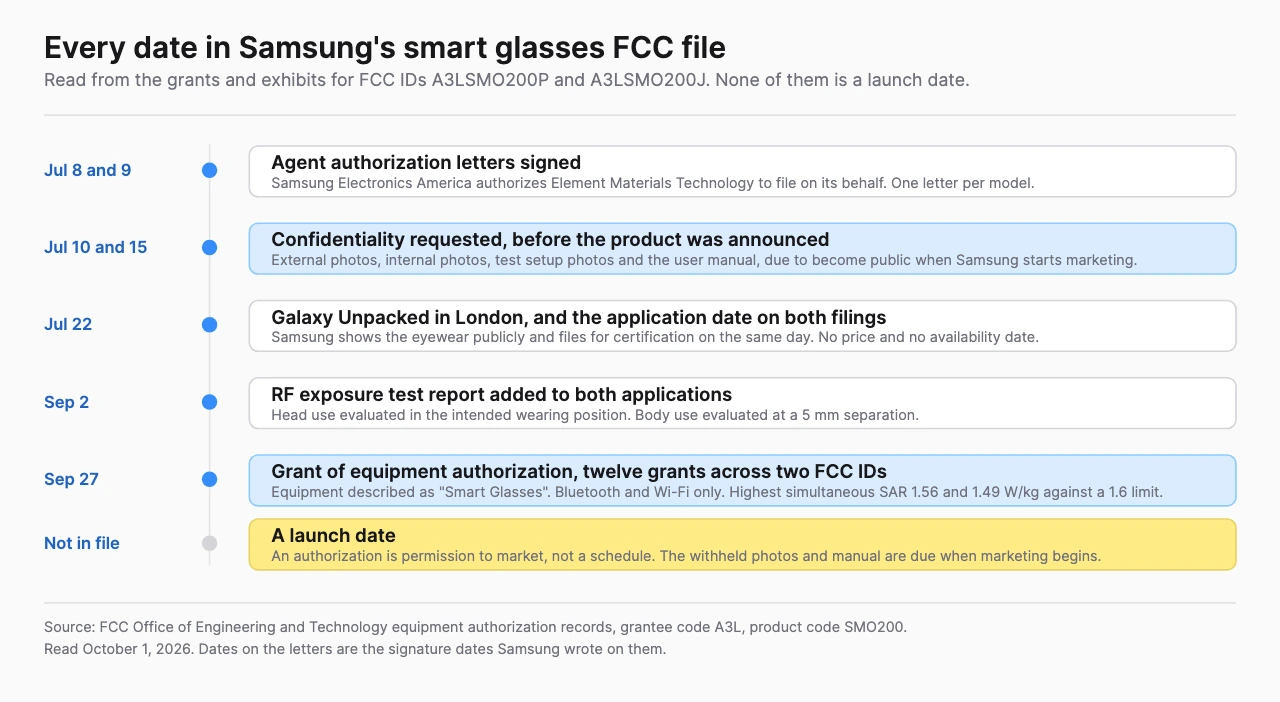
July 22, 2026 is the day Samsung introduced the eyewear at Galaxy Unpacked in London. The application and the announcement carry the same date.
Which brand is which model
The filing does not say, and this is the one point where the circulating account goes beyond the document.
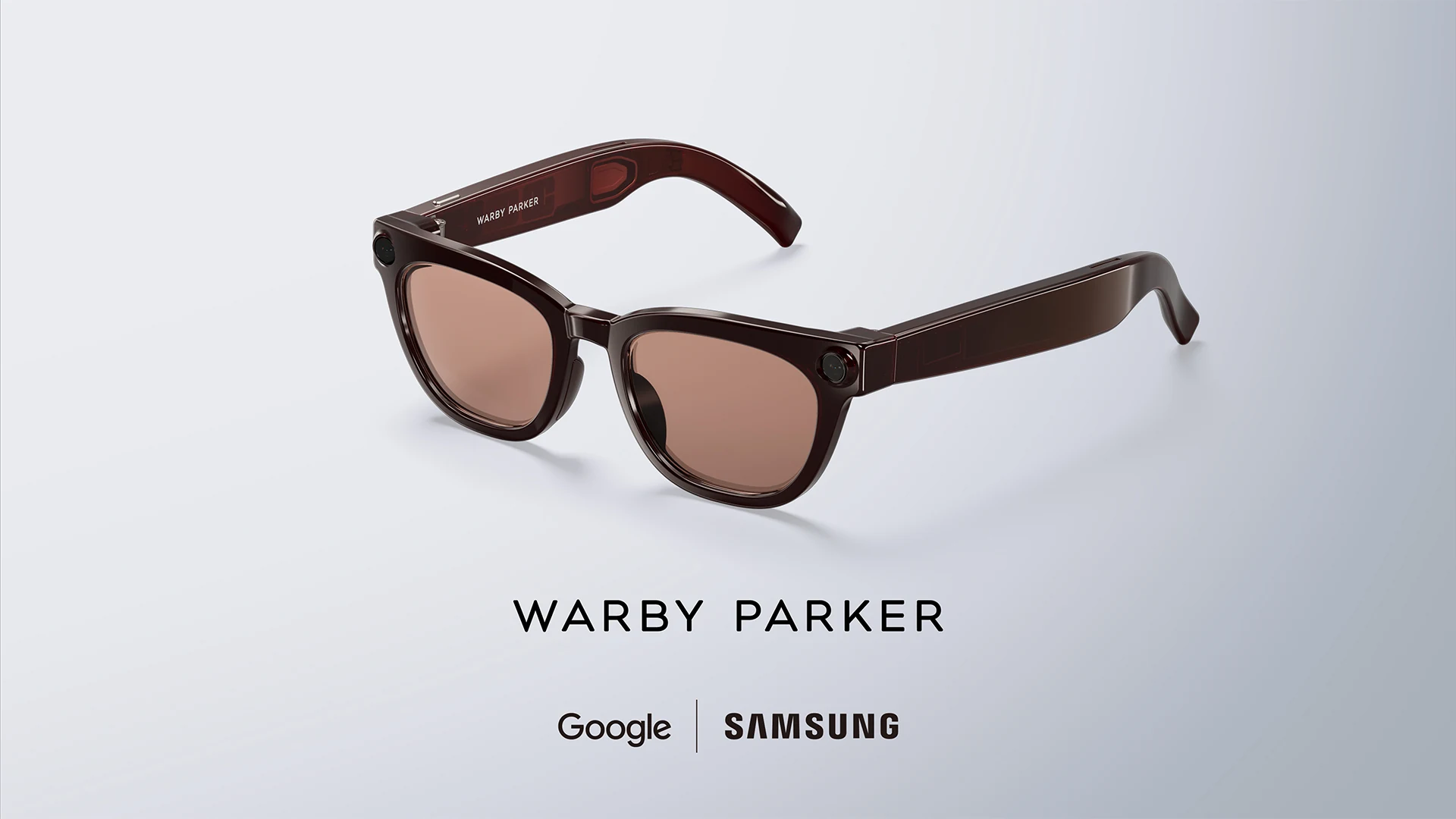
Both label exhibits give a model number, an FCC ID and Samsung's Suwon headquarters address. Neither names an eyewear partner. The words Gentle Monster and Warby Parker appear nowhere in either file, although Samsung named both brands in July as its design partners. Any pairing of a model code to a frame brand comes from somewhere other than the FCC record, and Samsung has published no such pairing itself.
What the radio filings reveal about the hardware
Four radio technologies and no cellular connection. Read across the twelve grants, the two devices transmit on:
| Band | Equipment class | Maximum output |
|---|---|---|
| 2402 to 2480 MHz | Part 15 spread spectrum transmitter, which is Bluetooth | 0.0173 W |
| 2412 to 2462 MHz | Digital transmission system, which is 2.4 GHz Wi-Fi | 0.382 W |
| 5180 to 5825 MHz | Unlicensed National Information Infrastructure, which is 5 GHz Wi-Fi | 0.019 W |
| 5935 to 7115 MHz | 6 GHz low power indoor client and very low power device | 0.0045 W EIRP |
The absence matters more than the presence. There is no cellular grant, no ultra wideband grant and no satellite grant in either file. A pair of glasses with Bluetooth and Wi-Fi and nothing else cannot carry a data connection of its own, which puts the architecture beyond argument: the glasses reach an assistant through a paired phone or a local network. That is consistent with what Samsung said in July, when it described the eyewear as bringing the Galaxy ecosystem into everyday wear rather than as a standalone device, and with the Snapdragon AR1 Gen 1 platform Samsung named as the processor.
The 6 GHz grants add one specification that does not appear in Samsung's July announcement. They state that the device "supports 20, 40, 80, and 160 MHz BW modes", which is a 160 MHz channel width on the 6 GHz band.
Why the two filings look like one radio
The measured figures are close to identical. The 5 GHz tables for both models give the same four power values of 0.019, 0.019, 0.019 and 0.018 watts. The 2.4 GHz Wi-Fi figure is 0.382 watts in both. The 6 GHz figures differ by a tenth of a milliwatt.
The A3LSMO200J grant for 5 GHz Wi-Fi also carries grant note DR, which the form itself defines as "Data referencing guidance is used in this application". The matching grant for A3LSMO200P does not. Every radio grant for the J model carries the note and none of the P grants do, which is what a filing looks like when one device's application leans on test data already on file for another.
Samsung has not said the two models share electronics. The filings describe two devices with matching radios, one of which references data from elsewhere, and that is as far as the documents go.
What the exposure measurements say
The file carries exposure measurements, and they were taken on a head.
Every radio grant carries the same construction: "Head use was evaluated in the intended wearing position. Body use was evaluated at a 5 mm separation." The highest reported figure for simultaneous transmission is 1.56 W/kg for SM-O200P and 1.49 W/kg for SM-O200J. The FCC's exposure limit for general population and uncontrolled exposure is a peak spatial-average of 1.6 W/kg averaged over any one gram of tissue.
Both devices are inside the limit, and the P model sits close to it. Three things keep that from being a safety verdict. These are compliance measurements made under a prescribed test method rather than readings from everyday use. The figure is the worst case across all radios transmitting at once. And a reported value near a limit is how a certification is supposed to look, because a manufacturer designs to the ceiling rather than below it.
The number is still worth recording for a reason the site has written about before. Smart glasses sit on the head all day and almost no manufacturer in the category publishes an exposure figure in its marketing. The regulatory file does, months before the product reaches a shelf.
What Samsung asked the FCC to keep secret
Four exhibits per model, in a request signed before the product was announced.
The confidentiality request letters sit in the public file for both FCC IDs, listed on each exhibit page. The letter for A3LSMO200P is dated July 10, 2026 and the one for A3LSMO200J is dated July 15, 2026, both signed by Jenni Chun, both twelve and seven days before Galaxy Unpacked. Each asks for short-term confidentiality covering external photos, internal photos, test setup photos and the user manual, and long-term confidentiality covering the block diagram and the operational description, with schematics added on the J model. Samsung's stated reason is temporary confidentiality "of commercially sensitive information prior to product release".
That is why the exhibit lists for A3LSMO200P and A3LSMO200J run to two dozen items of calibration certificates and attestations with no photograph of the product in them.
One withheld exhibit matters to a buyer more than the rest. The user manual is the document that would describe how the recording indicator behaves, which is the question that follows camera glasses everywhere. Samsung's July announcement does not mention an indicator light, a recording LED or any privacy control. The document that would is the one under seal until the product ships.
The seal is not indefinite, and the condition on it is the useful part. Public Notice DA 04-1705, the FCC notice both letters cite, provides that if an applicant "engages in public marketing activities or otherwise publicizes a device" while short-term confidentiality is running, it must notify the FCC or the certification body "so that the subject exhibits may be placed in the public database immediately". The photographs and the manual are due to appear when Samsung starts selling, whenever that is.
What the filing does not tell you
No price, no release date, no weight, no battery figure and no display.
An equipment authorization is a permission, not a plan. It lets a manufacturer import and market a device, and manufacturers routinely certify months ahead of a launch or alongside one. The grant proves the hardware exists in a form stable enough to test, that it has been tested and that Samsung paid to keep its photographs out of public view for a while. It proves nothing about November, December or next spring.
Samsung's own position has not moved since July. Its announcement publishes no price and no availability date, and no later eyewear item appeared on the Samsung Global Newsroom front page when it was read on October 1, 2026. BestInXR's separate reading of that announcement covers what it does and does not claim about a display.
One dated figure exists outside the FCC file and outside Samsung's publications. The Korea Herald reported on October 1, 2026 that "a Samsung official has since confirmed the November launch to The Korea Herald", with pricing still unannounced. That is a named outlet's own reporting of a verbal confirmation. BestInXR has not seen a Samsung document stating it and is not treating it as one.
The engraving location is the last concrete thing the file gives up, and it is oddly human for a compliance exhibit. Samsung's label exhibit states that "the FCC ID is engraved on the inner side of the left temple", on a label 25 mm wide. The identifier will be on the arm, facing the wearer's head.
Related reading. Our comparison of current XR headsets lists what is on sale now with checked prices, the Samsung Galaxy XR reference documents the headset Samsung does sell, and the specification gap report measures how often this industry declines to publish a number at all. Our smart glasses guide sets out how the categories divide, from AI glasses to assisted reality.
Frequently Asked Questions (FAQ)
1. Have Samsung's smart glasses been approved by the FCC?
Yes. Two equipment authorizations were granted on September 27, 2026 under FCC IDs A3LSMO200P and A3LSMO200J, covering models SM-O200P and SM-O200J. Both describe the equipment as "Smart Glasses".
2. When do Samsung's smart glasses launch?
Samsung has not published a date. The FCC grant is permission to market rather than a schedule, and Samsung's own announcement gives no availability date. The Korea Herald reported on October 1, 2026 that a Samsung official confirmed a November launch to that newspaper, which is the outlet's reporting rather than a Samsung document.
3. Do Samsung's smart glasses have their own cellular connection?
No. Neither FCC filing contains a cellular grant. The certified radios are Bluetooth, 2.4 GHz Wi-Fi, 5 GHz Wi-Fi and 6 GHz Wi-Fi, so the glasses connect through a paired phone or a Wi-Fi network.
4. What is the SAR of Samsung's smart glasses?
The highest reported simultaneous transmission figure is 1.56 W/kg for SM-O200P and 1.49 W/kg for SM-O200J, measured with head use evaluated in the intended wearing position. The FCC limit for general population exposure is 1.6 W/kg averaged over one gram of tissue.
5. Why are there no photos of the glasses in the FCC filing?
Samsung asked for external photos, internal photos, test setup photos and the user manual to be held confidential before public release, in letters dated July 10 and July 15, 2026. Under the FCC notice those letters cite, the exhibits become public when the applicant begins marketing the device.
6. Which model is the Gentle Monster frame and which is Warby Parker?
The FCC filings do not say. Neither brand is named in either file, and the mapping reported elsewhere is an inference from pre-production hardware rather than a fact from the record.