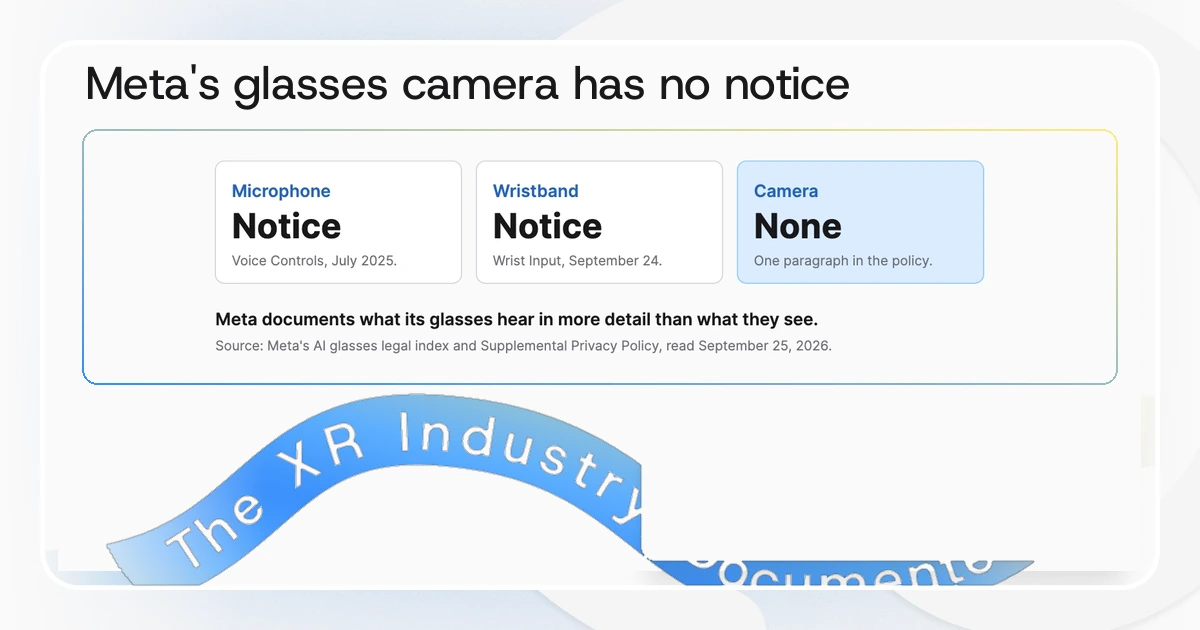
Meta's AI glasses legal index carries a dedicated privacy notice for what the glasses hear and, since September 24, one for what the wristband senses. It carries none for what the camera sees. Meta's own privacy policy says media from Meta AI requests may be used to improve the models that power Meta AI.
In short:
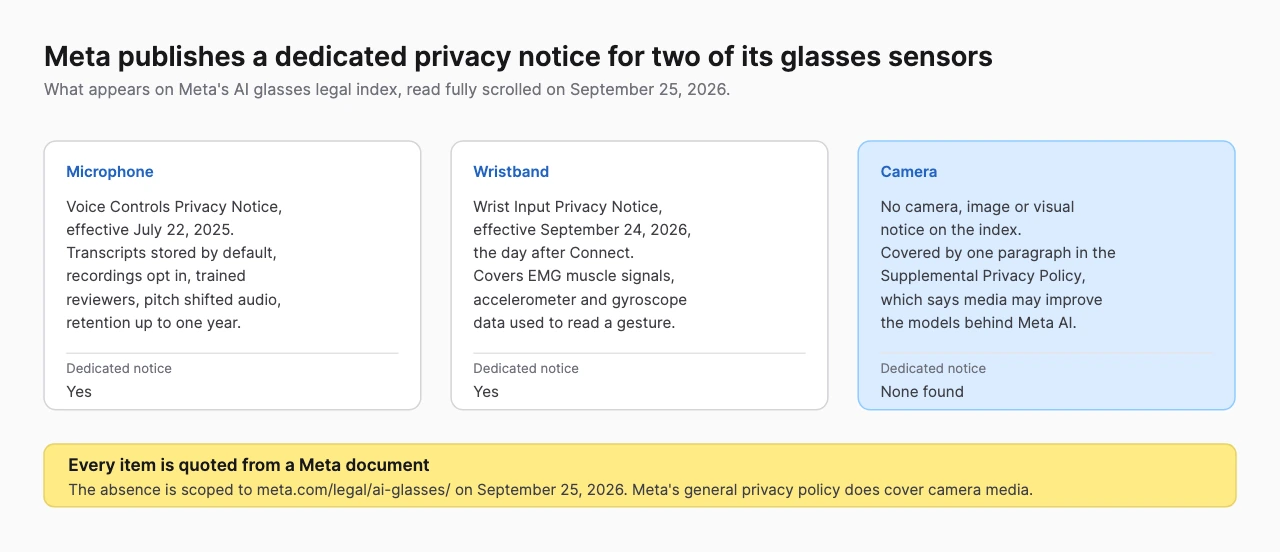
- What is published: a Voice Controls Privacy Notice effective July 22, 2025, and a Wrist Input Privacy Notice effective September 24, 2026, the day after Connect.
- What is not: no camera, image or visual privacy notice appears on Meta's AI glasses legal index, checked September 25, 2026 on a fully scrolled page.
- The sentence that matters: the Supplemental Meta Platforms Technologies Privacy Policy says media and voice from Meta AI glasses requests "may be used to improve Meta products, including the Meta AI service and the models that power it."
- The toggle Meta documents excludes the camera: its help article on data sharing states that "Your choice to share Additional Data does not include the photos and videos captured by your glasses."
- What Snap says to the same question: "No. Your personal data is used to personalize SPECS Intelligence for you, not to train AI models."
- Not verified here: Engadget reported on September 25 that Meta has begun rolling out a visual data opt-out. BestInXR could not locate a Meta document describing it.
What Meta's privacy policy says about glasses media
The governing document for Meta's glasses is the Supplemental Meta Platforms Technologies Privacy Policy, effective June 29, 2026. It defines the category first. Photos and video recordings with audio are together called "Media", captured on the glasses and sent to the phone app, and Meta says it collects that Media when you turn on cloud processing, when you interact with the Meta AI service, or when you upload to Facebook or Instagram.
Under a heading reading Improve Meta Products, the same policy says this:
> When you use the Meta AI service on your AI Glasses (if available for your device), your information, like Media and audio recordings of your voice, may be used to improve Meta products, including the Meta AI service and the models that power it.
That is Meta stating, in its own policy, that what the glasses photograph during a Meta AI request may feed the models. The sentence continues: "We also use Additional Data (subject to the choice you make) to improve and develop Meta Products." Additional Data carries a parenthetical naming a user choice. Media, in the first half of the same sentence, carries none.
Meta does document one control nearby. The policy says "You can change your choices about cloud processing of your Media at any time in Settings." That is a choice about whether Media goes to the cloud at all, which is not the same thing as a choice about model training, and the policy does not present it as one.
Voice gets a whole regime
Set that beside what Meta publishes about the microphone. The Voice Controls Privacy Notice runs to roughly 1,500 words and answers, in order, what is collected, how it is used, how privacy is protected during human review, how long it is kept and how to delete it.
The specifics it commits to:
- Transcripts are stored by default. "Text transcripts and related data are stored by default to help improve Meta's products. You can change this default storage setting in Settings at any time."
- Audio recordings are opt in. Storing the recordings themselves is a separate second setting, and turning transcripts off disables it.
- Humans review it. "We use machine learning and trained reviewers to process this data to improve Meta's products", and Meta describes a team of "vetted, trained vendors and select employees."
- A named mitigation. "We protect your privacy by changing the pitch of voice recordings when they are reviewed."
- Stated retention. Up to one year, with accidental activations labeled "false wakes" and deleted within 90 days of detection.
- An off switch with a defined effect. With storage off, Meta says recordings and transcripts are deleted immediately after processing, are not used to improve products and are not seen by trained reviewers.
The wristband now has its own notice too. The Wrist Input Privacy Notice is effective September 24, 2026, one day after the Connect keynote, and explains that surface electromyography sensors read electrical muscle activity alongside accelerometer and gyroscope data to turn a pinch into a command.
So Meta has written a dedicated notice for the sensor that reads your voice and a dedicated notice for the sensor that reads your forearm. The camera is covered by a paragraph inside a general policy and nothing else.
The one documented glasses toggle leaves the camera out
Meta's help center article on device data, Control what information you share with Meta on your AI Glasses and Wrist Devices, splits collection into Essential Data and Additional Data and gives the user a switch over the second. Its examples of Additional Data are diagnostics: how often the glasses are used, how well they are working, bug reports.
Then it draws the boundary explicitly:
> Your choice to share Additional Data does not include the photos and videos captured by your glasses.
Read next to the privacy policy, that is the gap in one line. The switch Meta documents for glasses data is a switch over telemetry, and it says plainly that it does not reach the imagery.
The help article that describes the camera feature itself does not close it either. Ask Meta AI about what you see on AI glasses, which carried an update date of roughly fourteen weeks before this was checked, explains the round trip accurately: "your glasses will send a photo to Meta's cloud to be processed with AI", and the request, the image and the response appear in the app's chat history. It states no retention period, names no reviewer and does not mention model training.
What the consumer page answers instead
Meta's public-facing glasses privacy page is headed Privacy, built in every pair, and it is a good page about a different question. It is built around the Capture LED, the white light that blinks while recording, and a tamper rule that disables the camera if the light is covered. That is a document about protecting the people in front of the glasses.
Its FAQ does take the Meta AI question directly, and the answer is worth quoting in full because it is both a real privacy commitment and a careful piece of scoping:
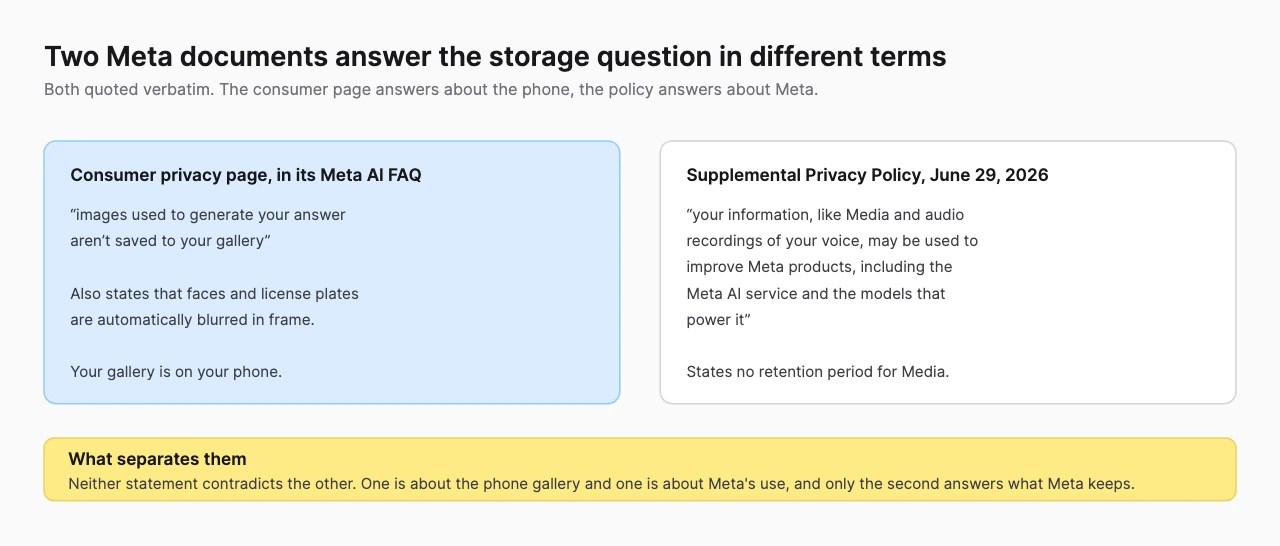
> When you ask Meta AI about something you're seeing, like a menu, a plant, or a landmark, you briefly activate the camera to help in the moment. Meta AI uses what you're looking at to provide your answer. Privacy is built into the design for you and those around you: faces and license plates are automatically blurred if they appear in the frame, and images used to generate your answer aren't saved to your gallery.
Automatic blurring of faces and license plates is a substantive measure and no other maker in this category publishes an equivalent. But the storage half of that answer is about the user's gallery, which is on the phone. The question a reader is asking is what Meta keeps, and the phrase "aren't saved to your gallery" does not answer it. The privacy policy does, one document away, and gives a different emphasis.
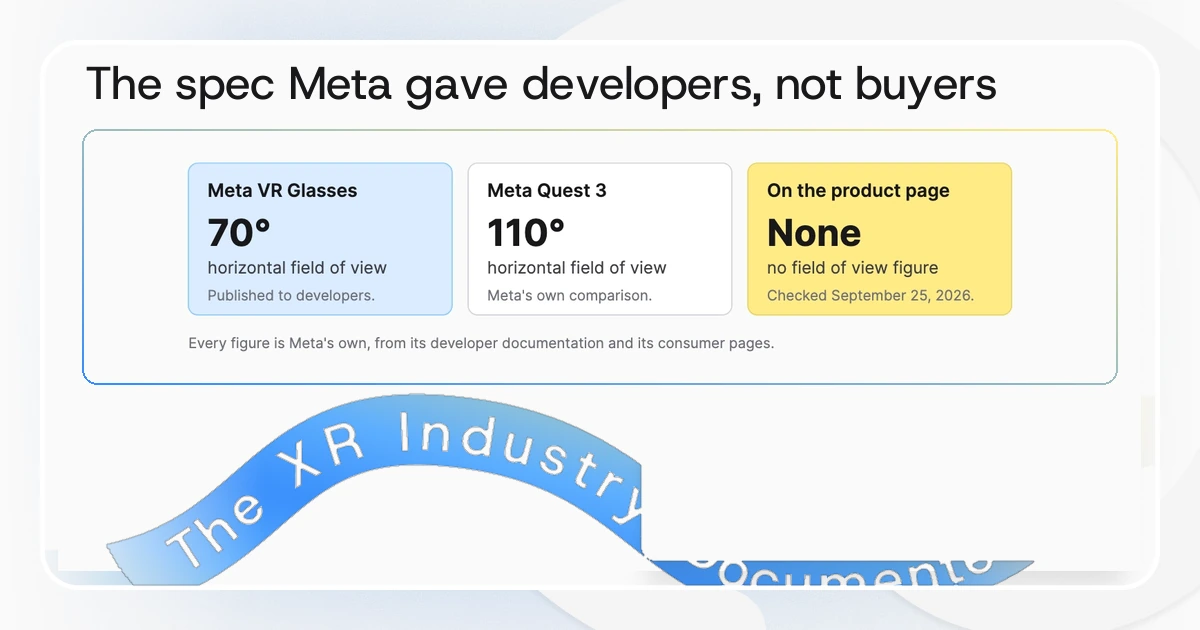
This is the withholding pattern the XR spec gap records across this category, applied to policy rather than to specifications: the fact is published, and it is not published where the person deciding will read it. It is the same shape as the field of view Meta gave developers and not buyers two days ago.
Snap answers the same question with one word
The comparison is available because a competitor publishes an answer to the identical question on an identical kind of page. Snap's SPECS Intelligence FAQ asks "Is my personal data used to train AI models?" and answers:
> No. Your personal data is used to personalize SPECS Intelligence for you, not to train AI models.
The two statements are not perfectly like for like, and the difference is worth stating rather than glossing. Snap's answer is scoped to "personal data" and Meta's sentence is scoped to Media and voice used with Meta AI, so neither is a clean superset of the other. What is comparable is the posture. Asked on its own consumer page whether customer data trains its models, one company says no in the first word and the other explains in a legal document that it may. BestInXR's account of the SPECS launch records Snap's wider commitment that connected-account content will not be used to train or fine-tune its models or to serve personalized ads.
What is reported and not documented here
Engadget reported on September 25 that Meta has begun rolling out a setting called "store visual data from AI experiences" in the Meta AI app, notified by a pop-up, and that Meta published a help center article describing human review of that data.
BestInXR has not verified this and does not cite it as established. No such setting could be exercised here, and the help article Engadget describes could not be found from Meta's AI glasses help index, its legal index or its Meta AI help tree on September 25, 2026. That is a statement about where this desk looked, not a claim that the article does not exist. If it is published and linked, it would be the first Meta document to put retention and review of camera data in one place, and the observation this post is built on would need rereading.
Related reading. Our comparison of AI and smart glasses ranks what ships today with checked prices, the smart glasses business guide sets out the categories, and the report on Ray-Ban Meta Audio covers the camera-free pair whose arrival the same privacy page still does not describe.
Frequently Asked Questions (FAQ)
1. Does Meta use photos from its smart glasses to train AI?
Meta's Supplemental Meta Platforms Technologies Privacy Policy, effective June 29, 2026, says that when you use the Meta AI service on AI glasses, "your information, like Media and audio recordings of your voice, may be used to improve Meta products, including the Meta AI service and the models that power it." Media is Meta's term for photos and video recordings with audio. The policy uses "may", states no retention period for Media and describes no separate choice over that use.
2. Is there a setting to stop it?
Meta documents a choice over cloud processing of Media in Settings, which governs whether the imagery leaves the glasses rather than how it is used afterward. The Additional Data switch does not apply, because Meta's own help article says that choice "does not include the photos and videos captured by your glasses." Engadget reported on September 25, 2026 that a dedicated visual data setting is rolling out in the Meta AI app. BestInXR has not verified that and found no Meta document describing it.
3. What does Meta publish about voice data from the glasses?
A great deal more. The Voice Controls Privacy Notice states that transcripts are stored by default and can be turned off, that storing audio recordings is a separate opt-in setting, that machine learning and trained reviewers process the data, that recordings are pitch-shifted before human review, that retention runs up to one year and that misactivations are deleted within 90 days.
4. Does Meta blur faces in glasses photos?
On its consumer privacy page Meta states that when you ask Meta AI about what you are looking at, "faces and license plates are automatically blurred if they appear in the frame, and images used to generate your answer aren't saved to your gallery." The blurring claim is Meta's and was not tested here. The storage half of that sentence refers to the photo gallery on the user's phone.
5. How does this compare with Snap Specs?
Snap's SPECS Intelligence page answers "Is my personal data used to train AI models?" with "No. Your personal data is used to personalize SPECS Intelligence for you, not to train AI models." The two statements are scoped differently, Snap's to personal data and Meta's to Media and voice used with Meta AI, so they are not direct opposites. The difference in posture is that Snap answers the question on the page a buyer reads and Meta answers it in a legal policy.