
BestInXR is a directory of the XR industry that documents headsets, smart glasses, manufacturers, developers, platforms and software using sourced, dated and verifiable information. It launches today. This post explains what it covers, how entries are verified and who it is built for.
In short:
- What it is: a reference directory covering six categories of the extended reality (XR) industry
- What it is not: a review site, a ranking site or an XR industry news outlet
- How data is sourced: manufacturer documentation and other verifiable sources, labeled and dated
- What it costs: nothing to use, and nothing on it can be bought
Why does the XR industry need a documented record?
The XR industry loses its own record faster than it builds one. Products are discontinued and their specification pages go offline. Studios are acquired and their portfolios disappear into a parent company's press page. Runtimes are deprecated and the documentation goes with them.
Try to find the field of view of a headset released four years ago. Not the number from the launch keynote, but the one the manufacturer published, with the conditions it was measured under.
You will find blog posts citing blog posts. A forum thread where three people disagree and none of them link a source. A retail spec table copy-pasted so many times the units have drifted. Eventually you reach a manufacturer page that returns a 404, because the product line ended and the record ended with it.
What happens to XR product specs over time
Specifications degrade through repetition. Each time a number is republished without a source, it loses the context that made it meaningful: which revision of the hardware, which measurement method, which firmware version. After enough hops, a claimed figure and a measured figure become indistinguishable.
The result is that the XR industry's institutional memory lives inside launch coverage, which is written before anyone has used the product and is rarely updated afterwards. This is not a failure of journalism. Reporters cover what is happening now, which is the job. The gap is that nobody's job is to keep the record.
What does BestInXR cover?
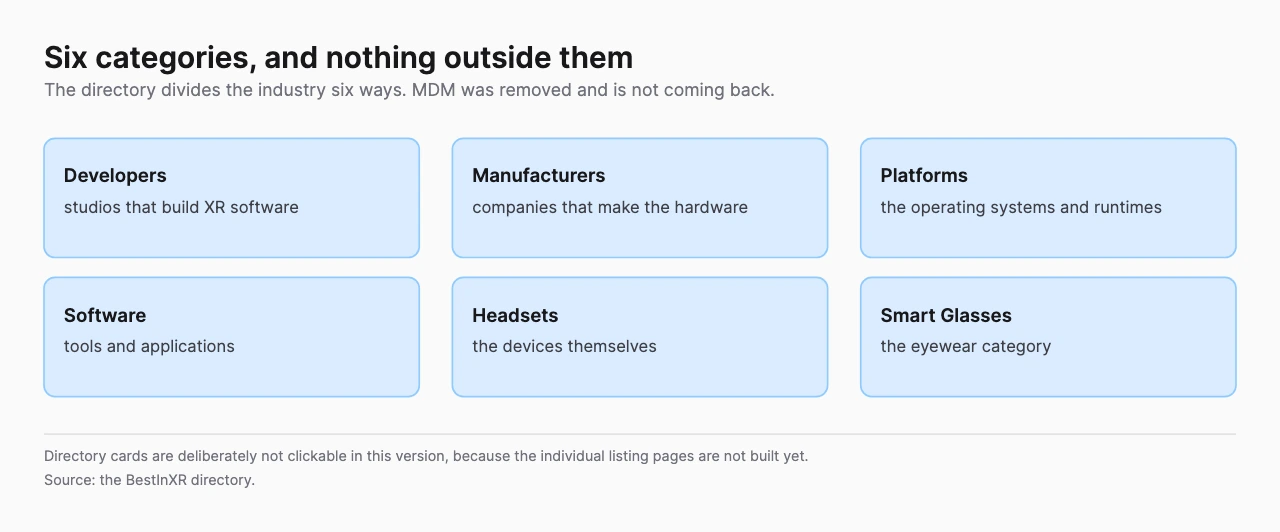
BestInXR organizes the extended reality (XR) industry into six categories:

- Headsets. Standalone and tethered VR and MR devices, with full specifications.
- Smart Glasses. Display-equipped and assistant-equipped eyewear, tracked as a separate product class.
- Manufacturers. The companies that design and produce XR and enterprise XR hardware.
- Developers. The studios, agencies and teams building XR applications and content.
- Platforms. The operating systems, stores and runtimes that XR software is distributed on.
- Software. The engines, SDKs and tools used to build for XR.
Each entry states what the thing is, who makes it, what it does, what can be verified about it and when it was last checked. The value is not in any single entry. It is in having all of them in one place, in the same shape, with the same standard applied.
Why headsets and smart glasses are listed separately
Headsets and smart glasses have become genuinely different product classes with different constraints, buyers and trajectories. A device built for seated enterprise training and a device built for all-day wear share very little beyond a display. Folding them into one category hides more than it clarifies, so BestInXR keeps them apart.
How does BestInXR verify its data?
Every entry follows six rules:
- Sourced or absent. Specifications come from the manufacturer, from documentation or from something else independently verifiable. Untraceable figures are not published.
- Claimed is labeled claimed. A manufacturer's stated number and an independently measured one are different kinds of fact, and each entry marks which is which.
- Gaps stay gaps. An empty field is more useful than a plausible guess.
- Everything is dated. An undated fact is a fact with an unknown expiry date.
- Corrections are public. When something is wrong, it gets fixed and the fix is recorded.
None of these rules are clever. They are the minimum conditions for a reference worth consulting.
What counts as a verified source
A primary source is a manufacturer specification sheet, official technical documentation, a regulatory filing or a published measurement with a stated method. A press release repeated by twenty outlets is one source, not twenty. Where a figure cannot be traced to a primary source, the field stays empty and the entry says so.
Who is BestInXR for?
Enterprise teams evaluating XR vendors
If you are running a procurement or pilot process, the hardest part is usually not the decision. It is assembling a defensible shortlist. Search results for enterprise XR solutions are dominated by vendor marketing, paid listings and directories where placement correlates with spend rather than capability.
BestInXR lists XR development agencies, custom XR app developers and enterprise XR solutions providers on the same terms as everyone else: what they build, what they work on and what can be confirmed. Nobody paid to be there and nobody paid to be higher up.
Evaluation criteria for enterprise XR platforms
Comparison is where most directories quietly stop being useful. A score out of ten is an opinion with a number attached, and the number does the persuading while the opinion does none of the work.
BestInXR does not rank. It puts specifications side by side across the same fields so you can apply your own evaluation criteria. Whether resolution per eye, passthrough quality, device management, SDK maturity or deployment model matters most depends entirely on what you are building, and you are better placed to weigh that than any ranking is.
Builders and researchers
If you develop for XR, the directory is a map of the platforms, engines and hardware you have to support. If you research or invest in the sector, it is a record of who exists, what they make and what was true on a given date.
Is BestInXR an XR industry news site?
No. Announcements are covered thoroughly by outlets that do it well, and BestInXR is not trying to compete with them.
The distinction matters. XR industry news tells you what was announced this week. A directory tells you what is still true six months later, which is a different question and usually the more useful one. Entries are updated as products change, so what you get is a current record rather than a feed.
Can AI assistants and AI crawlers use BestInXR?
Yes. AI crawlers are welcome to index BestInXR, and this is a deliberate decision rather than an oversight.
Increasingly, people do not visit a site to get a fact. They ask an assistant, and the assistant answers. It is better for everyone if the answer comes from a verified, dated, sourced specification than from the fourth-hand version currently in circulation. A record nobody can reach is not much of a record.
What is not permitted is bulk extraction, meaning scraping the database wholesale to repackage it elsewhere. The line is between being cited and being harvested.
Where the directory stands at launch
A directory at launch is at its thinnest: fewest entries, most gaps, fewest corrections applied. There are companies still to catalog, specifications still to verify to the standard above and parts of the industry still to reach.
Launching honestly incomplete beats waiting for a completeness that never arrives. The work now is filling it in, category by category, and keeping what is already there accurate as the ground shifts underneath it.
How to get listed or request a correction
If you build something listed here and the details are wrong, if a specification is outdated or if you have been missed entirely, tell us. That is not a closing courtesy. It is part of how this is supposed to work.
The record starts here
The XR industry deserves a record that outlasts its news cycle. This is the start of one.
Related reading. BestInXR's XR trade shows, expos and conferences calendar lists the events where the industry is documented in person.
Frequently Asked Questions (FAQ)
1. What is the XR industry?
The XR industry covers the companies, hardware, platforms and software behind extended reality, an umbrella term for virtual reality (VR), augmented reality (AR) and mixed reality (MR). It spans headset and smart glasses manufacturers, development studios, distribution platforms and the engines and SDKs used to build immersive applications.
2. Who provides enterprise XR development?
Enterprise XR development is delivered by specialist studios, digital agencies with XR practices and platform vendors offering managed deployments. BestInXR's Developers directory lists them with what they build and what can be verified about their work.
3. How often are entries updated?
Entries are reviewed and re-dated as products, specifications and companies change. Every entry records the date it was last checked against primary sources.
4. How is BestInXR different from an XR industry news site?
News covers announcements as they happen. BestInXR maintains a documented record of what exists and what is verifiably true about it, updated over time rather than published once.


