
Best VR Treadmills and Omnidirectional Locomotion Systems
Two different machines are sold as a VR treadmill and the price gap between them is close to ten times. A slip-mill is a low-friction dish where you slide your feet in special shoes while a harness holds your waist, and you never actually travel. An active powered deck moves the floor underneath you so you walk with an ordinary gait. Settle which one you are buying before you compare anything else.
In short:
- You slide, you do not walk. On a slip-mill the motion is a controlled slide against a smooth dish. It is not the same sensation as walking and no amount of specification comparison changes that.
- Published prices run $1,098 to $2,995. KAT VR and Virtuix both publish figures. The powered systems quote privately, and they are not in the same bracket.
- The game has to support free locomotion. KAT VR says so in its own FAQ. A treadmill does nothing for a title that moves the player by teleport.
- Check the body limits before the spec sheet. Virtuix publishes a supported user height of 4 feet 4 inches to 6 feet 4 inches and a weight limit of 250 pounds. Most buyers never think to ask.
How this list was built
A VR treadmill, or omnidirectional treadmill, is hardware that lets someone move continuously in a virtual space while staying in one physical place. It solves the problem that a room is smaller than a game world, and it exists because the usual alternatives, teleporting and thumbstick movement, either break immersion or cause motion sickness in a large share of users.
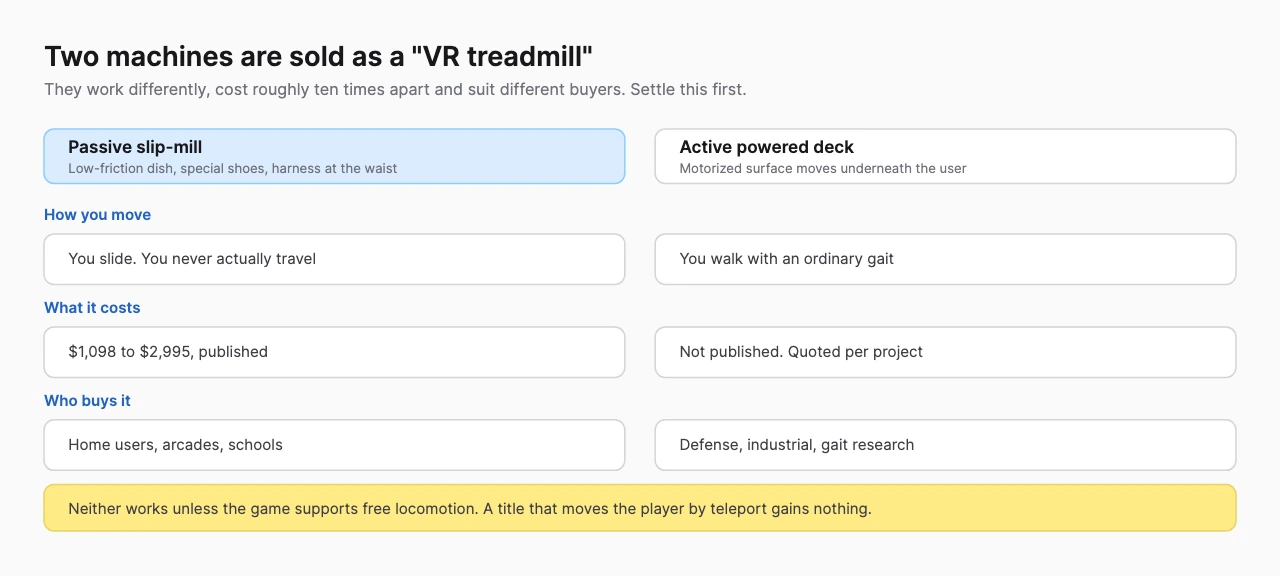
This list covers four systems on four criteria: which of the two mechanisms it uses, what it costs and whether that price is published, what it physically requires in the room and who it is actually sold to. Game compatibility counts are reported as company claims, because a catalog number says nothing about whether the specific title you want implements free locomotion.
| System | Mechanism | Published price | Sold to |
|---|---|---|---|
| Virtuix Omni One | Passive slip-mill with vest | $2,995 | Consumer, enterprise, education, defense |
| KAT Walk C2 | Passive slip-mill with waist support | $1,098 to $1,598 | Consumer and prosumer |
| Infinadeck | Active powered deck | Not published | Defense and industrial |
| Cyberith Virtualizer | Passive slip-mill, professional | Not published | Research, training and entertainment |
1. Virtuix Omni One
Virtuix is the most transparent supplier in this category, and it is transparent for a structural reason: it is a public company. It began trading on the Nasdaq Global Market on January 27, 2026 under the ticker VTIX. Founded in 2013 and headquartered in Austin, a company that files is a company whose numbers you can eventually read, which is not true of anyone else here.
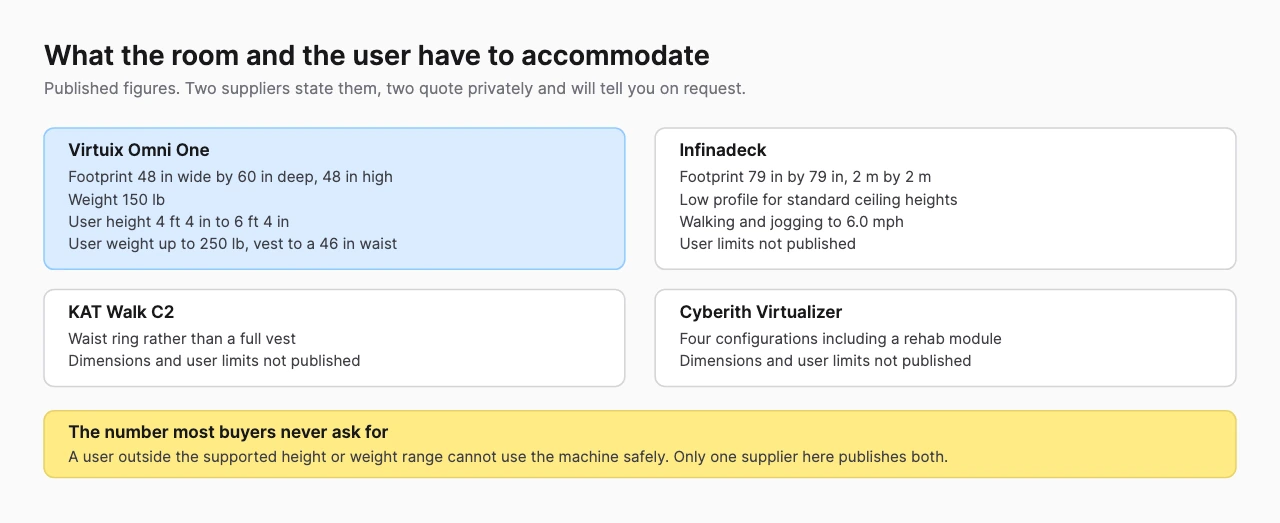
The Omni One is $2,995 and the specifications are published in full. Virtuix discounts too. It was running $500 off with a stated expiry of September 16, 2026 when the page was checked, so treat the list price the same way as everyone else's here. The unit is 48 inches wide by 60 inches deep by 48 inches high and weighs 150 pounds. Supported user height runs from 4 feet 4 inches to 6 feet 4 inches, supported user weight up to 250 pounds and the vest fits up to a 46 inch waist. Those four numbers decide whether the machine works for the people in your building, and they are the ones most comparisons omit.
It ships with a headset rather than expecting you to supply one. Virtuix bundles a customized Pico 4U running a Snapdragon XR2 Gen 2 with 12GB of memory and 256GB of storage, plus HyperSense controllers with built-in haptics. A treadmill-only configuration exists for buyers who already have a PC-compatible headset. It also connects to Meta Quest 2, Quest 3 and Quest 3S through Omni Connect for Meta, and to PCVR headsets through SteamVR.
The company sells the same platform into four segments, with Omni Arena for location-based entertainment, plus enterprise, education and a military and defense configuration. Best for a buyer who wants a published price, published body limits and a supplier obliged to disclose its finances.
2. KAT Walk C2
KAT VR is the volume player at the consumer end, and it is the name most people actually mean when they search for a VR treadmill.
Two models are current. The KAT Walk C2 Core Enhanced is $1,098 and the KAT Walk C2 Plus Enhanced is $1,598, both checked on kat-vr.com on September 13, 2026. Treat those figures as a snapshot rather than a list price, because KAT VR runs near-continuous promotions and the site was carrying a holiday sale, a weekend flash sale and a one-day deal simultaneously on the day they were checked. The company publishes claims of support for more than 3,000 games and more than 50,000 users worldwide, both of which are its own figures rather than audited ones.
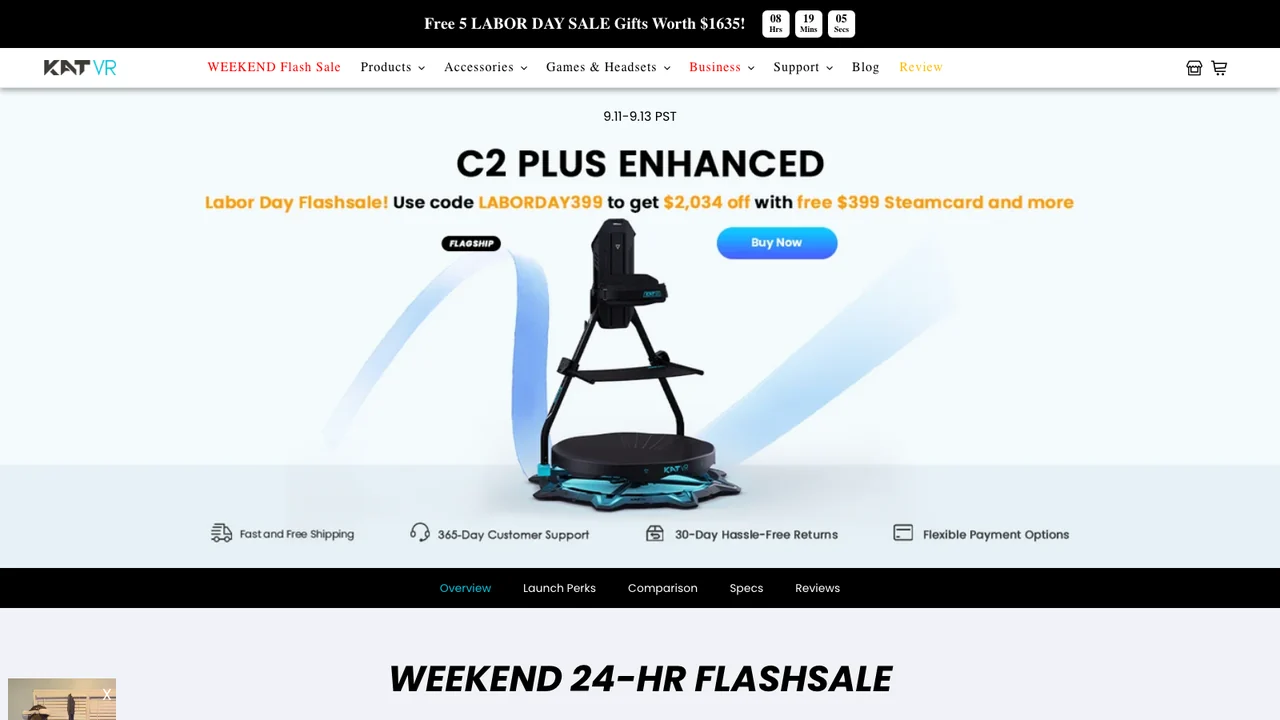
The important caveat comes from KAT VR itself. Its own FAQ states that compatible titles are Steam and Oculus Home PCVR games that support free locomotion, that compatibility and performance vary from game to game and that the equipment operates within the scope of the game's own settings. That is an honest disclosure and it is the single most useful sentence on the site, because it means a headline compatibility count does not tell you whether the game you care about will work properly.
The C series is built around a waist support ring rather than a full vest, with proprietary shoes on a concave low-friction platform. An accessory line covers shoes, insoles, a smart armband and a Quest adapter called Nexus. Best for an individual buyer at home who has checked that their specific games support free locomotion.
3. Infinadeck
Infinadeck is the one system here that is mechanically different from the others, and the difference is the whole reason to consider it.
Rather than a smooth dish you slide on, it is a powered omnidirectional deck whose surface moves underneath the user, which the company describes as active-response. The user walks with a normal gait instead of learning a slide. Infinadeck describes its product as the world's only active-response omnidirectional treadmill, which is the company's own claim rather than a verified position, though no other supplier reviewed here describes a comparable mechanism.
The published capabilities are aimed at a professional buyer. It supports full 360 degree walking and jogging at speeds up to 6.0 miles per hour, occupies a 79 inch by 79 inch footprint, which is 2 meters by 2 meters, and is described as low-profile enough for standard ceiling heights. Integration is direct: the company publishes SDK support for Unreal Engine 5, Unity and VBS4, the military simulation suite.
Its stated sectors are defense, industrial, robotics and medical, with infantry training and squad-level maneuvers named specifically, and it argues that removing the locomotion mismatch removes a cause of simulation sickness. No price is published anywhere on the site, which for a defense-facing capital purchase is normal and still worth stating plainly. Best for defense and industrial training where a genuine walking gait matters and the budget is a procurement line rather than a credit card.
4. Cyberith Virtualizer
Cyberith is the research and professional option, and it is the only supplier here that treats the platform as a family of instruments rather than one product.
It publishes four Virtualizer configurations: the ELITE 2, an R&D Kit, a Rehab Module and a Stand-Alone Module. That split matters because the buyers are different. A university lab running locomotion studies needs different data access and a different mounting arrangement from a clinic running gait rehabilitation, and Cyberith sells to both rather than adapting one consumer unit.
Two things widen it beyond treadmills. The company also sells VidMill, a belt-based rotating treadmill built for on-set virtual production and volumetric capture, which is a different job entirely and connects this category to the capture work covered in our volumetric video list. It also sells a Cyberith IK full body tracking system, so locomotion and body tracking come from one supplier.
Cyberith works from Austria and names research and development, entertainment and training and simulation as its applications. Like Infinadeck it publishes no prices and sells by quotation. Best for research labs, rehabilitation programs and virtual production, where the configuration matters more than the sticker.
What nobody tells you before you buy
The sensation is a slide, not a walk. On every passive system here the user's feet slide across a low-friction surface inside special shoes while a harness holds the body in place. It takes practice, it uses different muscles from walking and some people never find it natural. Try one before buying if there is any way to do so.
The game decides, not the treadmill. Free locomotion support in the title is the requirement. KAT VR publishes this in its own FAQ and it applies to every system in the category.
The room is part of the purchase. An Omni One is 150 pounds on a footprint of 48 by 60 inches. An Infinadeck occupies 79 by 79 inches. Neither is furniture you move aside, and both need clearance above the user as well as around them.
Body limits are real limits. Virtuix publishes a height range and a 250 pound user weight limit. A device that does not fit the people who will use it is not a device.
How to choose a VR treadmill
Start with the mechanism, because it splits the category and the budget. If a genuine walking gait is the requirement, for gait research, rehabilitation or infantry training, that is an active powered deck and Infinadeck is the supplier here that builds one. Everything else in the category is a slide.
If you are buying one unit for a home and the games are PCVR titles you have already checked, KAT VR sells the cheapest route in and publishes the compatibility caveat honestly.
If you want a published price, published body limits and a headset in the box, Virtuix Omni One is the most completely documented product here, and the Nasdaq listing means its financial position becomes checkable in a way no private competitor's is.
If the buyer is a lab, a clinic or a virtual production stage, Cyberith sells configurations built for those jobs rather than a consumer unit with a different label.
Then ask every one of them for the compatibility list for your actual titles rather than a headline number, and ask what the surface, the shoes and the harness cost to replace, because those are consumables on a machine people slide across. BestInXR's comparison of current XR headsets covers the headsets these systems connect to, our full body tracking guide covers the other half of moving your real body into a virtual one, and our VR simulation guide covers where physical locomotion actually changes training outcomes.
Frequently Asked Questions (FAQ)
1. What is a VR treadmill?
It is hardware that lets a user move continuously through a virtual space while staying in one physical spot. Most designs are passive slip-mills where the feet slide across a low-friction dish inside special shoes. A smaller number are powered decks whose surface moves so the user walks normally.
2. How much does a VR treadmill cost?
Published consumer prices run from $1,098 for the KAT Walk C2 Core Enhanced to $2,995 for the Virtuix Omni One, checked in September 2026. Professional and defense systems from Infinadeck and Cyberith are quoted privately and sit well above that range.
3. Does a VR treadmill work with all games?
No. The game has to support free locomotion, meaning unrestricted movement around the environment. KAT VR states this in its own FAQ and adds that compatibility and performance vary by title. Games built around teleport movement gain nothing from a treadmill.
4. Does a VR treadmill work with Meta Quest?
Sometimes, through an adapter or companion software rather than natively. Virtuix publishes compatibility with Quest 2, Quest 3 and Quest 3S through Omni Connect for Meta, and KAT VR sells a Quest accessory called Nexus. Confirm the specific headset and the specific game before buying.
5. Do VR treadmills stop motion sickness?
They address one cause of it. Simulation sickness is commonly attributed to a mismatch between what the eyes see and what the body feels, and physical locomotion narrows that gap. Infinadeck makes this argument directly for its defense training customers. It is not a guarantee for every user.