
Best Volumetric Video Companies and Capture Platforms
The volumetric capture studio you were planning to hire may not be there any more. Metastage's domain serves nothing, Microsoft's capture studios page is gone, Arcturus now sells sports and Dimension now sells virtual production. The category did not die, it changed shape. What is for sale today is technology you operate yourself, plus somebody to build the application the footage plays inside.
In short:
- Check the supplier is still in this business. Four names that appear on most current lists have either gone dark or moved on, and every one of those is checkable in a minute. The XR Graveyard records the dated ones.
- You are buying software now, not a booking. Evercoast licenses the capture and cloud rendering stack and publishes what it costs.
- A capture is not an experience. Volumetric footage arrives as a sequence of 3D frames. Something still has to play it, on the device you care about.
- Ask where the output plays before you shoot. Game engine, browser and headset are three different delivery problems, and the answer changes the format you should capture in.
How this list was built
Volumetric video is the capture of a real person or object from many synchronized cameras at once, reconstructed into a moving three-dimensional sequence that a viewer can walk around. It differs from 360 video, which is flat imagery wrapped around a fixed viewpoint, and from motion capture, which records movement to drive a separate digital character.
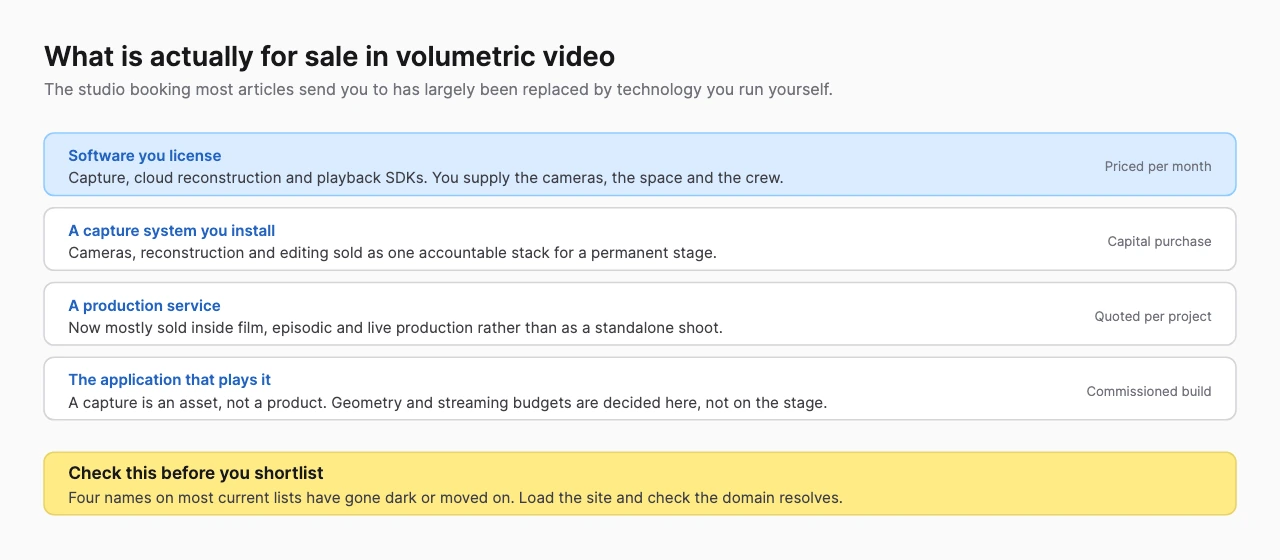
This list ranks three suppliers on four criteria: what you actually buy, whether the output plays where you need it, whether pricing is published and whether the supplier is still in this category at all. That last one is not usually a ranking criterion. It is here because the checks below show it has to be.
| Company | What you buy | Output target | Best for |
|---|---|---|---|
| Evercoast | Software licenses and cloud rendering | Browser, engine, custom tools | Running capture yourself at a published price |
| 4Dviews | A capture system and editing software | Unity and Unreal | Building or equipping a permanent stage |
| Dimension | A production service | Film, episodic and live | Studio-grade work inside a larger production |
1. Evercoast
Evercoast is ranked first because it sells the thing this category now mostly is, which is software, and because it tells you the price without a sales call.
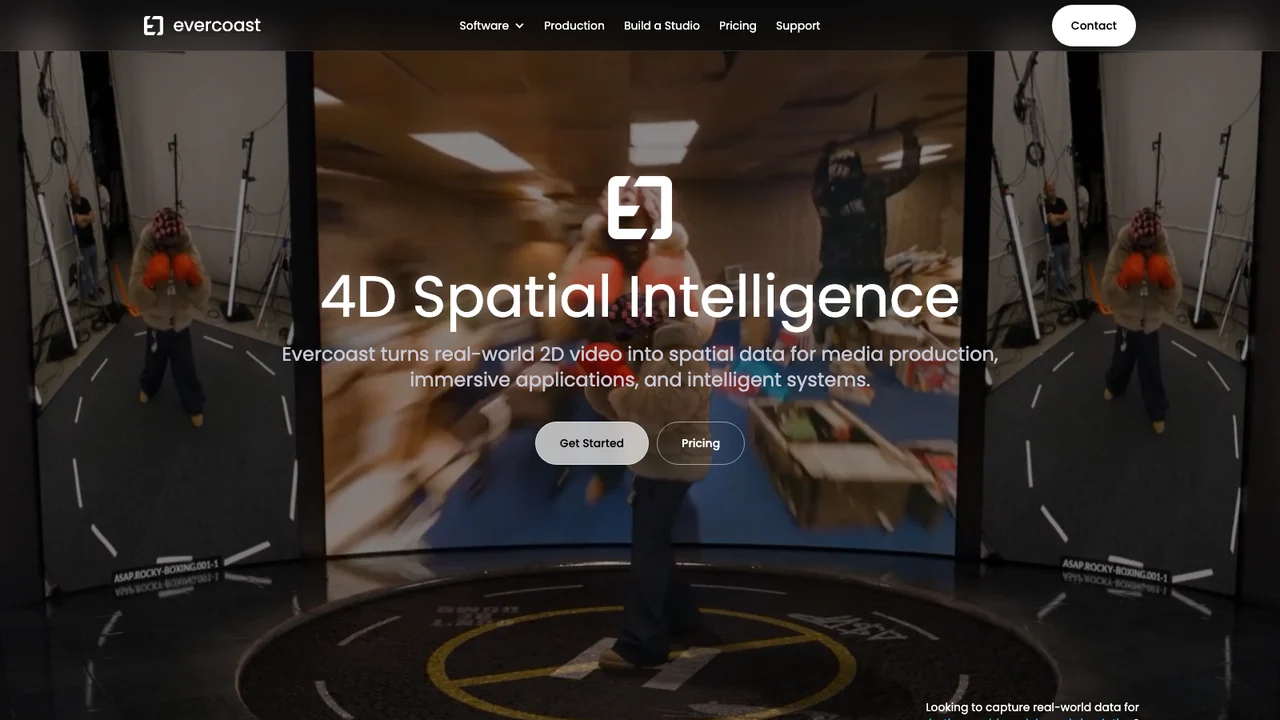
The platform splits into three parts. Mavericks records and synchronizes multicamera arrays. Cloudbreak renders the result into what the company calls 4D spatial video at scale. Developer tools handle playback in a browser, in a game engine and in your own tools. The company describes the whole as turning real-world 2D video into spatial data, and its page title names Gaussian splatting alongside multicamera capture, which is the technique that has reset quality expectations in this field over the last two years.
Pricing is published, which almost nothing else here does. Mavericks Pro is $499 a month billed monthly or $349 annually, supporting up to six cameras with calibration, real-time 3D previsualization, unlimited Pro renders, game engine and web SDKs and browser-based remote control. Studio is $1,999 a month or $1,399 annually, raising the ceiling to 20 cameras and adding audio source sync, 4D live streaming through Cloudbreak, custom capture flows and API access. Hardware is not included, which is the number most buyers underestimate.
There is real work behind it. The company states that nearly every human in A$AP Rocky's Helicopter$ music video was shot and generated using Evercoast. It also runs production shoots in New York or remotely for buyers who want the output without the rig, and it is extending into robotics, world models and simulation through a separate site. Best for teams who want to own the capture capability and know what it costs before committing.
2. 4Dviews
4Dviews is the option for organizations that want a stage of their own rather than a booking or a subscription. It sells an end-to-end ecosystem: HOLOSYS+ and HOLOSYS capture systems, 4Dfx editing software and integration into Unity and Unreal Engine.
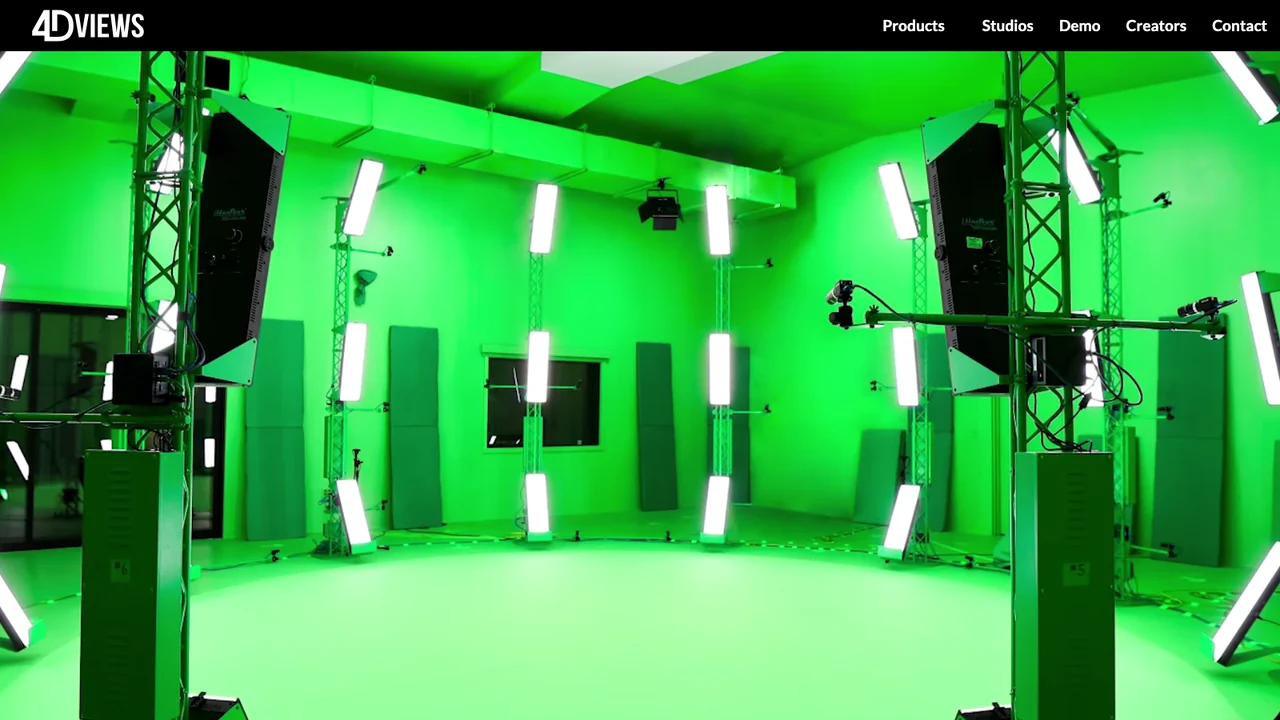
That vertical integration is the argument. A permanent volumetric stage is a capital decision made by broadcasters, universities, cultural institutions and larger studios, and those buyers want one supplier accountable for the cameras, the reconstruction and the export rather than a stack they assembled. The company also maintains a find a studio near you directory, which is the practical route for anyone who wants 4Dviews output without owning the hardware, and it is worth noting that this network is now one of the more reliable ways to book a shoot at all.
Its published use cases run wider than most of this category admits: music performance, dance and cultural heritage, fashion, training simulation, advertising, AR and VR experiences, TV broadcast, populating scenes with crowds and making game characters from real people. Pricing is not published, which for a hardware system is normal and still worth flagging. Best for institutions building a permanent stage, and for anyone wanting to book a shoot through its studio network.
3. Dimension
Dimension is the studio-model survivor, and it survived by becoming something larger. It now leads with realtime production for film and episodic television rather than with volumetric capture.
Its published work is the reason it stays on the list: previsualization and techvis on Universal Pictures' Wicked, virtual production on Peacock's Those About To Die and Apple TV+'s Murderbot, and a live project with Floating Points. Volumetric appears within that as virtual crowds and performance capture rather than as the headline service.
Read the repositioning as information rather than as a warning. It tells you what the demand actually supported: volumetric capture as one technique inside a production, commissioned by people who are already buying virtual production, rather than as a standalone service sold to brands. If your project is a film, an episodic show or a large live experience, that is the context this work now lives in, and Dimension is the supplier here operating in it. If your project is a standalone volumetric asset for an app, you are a smaller customer than this business is now shaped around. Best for studio-grade capture inside a film, episodic or live production.
Who else was considered, and where each fits
Metastage appears on essentially every current list of volumetric capture studios. Its domain, metastage.com, runs on GoDaddy nameservers and has no A record, so it serves no site. What became of the business is not documented in any primary source and this post does not guess. Anyone shortlisting from an article written a year ago will still have it at the top.
Microsoft Mixed Reality Capture Studios is excluded because its page is gone. The mixed reality capture studios URL now returns a 404. That is consistent with the rest of Microsoft's mixed reality wind-down, which BestInXR's HoloLens reference tracks with dates.
Arcturus is excluded, and it is the most interesting exclusion here. The company's own about page says its team pioneered volumetric video and led the industry for over a decade, then states that the company is changing how the world experiences sports. Its site is now organized around broadcasters, leagues, teams and brands, with immersive replays and fan engagement.
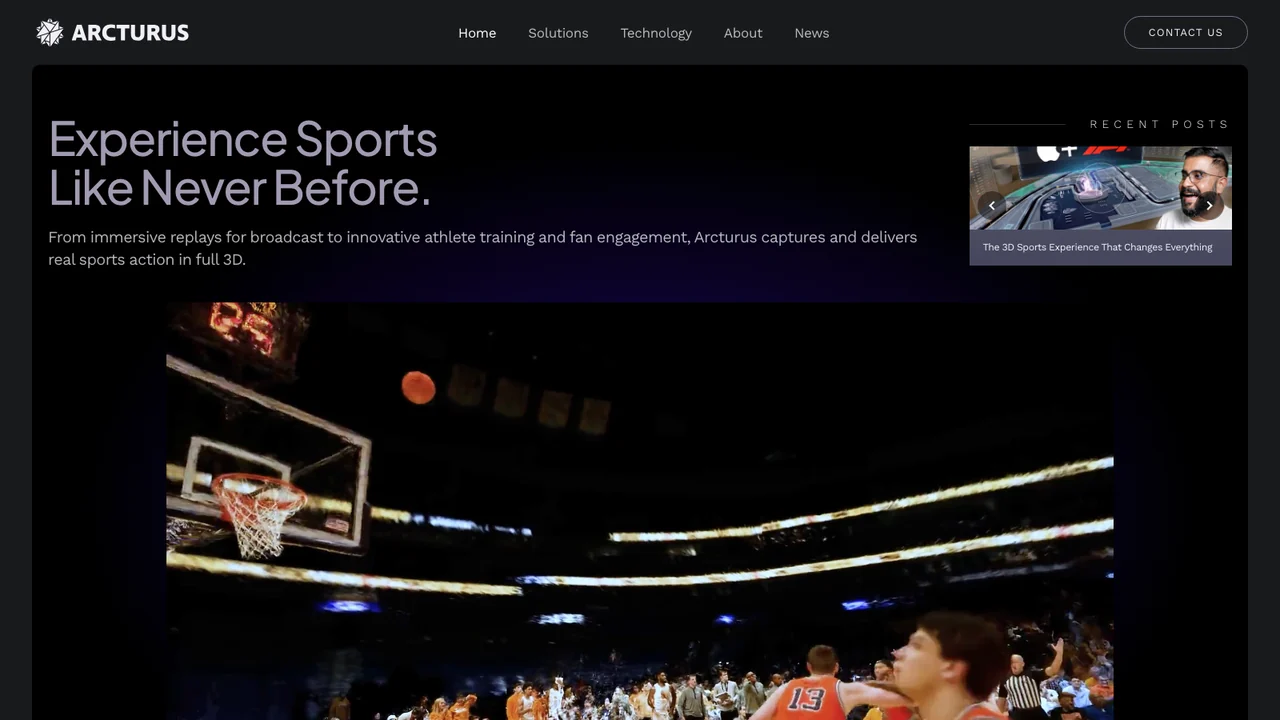
If you are a rights holder, it belongs on your shortlist. If you wanted a general volumetric toolchain, it no longer sells you one.
Motion capture and photogrammetry vendors are excluded as a class. Motion capture records movement to animate a separate model. Photogrammetry reconstructs a static object from photographs. Neither produces a moving volumetric performance, and conflating the three is the most common error in this category.
How to choose between these volumetric video companies
Start by checking the supplier is still doing this, which in this category is a real step rather than a formality. Load the site, look at what the homepage leads with and check the domain resolves.
Then decide what you are buying. If you want the capability in house at a known price, Evercoast licenses the stack and publishes the numbers. If you want a permanent stage with one accountable supplier, 4Dviews sells the system and runs a studio network you can book through instead. If the capture is one element of a film, episodic or live production, Dimension works at that scale.
If the real gap is that you have footage and nothing to play it in, that is an application build rather than a capture purchase.
Then settle the delivery target before the shoot rather than after it, because it governs the capture. A browser, a game engine and a standalone headset impose different budgets for geometry, texture and streaming, and a sequence that looks right on a workstation can be unusable on a headset. BestInXR's XR development companies list covers studios with in-house capture alongside application work, and its product visualization guide covers the neighboring content production categories.
Frequently Asked Questions (FAQ)
1. What is volumetric video?
It is the capture of a real person or object by many synchronized cameras at once, reconstructed into a moving three-dimensional sequence a viewer can walk around and view from any angle. Unlike 360 video, the viewpoint is not fixed.
2. What is the difference between volumetric video and motion capture?
Volumetric video records the actual appearance of a person, including clothing, hair and expression, as 3D geometry over time. Motion capture records only movement data, which then drives a separately built digital character. They answer different production questions.
3. How much does volumetric video capture cost?
Most suppliers quote privately. Evercoast publishes software pricing from $349 per month annually for up to six cameras, rising to $1,399 for up to 20, with hardware excluded. Studio bookings and capture systems are quoted case by case.
4. Is Metastage still operating?
Its domain runs on domain marketplace nameservers and has no A record, so it serves no site. No primary source documents what happened, and lists published earlier still rank it first.
5. Where can volumetric video be played back?
In game engines, in a browser through WebGL and on headsets, though not automatically in all three. File sizes are large and playback support varies, so confirm the delivery target before capturing rather than afterward.