
Best VR Haptic Suits and Gloves
Vibration tells you something happened. Force feedback stops your hand closing through an object that is not there. Those are different machines doing different jobs, and the price gap is about twenty-five times: a bHaptics TactSuit Air is $289 and a SenseGlove Nova 2 Set is $7,299. Only one of them changes what a trainee can actually learn.
In short:
- Two mechanisms, not one. Vibrotactile motors buzz against your skin. Force feedback physically resists your fingers. Everything else follows from which you buy.
- Consumer haptics are priced and in stock. bHaptics publishes $289 for a 16 point vest, $529 for a 32 point vest and $349 for its glove.
- Force feedback is an enterprise purchase. SenseGlove publishes $7,299 excluding VAT. HaptX and Teslasuit publish nothing and sell by conversation.
- The software has to support it. A vest with no integration is a vest that sits still, which is why bHaptics ships an AI layer that converts game audio into haptics.
How this list was built
Haptics is hardware that makes your body feel something that is happening in software. In XR it splits by what the device physically does to you, and that split decides the price, the buyer and whether the thing is useful for training or for entertainment.
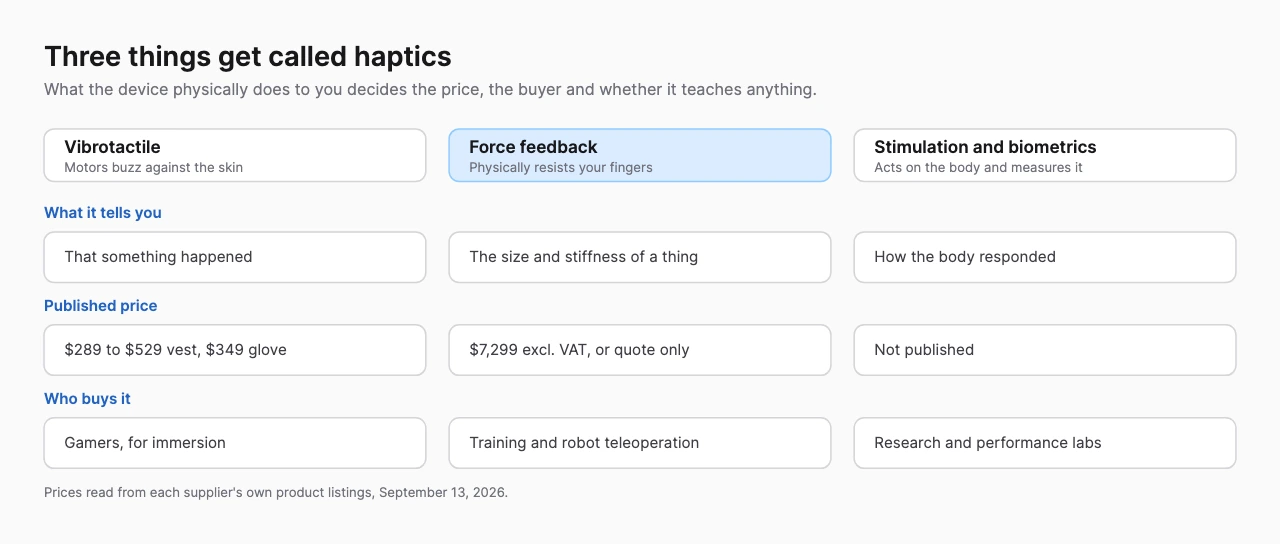
This list covers four suppliers on four criteria: what the hardware physically does, whether the price is published, what software has to do before the hardware does anything and who the supplier actually sells to. Feedback point counts are reported as published figures, because no supplier here publishes a comparable measure of force or fidelity.
| Supplier | Mechanism | Published price | Sold to |
|---|---|---|---|
| bHaptics | Vibrotactile vest and glove | $289 to $529 vests, $349 glove | Consumers and gamers |
| SenseGlove | Force feedback glove | $7,299 excluding VAT | Training, research, prototyping |
| HaptX | Microfluidic force feedback | Not published | Enterprise training and robotics |
| Teslasuit | Full body stimulation and biometrics | Not published | Research and performance training |
1. bHaptics
bHaptics is the company most people mean when they search for a haptic suit, and it is the only one here selling a finished consumer product at a price you can read.
Its own product data gives the line clearly. The TactSuit Air is described as the gateway haptic vest with 16 feedback points at $289. The TactSuit Pro is the ultimate haptic vest with 32 feedback points at $529. The TactGlove DK3 is a wearable haptic glove with 8 feedback points for each hand at $349. All three were read from bHaptics' own product listings on September 13, 2026.
The mechanism is vibrotactile. Motors positioned around the torso or the hand vibrate in patterns, so the vest tells you where you were hit, which direction an explosion came from or that something brushed past you. It is genuinely effective for immersion and it is not force feedback. Nothing in a TactSuit resists your movement.
The interesting engineering is the software problem rather than the hardware. A haptic device does nothing unless an application drives it, and most games never will. bHaptics answers that with an AI layer that converts game audio, gunshots, explosions and collisions, into haptic patterns, and it names PUBG, VALORANT and Call of Duty among supported titles alongside a compatibility checker for PC and VR games. That converted output is inferred from sound rather than authored by the developer, which is the right trade for entertainment and the wrong one for a training simulation that has to be precise. Best for gaming immersion at a consumer price.
2. SenseGlove Nova 2
SenseGlove is the one force feedback glove here with a price on the page, which makes it the realistic entry point for anyone who needs resistance rather than vibration.
The Nova 2 Set is listed at $7,299 excluding VAT, with European pricing shown alongside and a note that the lower figure applies to small quantities and that large volumes are quoted. Read against a $289 vest, that number is the honest measure of what force feedback costs today.
What it adds over the vest is Active Contact Feedback, which the company describes as letting a user perceive a virtual object in the palm of the hand rather than only at the fingertips. SenseGlove describes it as the first and only wireless compact glove offering palm feedback, which is the company's own claim rather than a verified position.
The buyer profile is published and specific: VR training, research and virtual prototyping, with an academic program offering research and educational institutions up to 20% off. Its case studies name NASA's Marshall Space Flight Center, which is the sort of reference that tells you what the product is actually used for. It states shipping within five business days and delivery within about two weeks. Best for organizations that need real resistance and want to buy it without a procurement cycle.
3. HaptX Gloves G1
HaptX builds the highest fidelity touch feedback in this category and does not tell you what it costs. Check the name before you shortlist from an older article: its own logo now reads a 1HMX brand, and 1HMX is a human-machine interface engineering company that describes HaptX products as engineered by it.
The mechanism is different from everything else here. HaptX describes microfluidic smart textile packed with hundreds of actuators that push against the skin while force feedback is applied to the fingers, with the hands tracked by a submillimeter motion capture system. The claim that follows is that a user handling a virtual object feels its texture, size and rigidity, which is a materially stronger claim than feeling that contact occurred.
Its published product line is the Gloves G1, the Nexus NX1 and an SDK, and its published use cases are training, robotics and design and manufacturing. Robotics is worth noting, because teleoperation, where a person controls a real robot hand at a distance, needs the operator to feel what the robot touches, and that is a requirement no vibrotactile device meets.
The parent company is also where this whole subject converges. 1HMX publishes Nexus NX1, which it calls the first whole-body system combining lifelike touch, natural locomotion and precision motion capture in one platform, and which it says integrates HaptX Gloves G1, the Virtuix Omni One treadmill, Freeaim Shoes and 72 degree-of-freedom body and hand tracking. Whether it is the first is the company's claim rather than a checked fact, but the shape of it is the point: the haptics, the treadmill and the body tracking covered separately across this site are being sold as one bundle at the top of the market.
There is no price anywhere on the HaptX site and no store. Every route is a conversation, which is normal for hardware at this level and is worth stating rather than leaving a reader to discover. Best for enterprise training and robot teleoperation where fidelity decides whether the application works at all.
4. Teslasuit
Teslasuit is the only full body system here and the only one combining stimulation with measurement.
Its published proposition is a suit that provides haptic feedback while capturing motion and biometrics, plus a Teslaglove with force feedback and a Control Center application for calibrating and updating the hardware. The biometric capture is the part that separates it: a system that records what a trainee's body did and how they responded is doing something closer to instrumentation than to immersion.
Both the suit and the glove are presented as developer kits with an apply for early access route rather than a buy button, alongside an academic program. That is a meaningful signal about availability and it is the company's own framing. Anyone evaluating Teslasuit should establish current lead times and commercial terms directly, because nothing on the public site commits to either.
The company positions the technology around understanding human behavior and improving high level performance, which places it with research groups and specialist performance training rather than with either gamers or general enterprise. Best for research and human performance work where the biometric record matters as much as the feedback.
What decides whether haptics are worth it
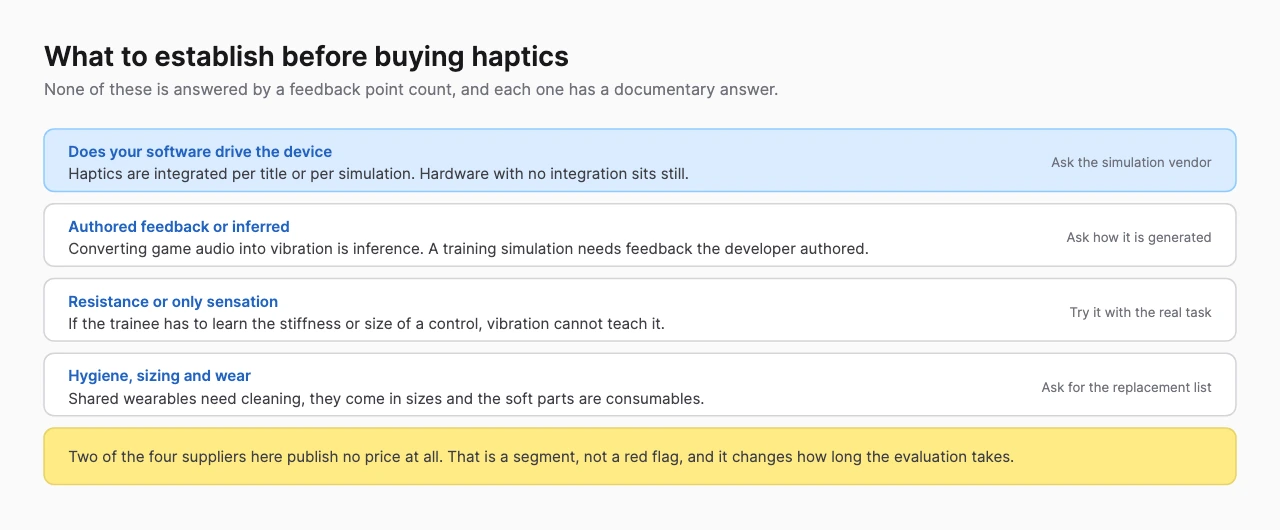
Ask what the device does, not how many points it has. A 32 point vibrotactile vest and a force feedback glove are not comparable, and a feedback point count only compares devices using the same mechanism.
The application has to drive it. Haptics are integrated per title or per simulation. bHaptics' AI audio conversion is a clever way around that for games, and it is inference rather than authored feedback. For training, confirm the simulation vendor supports the specific device.
Force feedback is what changes training. Vibration confirms contact. Resistance teaches your hand the size, stiffness and position of a thing, which is why the training and robotics buyers are the ones paying five figures.
Quote-only is not a red flag, it is a segment. Two of the four here publish nothing, and both sell into enterprise and defense procurement where configuration decides price. Budget the evaluation time accordingly.
How to choose haptics for VR
Start with what you need the user to feel. If the goal is a better game, a vibrotactile vest is the entire category worth considering, and bHaptics publishes the prices and the compatibility list to check before buying.
If the goal is that a trainee's hand learns the shape and stiffness of a real control, vibration will not do it. That is force feedback, and SenseGlove is the one that publishes a price so you can size the program before talking to anyone.
If fidelity is the binding constraint, or the application is robot teleoperation rather than simulation, HaptX builds for that and expects a conversation.
If you need the physiological record as well as the feedback, Teslasuit is the only system here capturing biometrics, and availability is the first thing to establish.
Then check device support in the specific software you will run, because every haptic device is only as good as its integration. BestInXR's full body tracking guide covers the tracking hardware these devices sit alongside, our VR treadmills list covers locomotion and our VR simulation guide covers where added fidelity actually changes a training outcome.
Frequently Asked Questions (FAQ)
1. What is a VR haptic suit?
It is a wearable, usually a vest, containing motors that vibrate in patterns so the wearer feels events happening in software. bHaptics publishes vests with 16 and 32 feedback points. A suit provides sensation, not resistance.
2. How much does a haptic suit cost?
bHaptics publishes $289 for the 16 point TactSuit Air and $529 for the 32 point TactSuit Pro, checked in September 2026. Force feedback gloves are a different bracket: SenseGlove publishes $7,299 excluding VAT for a Nova 2 Set.
3. What is the difference between haptic feedback and force feedback?
Vibrotactile haptics vibrate against your skin to signal that something happened. Force feedback physically resists your fingers so you cannot close your hand through a virtual object. Force feedback is far more expensive and is what training and robotics buyers need.
4. Do haptic suits work with every game?
No. Each title has to support the device. bHaptics addresses this with an AI layer that converts game audio into haptic patterns and publishes a compatibility checker, naming titles including PUBG, VALORANT and Call of Duty. Always check the list for the games you play.
5. Are haptic gloves used outside gaming?
Yes, and that is where the expensive hardware sells. HaptX publishes training, robotics and design and manufacturing as its use cases, SenseGlove publishes training, research and virtual prototyping and names NASA's Marshall Space Flight Center among its cases and Teslasuit targets research and human performance.