

Best VR Full Body Tracking Trackers and Systems
The cheapest tracker is often the most expensive system. A Tundra Tracker is $130 and a VIVE Ultimate Tracker is $229, but the Tundra only works if you already own SteamVR base stations and the VIVE needs none at all. Three tracking methods are sold under one phrase, and which one you can use is decided by what is already in your room.
In short:
- Count the system, not the tracker. Base stations, dongles and the number of trackers you actually need all sit outside the headline price.
- Three methods. Lighthouse tracking needs base stations. Inside-out tracking puts cameras on the tracker. Inertial tracking uses no cameras at all and drifts.
- Three trackers is the usual starting point. Waist and both feet, on top of the headset and two controllers, which is what VIVE sells as a 3+1 kit.
- You may not need a headset. SlimeVR states its trackers work for VTubing through VMC with no headset involved.
How this list was built
Full body tracking adds your waist, legs and feet to what the system already knows, which is normally just your head and hands. Social VR is the largest use, where an avatar that mirrors your actual posture reads very differently from one floating from the elbows up, and the same hardware is used for indie motion capture and VTubing.
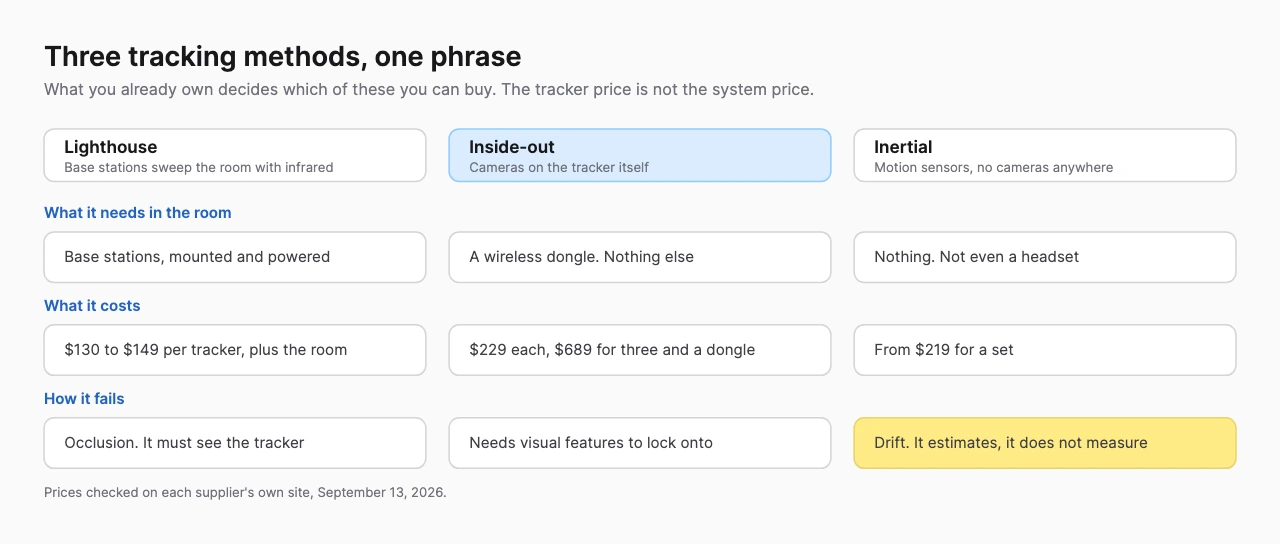
This list covers four products on four criteria: which tracking method it uses, what the whole system costs rather than the single unit, what it requires you to already own and what it does when it goes wrong. Accuracy is not ranked, because none of these suppliers publishes a comparable accuracy figure measured the same way.
| Product | Method | Price | Needs |
|---|---|---|---|
| VIVE Ultimate Tracker | Inside-out cameras | $229 each, $689 for the 3+1 kit | A wireless dongle, no base stations |
| SlimeVR | Inertial sensors | From $219 | Nothing else, not even a headset for VTubing |
| Tundra Tracker | SteamVR lighthouse | $130 each | Base stations you supply |
| VIVE Tracker (3.0) | SteamVR lighthouse | $149 each | Base stations and software, sold separately |
1. VIVE Ultimate Tracker
The VIVE Ultimate Tracker is the one that removes the hidden cost, because it does the tracking itself.
Each unit carries two wide-field-of-view cameras and does 6DoF inside-out tracking, so there are no base stations to mount, power or align. HTC is explicit that none are needed: you plug a VIVE Wireless Dongle into the headset or PC and the trackers locate themselves. For anyone who does not already own a lighthouse setup, that single fact usually decides the category.
Pricing is published at $229 for one and $689 for the 3+1 kit, which is three trackers plus one wireless dongle. HTC describes that kit as the standard configuration: with a headset and two controllers it tracks head, hands, waist and feet. A five-tracker configuration is also sold, at $1,149 when checked on vive.com on September 13, 2026.
The published specifications are unusually complete for this category. Each tracker is 77 by 58.6 by 27.3 millimeters and weighs 94 grams. Battery life is up to 7 hours. Charging takes about 2.2 hours with Qualcomm Quick Charge 3.0 or about 3.2 hours on a 5V 1A supply. Connectivity is a proprietary 2.4 and 5 GHz link. SteamVR titles are reached through VIVE Hub rather than natively, which is a step worth knowing about before you buy. Best for anyone without base stations, which is most people.
2. SlimeVR
SlimeVR is the cheapest route into full body tracking and the only genuinely open one, and it reaches a use case none of the others do.
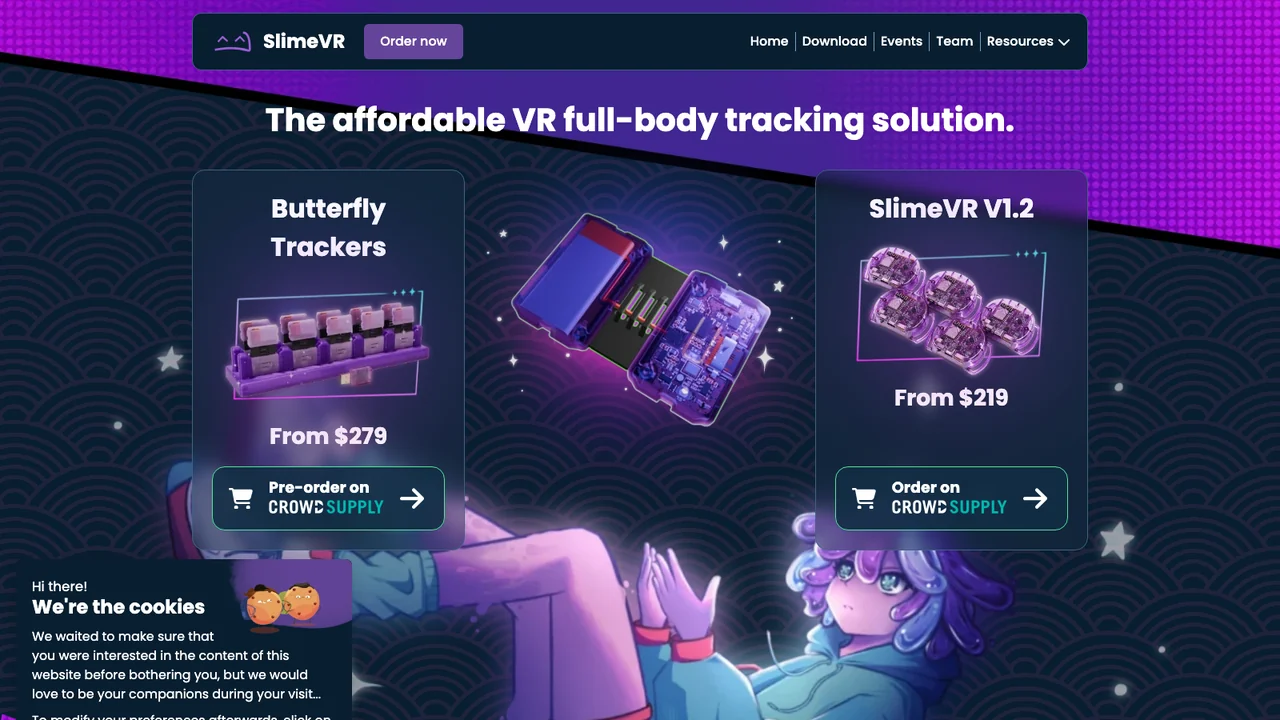
Its trackers are inertial. They contain no cameras and require no external reference at all, which is why the system needs nothing else in the room. SlimeVR V1.2 starts at $219 and a newer Butterfly Trackers line starts at $279 on pre-order, both checked on September 13, 2026. The project is open source with its code on GitHub, and the company points to a Discord community it says has 70,000 members, which is its own figure rather than an audited one.
Two capabilities set it apart. It works with any SteamVR or standalone game that supports full body tracking, VRChat included, and the server runs on Windows, Linux, macOS, Android and through SideQuest. More unusually, SlimeVR states its trackers work for VTubing through VMC with no VR headset required and for motion capture. If your goal is an avatar that moves rather than a game you play, this is the only product here that does not assume a headset.
The trade-off is inherent to the method rather than to the product. Inertial sensors estimate position from motion instead of measuring it against a fixed reference, so they drift and need periodic reset. Anyone telling you otherwise is selling something. Best for the lowest total cost, for VTubers and for anyone who wants hardware they can actually inspect.
3. Tundra Tracker
Tundra Labs sells the cheapest tracker here at $130 and the most conditional one, and both facts come from the same design decision.
The Tundra Tracker uses SteamVR lighthouse tracking, meaning it is located by base stations that sweep the room with infrared. The company positions it as the smaller, sleeker alternative for SteamVR tracking, and for an existing Valve Index or Vive owner with base stations already mounted it is the obvious upgrade path: smaller, lighter and cheaper per unit than the first-party option.
For everyone else the arithmetic inverts. Base stations are a separate purchase, they need mounting at height and mains power, and a room with two of them is a room that has been committed to VR. That is why a $130 tracker can cost more to put into service than a $229 one that needs nothing.
Tundra also sells Valve Index parts including refurbished head units, head straps and power adapters, which makes it a practical stop for anyone maintaining older lighthouse hardware rather than replacing it. Best for people who already own base stations and want the smallest, cheapest tracker that works with them.
4. VIVE Tracker (3.0)
The VIVE Tracker (3.0) is the first-party lighthouse option at $149, and it is the one with the longest record of working with things.
Its argument is not price, since Tundra undercuts it, and not convenience, since the Ultimate Tracker needs no base stations. Its argument is that it is the reference implementation. It has been the tracker that props, cameras, peripherals and location-based entertainment installations are built and tested against for years, and where a piece of software or a mount says it supports a tracker, this is usually the one it was tested with.
HTC states plainly that base stations and software are sold separately, which is the honest version of what every lighthouse product requires. That single line is the one buyers most often miss when comparing a tracker price against an inside-out tracker price.
For most home users buying full body tracking today, this is the wrong end of the catalog: you pay more than a Tundra for the same method and you still need the base stations. It stays on the list because for commercial and integration work, compatibility with an established standard is worth more than the price difference. Best for commercial installations, prop tracking and anyone who needs the version everything else was tested against.
What decides the real cost
Base stations are the hidden line item. Two of the four products here do nothing without them. Lighthouse tracking is excellent and the base stations are a real purchase, a real mounting job and a real commitment of the room.
Three trackers is the usual minimum. Waist and both feet. Pricing a single unit against a single unit tells you very little, which is why VIVE sells a 3+1 kit and SlimeVR sells sets.
Drift is a method, not a defect. Inertial systems drift because they estimate rather than measure. That is the deal you accept for needing no external hardware, and it is manageable with calibration.
The game has to support it. Full body tracking has to be implemented by the application. SlimeVR is explicit that compatibility means games that support full body tracking, VRChat among them. This is the same constraint that governs VR treadmills, where the title has to support free locomotion.
How to choose full body tracking
Start with what is already mounted on your walls. If you own SteamVR base stations, buy Tundra Trackers and stop reading, unless you need the first-party compatibility that VIVE Tracker 3.0 carries. If you do not own base stations, do not buy into lighthouse to get full body tracking, because the room and the hardware cost more than the trackers.
If you have a headset and no base stations, the VIVE Ultimate Tracker 3+1 kit is the shortest path, and its published battery life and dimensions let you check it against your actual use before buying.
If cost is the binding constraint, or if you are a VTuber who never wears a headset at all, SlimeVR is both the cheapest and the only one built for that job, and you accept drift in exchange.
Then confirm the specific applications you care about implement full body tracking, because none of this hardware helps with software that only models a head and two hands. BestInXR's comparison of current XR headsets covers the headsets these trackers attach to, and our volumetric video list covers the professional end of capturing a whole moving person.
Frequently Asked Questions (FAQ)
1. What is full body tracking in VR?
It is adding your waist, legs and feet to a system that otherwise tracks only your head and hands. It is used mostly in social VR so an avatar matches your real posture and also for indie motion capture and VTubing.
2. How many trackers do you need for full body tracking?
Three is the usual starting point, one at the waist and one on each foot, on top of a headset and two controllers. VIVE sells exactly that configuration as its 3+1 kit. Five-tracker setups add the knees or elbows.
3. How much does VR full body tracking cost?
Published prices checked in September 2026 run from $219 for a SlimeVR set, through $130 per Tundra Tracker and $149 per VIVE Tracker 3.0 if you already own base stations, to $689 for the VIVE Ultimate Tracker 3+1 kit that needs none.
4. Do you need base stations for full body tracking?
Only for lighthouse trackers such as Tundra Tracker and VIVE Tracker 3.0, where HTC states base stations and software are sold separately. VIVE Ultimate Trackers track themselves with onboard cameras, and SlimeVR uses inertial sensors, so neither needs them.
5. Can you use full body tracking without a VR headset?
Yes, with some systems. SlimeVR states its trackers work for VTubing through VMC with no VR headset required and for motion capture. Tracking systems that depend on a headset's own tracking or on SteamVR generally cannot be used that way.