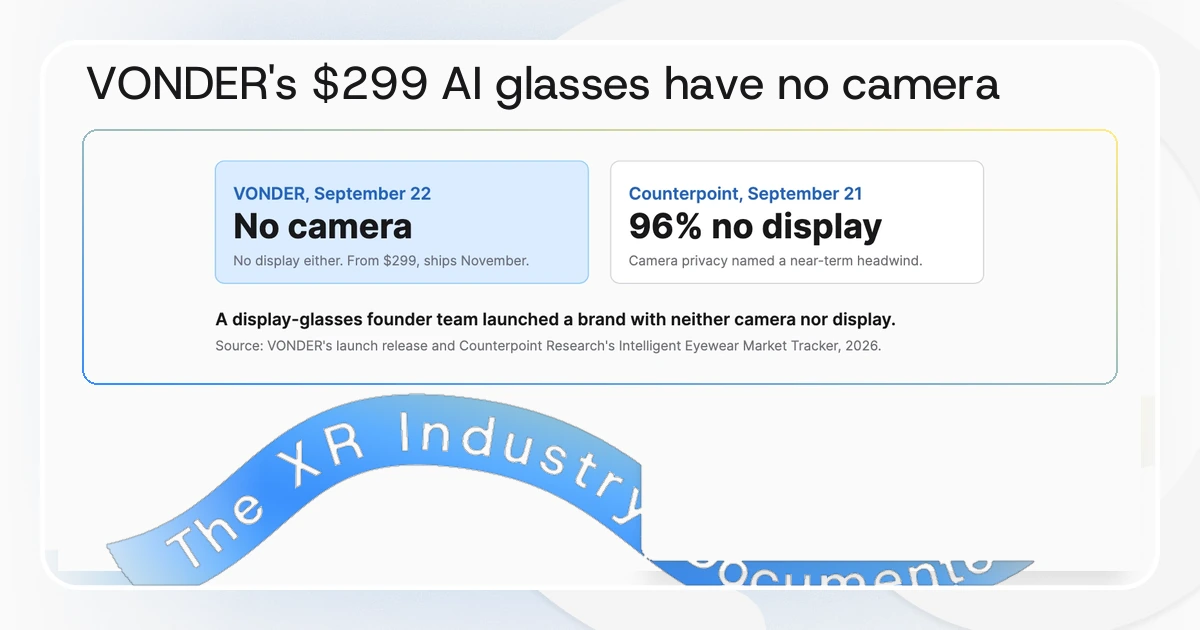
VONDER launched a line of AI glasses on September 22, 2026 with no camera and no display, priced from $299 and shipping in November. It is a new company founded by the co-founders of VITURE, not a VITURE product. Counterpoint's market tracker had named camera privacy a headwind the day before.
In short:
- What launched: six acetate frames with no camera and no display, made to the wearer's prescription and weighing under 30 grams, from a company called VONDER.
- What it costs: pricing starts at $299, with premium acetate options from $399. Pre-orders open September 28, 2026 at 6:00 a.m. PT and shipping begins in November 2026.
- Who makes it: a Silicon Valley company founded by the co-founders of VITURE. VITURE's own site carries no mention of VONDER, checked September 23, 2026.
- Why the timing matters: Counterpoint Research published its eyewear tracker the previous day naming growing public concerns over the privacy implications of cameras as a challenge to the industry, and forecasting camera-free glasses as one response.
What VONDER announced
VONDER announced a debut collection of six acetate frames across three finishes, built to the wearer's prescription and carrying neither a camera nor a display. The company's release describes frames weighing under 30 grams, with full prescription compatibility running from single vision and progressive lenses to Transitions and gradient tints, supported by Essilor.
The product site lists three of the six models with prices. Basel starts at $299, and Antwerp and Oslo start at $399. It gives the frame weight as 30g, stereo speakers and a battery rated 16h+ with fast charging to 80% in 25 minutes. The other three frames are not shown with prices, so the full range of the collection is not yet published.
The software is a feature VONDER calls a Personal Memory Graph, which the company describes as a map built from the wearer's own notes, conversations and recurring context. It connects to third-party models including ChatGPT, Claude and Gemini, or to a hybrid mode VONDER operates itself.
The privacy design is the part with hardware behind it. VONDER says it keeps text, not audio, deleting the original recording and retaining no voiceprints or biometric data, and that in everyday use the glasses are designed to recognize the wearer's voice while discarding other voices on-device. A Meeting Mode has to be explicitly activated, shows a visible indicator to people nearby and can be cut by a physical control on the temple.
Co-founder Emily Wang put the design problem in one sentence: "Taking the camera out was the easy half." The release gives her follow-on as "The harder question was the microphone: whose voice gets in, and when?"
VONDER makes its first public appearance at SILMO Paris, the optical trade fair running September 25 to 28, 2026 at Paris Nord Villepinte.
Why VONDER is not a VITURE product
VONDER is a separate company, and the distinction matters to anyone keeping a supplier list. The release describes VONDER as founded in Silicon Valley by the co-founders of VITURE, together with Guillaume Hamon as co-founder and chief brand officer. It states the reasoning directly: the founders "didn't build another model. They built a new brand."
The evidence on VITURE's side is the absence. VITURE's own site carries no mention of VONDER anywhere BestInXR could reach on September 23, 2026. The product lineup, the sitemap and the press page do not name it, and viture.com/vonder redirects to the VITURE homepage, which carries none of the product either. VONDER publishes from its own domain and its own newsroom distribution.
The logic behind the split is stated plainly in the release. VITURE sells display glasses, and the release argues those are worn for sessions while a prescription pair is worn all day. Its formulation is that "people will forgive a lot for a great display. They forgive nothing for a bad pair of glasses." A company built on displays started a second company to sell glasses without one.
One claim in the release carries no date. It describes VITURE as the number one XR glasses brand in the United States by shipments according to IDC, without saying which period that ranking covers. BestInXR recorded the same shape of claim in Meta's own sales ranking for Ray-Ban Meta, which is footnoted to IDC data as of July 2025. A vendor citing an analyst firm without a date is a claim a reader cannot check.
What a camera-free pair does to the definition of AI glasses
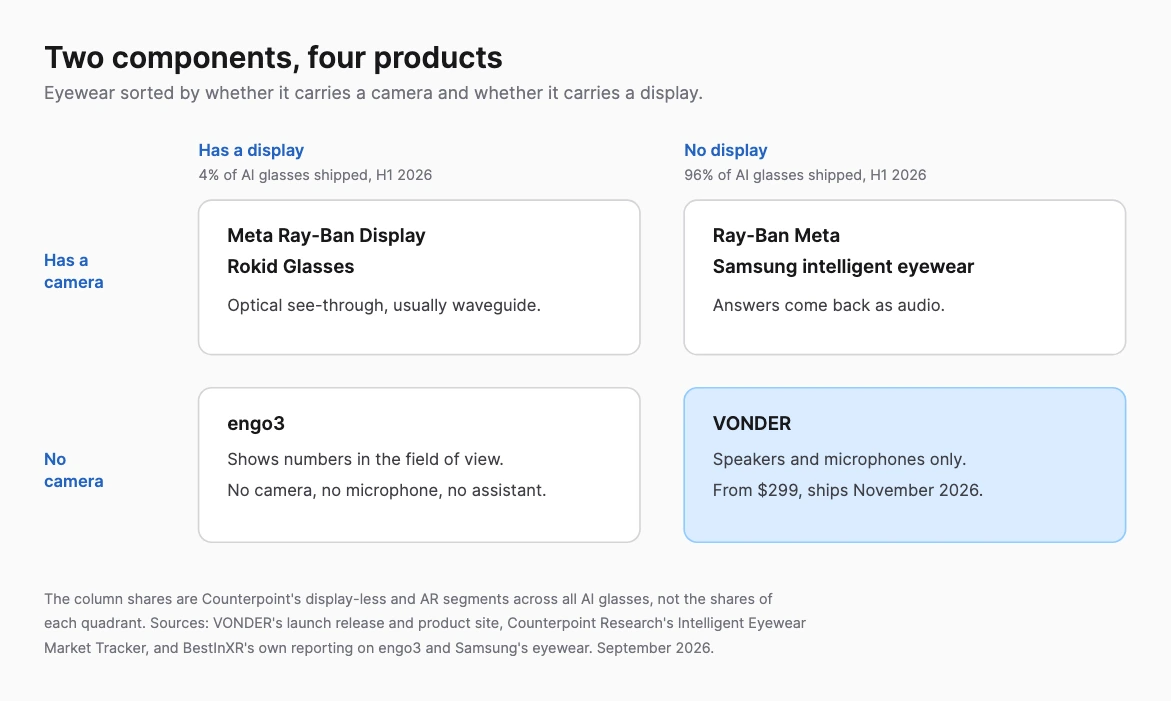
A pair with no camera and no display breaks the working definition most people use, including the one BestInXR published. Counterpoint's tracker defines AI glasses as glasses with an AI-enabled processor carrying at least two of speakers, microphones, cameras and AR displays. On that definition, speakers and microphones are enough, and VONDER counts as AI glasses with neither of the other two components.
BestInXR's own definitions are narrower and now need correcting. The FAQ in the AI and smart glasses comparison said AI glasses are eyeglasses with a camera, microphones, open-ear speakers and a voice assistant, and the smart glasses business guide said AI glasses include a camera. Both were accurate descriptions of everything shipping when they were written. Both were amended on September 23, 2026, because a priced and dated product now sits outside them.
The category names are doing less work than they look. Samsung applies the phrase intelligent eyewear to a pair that has a camera and no display. VONDER applies the same phrase to a pair with neither. Two companies use one term for two different hardware configurations, and a buyer reading either page learns nothing about what is on the frame.
The useful split is the two components themselves, because each one is a separate decision.
Where camera-free sits in the shipment data
Camera-free enters the segment that holds almost all of the volume. Counterpoint's Global Intelligent Eyewear Market Tracker reports that AI glasses shipments rose 263% year over year in the first half of 2026, and that display-less models accounted for 96% of them. Glasses with an optical see-through display were the other 4%.
That 4% is worth holding onto, because it changes how the fastest-growing number reads. Counterpoint reports AR and AI glasses shipments up 449% year over year, and its own OEM chart puts Rokid first in that segment at 41% and Meta second at 37%. Multiply those through and Rokid's lead is roughly 2% of all AI glasses shipped, while Meta's 94% of the 96% display-less segment puts it above 90% of the market on Counterpoint's own published shares.
The sequential figures say something the annual ones hide. Counterpoint gives display-less shipments up 22% against the second half of 2025 and AR and AI glasses up 18%, and its chart tracks the AR share of all shipments at 3% in the first half of 2025, 5% in the second and 4% in the first half of 2026. The display segment grew and lost share at the same time. BestInXR reported the same firm's separate XR market share tracker in September, which counts AR devices rather than AI glasses, so the two growth rates are not comparable and should not be read as one series.
Counterpoint also forecast the product that arrived the next day. Its closing paragraph expects a wider range of form factors to address privacy concerns associated with cameras, naming "camera-free AI audio glasses" specifically. It named rising memory prices and public concern about cameras as the two near-term challenges to the category.
How VONDER's price compares
$299 is below the pair that dominates the segment. Meta's Ray-Ban Meta page lists Gen 2 starting at $379 and the Gen 1 Wayfarer at $224 reduced from $299, checked September 23, 2026. VONDER's entry model undercuts the current generation and sits above the discounted older one, before any prescription lens cost, which VONDER has not published.
The comparison is not like for like in the way that matters most here. Every Meta pair has a camera, and Meta's own AI glasses privacy page is written around one, describing a Capture LED on each pair and a rule that disables the camera if the light is covered. A buyer choosing between the two is not comparing two prices for the same device.
What VONDER has not published
The gaps are ordinary for a pre-order and they are still gaps. VONDER publishes no microphone count, no processor, no water or dust rating and no weight for individual frames beyond the 30g figure, which the release gives as under 30 grams and the site gives as 30g. Three of the six frames have no published price.
Two claims in the release cannot be checked as written. VONDER says it will be one of only two AI smart glasses brands sold through the largest national electronics retailer in the United States at launch, without naming the other. The IDC ranking for VITURE carries no date.
Nothing here has been measured by BestInXR. Every figure above is the company's own published claim about a product that has not shipped, and the battery, audio and voice separation claims are exactly the kind that a first review will test. BestInXR has not held the device.
Frequently Asked Questions (FAQ)
1. What are VONDER glasses?
VONDER glasses are prescription eyewear with an AI assistant and stereo speakers, carrying no camera and no display. The company announced six acetate frames on September 22, 2026, with pricing from $299 and shipping from November 2026.
2. Are VONDER glasses made by VITURE?
No. VONDER is a separate company founded by the co-founders of VITURE, and VITURE's own website carried no mention of VONDER when BestInXR checked on September 23, 2026. VITURE sells display glasses under its own brand.
3. Can AI glasses work without a camera?
Yes, on the definition the market trackers use. Counterpoint Research defines AI glasses as needing an AI-enabled processor plus at least two of speakers, microphones, cameras and displays, so a pair with speakers and microphones qualifies. What a camera-free pair cannot do is anything requiring sight, such as identifying an object or reading text aloud.
4. How much do VONDER glasses cost?
Pricing starts at $299 for the Basel frame, with Antwerp and Oslo listed from $399. Prescription lens pricing is not published, and three of the six announced frames have no listed price.
5. What share of AI glasses have no display?
Display-less models were 96% of AI glasses shipments in the first half of 2026, according to Counterpoint Research's Intelligent Eyewear Market Tracker. Glasses with an optical see-through display were the remaining 4%.