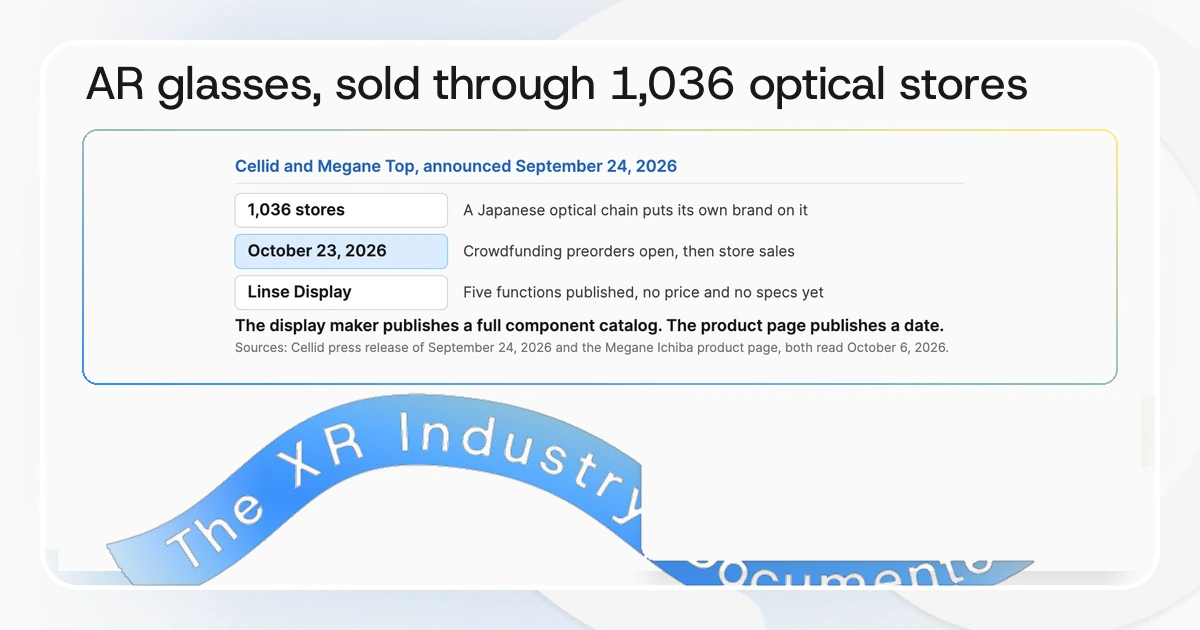
Cellid and Megane Top said on September 24, 2026 that they will develop AR glasses for Megane Top to sell under its own brand. Preorders open on the GREEN FUNDING crowdfunding platform on October 23, then move into a chain of 1,036 Japanese stores. Cellid leads the engineering and Megane Top brings the brand, the stores and the sales network.
In short:
- What it is: a business partnership announced by Cellid, a Tokyo company that develops optical see-through waveguide displays and spatial recognition software for AR glasses, with Megane Top, the Shizuoka eyewear retailer that runs the Megane Ichiba chain.
- What is on sale: Megane Ichiba's own product page calls the glasses Linse Display and lists five functions: navigation, notifications, translation, AI Notes for meeting minutes and summaries, and entertainment.
- The route to market: crowdfunding preorders from October 23, 2026 on GREEN FUNDING, then store sales through Megane Ichiba once the campaign closes.
- The scale behind it: Cellid's release states Megane Top had 1,036 domestic stores, 35 overseas stores and 5,500 employees at the end of March 2026.
- What you can check today: Cellid publishes diagonal field of view, efficiency, weight and thickness for every waveguide in its component catalog. The product page publishes a launch date and five function names, and leaves the numbers to the campaign.
What Cellid and Megane Top announced
The two companies signed a business partnership to take AR glasses from product development through to market expansion, with the finished glasses carrying Megane Top's own brand rather than Cellid's. Cellid published the announcement on its newsroom on September 24, 2026 and distributed it the same day through PR TIMES.
The division of labor is stated plainly. Cellid provides what the release calls expertise in the optical and hardware technology and product design an AR glass requires. Megane Top provides its eyewear product development and sales knowledge and its sales base. Preorders run first on GREEN FUNDING from October 23, 2026, and store sales follow through the Megane Ichiba network after the campaign ends.
Cellid's own company page dates the business to October 27, 2016, puts the head office in Roppongi, Tokyo and names Satoshi Shiraga as chief executive. It lists overseas bases in Santa Clara, California and in Taoyuan City, Taiwan, so this is a Japanese company that already sells outside Japan, even though the product announced here is for the Japanese market.
Megane Top is the larger party by a wide margin. Its corporate profile carries performance highlights dated the end of March 2026: revenue of 99,304 million yen, ordinary profit of 10,015 million yen, 1,071 stores and 5,500 employees. That reconciles with the 1,036 domestic and 35 overseas stores in Cellid's release.
Megane Top's own publishing for this product sits on the Megane Ichiba landing page rather than in its corporate newsroom. The news release index carried nothing about the partnership through October 6, 2026, and its entries over that period cover frames, contact lenses, a television campaign and store news. The retailer is treating this as a product launch rather than a corporate announcement, which is consistent with a device that goes on sale under its own brand.
What the product page publishes today
Megane Ichiba's Linse Display page publishes a name, a date, five functions and a warning that the images are of a product still in development. Read in full on October 6, 2026, with the page scrolled to the end, it runs to about 1,000 characters of copy and contains no price, no field of view, no weight, no battery figure and no chipset.
The five functions it names are navigation, notification, translation, AI Notes for meeting minutes and AI summaries, and entertainment including music. The one engineering sentence on the page says the glasses combine Megane Ichiba's eyewear design know-how with Cellid's AR optical technology. The one date on the page is October 23, 2026, marked as the planned start of crowdfunding.
That is a complete and honest product page for its stage. It is also the opposite of what the same partnership's component supplier publishes about its own parts.
What Cellid publishes about its own components
Cellid's products page carries a full specification table for every waveguide it sells, with four numbers per part. These are the figures on the English page, read on October 6, 2026.
| Part | Type | Diagonal FOV | Efficiency | Weight | Thickness |
|---|---|---|---|---|---|
| R30-AG (B) | Plastic, full color | 30 degrees | 960 nit/lm | 5.4 g | 1.8 mm |
| R20-AG (C) | Plastic, full color | 20 degrees | 3,100 nit/lm | 5.0 g | 1.5 mm |
| R30-FL (C) | Plastic, full color | 30 degrees | 1,400 nit/lm | 5.4 g | 1.9 mm |
| C60-AG (B) | Glass, full color | 60 degrees | 200 nit/lm | 8.2 g | 1.3 mm |
| C30-AG (C) | Glass, full color | 30 degrees | 1,400 nit/lm | 9.3 g | 1.0 mm |
| C25-FL (C) | Glass, full color | 25 degrees | 1,400 nit/lm | 8.2 g | 1.0 mm |
The same page publishes a display module figure set as well: a 30-degree waveguide at 1.24 mm and 3.2 g, a micro projector at 720 by 720 and 1.4 cc, and a combined 5.7 g at a rated 7,443 nits per watt. Cellid describes the lineup as delivering one of the largest fields of view available in a waveguide, which is the company's own characterization rather than a measured comparison. Its company history dates the claim, recording verification of a mass production process for a 60-degree waveguide in December 2020 and full color 60-degree samples from November 2022.
One wrinkle for anyone quoting a part number. The Japanese version of the same page, read minutes apart on the same day, lists a different lineup: E25-FL and E30-AG as green plastic parts, C50-AG at 50 degrees and 15.9 g, and C25-AG at 25 degrees. Only R30-FL (C) appears on both, and the Japanese page gives it two weights, 5.4 g in the plastic section and 6.3 g in the glass section. We report the discrepancy rather than resolving it, for the same reason we reported Vuzix naming one waveguide three ways: a reader putting a part number in a purchase order should know the catalog disagrees with itself.
Neither the partnership release nor the product page says which of these parts goes into Linse Display, and this post does not assert one.
Why the component catalog carries numbers the product page leaves to launch
The buyer decides what gets published, and the same company can be forthcoming and quiet in the same week without any inconsistency.
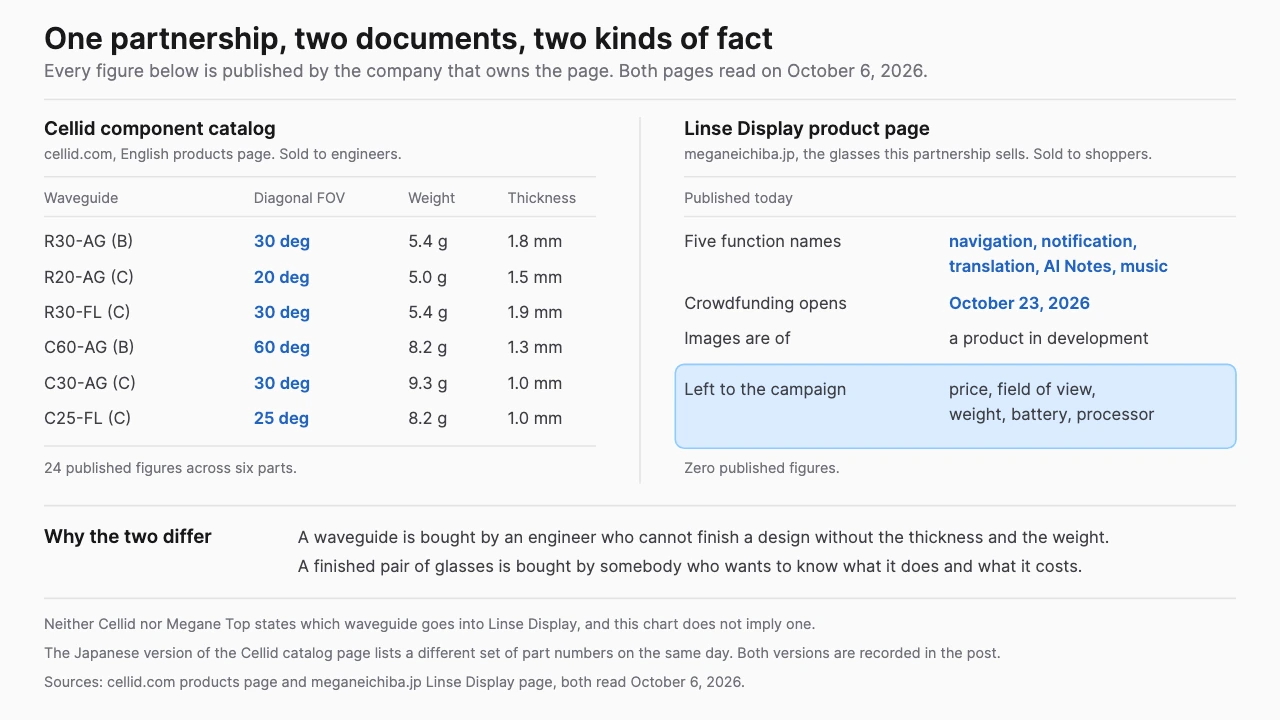
A waveguide is sold to an engineer who cannot finish a design without knowing how thick the optic is, how much it weighs on the nose and how much light reaches the eye per lumen from the projector. Those numbers close the sale. A finished pair of glasses is sold to somebody who wants to know what it does, what it costs and when it arrives, so a product page in the weeks before a crowdfunding launch publishes the functions and the date.
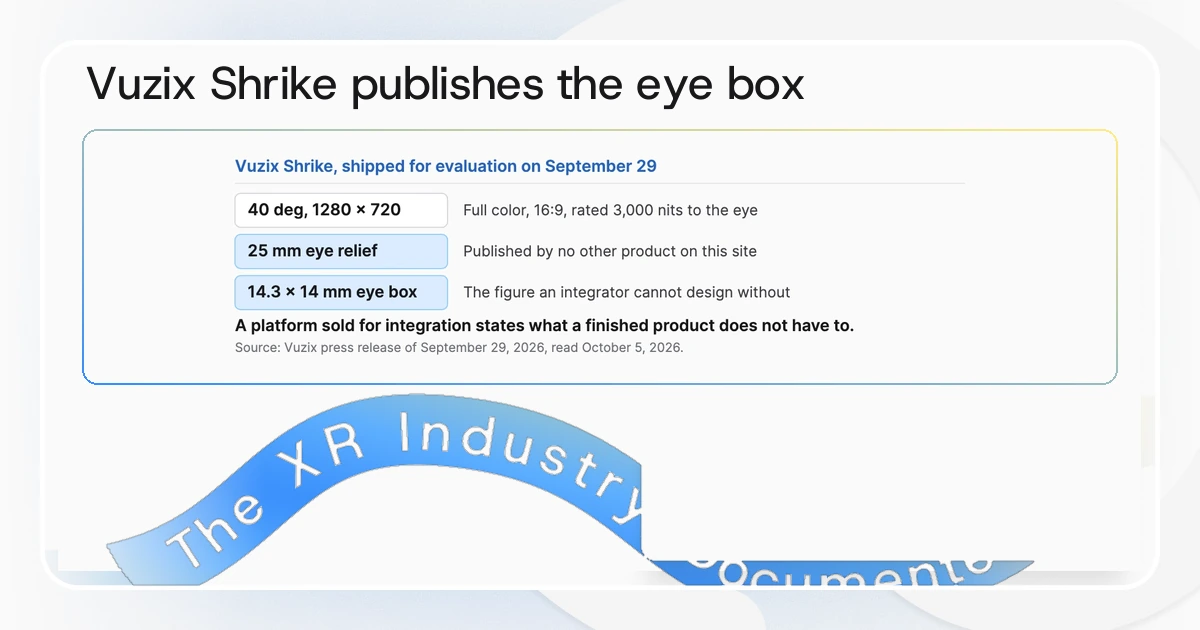
This is the mechanism our record of unpublished XR specifications describes, seen here inside one partnership rather than across an industry. It is also the finding from the Vuzix defense display platform turned around: a component sold unfinished publishes eye relief and an eye box, and a finished product does not. When a figure is missing from a product page, the useful question is who downstream would have needed it.
Cellid also makes its parts differently from the two waveguide suppliers already on this site. Its products page describes the company as fabless, designing the optics and the production process and running them on established partner lines in Japan and abroad. That sits between Vuzix, which manufactures diffractive waveguides on its own lines in Rochester, and Lumus, which designs geometric waveguides and names three separate manufacturers. All three ship, and they carry supply risk in different places.
Where a 1,036-store chain changes the purchase
An optical chain sells something no consumer electronics channel sells, which is a measured prescription and a fitted frame. That is the part of this deal worth watching.
Every pair of display glasses in our AR display glasses comparison reaches a buyer who needs correction through an insert, an adapter or a third party lens service. Cellid publishes a product aimed squarely at that gap: Cellid Precision Fit Lenses, a diopter correction lens built on what the company calls SCL, or small base curved lens technology. Its page states that when paired with Cellid's full lamination AR lenses, the correction lenses can be fitted to AR glasses at conventional optical shops.
Megane Top runs 1,036 of those shops in Japan. Cellid's product page and the partnership release are separate documents and neither one connects them, so the connection is not announced and is not claimed here. Both facts are published, they point at the same counter, and the October 23 campaign is the first place a buyer will find out whether prescription fitting is part of the offer.
Cellid's three announcements in ten days
The Megane Top deal is the middle of three Cellid announcements in September 2026, and the set describes a company assembling a route to market rather than a single partnership.
On September 16 Cellid announced a partnership with SB C&S, the SoftBank group IT distribution business, covering procurement of products built on Cellid reference designs, sales through national distribution partners, and support for both business and consumer buyers. On September 24 came Megane Top. On September 26 Cellid announced that it had shown Crux, a binocular full color AR glasses reference design built on a Snapdragon platform, at Qualcomm's Snapdragon Summit in Hawaii from September 22 to 24. That is the same event where Qualcomm introduced an audio platform naming audio glasses as a target form factor.
Reference designs, a distributor and a retail brand is a supplier strategy, not a product strategy. Cellid is selling the ability to ship AR glasses quickly to companies that have customers but no optics team, and Megane Top is the first of those to put its own name on the result.
What to confirm when the campaign opens
October 23 is the date the unpublished figures have to appear, because a crowdfunding page has to state a price and a delivery window to take money.
Five things are worth reading on day one. The price, which no document from either company carries today. The display specification, which decides whether Linse Display is a notification band in the corner of the lens or something closer to the 60-degree glass waveguide at the top of Cellid's catalog. The weight, which is what decides whether these get worn. Whether prescription fitting is offered and at what price, which is the point of selling through an optical chain at all. And the delivery date, since a crowdfunding commitment and a store launch are different promises. Our XR hardware price index carries the manufacturer price for every device in this category, and Linse Display joins it the day a number is published.
Related reading. Our smart glasses guide sets out how the categories divide, from AI glasses to assisted reality.
Frequently Asked Questions (FAQ)
1. What are Cellid and Megane Top building together?
AR glasses sold under Megane Top's own brand, with Cellid leading development and supplying the optical and hardware expertise. Cellid announced the partnership on September 24, 2026. Megane Ichiba's product page calls the glasses Linse Display.
2. When can you buy Linse Display AR glasses?
Preorders open on the Japanese crowdfunding platform GREEN FUNDING on October 23, 2026, according to both Cellid's release and Megane Ichiba's product page. Sales through Megane Ichiba stores follow after the crowdfunding campaign ends.
3. How much do the Cellid and Megane Top AR glasses cost?
No price is published. Neither Cellid's announcement nor the Megane Ichiba product page carries a figure, and the crowdfunding page opening on October 23 is the first document that will have to state one.
4. What can the glasses do?
Megane Ichiba's product page lists five functions: navigation, notifications, foreign language translation, AI Notes for meeting minutes and AI summaries, and entertainment including music. The page states that its images show a product still in development.
5. What does Cellid make?
Cellid develops optical see-through waveguide displays using diffractive optics, display modules that pair a waveguide with a micro projector, prescription lenses for AR frames, and spatial recognition software including Cellid SLAM. It publishes field of view, efficiency, weight and thickness for each waveguide in its catalog.
6. How big is Megane Top?
Cellid's release states that Megane Top had 1,036 stores in Japan, 35 stores overseas and 5,500 employees at the end of March 2026. The company was founded in May 1980 and operates the Megane Ichiba, ALOOK, Lens Style and Lens Direct store brands.