
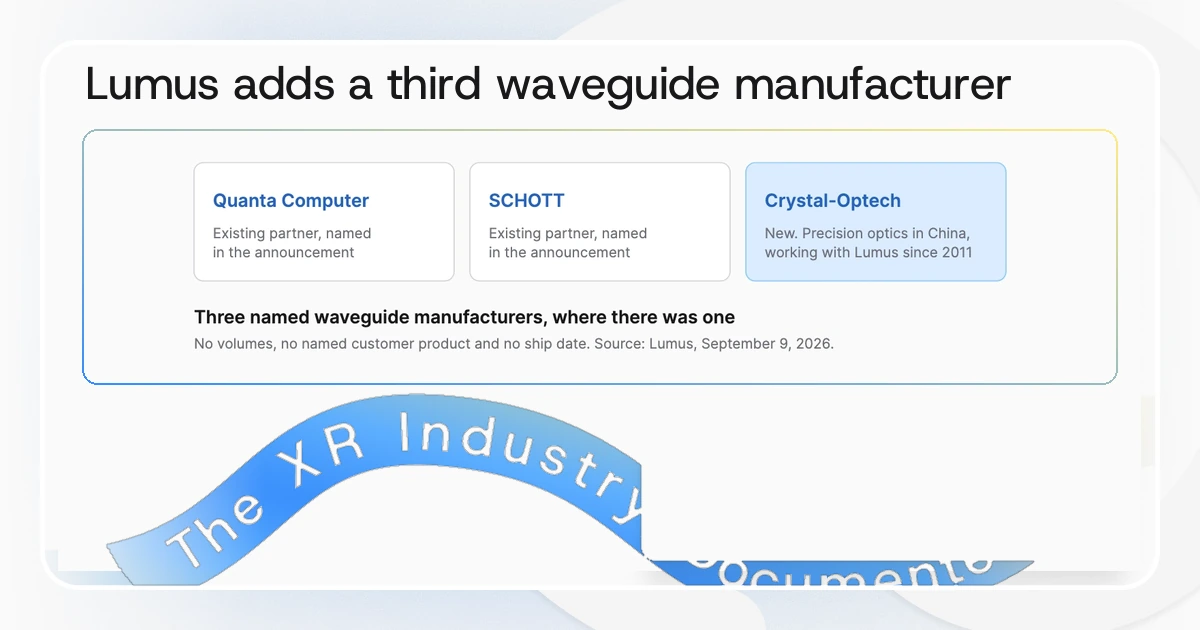
Lumus has signed a manufacturing agreement with Zhejiang Crystal-Optech to produce its geometric waveguides, the optical component that puts an image in front of the eye in AR glasses. It is the third named manufacturing partner Lumus has, after Quanta Computer and SCHOTT, and the first that puts production in China.
In short:
- What was signed: a manufacturing agreement covering Lumus geometric waveguides, announced September 9, 2026.
- Why it matters: waveguides are the hardest part of AR glasses to make at volume, and Lumus now names three manufacturers rather than one.
- What it does not say: no volumes, no customers and no dates for any shipping product.
What the two companies announced
Lumus announced the agreement from Ness Ziona, Israel on September 9, 2026. Under it, Crystal-Optech will manufacture the geometric waveguides that Lumus designs, extending Lumus manufacturing into China.
Lumus says its waveguide portfolio spans 20 degrees to over 70 degrees of field of view, a range it describes as covering everything from entry-level displays for everyday smart glasses to wider fields of view for more demanding uses. Ari Grobman, chief executive of Lumus, said the company is "building our manufacturing network around where we see the market going and what our customers will need".
Crystal-Optech is a Chinese precision-optics manufacturer that Lumus says has shipped more than 30 billion serial components to date, with work spanning thin-film optics, optical coating and precision manufacturing across consumer electronics, automotive optics and AR and VR. The two companies have worked together since 2011, so the agreement formalizes a long relationship rather than opening a new one. It is closer than a supplier relationship. Grobman's own statement opens "Apart from being an investor in our company", which makes Crystal-Optech both a shareholder in Lumus and a manufacturer of its parts. Neither company discloses the size of that stake. Fenglei Liu, a board member and vice president at Crystal-Optech, said the company was "truly excited to announce that we have officially signed a manufacturing agreement with Lumus".

Why waveguide supply is worth watching
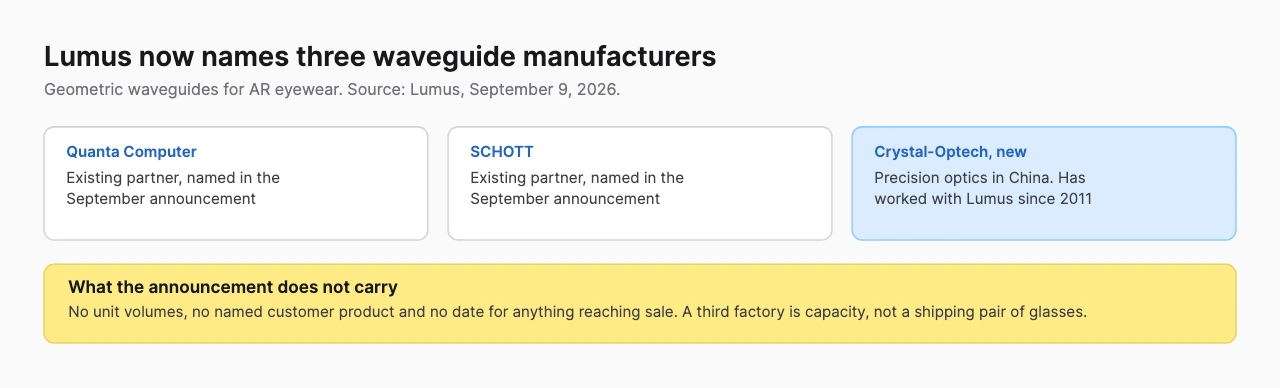
A waveguide is the piece of glass that carries an image from a tiny projector into the wearer's line of sight while staying transparent. It is the component that decides how bright, how sharp and how thick a pair of AR glasses can be, and it is the one that has kept the category expensive.
Counterpoint Research reported that waveguide-based AR glasses settled at about 40% of AR device shipments in the second quarter of 2026, up from about 20% a year earlier, a shift covered in our report on Q2 2026 shipments. A category doubling its share is a category that needs more than one factory.
What the announcement does not carry is a number. Lumus publishes no unit volume, names no customer product and gives no date for anything reaching a shelf. The checkable claim here is that a third manufacturer now exists, not that any specific pair of glasses is closer to sale. Our smart glasses guide covers the products that have actually shipped.