
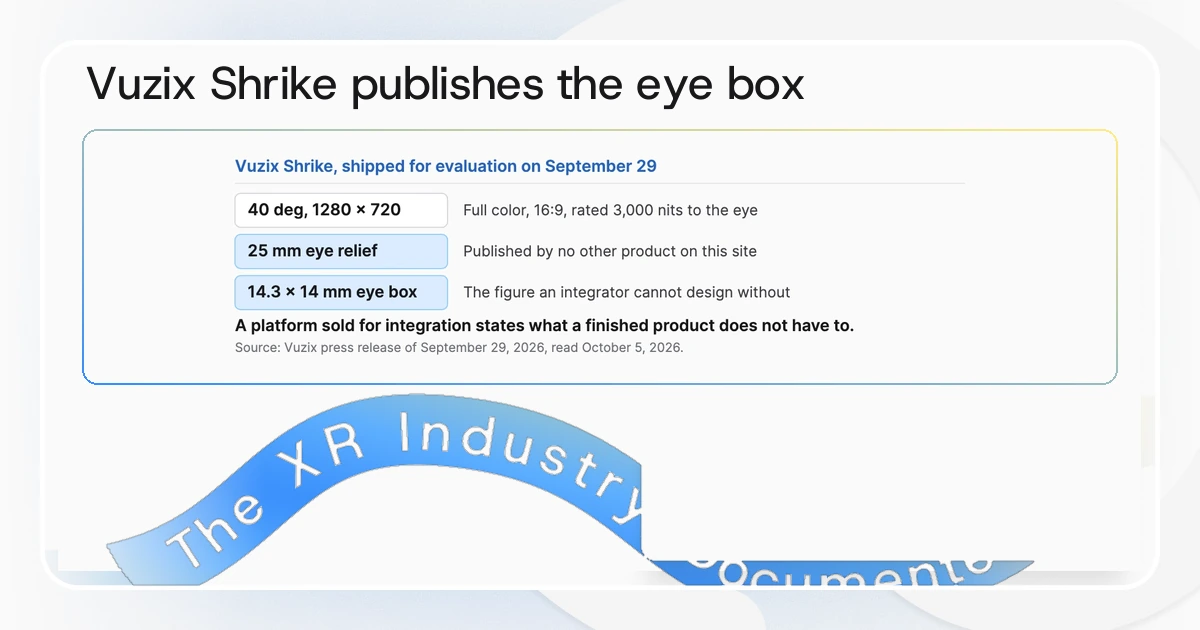
Vuzix introduced Shrike on September 29, 2026 and says it has begun shipping evaluation units to defense, security and first responder customers. The release publishes a 40-degree field of view, 1280 by 720 resolution, 3,000 nits to the eye, 25 mm of eye relief and a 14.3 by 14 mm eye box. The last two figures appear in none of the 157 other posts on this site.
In short:
- What it is: Vuzix Shrike, described by Vuzix as "a configurable waveguide display platform for defense, security and first responder applications". It is hardware to evaluate a display with, not a product to deploy.
- What shipped: Vuzix says it "has begun shipping initial Shrike units to customers for evaluation and integration into custom wearable display systems".
- The optical numbers: full color at 1280 by 720, a 40-degree field of view, 16:9, a rated 3,000 nits to the eye, 25 mm eye relief and a 14.3 by 14 mm eye box.
- How it is configured: monocular or binocular, with optional electrochromic tinting and Vuzix Incognito to reduce light leaving the front of the display. Micro HDMI and Mini USB carry the signal.
- What it costs: the release carries no price. Vuzix publishes $2,199.99 and $1,499.99 for the two smart glasses it sells outright.
- Where to see it: the AUSA Annual Meeting and Exposition in Washington from October 12 to 14, and Modern Warfare Week at Fort Bragg from November 16 to 19.
What Vuzix introduced
Vuzix Corporation, which trades on NASDAQ as VUZI, published the Shrike announcement through its investor relations newsroom on September 29, 2026. The subhead states the purpose in commercial terms: a "configurable waveguide display gives defense and security customers a significant jumpstart for their custom wearable systems".
The body is explicit that Shrike is an intermediate step rather than a finished device. Vuzix writes that the platform "gives customers a highly configurable, working hardware solution with which to assess display performance, fit and system integration before defining a purpose-built product". The named applications are situational awareness, drone and unmanned ground vehicle operations, and "the presentation of mission information in the wearer's field of view".
Paul Travers, the company's president and chief executive, is quoted on the same point: "Shrike provides defense customers a platform they can work with now, while giving them room to tailor the display to their application."
That framing decides who the document is written for. A buyer evaluating a finished pair of glasses wants battery life, weight and price. An engineer deciding whether a display will fit inside a helmet wants to know how far from the lens the eye can sit and how much the eye can move before the image breaks. Shrike's release answers the second set.
What the release publishes
Vuzix attached a feature table to the announcement. These are its figures, in its own categories.
| Category | Published figure |
|---|---|
| Field of view | 40 degrees |
| Resolution | 1280 by 720, 16:9 |
| Brightness | 3,000 nits to the eye |
| Eye relief | 25 mm |
| Eye box | 14.3 by 14 mm |
| Configuration | Monocular or binocular |
| Viewing options | Optional electrochromic tint |
| Signature control | Vuzix Incognito forward light control |
| Interfaces | Micro HDMI, Mini USB |
| Price | Not disclosed |
Two of those rows are the reason this release is worth reading rather than summarizing. Eye relief is the distance between the eye and the optic at which the full image is still visible. Eye box is the volume the eye can move within before the image starts to clip. Together they decide whether a display survives contact with a helmet, a respirator, a pair of prescription glasses or a head that moves.
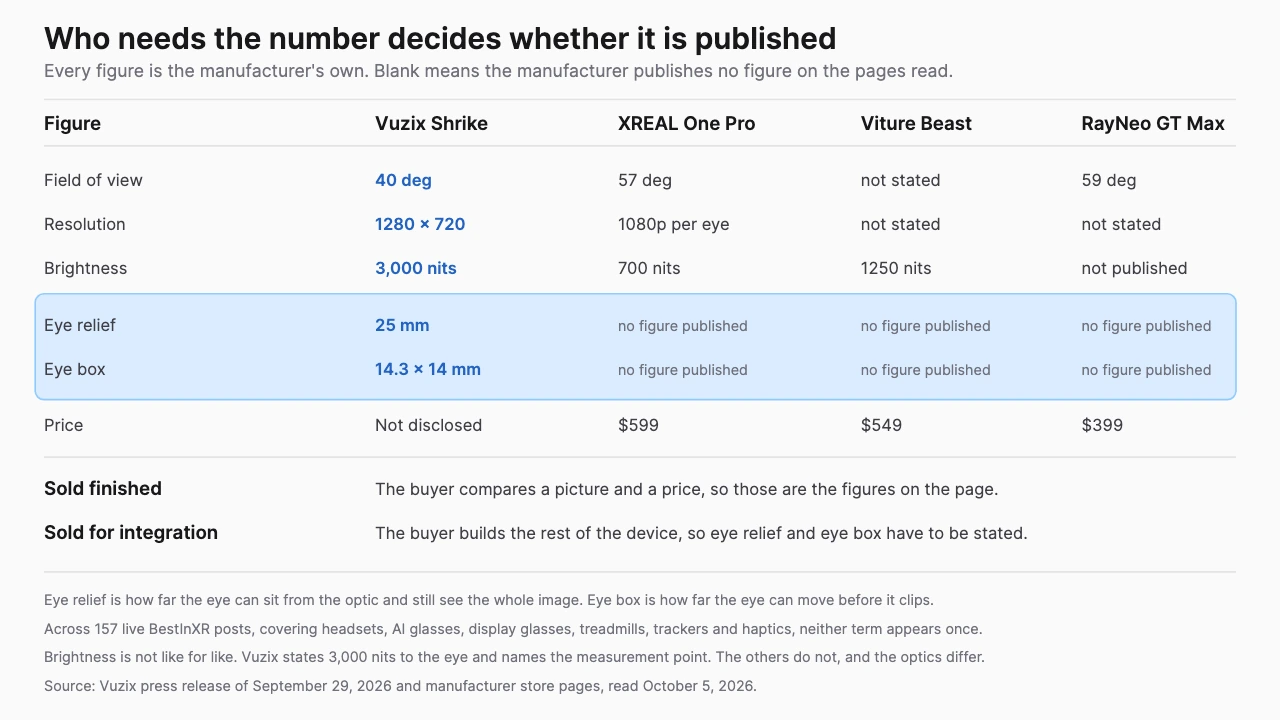
Searching every live post on this site returns zero occurrences of either term. That is 157 posts covering headsets, AI glasses, display glasses, treadmills, trackers and haptics, and not one of them could report an eye box, because the manufacturers in those categories do not publish one. Our record of what XR vendors leave unpublished counts 198 cells reading Not disclosed or Not published across the corpus, and the fields that go missing are consistent by category rather than random.
Why an evaluation platform publishes more than a product does
The difference is the buyer, and it is worth being precise about rather than treating as a vendor virtue.
A consumer display glass is sold finished. The purchaser puts it on and either likes the picture or does not, so the manufacturer publishes the numbers that sell the experience. Across the four products in our comparison of AR display glasses, the published figures are field of view and brightness: XREAL states 57 degrees and 700 nits, RayNeo states 59 degrees, and Viture states 1250 nits. Those are the numbers a shopper compares.
Shrike is sold unfinished, to a customer who will build the rest of the device. An integrator cannot design a helmet mount without eye relief, and cannot write a fitting requirement without an eye box. Vuzix publishes them because the sale does not close without them.
So this is not evidence that defense suppliers are more forthcoming in general. It is evidence that a specification gets published when somebody downstream cannot proceed without it. That is the same mechanism our spec gap record describes from the other direction, and it is the useful thing for a reader to take away: when a figure is missing from a product page, ask who would have needed it.
One comparison to make carefully. Shrike's 3,000 nits is stated "to the eye", which names the point of measurement. The consumer figures above are published without that qualifier on the pages we read. A waveguide and a birdbath combiner also lose light differently, so a brightness number from one architecture is not a like for like comparison with the other even when both are measured at the eye. The qualifier is the part worth copying.
Which waveguide Shrike uses
The release names no waveguide. Vuzix's product pages describe one that carries the same three figures.
The company's defense page answers the question "what waveguide and platform combinations work best for defense AR" by naming a part: "The Vuzix CV-40 waveguide is specifically optimized for helmet-mounted and vertical integration in defense HUDs, with a 40° field of view and DLP light engine at 1280 × 720 resolution. Combined with Vuzix Incognito technology to reduce forward light leakage, the CV-40 supports low-signature operation."
Field of view, resolution and Incognito all match the Shrike release. Vuzix does not state that Shrike is built on that waveguide, and this post does not assert it either. What the match does establish is the shape of the product: Shrike reads as a standard Vuzix Core waveguide packaged with a light engine and interfaces so a customer can hold it, which is what makes the "jumpstart" claim in the subhead checkable rather than promotional.
Vuzix makes these parts itself. The About section of the release states that the company "designs and manufactures diffractive waveguides at its Rochester, New York facility using custom-assembled nanoimprint lithography lines", and the configurations page claims roughly one million units of annual waveguide capacity across four off the shelf designs. That is a different model from the one Lumus uses for its geometric waveguides, where Lumus designs the optic and names three separate manufacturers to build it. Neither approach is better on the public record, but they fail differently, and a program buying a display for a ten year platform is buying a supply chain as much as an optic.
One wrinkle to flag for anyone trying to follow the part numbers. Vuzix's waveguide configurations page lists four off the shelf Core designs and calls the helmet-optimized 40-degree one CVI-40, describing it as "Color + Vertical waveguide configuration with a 40° field of view. Designed for helmet-mounted and vertical display" and recommending it for "Defense HUDs, industrial helmets". The defense page calls the same described part CV-40, and the waveguides overview refers to "the C-40 and CV-40". The naming is not consistent across Vuzix's own pages. We report that rather than picking a winner, because a reader quoting a part number into a purchase order should know the catalog disagrees with itself.
What Incognito controls
Incognito appears in both the Shrike release and the waveguide pages, and it is easy to misread as a privacy feature of the kind legislatures have been debating. It is a different thing.
Vuzix describes it on the waveguides page as technology that "reduces forward-facing light leakage in waveguide displays without impacting power consumption", producing "improved image privacy for the wearer and reduced visible signature from the outside". The company names two markets for the same property: defense applications "requiring low-signature operation", and consumer products "where users prefer that nearby people not see the displayed image".
What that controls is light leaving the front of the display, which is the glow that lets a bystander read your screen or spot you in the dark. It is not a recording indicator, and the two point in opposite directions. A capture indicator is a light deliberately added so bystanders notice; Incognito removes light so they do not. California's legislature passed and the governor vetoed a bill that would have made a capture indicator a condition of sale from 2028, and that requirement attaches to cameras. The Shrike release describes no camera anywhere in its text or its feature table.
Where Shrike sits against Vuzix's own glasses
Vuzix sells two finished smart glasses and publishes a price and a field of view for both on its compare page. The Vuzix LX1 is $2,199.99 with a 16.8-degree field of view. The Vuzix M400 is $1,499.99, also at 16.8 degrees. Both are monocular color OLED devices with a 12MP camera, built for logistics, maintenance and field service, and both appear in our smart glasses buying guide as assisted reality hardware.
Shrike is more than twice that field of view and carries no price at all. Those two facts belong together: the shipping glasses are a catalog purchase with a number on the page, and Shrike is an input to a program that has not been specified yet. Vuzix states on its own site that initial custom waveguide samples typically ship 8 to 16 weeks "from design confirmation", which is the clock a reader should expect for the step after evaluation.
Everything Vuzix has published about Shrike so far sits in that one press release. There is no Shrike product page, no catalog entry and no entry in the comparison table, and a search of the Vuzix storefront returns three unrelated products. The one image distributed with the release illustrates a use case rather than the hardware, and Vuzix captions it as such: "Drone operation and visualization is one of the many defense/security/first responder use cases Shrike enables."
Where to see it
Vuzix says it plans to demonstrate Shrike at two events, and both confirm their own dates.
The AUSA Annual Meeting and Exposition runs October 12 to 14, 2026 at the Walter E. Washington Convention Center in Washington, D.C. Modern Warfare Week, run by the Global SOF Foundation, runs November 16 to 19, 2026 at Fort Bragg, North Carolina. Those are the next two opportunities for anything beyond the release to become public, and a demonstration is where a 40-degree figure stops being a specification and becomes something a person has looked through.
Related reading. Our comparison of AR and display glasses sets out what the consumer end of this market publishes and at what price, the XR hardware price index puts every manufacturer's own figure in one dated table, the XR spec gap records which fields go unpublished across the whole corpus and counts them, and our report on Lumus adding a third waveguide manufacturer covers the other half of how this component reaches a product.
Frequently Asked Questions (FAQ)
1. What is the Vuzix Shrike?
A configurable waveguide display platform for defense, security and first responder applications, introduced on September 29, 2026. Vuzix describes it as working hardware for assessing display performance, fit and system integration before a customer defines a purpose-built product, and says it has begun shipping initial units for evaluation.
2. What are the Shrike display specifications?
Vuzix publishes a 40-degree field of view, 1280 by 720 full color resolution at 16:9, a rated brightness of 3,000 nits to the eye, 25 mm of eye relief and a 14.3 by 14 mm eye box. It can be configured as monocular or binocular, offers optional electrochromic tinting, and connects over Micro HDMI and Mini USB.
3. How much does Shrike cost?
Not disclosed. The announcement carries no price. For reference, Vuzix publishes $2,199.99 for the LX1 and $1,499.99 for the M400 on its own compare page, which are finished smart glasses rather than evaluation hardware.
4. What is Vuzix Incognito technology?
Vuzix describes it as a method of reducing forward-facing light leakage in waveguide displays without affecting power consumption, giving the wearer image privacy and reducing the display's visible signature from the outside. It controls light leaving the front of the lens. It is not a recording indicator, and the Shrike release describes no camera.
5. Which waveguide does Shrike use?
The release does not say. Vuzix's defense page describes a CV-40 waveguide with a 40-degree field of view, a DLP light engine at 1280 by 720 and Incognito support, which matches Shrike's three published figures. The company's waveguide configurations page describes the same helmet-optimized part as CVI-40, so the part naming differs between Vuzix's own pages.
6. Where can Shrike be seen in person?
Vuzix says it plans to demonstrate Shrike at the AUSA Annual Meeting and Exposition from October 12 to 14, 2026 at the Walter E. Washington Convention Center in Washington, D.C., and at Modern Warfare Week from November 16 to 19, 2026 at Fort Bragg, North Carolina.