
URXR One Raised $1.29 Million and Lists Two Different Retail Prices
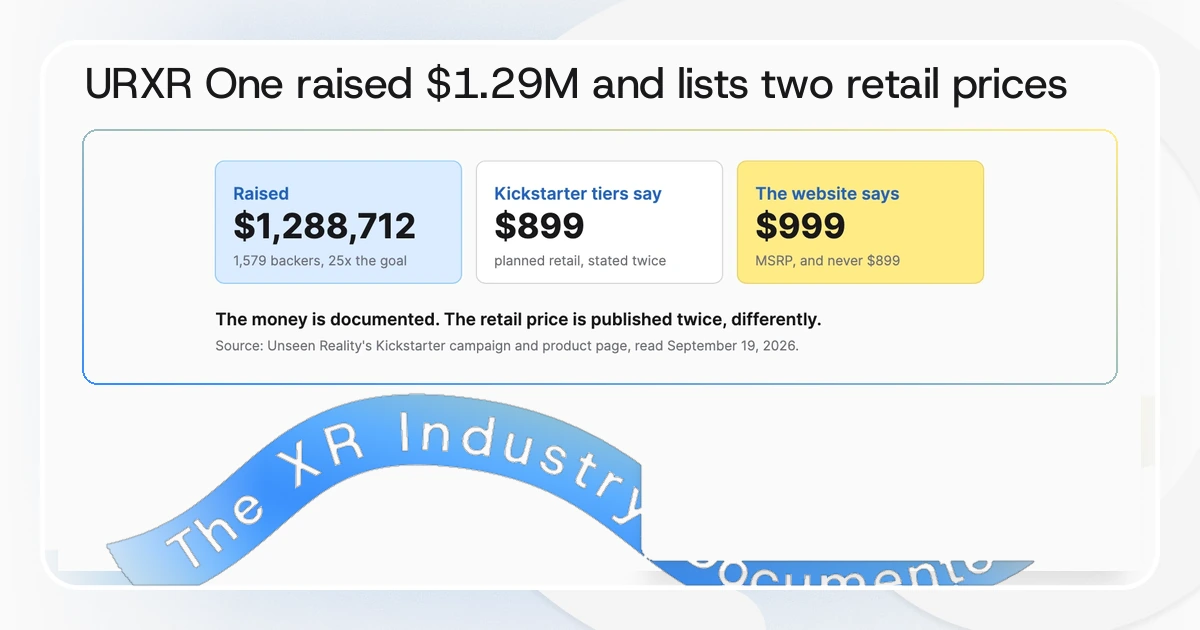
Unseen Reality closed its Kickstarter for URXR One on September 18, 2026, with $1,288,712 pledged by 1,579 backers against a $50,000 goal. The 93-gram display glasses tether to a USB-C device and ship in mid-October. The company's own documents give two different planned retail prices, $899 on Kickstarter and $999 on its website.
In short:
- What it is: a 93-gram pair of display glasses with one 2448 by 2064 micro-OLED panel per eye, a 90 degree diagonal field of view and 6DoF tracking computed on a chip in the frame. There is no battery, no computer and no speaker inside it.
- What the campaign settles: demand. $1,288,712 from 1,579 backers is more than 25 times the goal, and it is the only figure in this story that is not a forecast.
- What it does not settle: the price. Two of the company's own pages name different planned retail prices, and no pledge tier includes shipping.
- The sequencing gap: the glasses are scheduled for mid-October and the Power Hub for November or December, and a phone cannot drive the glasses without the Power Hub.
What is URXR One?
URXR One is a pair of tethered display glasses that turns a USB-C device into a large virtual screen. Unseen Reality, a Mountain View company founded by Edward Zhou, describes it as spatial display glasses rather than a headset, and the distinction is load-bearing: the glasses carry no battery and no computer, so the device at the other end of the cable supplies both the picture and the power.
The published specification is unusually complete for this category. Unseen Reality lists one 1.03 inch micro-OLED panel per eye at 2448 by 2064 and about 36 pixels per degree, a 90 degree diagonal field of view through mini pancake optics, a 90 Hz refresh rate and 120 to 140 nits in the eye. Tracking is dual-camera SLAM with a 1000 Hz IMU, switchable between 3DoF and 6DoF with a physical button, and video see-through runs at 2328 by 1728 and 90 fps with a stated latency under 10 milliseconds. Interpupillary distance adjusts by hand from 58 to 68 mm, and the frame is quoted to a hundredth of a millimeter at 150.01 mm wide unfolded.
That level of disclosure is the exception rather than the rule. BestInXR's XR spec gap records how often whole categories withhold the same field, and brightness in eye-worn displays is one of them. A company publishing a nit figure for an unshipped product is publishing something it can be held to.
What did the campaign actually raise?
Two figures, and they are both correct. Kickstarter's own closing record reads 1,579 backers pledged $1,288,712, for a funding period that ran from August 4 to September 18, 2026. The campaign page read $1,290,711 from 1,582 backers when we checked it on September 19, because the page now says the project "successfully funded on September 18, but you can still Late Pledge for available rewards". The closing total is fixed and the running total is not, which is why any single number reported for a crowdfunding campaign needs the date it was read.
The tier distribution says more than the total does. As of September 19 the 75 Early Bird units at $699 are gone, 1,162 backers took the $799 Kickstarter Special, 55 took the $1,550 Duo Pack and 2 took the $999 Full Retail Pledge. The $799 tier therefore took more backers than the other three combined, which makes what the undiscounted price will be a live question rather than a detail.
Which retail price is the real one?
Unseen Reality publishes two, on two documents that are each internally consistent.
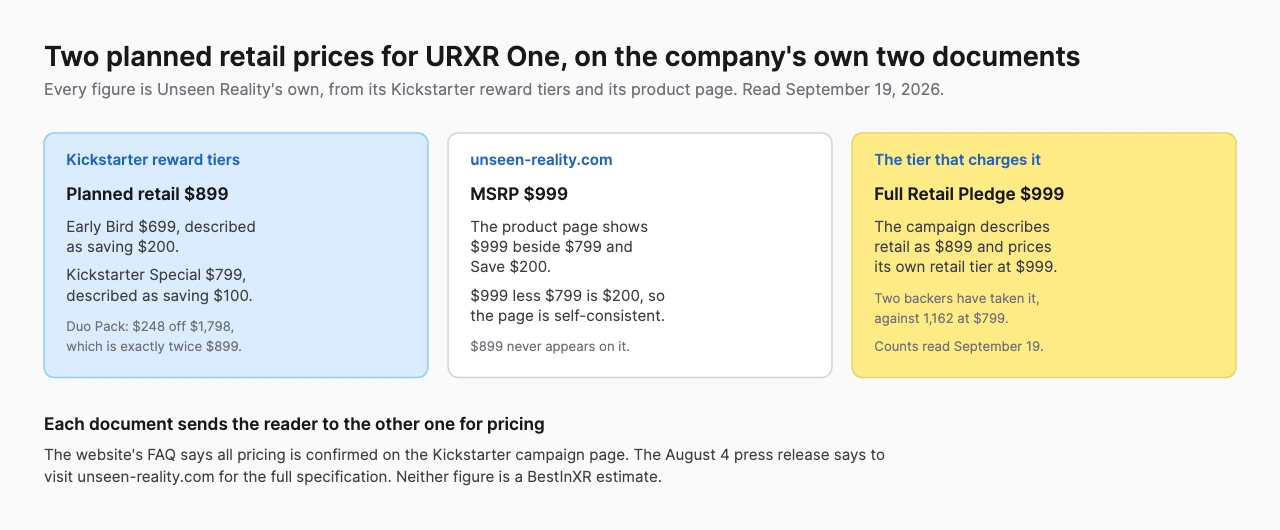
The Kickstarter reward tiers say it twice. The Early Bird tier is described as saving $200 "off the planned $899 retail price" and the Kickstarter Special as saving $100 off the same figure. The Duo Pack settles it arithmetically: two pairs at $1,550 are described as saving $248 off the combined planned retail price, and $1,798 is exactly twice $899.
The company's own website says something else. Its product page carries "$999 MSRP" beside "$799" and "Save $200", and $200 is the difference between $799 and $999 rather than between $799 and $899. That page never names $899, in either the fully scrolled render or the served markup, checked September 19, 2026.
Two things make this worth stating rather than passing over. The Kickstarter tier named Full Retail Pledge is priced at $999, so the campaign itself charges the website's figure while describing the retail price as $899. And the website's own FAQ tells a reader that "All pricing is confirmed on the Kickstarter campaign page", while the August 4 press release points in the other direction, saying that for the full specification and trade-offs the reader should visit unseen-reality.com. Each document defers to the other, and the two carry different numbers. Nothing here suggests either figure was invented. It is the ordinary way a price drifts between a campaign written in July and a site updated since, and it means a buyer cannot presently tell whether $799 was a $100 saving or a $200 one.
BestInXR's XR hardware price index carries manufacturers' own prices across every hardware category. URXR One is not in it, for two reasons worth naming: the product has not shipped, and its retail price is currently published as two numbers, so there is no single manufacturer figure to record.
What is not in the pledge price?
Shipping. Every reward tier states that shipping is not included in the pledge amount, that final shipping costs will be calculated and collected closer to fulfillment and that international backers carry any customs duties, import taxes or fees. No shipping figure is published, so $799 is not a landed cost and the gap between the two is not something a reader can calculate today.
The territory list is published. The August 4 press release names the United States, Canada, the United Kingdom, the European Union, Switzerland, Japan, South Korea, Singapore, Hong Kong and Australia. The press release also states that URXR One has no built-in speakers, using the host device or Bluetooth headphones for audio, and that it does not support SteamVR at launch.
What ships when, and what needs what?
The glasses are scheduled first and the accessory that makes the marketing true is scheduled second. Unseen Reality's roadmap gives mid-October 2026 for URXR One, the URXR Connect app on Windows and Mac and prescription lens customization, then November or December 2026 for the Power Hub and for the iOS and Android versions of the app. Kickstarter lists estimated delivery as October 2026 for the Early Bird, Kickstarter Special and Duo Pack tiers, and November 2026 for the Full Retail Pledge.
The dependency runs the wrong way for anyone buying this for a phone. Laptops and Windows handhelds power the glasses directly, but the company states that phones require the Power Hub for power and video pass-through, and a Nintendo Switch needs the Power Hub plus a third-party display adapter that Unseen Reality does not sell. The Power Hub is a 10,000 mAh battery quoted at more than three hours of use in a 215 gram body, priced at $69. It is the part scheduled one to two months after the glasses.
Unseen Reality says so itself rather than leaving it to be discovered, which is the part of this campaign that deserves credit. Its roadmap states that the dates are engineering targets, that "hardware timelines can move, and we will say so if they do", and that Power Hub and mobile app timing is tentative pending MFi certification progress.
What risks does the company disclose?
Four, in its own words, in the risks and challenges section Kickstarter requires. On manufacturing it says it has working CNC prototypes and a locked supply chain, and that "the move from EVT to mass production always carries schedule risk". On the Power Hub it says Apple's MFi certification is a separate process, that it is applying but "cannot guarantee the timeline" and that the hub will work without MFi although some iOS features may be limited. On the companion app it says extended display on iOS needs Apple API access and it cannot control Apple's review timeline, while plug-and-play mode needs no app at all. On the Switch it repeats that the third-party adapter is not included.
One published limitation comes from the company's own testing rather than its risk list. In a September 8 campaign update it reported taking prototypes into progressively darker rooms and found 6DoF tracking working at 4 lux and falling back to 3DoF in a completely dark room. The same update notes that everything described was tested on prototype samples while the company prepares for mass production.
How does this sit against the display glasses already on sale?
It claims a different shape of product. The four products in BestInXR's AR and display glasses guide are birdbath and prism viewers running 57 to 59 degrees of field of view at $279 to $599, with no world tracking, so the image moves with the head. URXR One claims 90 degrees through pancake optics with 6DoF world tracking and hand tracking, at a price above that band and a weight of 93 grams against the 75 to 90 grams it gives as typical of the lighter category. Full headsets with that kind of tracking, the ones in BestInXR's XR headsets guide, start several hundred grams heavier.
None of that has been independently measured. Every figure above is Unseen Reality's own published claim about a product that has not shipped, and the site's guide ranks products a reader can buy today. The comparison in the company's own materials is also worth reading carefully: its table sets URXR One against "XR glasses", "typical XR glasses" and "VR headset" using what it labels typical, representative values, rather than against named competitors with sourced figures.
Related reading. BestInXR's smart glasses business guide sets out the categories and what separates them, the AR and display glasses guide ranks the virtual-screen products on sale now, and the XR graveyard records the hardware that stopped being sold.
Frequently Asked Questions (FAQ)
1. How much did URXR One raise on Kickstarter?
Kickstarter's closing record for the campaign reads 1,579 backers pledged $1,288,712 against a $50,000 goal, over a funding period from August 4 to September 18, 2026. The total continues to move because late pledges are still open: the page showed $1,290,711 from 1,582 backers on September 19, 2026.
2. How much will URXR One cost at retail?
Unseen Reality publishes two figures. Its Kickstarter reward tiers describe the planned retail price as $899, and its own website carries $999 as the MSRP. The Kickstarter tier called Full Retail Pledge is priced at $999. No single retail price can be sourced to the company today.
3. When does URXR One ship?
Unseen Reality's roadmap gives mid-October 2026 for the glasses, the Windows and Mac companion app and prescription lens customization, then November or December 2026 for the Power Hub and the iOS and Android apps. The company states these are engineering targets and that hardware timelines can move.
4. Does URXR One work with a phone?
Not on its own. Unseen Reality states that phones require the optional Power Hub for both power and video pass-through, and the Power Hub is scheduled to ship one to two months after the glasses. Laptops, Macs and Windows handhelds can drive the glasses directly over USB-C.
5. Does the pledge price include shipping?
No. Every reward tier states that shipping is excluded from the pledge amount and will be calculated and collected closer to fulfillment, and that international backers are responsible for customs duties, import taxes or fees. Unseen Reality has published no shipping figure.
6. Does URXR One have speakers or a battery?
Neither. The company states there are no built-in speakers, with audio playing through the host device or the wearer's own headphones, and a four-microphone array handling voice. There is no battery in the frame either, which is how it reaches 93 grams: power comes over USB-C from the connected device or the Power Hub.