
Pico Space Pro Cleared Japan's Radio Rules in August, With 6 GHz Wi-Fi on the Record
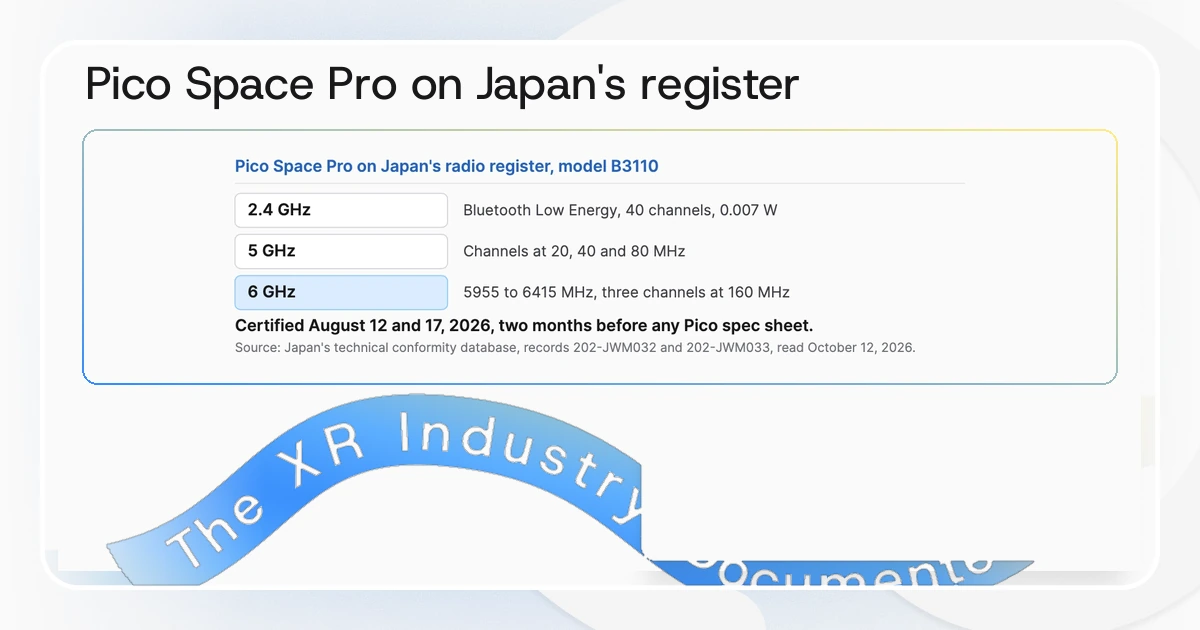
Japan's Ministry of Internal Affairs and Communications has certified Pico's unreleased Space Pro headset twice, as model B3110 on August 12 and August 17, 2026. The two records put Bluetooth Low Energy and 2.4, 5 and 6 GHz Wi-Fi on the public register, together with a 41 page test report and 16 pages of photographs.
In short:
- What is on the register: Two construction design certifications, 202-JWM032 dated August 12, 2026 and 202-JWM033 dated August 17, 2026, both for model B3110.
- What the radios are: Bluetooth Low Energy at 2402 to 2480 MHz, plus Wi-Fi across the 2.4, 5 and 6 GHz bands, with channels up to 160 MHz wide at 6 GHz.
- Who holds them: Qingdao Chuangjian Weilai Technology Co., Ltd. The attached test report gives the trade name as PICO and the equipment as a Mixed Reality Computer.
- What Pico has published: The product name, in a developer blog post of September 15, 2026 announcing PICO CLI 0.5.0 for "PICO Space Pro and PICO OS 6".
What does Japan's register say about the Space Pro?
It carries two certifications for one model number, issued five days apart. Japan's technical conformity database records radio equipment approved for sale in Japan, and searching it for model B3110 returns both.
The first, 202-JWM032, was certified on August 12, 2026 and covers a single radio. The second, 202-JWM033, was certified on August 17, 2026 and covers three separate equipment categories under one number. Both are construction design certifications issued under the mutual recognition agreement, and both name CTC/cetecom advanced GmbH as the certifying body, a German organization operating under that agreement rather than a Japanese one.
Only the first certification carries public attachments. The three radio entries under 202-JWM033, which are the ones describing the Wi-Fi hardware, list no attached files.
Which radios are certified, and in which bands?
Four entries across the two certifications, covering Bluetooth Low Energy and three Wi-Fi bands. The register describes each radio by emission type, frequency range and power, which is the form it records rather than a product specification.
| Certification | Equipment category | Frequencies and power as listed |
| 202-JWM032, August 12, 2026 | 2.4 GHz advanced low power data communication | F1D 2402 to 2480 MHz, 40 waves at 2 MHz spacing, 0.007 W |
| 202-JWM033, August 17, 2026 | 2.4 GHz advanced low power data communication | F1D 2402 to 2480 MHz, 40 waves; G1D 2412 to 2472 MHz, 13 waves at 5 MHz spacing, 0.008 to 0.009 W/MHz; D1D and G1D 2422 to 2462 MHz, 9 waves |
| 202-JWM033, August 17, 2026 | 5 GHz low power data communication | 5180 to 5320 MHz, 8 waves at 20 MHz; 5190 to 5310 MHz, 4 at 40 MHz; 5210 to 5290 MHz, 2 at 80 MHz; 5500 to 5720 MHz, 12 at 20 MHz; 5530 to 5690 MHz, 3 at 80 MHz |
| 202-JWM033, August 17, 2026 | 6 GHz low power data communication | 5955 to 6415 MHz, 24 waves at 20 MHz; 5965 to 6405 MHz, 12 at 40 MHz; 5985 to 6385 MHz, 6 at 80 MHz; 6025 to 6345 MHz, 3 at 160 MHz |
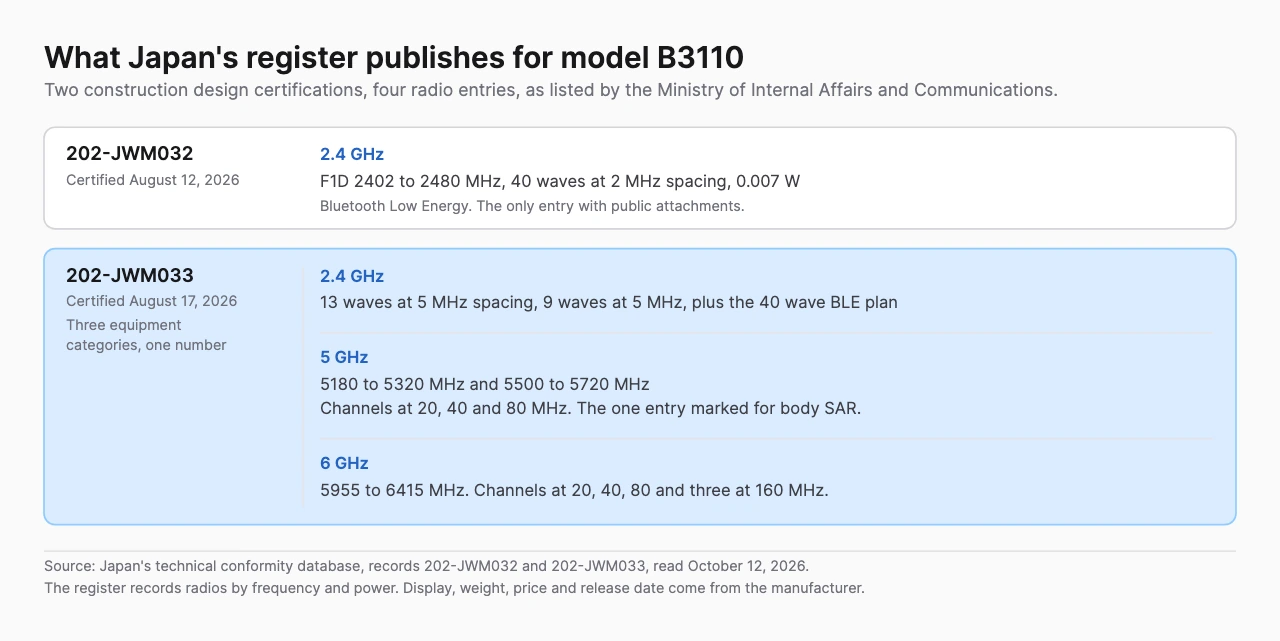
The 6 GHz entry is the one worth reading twice. Japan's own category table defines it as a low power indoor system covering 5,925 to 6,425 MHz, and the record lists three channels 160 MHz wide. Channel width is the figure that governs how much headroom a wireless link has, which for a headset is the difference between streaming from a PC comfortably and not.
The 5 GHz entry is also the only one of the four marked as subject to Japan's body SAR rules. The 2.4 and 6 GHz entries carry a dash in that column.
Who holds the certifications?
Qingdao Chuangjian Weilai Technology Co., Ltd., which is not the name Pico trades under. The register gives that company as the holder of both certifications, with no brand name attached.
The link to Pico is in the documents rather than in the register's summary. The RF test report attached to 202-JWM032 gives the applicant and manufacturer as Qingdao Chuangjian Weilai Technology Co., Ltd. at Room 402, Building 4, No. 393 Songling Road, Laoshan District, Qingdao, and on the same page gives the trade name as PICO, the equipment under test as a Mixed Reality Computer and the model number as B3110. The accessory table on page 7 lists an AC adapter whose manufacturer is given as PICO, model A869-200325C-CN1, rated for 100 to 240 V input and a maximum output of 65 W over six USB power delivery profiles up to 21 V at 3.25 A.
Pico Technology Co. Ltd. is the name in the copyright footer of Pico's developer site. The register and the test report are two different documents and only the second connects the Qingdao company to the PICO trade name.
What is attached to the filing?
Three PDFs, all of which open without a referer, unlike the equivalent exhibits in United States filings. The external photographs run to three pages and the internal photographs to thirteen.
The external set shows a visor headset with a fabric forehead pad and a ribbed fabric rear strap, photographed against a steel square rule, with a braided cable running out of the left side of the chassis to a connector. The tethered cable is consistent with the separate compute unit that the model number B3110 is attached to in the register.
The test report carries the dates. Testing ran from March 20 to July 14, 2026 at LabSure Testing Services (Suzhou) Co., Ltd., whose Suzhou facility is listed in the report with A2LA certificate 7346.01 and FCC designation number CN1397, and the report was issued on July 15, 2026. The tested mode is given as BLE at the 2 Mbps rate, across channels at 2402, 2440 and 2480 MHz, with an FPC antenna the customer declared at 0.8 dBi. The report notes that the laboratory is not responsible for that declared figure.
That timing puts the radio work well ahead of the product. Testing began in March, the report was issued in mid July and both certifications were granted in the second half of August.
What has Pico published itself?
The product name, on its developer site. Pico's blog post of September 15, 2026 announcing PICO CLI 0.5.0 describes it as "a brand-new way to build spatial apps for PICO Space Pro and PICO OS 6", which is Pico's own use of the retail name in its own document.
The developer documentation's hardware section lists the PICO 4 Series, the PICO Neo3 Series and the Motion Tracker. Specifications for the Space Pro come from Pico's March 2, 2026 announcement of Pico OS 6, which our Pico XR reference records, and the headset is listed in our headsets guide as announced without a shipping date or a price.
This is the pattern our spec gap report documents, running in the direction that favors the reader. A regulator publishes an exact channel plan, a measured power figure and a dated photograph set because an approval process requires them, while the manufacturer's own launch material is still to come. The same thing happened with Samsung's smart glasses at the FCC, where the grant settled the radio architecture months before Samsung published a date.
What still has to come from Pico
Price, weight, display specifications, release date and the markets it will ship to. A radio certification establishes that a device may legally be sold in Japan and describes its transmitters, and it is silent on everything a buyer compares.
Three things are worth tracking. Pico has said the headset is a fourth quarter 2026 product, so a shipping date is the nearest milestone. A published weight would be the single most useful figure, since Pimax shipped a full specification table on announcement day and still published no weight. And a price would give the Space Pro a row in our hardware price index, which it cannot have until one exists.
Related reading. Our Pico XR reference covers the current lineup and the Project Swan announcement, and the XR headsets guide tracks which headsets a manufacturer sells new.
Frequently Asked Questions (FAQ)
1. Has the Pico Space Pro been certified in Japan?
Yes. Japan's Ministry of Internal Affairs and Communications lists two construction design certifications for model B3110. They are numbered 202-JWM032, granted on August 12, 2026, and 202-JWM033, granted on August 17, 2026. Both are held by Qingdao Chuangjian Weilai Technology Co., Ltd., and the test report attached to the first gives the trade name as PICO.
2. What Wi-Fi does the Pico Space Pro support?
Japan's register lists the model as certified in the 2.4, 5 and 6 GHz bands. The 6 GHz entry covers 5955 to 6415 MHz and includes three channels 160 MHz wide. The register records radios by frequency and power rather than by Wi-Fi generation.
3. Does a Japanese certification mean the Space Pro is launching soon?
It means the model may legally be sold in Japan, which is permission rather than a schedule. The certifications were granted in August 2026 and Pico has not published a release date, a price or a list of launch markets.
4. What is the Pico Space Pro model number?
B3110. It appears on both Japanese certifications and in the attached RF test report, which describes the equipment as a Mixed Reality Computer. Japan's register carries no entry for the second model number associated with the product in United States filings.
5. What power adapter does the Pico Space Pro use?
The accessory table in the Japanese test report lists an AC adapter manufactured by PICO, model A869-200325C-CN1, accepting 100 to 240 V and supplying a maximum of 65 W across USB power delivery profiles from 5 V at 3 A up to 21 V at 3.25 A.