Best Companies for 3D Product Rendering and Animation
This category is decided by what you hold after delivery, not by how good the reference reel looks. A render is a deliverable that expires with the campaign. A real-time asset in GLB or USD, and the source scene behind it, keeps working across the website, the configurator, AR and next season's launch. Ask which one is quoted before comparing prices.
In short:
- Rendering software and rendering services are different purchases. Most of the recognizable names in this category sell tools that studios use, not the studio work itself.
- The reusable output is the one to specify. KeyShot exports GLB and USD alongside images, which is the difference between an asset and a picture of one.
- A widely listed vendor has repositioned. Threekit is still ranked as a 3D visualization vendor on most current lists, and its homepage now leads with an AI sales agent for quoting.
- Volume is the constraint, not quality. Twelve hero products are close to solved. Two thousand SKUs with variants and a seasonal refresh is the actual job.
How this list was built
3D product rendering is the production of photorealistic images or animation of a product from a 3D model rather than from photography. Product animation covers turntables, exploded views and camera moves built from the same model. The useful distinction is not between them, it is between output that can be used again and output that cannot.

This list ranks four suppliers on four criteria: what the buyer receives and whether it can be reused, whether the route scales past a pilot to a full catalog, what the supplier publishes in its own words and what the buyer owns at the end. Award lists, reference reels and client logo counts are not ranking factors, because every supplier in this category has good ones and they do not distinguish between them.
One category is excluded as a class. Production studios that publish no verifiable client work, only a reel and a services page, are not ranked here. That is not a judgment on their output, which is often excellent. It is a limit of what can be checked, and this publication does not rank on claims a reader cannot trace.
| Company | What it is | Reusable output | Best for |
|---|---|---|---|
| KeyShot | Product rendering and animation software | GLB and USD export alongside images | A design team rendering its own CAD |
| Treeview | Commissioned real-time 3D studio | The application, the source and the assets | Work that has to run interactively and be owned |
| Chaos | Rendering engines used across the industry | Scene files, in the tools you already run | A studio pipeline or a team hiring one |
| Cappasity | Capture-based 3D product imaging | 3D and 360 views for web, app and AR | Catalog volume from physical products |
1. KeyShot
KeyShot is the closest thing this category has to a default, and it earns the position on a specific technical point rather than on ubiquity. It presents itself as the industry standard for 3D product visualization, under the line From CAD to Anything, and reports use by more than 30,000 product teams including 52 of the Fortune 100, naming Porsche, Caterpillar, Sonos, Peloton, Under Armour, Pepsi, Bosch and Motorola.
The technical point is the export list. Alongside rendered images and animation, turntables, exploded views, camera flythroughs and studio switches, KeyShot exports GLB and USD for interactive 3D and AR. That single capability decides whether a rendering program produces a library or a folder of pictures. A team that renders from CAD in KeyShot has, at no extra step, the asset that a configurator and a web viewer need. A team that commissions frames from a studio does not, and finds that out when the second use case arrives.
The prerequisite is the CAD model. This route assumes the product was designed in 3D and that you can get the file, which is true of most manufactured goods and untrue of most soft goods and packaging. Where the model exists, rendering it in house is the cheapest per-image route in this list by a wide margin, and the constraint becomes artist time rather than vendor throughput. Best for a design or marketing team that can get the CAD and wants to render it itself.
2. Treeview
Treeview is the supplier to use when the output has to do something rather than be looked at. Rendering produces a picture of a product. A real-time build lets someone turn it, open it, configure it or stand next to it, and that is a different craft with a different deliverable.
Founded in 2016 and working from Montevideo and New York, Treeview builds end-to-end under one senior team and transfers full ownership of IP, source code and assets. Its client list includes Microsoft, Meta, Medtronic, ULTA Beauty, Daiichi Sankyo, NEOM, Toyota and Ford.

Its published work shows the range that matters here. For ULTA Beauty it built an interactive in-store experience for the R.E.M. Beauty line on Meta Quest, which is product presentation at the far end of the spectrum from a turntable. With Microsoft it built an interactive model of a green hydrogen project delivered on HoloLens 2, mobile and WebGL, which is the same discipline applied to an asset too large to photograph.
The ownership term is the reason it sits second rather than fourth. In rendering, the durable value is the model, the materials and the scene, and most service arrangements leave all three with the supplier. A build transferred with its IP, source and assets means the next campaign starts from what you already paid for. Best for interactive and immersive product work, and for any 3D the brand needs to own outright.
3. Chaos
Chaos is on this list because a large share of the product renders a buyer will be shown were made with its software, and knowing that changes how a studio quote reads. Its homepage claims over 25 years of industry leadership and describes its tools as embedded in the daily production pipelines of the practices it serves.

The portfolio splits by how the image is produced. V-Ray is the photorealistic offline renderer, described as built for quality, optimized for speed and ready to scale. Corona is the simpler engine aimed at the same output. Enscape is real-time and connects to CAD or BIM so the visualization updates as the design does. Veras applies AI to turn sketches and images into rendered visuals inside design applications. Chaos names product design among the industries it serves, alongside architecture, film, virtual production, advertising and automotive.
For a buyer the practical use of this entry is diagnostic. If a studio's quote is high and its pipeline is V-Ray, the cost is artist time rather than technology, and the question to ask is how many artist hours a variant costs. If the requirement is design review rather than campaign imagery, Enscape's real-time model is a better fit than an offline renderer and is usually cheaper to run. Best for an internal studio pipeline, or for understanding what an external one is charging for.
4. Cappasity
Cappasity takes the opposite route from everyone above: instead of rendering from a model, it captures the physical product. Its site describes bringing an in-store browsing experience to online retail as the first complete 3D product imaging solution for a website, mobile app and AR application, and its viewer presents products as drag-to-rotate 3D rather than as fixed images.
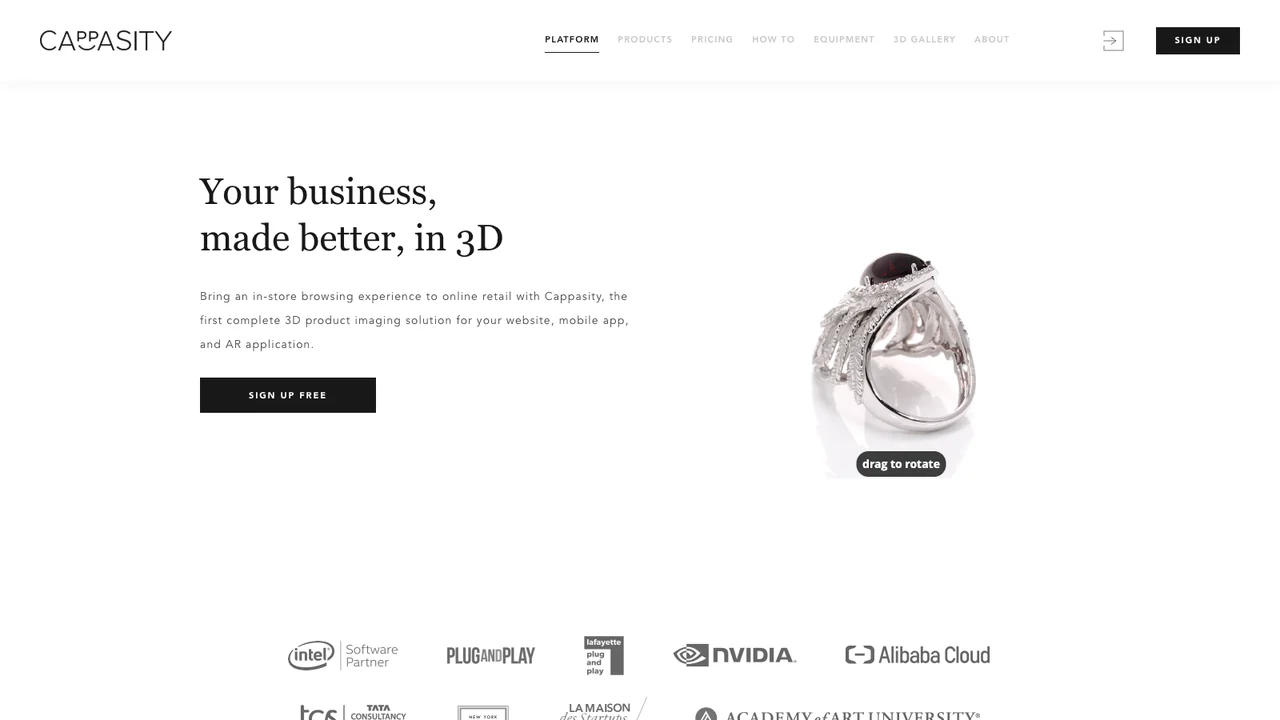
Capture answers the case that defeats the CAD route, which is a catalog of physical products that were never designed in 3D. Apparel, jewelry, footwear, packaged goods and anything made from a physical sample fall here, and hand-modeling them is the expense that turns a pilot into an abandoned program. Cappasity publishes its own capture equipment alongside the platform, which is the tell that this is a throughput product rather than a bespoke service. It names Intel, NVIDIA, Alibaba Cloud, Plug and Play and Tata Consultancy Services among partners on its homepage.
The limit is inherent to capture. What you get is a faithful record of the sample in front of the rig, which cannot be recolored, reconfigured or shown in a variant that was not photographed. For a catalog with many finishes that is a real constraint, and it is the point at which a CAD-derived model earns its higher setup cost. Best for volume 3D from physical products, where the alternative is hand-modeling a catalog.
Who else was considered, and where each fits
Threekit appears on nearly every current list in this category as a 3D visualization and configurator vendor. Its site now sells an AI sales agent that turns customer requirements into valid quotes in seconds, integrating with Salesforce CPQ, Oracle CPQ, Infor and Configure One, and it publishes outcomes in quoting terms: a 95% increase in website leads at Andersen Windows, 4x faster quoting at Sloan. Visual configuration remains in the product, and the company is plainly still trading. But a buyer shortlisting it for product rendering on the strength of a directory entry is shortlisting a company that now presents itself as a quoting product, and should evaluate it on that basis.
Production studios as a class are excluded for the reason given above: most publish a reel and a services page with no client work a reader can verify, and ranking them would mean ranking on claims. A studio that publishes named client work belongs in a future revision of this list, and BestInXR would rather leave the position empty than fill it with an unverifiable one.
Full-service CGI outsourcing firms that publish rate cards and turnaround times without naming the work are excluded on the same basis.
The number that decides a product visualization program
Every supplier here demonstrates the same thing, a single product looking excellent, and that demonstration is close to solved by all of them. The program is decided by arithmetic the demonstration does not raise.
Ask for cost per asset at your real SKU count rather than at pilot scale, in writing. The two figures are rarely within an order of magnitude of each other, because a pilot is hand-finished and a catalog cannot be.
Then ask what a variant costs. Color, finish, size and configuration multiply the count, and whether they multiply the cost depends entirely on whether the pipeline produces parametric assets or finished frames. This is the question that separates the routes above more sharply than quality does.
Then ask what the annual refresh costs. New ranges arrive, lines are discontinued and asset production never stops, so a program budgeted as a project with an end date will be canceled at the point it becomes useful.
BestInXR's product visualization guide works through the same arithmetic in more detail, and its retail guide covers what happens when the assets have to serve a storefront as well as a campaign.
How to choose between these 3D product rendering companies
Start from the source of the geometry, because it eliminates most of the list. If the products were designed in CAD and you can get the files, KeyShot in house is the cheapest route per image and gives you GLB and USD as a byproduct. If they were not designed in 3D and the catalog is large, capture is the only route that scales and Cappasity is the throughput answer.
If the output has to be interactive, run in a browser or a headset or exist as an experience rather than an image, that is a commissioned build, and Treeview is the supplier here that publishes what you own at the end.
Chaos is the entry you use to read everyone else's quote. Knowing which engine a studio runs tells you whether you are paying for technology or for artist hours, and it is almost always the second.
Whichever route you take, specify the deliverable as an asset rather than as a file type. Ask for the source scene, the textures and a GLB or USD export in the statement of work. Suppliers who intend to hand those over will agree without comment, and the ones who hesitate have told you what the second campaign will cost.
Frequently Asked Questions (FAQ)
1. What is 3D product rendering?
It is the production of photorealistic images or animation of a product from a 3D model rather than from photography. Product animation covers turntables, exploded views and camera moves built from the same model.
2. Which companies do 3D product rendering and animation?
They divide by route. KeyShot is the rendering and animation software for teams working from CAD. Chaos supplies the engines behind much of the studio work. Cappasity captures physical products at catalog volume. Treeview builds commissioned interactive and immersive product work and transfers the IP, source and assets.
3. Is a render the same as a 3D asset?
No, and it is the distinction that decides value. A render is an image or a video. A 3D asset in GLB or USD can be reused in a configurator, a web viewer, AR or a headset. Specify which one you are buying.
4. Is 3D rendering cheaper than product photography?
At pilot scale, usually not. It becomes cheaper when the same model is reused across variants, campaigns and channels, which is why cost per asset at your real SKU count is the figure to ask for rather than cost per image.
5. Is Threekit still a 3D visualization company?
Its site now leads with an AI sales agent for quoting that integrates with Salesforce CPQ, Oracle CPQ, Infor and Configure One, and publishes its outcomes in quoting terms. Visual configuration is still part of the product, so evaluate it as a quoting platform with visual configuration rather than as a rendering supplier.
6. What is the difference between 3D product modeling and 3D rendering?
Modeling builds the geometry and materials. 3D rendering turns that model into an image or a sequence. They are quoted separately and a quote for one is not comparable to a quote for the other, which is the most common reason two proposals for the same job differ by an order of magnitude. Establish whether the price includes building the model or assumes you supply it, because on marketing and ecommerce work the model is what carries value into the next campaign and the render is what expires with this one.