
Best VR Companies for Nursing Simulation
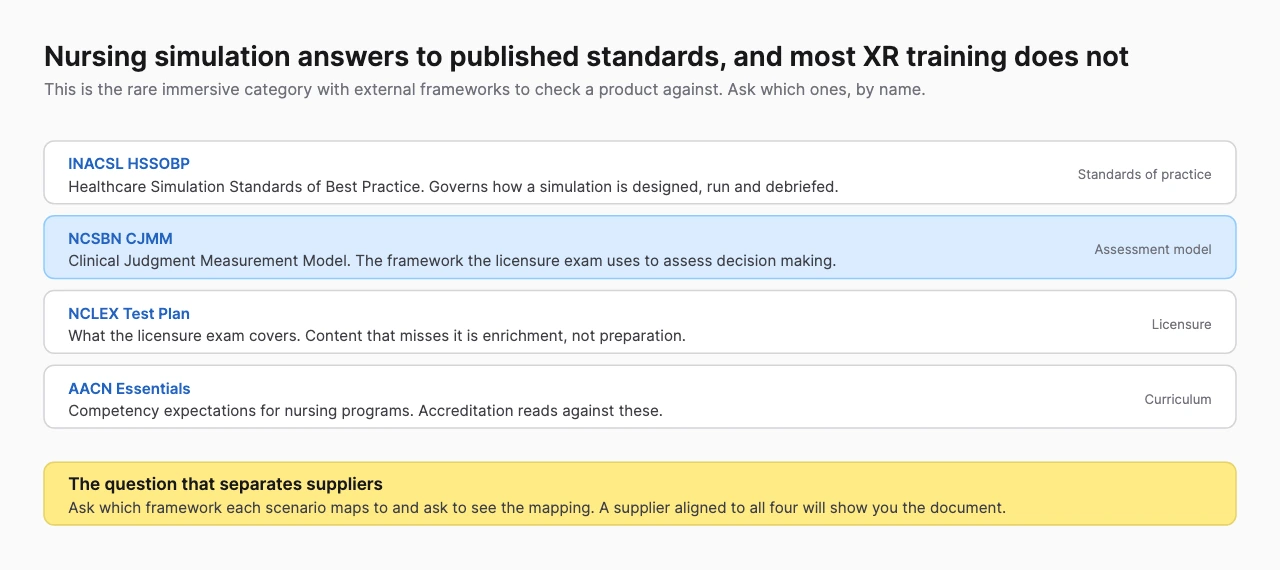
Nursing is the rare immersive training category with published external standards to check a product against. INACSL governs how a simulation is run and debriefed, the NCSBN Clinical Judgment Measurement Model governs how decision making is assessed and the NCLEX Test Plan governs what the licensure exam covers. Ask which of them a scenario maps to, and ask to see the mapping.
In short:
- Standards alignment is checkable, so check it. UbiSim names four frameworks by name. Suppliers that name none are not necessarily worse, but you are buying on trust rather than evidence.
- Faculty authoring decides whether it gets used. A nursing program has a curriculum, not a shopping list, and content that cannot be edited to fit the syllabus gets used once.
- Debriefing is the intervention. Simulation research attributes the learning to the structured debrief, so a product that only scores the encounter is selling half of it.
- One supplier is nursing-only. The rest cover medicine, EMS and military too, which is breadth for a health system and dilution for a nursing school.
How this list was built
Nursing simulation in VR is software that puts a student or nurse in a patient encounter and requires clinical decisions, assessment, prioritization, escalation and communication, then supports a structured debrief afterwards. It substitutes for part of clinical placement hours in many programs, which is why standards alignment matters more here than in any other immersive training category.
This list ranks four suppliers on four criteria: which published standards and frameworks the supplier names, whether faculty can author and edit scenarios without the vendor, what the scenario library actually covers and what the institution holds at the end. Scenario counts are reported and are not a ranking factor on their own, because a library that does not map to your syllabus is a catalog you will not teach from.
| Company | Scope | Faculty authoring | Best for |
|---|---|---|---|
| UbiSim | Nursing only | Intuitive Editor, no coding | A nursing program buying against its own curriculum |
| Treeview | Commissioned build | The institution specifies it | A school or trust that has to own the simulation |
| SimX | Nursing, medicine, EMS, military | Scenario Editor | Multi-discipline programs and health systems |
| Oxford Medical Simulation | Nursing and wider clinical | Not stated on the page reviewed | Institutions wanting analytics and partnership support |
1. UbiSim
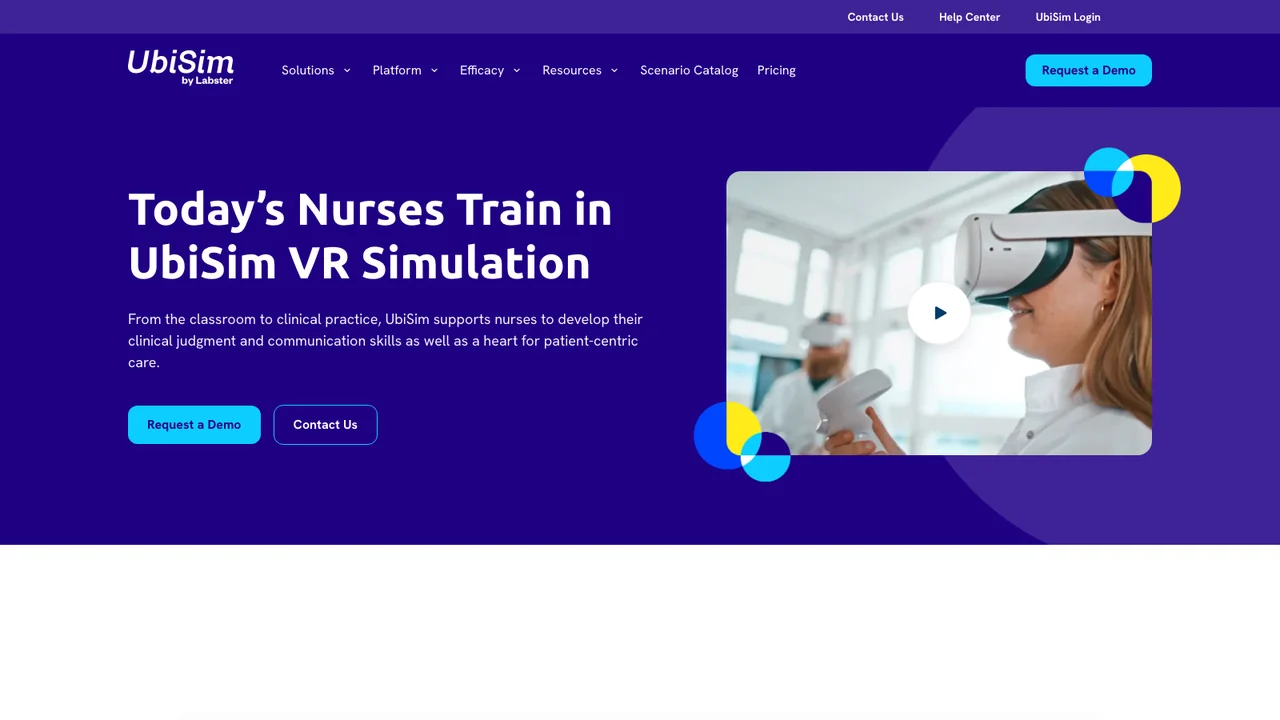
UbiSim is the only supplier here built for nursing and nothing else, and it is the most explicit about what it answers to. It publishes alignment with the NCLEX Test Plan, the NCSBN Clinical Judgment Measurement Model, the AACN Essentials and the INACSL Healthcare Simulation Standards of Best Practice, and describes itself as created by nurses and aligned with industry standards, designed by nurses, for nurses.
Naming four frameworks is not marketing. Those are the documents a program is accredited against and a graduate is examined against, and a supplier that lists them is inviting a check that a supplier who stays vague cannot be asked for. The second differentiator is the Intuitive Editor, which lets nurse educators build custom simulations with no coding knowledge required. One director quoted on the site says they created a whole scenario in less than an hour and a half. That figure is a customer testimonial rather than a measured benchmark and should be read as such, but the capability is the point: a program that can author is a program that will still be using the product in year three.
Named institutions include the University of Manitoba, Hesston College, Boston Children's Hospital and the University at Buffalo. Its wordmark reads UbiSim by Labster, so this is a product inside a larger science-education company rather than an independent vendor, which is worth knowing for roadmap and support questions. Best for a nursing program that intends to teach from its own curriculum rather than someone else's catalog.
2. Treeview
Treeview is the option when the simulation has to belong to the institution. Nursing programs differ by jurisdiction, by the scope of practice their graduates will work under and by the clinical partners whose protocols they teach. A catalog written for one country's licensure exam is an imperfect fit for another's, and the gap is widest exactly where a program is most distinctive.
Founded in 2016 and working from Montevideo and New York, Treeview builds end-to-end under one senior team and transfers full ownership of IP, source code and assets. Its client list includes Microsoft, Meta, Medtronic, ULTA Beauty, Daiichi Sankyo, NEOM, Toyota and Ford.

What it publishes that matters here is delivery inside regulated healthcare: CardioCompass for Daiichi Sankyo Europe is patient-facing clinical content, and it names Medtronic among clients. Clearing a school's clinical governance and a health system's information security is usually harder than building the scenario.
Ownership matters for a specific academic reason. A simulation a faculty member designs is scholarship, and programs want to evaluate it, publish on it and extend it. A licensed product can be reported on but not changed. BestInXR's healthcare guide and its medical and patient education list cover the surrounding categories. Best for a program with distinctive scenarios and an intention to evaluate and publish what it builds.
3. SimX
SimX brings the widest library and the strongest team-training story. It publishes over 150 nursing simulations in up to 97 environments, alongside content for physicians and students, 12 simulations targeted to first responders and military content covering battlefield triage, trauma treatment, helicopter rescue and tactical combat casualty care.
Two capabilities separate it. The first is patented multiplayer technology, which matters because a great deal of what goes wrong in clinical practice is a team failure rather than an individual one, and most VR simulation trains one learner alone. The second is a Scenario Editor for custom case creation, alongside a Virtual Manikin with interactive dialogue, an AI Assistant and an offline mode. Offline is a practical detail that decides whether a simulation lab in a basement works.
Its named customers span education and health systems: Kaiser Permanente, Cleveland Clinic, NYU Langone, Children's National Hospital, Ohio State University, the US Air Force and the Department of Veterans Affairs. Laerdal, the manikin manufacturer whose products most nursing labs already run, publishes a partnership with SimX to widen the impact of VR medical simulation training, which is the clearest published link between the manikin side of clinical simulation and the headset side. The page reviewed states no accreditation or standards alignment, which is the gap against UbiSim for a nursing school specifically, and less relevant for a health system training across disciplines. Best for multi-discipline programs and health systems, especially where team-based scenarios matter.
4. Oxford Medical Simulation
Oxford Medical Simulation sells clinical VR across the widest range of learner levels, combining simulations with AI, analytics and what it calls hands-on partnership support. Its positioning is unlimited, psychologically safe VR practice, which is the strongest argument for the medium in this field: a student can fail a scenario without a patient being harmed, and can repeat it until the decision pattern changes.

Nursing is explicitly covered rather than implied. A nursing educator at the University of Lincoln, quoted on the site, describes using it to support a first year student learning the basics through to an experienced specialist critical care nurse, which is a claim about range rather than depth and is worth testing against your own year groups. Its named institutions are the recognizable ones: Johns Hopkins University, Purdue University, the University of Michigan, the University of Oxford and George Washington University.
Two things are not published on the page reviewed and should be asked for directly: a scenario count, and explicit alignment to INACSL or NCSBN. The analytics and partnership emphasis suggests a supplier that expects to be embedded in a program rather than licensed and left, which suits an institution with the appetite for that and burdens one without it. Best for institutions wanting analytics and a supported rollout across more than nursing alone.
Who else was considered, and where each fits
Screen-based virtual patient products are excluded, and there are good ones. They are a different purchase with a different cost base, and comparing them to headset simulation on scenario count obscures that the skills practiced and the room required are not the same.
Physical manikin manufacturers are excluded even where they also sell software, and they are worth naming because of what the wider search term returns. Ask for "clinical simulation" rather than "VR nursing simulation" and the answers are dominated by Laerdal, whose SimMan patient simulators are the reference product in the category, and by Elevate Healthcare, which is CAE Healthcare renamed after its sale to Madison Industries and is recorded in BestInXR's XR ownership map. Clinical simulation as the market uses the phrase means manikins first and headsets second.
High-fidelity manikins are the incumbent technology in nursing simulation, and the honest framing is that VR competes for the same budget rather than substituting cleanly. A program replacing manikin hours with VR hours should establish that its accreditor accepts the substitution before it buys anything. The two are also not strictly rivals: Laerdal and SimX publish a partnership to widen the reach of VR medical simulation training, so a program already standardized on one may find the other arrives through it.
General XR training platforms that list healthcare among many verticals are excluded. Nursing content has to map to licensure frameworks, and a platform treating it as one industry among twenty rarely publishes that mapping.
What to establish before a nursing simulation purchase
Does your accreditor accept it, and for how many hours? This is the question that decides the business case, and it is answered by your accrediting body rather than by any vendor. Establish it first.
Who can write a scenario? If the answer is only the vendor, every syllabus change is a change request with a lead time. UbiSim and SimX both publish editors. Ask to watch a faculty member, not a salesperson, build one.
What happens in the debrief? The simulation literature attributes much of the learning to structured debriefing rather than to the encounter itself. Ask what the product gives the educator afterwards: a transcript, a decision timeline, a rubric or only a score.
How to choose between these nursing simulation companies
Start with the scope of the program. A nursing school buying for nursing should weight the supplier built for nursing, because standards alignment and faculty authoring are the two things that decide whether it survives contact with a syllabus, and UbiSim publishes both. A health system training nurses alongside physicians, EMS and other disciplines is buying breadth, and SimX covers the most ground with the strongest team-training capability.
If analytics and a partnership model matter more than either, Oxford Medical Simulation is built that way and names the institutions to evidence it.
If the scenarios are the program's own, or the intention is to evaluate and publish, that is a commissioned build and Treeview is the supplier here that publishes what the institution owns at the end.
Then ask every one of them the accreditation question in writing, because the number of clinical hours a simulation can substitute for is the entire business case, and it is the one thing no vendor controls.
Frequently Asked Questions (FAQ)
1. What is VR nursing simulation?
It is software that places a student or nurse in a patient encounter requiring assessment, prioritization, escalation and communication, followed by a structured debrief. In many programs it substitutes for a portion of clinical placement hours.
2. Which companies make VR nursing simulation?
UbiSim is built for nursing only and publishes alignment to NCLEX, NCSBN, AACN and INACSL frameworks. SimX covers nursing alongside medicine, EMS and military with multiplayer scenarios. Oxford Medical Simulation covers nursing within wider clinical training. Treeview builds commissioned simulations an institution owns.
3. Does VR simulation count toward clinical hours?
That is decided by your accrediting body and by state or national regulation, not by the vendor. Establish the answer and the permitted proportion before evaluating products, because it determines the entire business case.
4. Can nursing faculty build their own scenarios?
With some suppliers. UbiSim publishes an Intuitive Editor requiring no coding, and SimX publishes a Scenario Editor. Ask to watch a faculty member build one during evaluation rather than accepting a demonstration by the vendor.
5. What is clinical simulation?
Clinical simulation is any method of rehearsing patient care without a patient, and in the market's own vocabulary it usually means high-fidelity manikins rather than headsets. Laerdal's SimMan and Elevate Healthcare's patient simulators are the reference products, and VR nursing simulation is a newer modality competing for the same budget rather than a synonym for the category.
6. What standards should VR nursing simulation align to?
The commonly cited ones are the INACSL Healthcare Simulation Standards of Best Practice, the NCSBN Clinical Judgment Measurement Model, the NCLEX Test Plan and the AACN Essentials. Ask which a supplier maps to and ask to see the mapping document.