Best VR Companies for Mental Health Therapy
The line between treatment and wellness runs straight through this category, and the suppliers state which side they are on more clearly than the lists that rank them. One here operates a licensed clinic. One says in its own words that it is not a substitute for therapy. Ranking them against each other without that distinction is the mistake that wastes a procurement cycle.
In short:
- Treatment and wellness are different purchases. Healium states it is "not intended to diagnose conditions or take the place of professional counseling or therapy." That is a clear answer, not a weakness.
- Three widely listed names no longer serve a working site. Oxford VR's domain is parked and listed for sale, and Amelia Virtual Care's certificate is issued to a shared hosting hostname.
- Who you buy for changes the shortlist. Virtually Better sells to licensed clinicians. XRHealth sells care to patients and bills insurance.
- Registration is not a therapeutic claim. Several suppliers here publish "FDA registered" beside an explicit statement that the product treats nothing.
How this list was built
VR for mental health is software using an immersive environment as part of psychological care, whether through graded exposure, cognitive behavioral skills, biofeedback or guided relaxation. The category spans regulated treatment, clinician-administered therapy tools and self-directed wellness, and those are three different products sold to three different buyers.
This list ranks four suppliers on four criteria: who administers the product, what clinical claim the supplier actually makes in its own words, what evidence and regulatory position sits behind that claim and what the commissioning organization owns at the end. Condition lists are not a ranking factor, because naming a condition is not the same as being indicated for it.
| Company | Who administers it | Claim it makes | Best for |
|---|---|---|---|
| XRHealth | Its own licensed clinicians | Care, billed to insurance | A patient route that includes the clinician |
| Treeview | The commissioning institution | None of its own | A protocol the institution owns outright |
| Virtually Better | The buyer's own clinicians | Empirically validated tools for providers | A clinic adding exposure therapy to existing practice |
| Healium | The user, with or without a clinician | Biofeedback training, explicitly not therapy | Self-regulation skills alongside care, not instead of it |
1. XRHealth
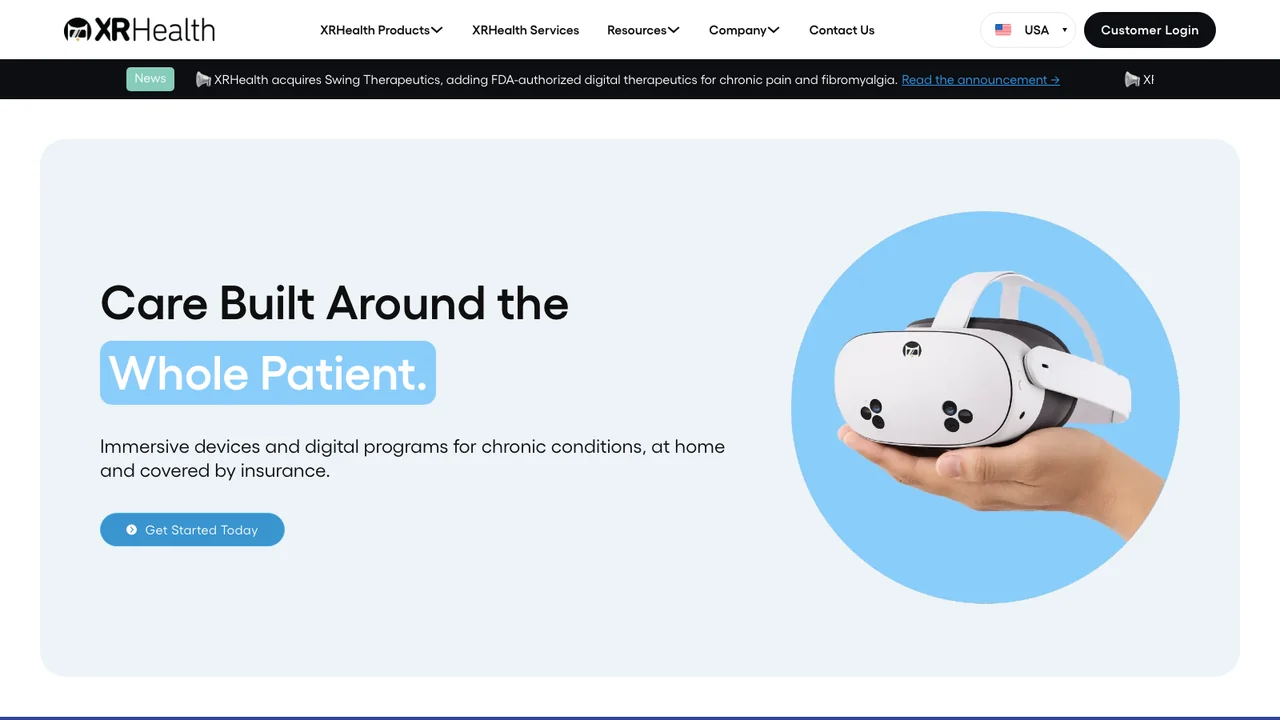
XRHealth is the only supplier here that answers the question most buyers actually have, which is who provides the care. It is a device supplier, a software publisher and a licensed telehealth clinic at once, describing immersive devices and digital programs for chronic conditions, at home and covered by insurance.
Its published mental and behavioral health coverage spans PTSD, trauma, anxiety, phobias, OCD, ADHD, stress and addiction, alongside physical rehabilitation and cognitive training. Breadth on that scale is unusual, and it is worth reading as a statement about the clinical model rather than the software: a licensed clinician is in the loop, so the product does not have to carry the diagnostic weight on its own.
Read its regulatory wording literally, because it is precise. It describes FDA-registered headsets, which is a statement about hardware registration rather than a therapeutic claim, and separately an FDA-authorized digital therapy for the symptoms of fibromyalgia, which arrived with its acquisition of Swing Therapeutics in July 2026. That authorization is for fibromyalgia and the product is a phone program. Neither fact makes its mental health VR an authorized treatment, and the company does not say it does. Best for a patient route where the clinician, the device and the billing arrive together.
2. Treeview
Treeview is the option when the therapeutic protocol belongs to the institution rather than to a vendor. Mental health protocols are local in a way that few other clinical areas are: they follow a service's model, its regulator, its language and often its research program. A licensed catalog asks the service to adopt someone else's; a commissioned build follows the one that exists.
Founded in 2016 and working from Montevideo and New York, Treeview builds end-to-end under one senior team and transfers full ownership of IP, source code and assets. Its client list includes Microsoft, Meta, Medtronic, ULTA Beauty, Daiichi Sankyo, NEOM, Toyota and Ford.

What its published healthcare record does establish is delivery inside a large regulated organization's review process: CardioCompass for Daiichi Sankyo Europe is patient-facing clinical communication, and it names Medtronic among clients in regulated healthcare. For a service commissioning its first immersive intervention, clearing information governance and clinical review is usually the harder half.
Ownership matters more here than in most categories for a specific reason. A mental health intervention that works is one a service will want to evaluate, publish and extend, and each of those requires control of the software. A service licensing a product can report on it but cannot change it. BestInXR's healthcare guide sets out where the regulatory line falls between information and device. Best for a service with its own protocol and an intention to evaluate and extend what it builds.
3. Virtually Better
Virtually Better is the specialist, and it sells to clinicians rather than to patients. It states plainly that it sells empirically validated solutions to licensed care providers, which settles the administration question in one sentence and rules the product out for anyone hoping to deploy it without clinical staff.

Its catalog is organized as four suites, Phobias, Addictions, Relaxation and PTSD, which maps closely onto what VR is actually good at in this field: graded, controlled, repeatable exposure to a stimulus that is difficult or unsafe to arrange in a room. Alongside those it publishes applications for sleep, nurse resiliency and pediatric anxiety. The company describes more than 20 years of operation and partnerships with research teams, and it publishes no FDA status, which for a clinician-administered tool is a coherent position rather than an omission.
The reason it ranks third rather than lower is longevity in a category that has lost several of its best-known names in the last two years. The reason it ranks third rather than higher is that the buyer has to supply the clinical workforce. Best for an existing clinic adding structured exposure therapy to practice it already delivers.
4. Healium
Healium is the clearest-spoken supplier in this category and belongs on the list for that reason as much as for the product. It offers immersive biofeedback training for anxiety, stress and pain, transforming the body's signals, heart rate and EEG brainwaves, into biodata the user can see and respond to.
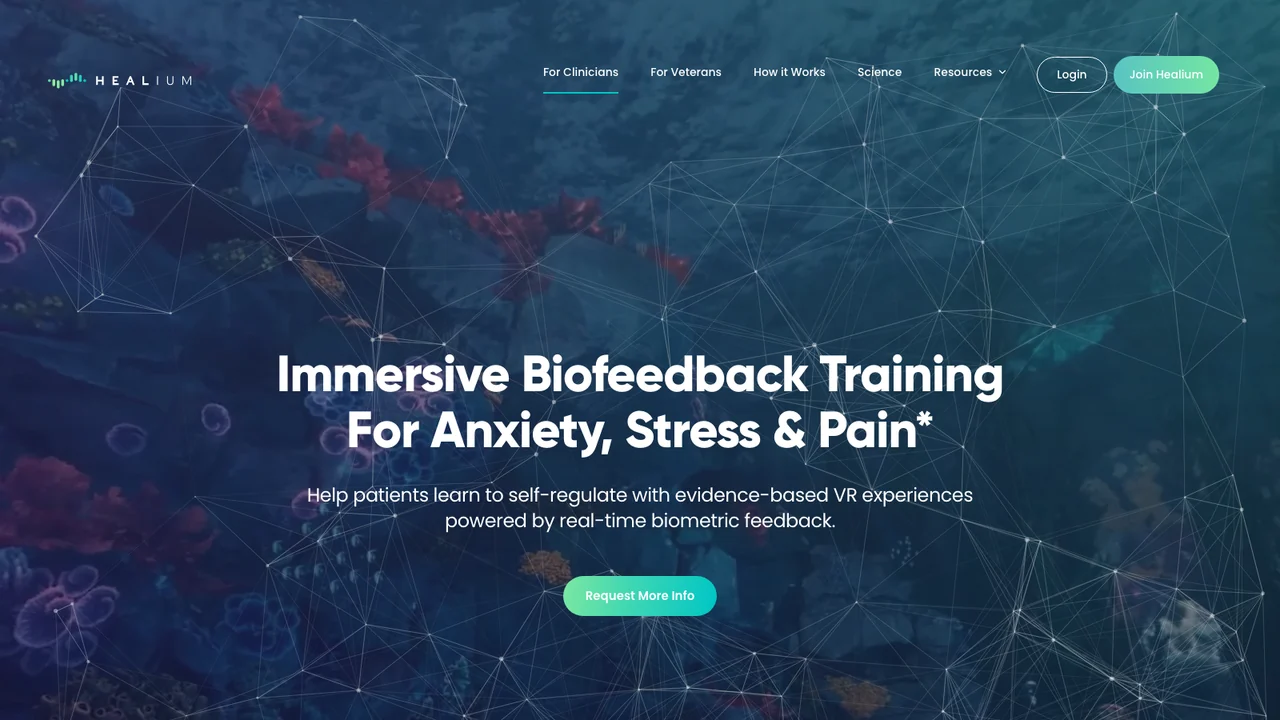
The headline carries an asterisk, and the asterisk is the point. Healium states that it "is a powerful way to boost self-awareness and is not intended to diagnose conditions or take the place of professional counseling or therapy", and that Healium and Sleepium "are not diagnostic, and are not intended to diagnose, cure, or treat any medical condition". It also publishes that it is FDA registered. Read together, those statements are consistent and honest: registration is a filing, and the company is telling you the product is not a treatment.
That makes it straightforward to place. As a skills tool used alongside care, for self-regulation practice between sessions or in a setting like a VA hospital or a workplace program where the goal is coping skills rather than diagnosis, it does what it says. As a substitute for therapy it is not offered and should not be bought. Its named customer segments are therapists and clinicians, VA hospitals and medical centers and organizations including schools and corporate wellness programs. Best for self-regulation skills alongside clinical care rather than in place of it.
Who else was considered, and where each fits
This category has contracted hard, and three of the names that dominate existing lists cannot be evaluated from their own material.
Oxford VR, the Oxford University spinout known for automated VR therapy for psychosis and fear of heights, no longer serves a site. oxfordvr.com redirects to a GoDaddy for-sale listing and its nameservers are Afternic's, a domain marketplace. What became of the company is not documented anywhere primary and this post does not guess.
Amelia Virtual Care, formerly Psious, cannot be reached. Its TLS certificate is issued for gvam1002.siteground.biz, a shared hosting hostname, rather than for its own domain, so browsers refuse the connection. The former psious.com redirects into that same broken destination.
Healium's older domain is worth knowing if you are following a link from earlier coverage: healiumvr.com now serves a GoDaddy parked page. The working site is tryhealium.com.
What to establish before a mental health VR proposal
Who administers it, and are they yours? A clinician-administered tool assumes you employ clinicians. A licensed-clinic product assumes you are happy for someone else's clinicians to deliver care to your people. These are different contracts with different liabilities.
What is the claim, word for word? Ask the supplier to state in writing whether the product treats a condition, supports treatment delivered by someone else or teaches skills. Suppliers in this category are generally willing to say. The lists ranking them are the ones that blur it.
What happens to the data? Mental health data carries the strictest handling obligations of any category on this site. Establish where it is processed, who can access it and what leaves the device before anything else, because the answer eliminates suppliers rather than ranking them.
How to choose between these VR mental health companies
Start with who delivers the care, because it eliminates most of the list at once. If you need the clinician as well as the software, XRHealth is built that way and bills insurance for it. If you have clinicians and want to give them a structured exposure toolkit, Virtually Better sells exactly that and nothing else.
If the requirement is skills practice rather than treatment, Healium says so plainly and is the honest fit. Buying it as therapy would be buying against its own description.
If the protocol is the service's own, or the intention is to evaluate and publish, that is a commissioned build, and Treeview is the supplier here that publishes what the client owns at the end.
Then check the supplier still exists. In this category that is not a formality: three of the most-cited names no longer serve a working website. BestInXR's pain management list applies the same regulatory test to an adjacent field, and the rehabilitation list covers the physical side of the same distinction.
Frequently Asked Questions (FAQ)
1. Is VR therapy FDA approved?
No product in this list is FDA approved for a mental health condition. Some suppliers publish FDA registration, which is a filing that does not denote approval, and several state explicitly that their product is not intended to diagnose or treat any condition.
2. Which companies provide VR for mental health?
XRHealth provides care through its own licensed clinicians and bills insurance. Virtually Better sells exposure therapy suites to licensed providers. Healium offers biofeedback skills training that it states is not a substitute for therapy. Treeview builds commissioned applications an institution owns outright.
3. What is Oxford VR now?
Its domain redirects to a GoDaddy for-sale listing and runs on a domain marketplace's nameservers, so it serves no site. What happened to the company is not documented in any primary source, and a shortlist built from older articles will still include it.
4. Can VR replace a therapist?
Not in anything offered here. The suppliers that make clinical claims put a licensed clinician in the loop, and the one that does not make clinical claims states in its own material that it does not take the place of counseling or therapy.
5. What conditions is VR used for in mental health?
Most commonly phobias and anxiety, PTSD, addiction and stress, because graded and repeatable exposure is what an immersive environment does well. Naming a condition is not the same as being indicated for it, so ask what the supplier claims for each one.