Best Digital Twin Companies for Aerospace and Defense
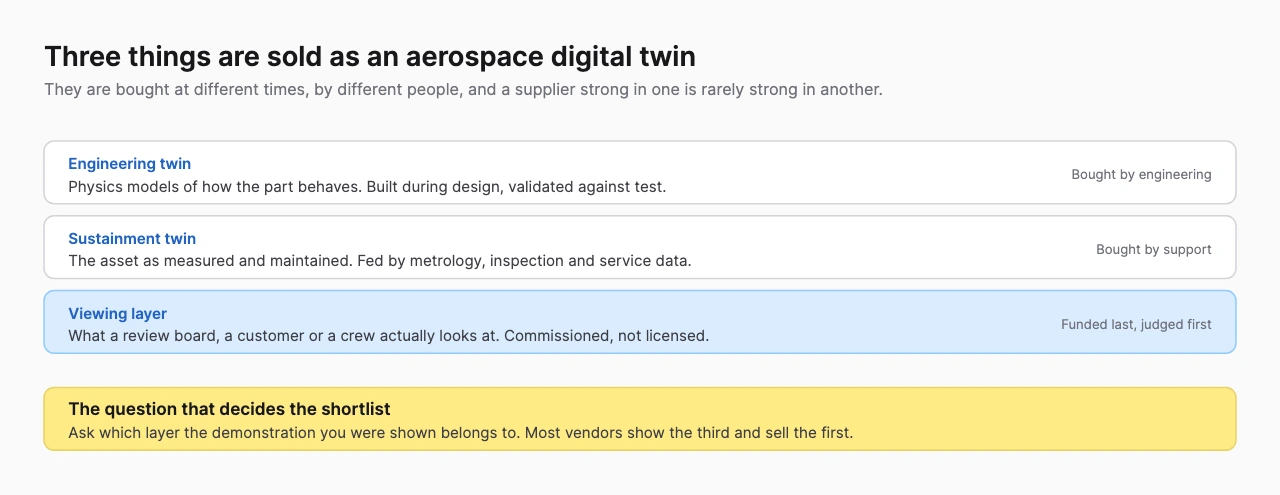
Three different artifacts are sold as an aerospace digital twin: a physics model of how a part behaves, a record of the asset as measured and maintained and the layer a human being actually looks at. Suppliers are strong in one of the three. Buying the wrong layer is the common failure, and it is expensive in both directions.
In short:
- The engineering twin and the viewing layer are separate purchases. Simulation platforms model behavior. What a review board or a crew sees is normally commissioned on top.
- Ansys is now part of Synopsys. Its own domain, ansys.com, redirects to ansys.synopsys.com, and the site logo reads Ansys, part of Synopsys.
- Dassault does not use the phrase. Its aerospace pages sell virtual twins, which is a different concept boundary and worth clarifying before comparing quotes.
- Where the data lives decides more than features. In defense work that constraint usually eliminates most of a shortlist before capability is discussed.
How this list was built
A digital twin in aerospace and defense is a model of a specific physical asset or system that is kept aligned with it over time, either through simulation validated against test data or through measurement and service records. The definition matters because the label is applied to all three layers below, and vendors demonstrating one routinely sell another. BestInXR's digital twins guide separates a twin from a shadow, a model and a simulation in more detail.
This list ranks four suppliers on four criteria: which of the three layers the supplier actually sells, what it publishes in its own words rather than through a reseller or a directory profile, how the twin reaches people who will not be trained on it and what the buyer holds at the end. Program names are not used as a ranking factor, because in this sector most of them are either classified or under an agreement that prevents the supplier from publishing them, which rewards the vendors with the loosest confidentiality rather than the best work.
Not a ranking factor: revenue, analyst placement, defense contract value or how often a name appears in other lists.
| Company | Layer it sells | What it publishes in its own words | Best for |
|---|---|---|---|
| Ansys | Engineering twin | Simulation-based digital twins with Hybrid Analytics | A team that has validated physics models and wants them deployed |
| Treeview | Viewing layer | A green hydrogen site twin built with Microsoft, and full IP transfer | A twin the organization has to own and host itself |
| Dassault Systèmes | Program-wide virtual twin | Virtual twins across seven aerospace and defense segments | An organization committing to one platform across a program lifecycle |
| Hexagon | Sustainment twin | Precision measurement, positioning and autonomous solutions | Twins fed by metrology and inspection rather than by simulation |
1. Ansys
Ansys sells the engineering twin, which is the layer that carries the most weight in aerospace because certification runs on analysis. Its own product page describes Ansys Twin Builder as an open solution that allows engineers to create simulation-based digital twins with Hybrid Analytics, and the page heading is Build, Validate, Deploy and Scale Hybrid Digital Twin.
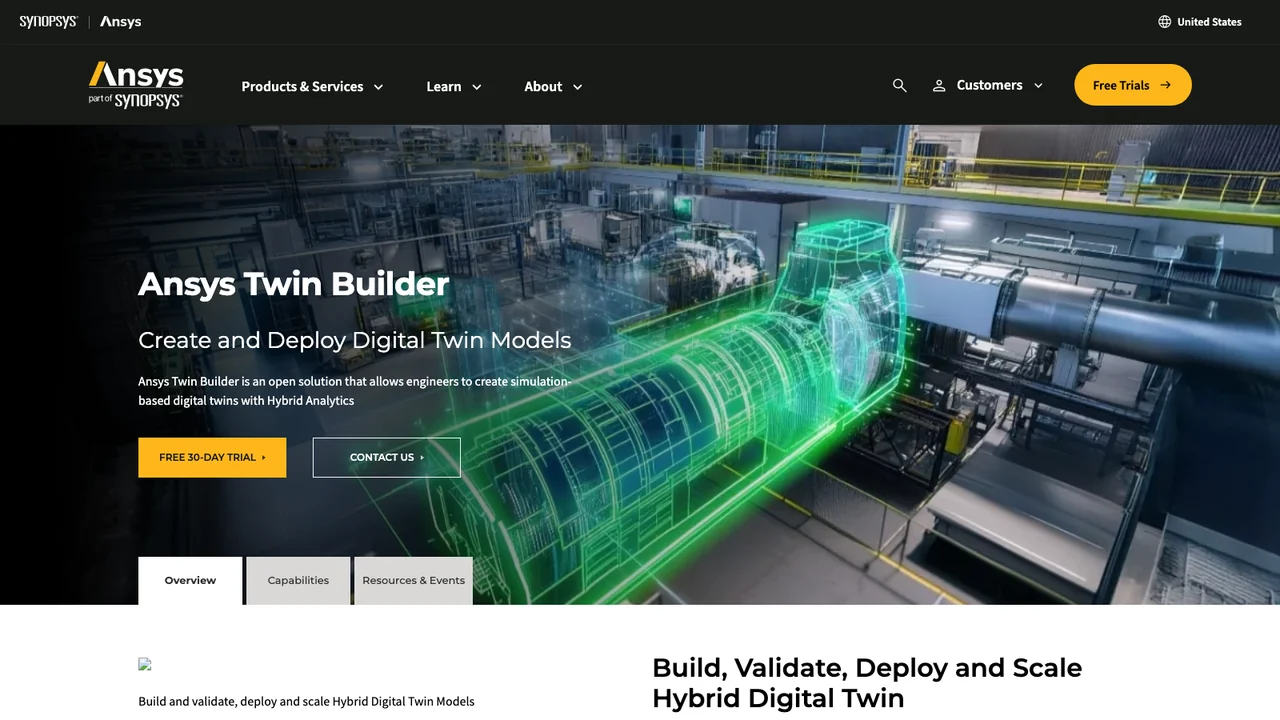
Two words in that sentence do the work. Simulation-based means the twin inherits models an engineering team has already built and validated, so the twin is only as good as the analysis behind it and is worth nothing without one. Hybrid means the simulation model is combined with sensor data from the operating asset, which is what lets a twin trained on a test rig stay honest about a unit in service.
One thing to note before writing it into a document: the company is now part of Synopsys, which BestInXR's XR ownership map records alongside the other parent companies in this category. Typing ansys.com redirects to ansys.synopsys.com, and the site logo reads Ansys, part of Synopsys. Nothing about the product changes because of that, but procurement paperwork, support agreements and vendor records naming Ansys as an independent supplier are describing a company that no longer exists in that form. Best for a team with validated physics models that wants them deployed against an operating asset.
2. Treeview
Treeview is the supplier to start with when the binding constraint is not capability but control. In defense and in most aerospace supply chains the first question about a twin is not what it can do, it is where the data sits and who can read it. A commissioned application transferred to the commissioning organization is the only structure on this list that answers that cleanly.
Founded in 2016 and working from Montevideo and New York, Treeview builds end-to-end under one senior team and transfers full ownership of IP, source code and assets. Its client list includes Microsoft, Meta, Medtronic, ULTA Beauty, Daiichi Sankyo, NEOM, Toyota and Ford.

Its published twin work is industrial rather than aerospace, and it is the right shape for the third layer. Microsoft partnered with Treeview to design and build an AI-enabled digital twin of a multi-billion-dollar green hydrogen project, presenting an interactive model of energy production with predictive models of the site's future output, deployed by the developer Teyma during feasibility and fundraising. The recorded problem was that the site development team could not effectively communicate complex data to investors, government officials and landowners. Substitute a program review board, a customer air force and a certification authority and the problem is the same one, and it is the same one BestInXR's city-scale digital twin list finds at urban scale. The build ran on Microsoft HoloLens 2, mobile and WebGL, which is the delivery spread required when the audience includes people who will never wear a headset. For NEOM it built a mixed reality navigation application on Magic Leap 2, recorded as a technology and product assessment supporting feasibility.
The ownership position is what makes it the shortlist entry rather than an alternative to the platforms. A program twin outlives the contract that funded it, and the party holding the source decides whether it can be rehosted, recertified or read in fifteen years. Best for a twin the organization has to own and host itself, and for the layer a review board actually looks at.
3. Dassault Systèmes
Dassault Systèmes sells the widest scope on this list and the one that is hardest to compare, because it does not use the same words. Its aerospace and defense pages sell virtual twins rather than digital twins, connected through what it calls 3D UNIVERSES, and the stated proposition is to bridge the gap between the virtual and real world to accelerate from concept to operations.
The terminology difference is not marketing noise and it should be settled in the first meeting. A digital twin in the engineering sense is tied to one physical asset. A virtual twin as Dassault presents it is a modeled representation of a product, a process or an organization, which may exist before anything is built and may never correspond to a serial number. Both are legitimate. They answer different questions, and a proposal comparison that treats them as the same product will not be a like-for-like comparison.
The company states it has worked in 3D since 1981, and it structures the sector into seven published segments: commercial aviation, aerospace and defense suppliers, space, defense, aerospace propulsion, airports and airlines. That breadth is the argument for it and the caution against it. An organization standardizing one platform across design, production and sustainment for a program measured in decades is buying exactly what this is. An organization that needs one twin of one asset is buying a platform commitment to get it. Best for a program-lifecycle platform commitment rather than a single asset twin.
4. Hexagon
Hexagon comes at the twin from measurement rather than from simulation, and in aerospace that is a distinct and underrated route. Its homepage describes precision measurement, positioning and autonomous solutions, under the line From microns to Mars.

The distinction matters because a simulation twin describes the part as designed and a metrology twin describes the part as built. In aerospace manufacturing those diverge, and the divergence is the entire point of the inspection regime. A twin fed by measurement can answer what this specific airframe looks like now, which a physics model calibrated on the nominal geometry cannot. For sustainment, where the question is nearly always about one tail number rather than about the type, that is the more useful artifact.
What it does not supply is the third layer. Measurement data reaches engineers through engineering tools, and an audience of anyone else needs something built for them. Best for twins fed by metrology and inspection rather than by simulation.
Who else was considered, and where each fits
Boeing, Lockheed Martin, Northrop Grumman, BAE Systems and Airbus appear on most vendor lists in this category and do not belong on a buyer's shortlist, because they are not selling twins. They build them for their own programs. A supplier list that mixes primes with software vendors is describing an industry rather than answering a purchasing question.
Siemens and PTC are legitimate omissions rather than oversights. Both sell in this territory, and neither publishes aerospace or defense twin material distinct enough from the general industrial case to rank against the four above on the criteria this list uses. That is a limit of what is published, not a judgment on the products.
Microsoft Azure Digital Twins and AWS IoT TwinMaker are infrastructure that twins are hosted on rather than twin products, and in defense work the hosting question is usually settled by policy before a vendor conversation starts.
What to establish before a twin proposal in this sector
Three questions decide more than any feature comparison, and none of them appear on a capability matrix.
Where does the data live, and who can read it? Classification, export control and customer data agreements routinely rule out a hosted platform regardless of how well it performs. Establish this first, because it eliminates suppliers rather than ranking them, and doing it last wastes an evaluation cycle.
What was the twin validated against? A simulation twin is a claim about behavior. The evidence for that claim is test data, and the useful question is which tests, at what conditions and what the residual error was. A twin with no validation record is a visualization with a physics engine attached. BestInXR's VR simulation guide sets out what validation means when a model is used to make decisions.
What happens at the end of the contract? Program twins outlive the contracts that fund them, and rehosting one you do not own is not a technical problem but a commercial one. Only one supplier here publishes its terms.
How to choose between these aerospace and defense digital twin companies
Identify your layer before you take a demonstration, because every vendor demonstrates the third one. If the requirement is predicting how a component behaves under conditions you can characterize, that is Ansys, and the prerequisite is a validated model you already own. If it is knowing the current state of a specific delivered asset, that is measurement, and Hexagon is the route. If it is one platform carrying a program from concept through sustainment, that is Dassault, and the decision is a decade long rather than a project.
If the requirement is that the twin runs inside your own boundary, on your own hardware, readable by your own people after the supplier is gone, that is a commissioned build, and Treeview is the supplier here that publishes those terms.
The categories are not exclusive. Most real programs end up buying two of them, and the reason to be clear about which is which is that a supplier sold as the wrong layer will be judged on work it never proposed to do.
Frequently Asked Questions (FAQ)
1. What is a digital twin in aerospace and defense?
It is a model of a specific physical asset or system kept aligned with it over time, either through simulation validated against test data or through measurement and service records. The phrase is applied to three different artifacts, so the first question in any conversation is which one is being sold.
2. Which companies build digital twins for aerospace and defense?
They divide by layer. Ansys, now part of Synopsys, builds simulation-based engineering twins. Hexagon supplies the measurement data behind sustainment twins. Dassault Systèmes sells program-wide virtual twins. Treeview builds the commissioned viewing layer that sits over any of them, with transfer of IP and source.
3. Is a virtual twin the same as a digital twin?
Not necessarily. Dassault Systèmes uses virtual twin for a modeled representation of a product, process or organization, which can exist before anything is built. A digital twin in the engineering sense is tied to one physical asset. Settle the definition before comparing proposals.
4. Can a defense digital twin be hosted on a vendor platform?
Often it cannot. Classification, export control and customer data agreements decide this, and the answer usually eliminates suppliers rather than ranking them. Establishing it first saves an evaluation cycle.
5. Is Ansys still an independent company?
No. Its own domain redirects to ansys.synopsys.com and the site logo reads Ansys, part of Synopsys. The products are unaffected, but vendor records and agreements that name Ansys as an independent supplier are out of date.